3 Months Postpartum: A Realistic Recovery Guide
Three months postpartum can feel oddly confusing. The newborn blur has changed shape, but it hasn't exactly lifted. Your 6 week visit may have come and gone. People may ask if you're “all healed up now,” yet your body still feels unfamiliar, your energy is unpredictable, and some days your emotions seem to sit right on the surface.
That mismatch is where many moms get stuck.
At 3 months postpartum, routines may be forming, but recovery often isn't finished. You might be leaking when you sneeze, feeling pressure in your pelvis by evening, avoiding sex because you're worried it will hurt, or wondering why you still don't feel like yourself mentally. None of that means you're failing. It means your body is still adapting, and sometimes it needs more support than a quick “you're cleared” can provide.
What most women want at this stage is simple. They want to know what's part of normal healing, what's a sign to get help, and what they can do today without making things worse. That's what this guide is for.
Navigating the 'Fourth Trimester' Fog
At this point, life may look more functional from the outside. You know where the burp cloths are. You can probably leave the house with less chaos than before. Your baby may be a little more alert. But internally, things can still feel muddy.
A lot of postpartum advice skips over that gap. It tells you what your baby may be doing, but not how to interpret your own recovery. As one overview of this stage notes, many postpartum guides don't clearly define what's expected at 3 months versus what should be treated as a red flag, and many mothers still need education, realistic expectations, and access to care like pelvic floor physical therapy at this stage in recovery Aeroflow's 3 months postpartum guide.
That matters, because “common” and “normal” are not the same thing.
Cleared is not the same as recovered
Many women hear some version of “you can return to activity” after an early postpartum check. They translate that to, “My body should be back to normal now.” But healing after pregnancy and birth is more like remodeling a house while living in it than flipping a switch. Tissue is still adapting. Muscles are relearning their jobs. Sleep disruption changes how you feel and function.
If the phrase fourth trimester helps you feel less behind, it's worth keeping. Lake City PT explains this transition well in its guide to the fourth trimester of pregnancy. The name fits because this period still asks a lot of your body, mind, and support system.
Recovery at 3 months postpartum often feels less dramatic than the early weeks, but that doesn't make it complete.
The question to ask at 12 weeks
Instead of asking, “Shouldn't I be over this by now?” ask a better question.
What is improving on its own, and what keeps showing up no matter how much I rest or try to ignore it?
That one question can help you sort normal healing from a sign your body wants backup.
Your Body's Healing Journey at 12 Weeks
Some symptoms fade steadily by this point. Others become more noticeable because you're doing more. You may be lifting the baby carrier more often, walking longer, sitting differently while feeding, or trying to exercise again. That's often when hidden weak spots start talking.
Your pelvic floor and core are still rebuilding
Think of your pelvic floor like a small hammock at the base of your pelvis. During pregnancy it carried increasing load. During birth, it stretched under pressure. After delivery, it doesn't automatically spring back to full strength and coordination.
That's why symptoms such as leaking, heaviness, or difficulty controlling gas can show up when activity picks up. It doesn't always mean something is badly wrong. It does mean the system may not yet be handling pressure well.
Your abdominal wall goes through a similar process. If you have a lingering bulge or feel like your middle can't generate support, think of the tissue less like “broken abs” and more like an overstretched sweater. The fibers need time, smart loading, and coordination work. They usually don't respond well to jumping straight into sit-ups or intense workouts.
Pain that lingers deserves attention
Most soreness from birth settles over time, but not all pain should be brushed off. A qualitative review notes that while acute pain often declines, some women develop chronic pain, and survey data from Sweden found 1 in 6 women still reported chronic pain at 8 months postpartum. Persistent pain at 3 months can reflect pelvic floor trauma, scar sensitivity, musculoskeletal strain, or nerve-related irritation, which is why it warrants evaluation rather than rest alone review of persistent postpartum pain.
Pain may show up as:
- Pelvic pain: aching, burning, or sharp discomfort with sitting, walking, or intimacy
- Scar pain: tenderness, pulling, numbness, or sensitivity after a C-section or perineal tear
- Back, hip, or wrist pain: often linked to feeding posture, lifting, carrying, and reduced strength
- Pressure symptoms: a dragging or heavy feeling that worsens later in the day
Practical rule: If a symptom keeps returning with normal daily activity at 3 months postpartum, it deserves more than “wait and see.”
Hormones are still part of the picture
If you're breastfeeding, hormone shifts can continue to affect energy, tissue comfort, and vaginal health. Lower estrogen can contribute to dryness and irritation. Ongoing feeding and sleep disruption can also make your joints and muscles feel less resilient.
That's one reason some women feel puzzled when they “look healed” but don't feel strong or comfortable.
A few gentle physical checks
You don't need to diagnose yourself, but you can notice patterns.
- Notice pressure: Do you feel heaviness after standing, walking, or lifting?
- Watch leaking: Does it happen with coughing, laughing, or exercise?
- Scan your scar: Is it still very sensitive, stuck, or painful with movement?
- Check your midsection: Does your abdomen dome or push outward with getting up, lifting, or exercise?
If you're unsure what timeline is realistic, this overview on how long postpartum recovery can take helps put the 3 month mark in context.
Scar care and day-to-day support
If your incision or perineal scar is fully closed, gentle touch can help reduce sensitivity. Start with the basics. Rest your fingers over the scar. Breathe. Then try tiny skin movements, like moving the surface a little up, down, or side to side. It should feel tolerable, not forceful.
You can also support healing by:
- Exhaling with effort when you lift the baby, car seat, or laundry
- Changing feeding positions so the same tissues aren't loaded all day
- Using a footstool or pillow support during feeding to reduce neck and back strain
- Stopping short of symptom flare-ups instead of pushing until your body protests
Checking In On Your Mental and Emotional Health
By 3 months postpartum, many moms expect their emotions to have “settled down.” That expectation can make normal struggle feel scary, and it can make more serious symptoms easier to dismiss.

A broader postpartum mental health review reports that about 85% of women experience some type of mood disturbance after birth, and 10 to 15% develop more significant symptoms of depression or anxiety. It also notes that the 3 to 6 month window is the peak onset time for these conditions MGH Center for Women's Mental Health overview.
That means if you're feeling more off now than you did in the first few weeks, you are not making it up.
Baby blues versus something that needs support
The baby blues are common in the early postpartum period. They usually involve tearfulness, irritability, and emotional ups and downs that pass.
At 3 months postpartum, what deserves closer attention is a pattern that sticks, deepens, or starts to interfere with daily life.
Here's a simple way to sort what you're feeling:
- More consistent sadness: you feel flat, numb, hopeless, or cry often
- Anxiety that runs the day: your thoughts race, you can't relax, or you feel on edge even when the baby is asleep
- Loss of interest: things you used to enjoy feel distant or pointless
- Heavy guilt or inadequacy: you feel like you're failing no matter what you do
- Fear-based avoidance: you avoid leaving the house, being alone, asking for help, or doing normal tasks
- Intrusive thoughts: upsetting thoughts pop in and feel hard to shake
Some moms don't feel “sad” at all. They feel agitated, overwhelmed, disconnected, or unable to stop scanning for what might go wrong.
Why the load feels so intense
Part of what makes this stage hard is the stack of demands. You're not only caring for a baby. You're also recovering physically, sleeping in fragments, adapting to identity changes, and often carrying the invisible planning work of the household.
That's why support needs to be practical, not just inspirational.
A small comfort can help too. If someone asks what would feel supportive right now, thoughtful, personal gifts often land better than more baby gear. That Blanket Co's new mom gift guide has ideas that center the mother rather than shifting all attention back to the baby.
If you keep saying “I should be handling this better,” pause there first. That thought is often a symptom of overload, not a fact.
A quick visual explanation can help if you're trying to put words to what you're feeling:
When to reach out right away
Tell a healthcare professional promptly if your symptoms are escalating, you feel persistently unable to function, or you have thoughts of harming yourself or your baby. You do not need to wait for a postpartum checkup to ask for help.
Mental health care is postpartum care. It counts just as much as physical recovery.
Your Baby Your Sleep and Finding a New Rhythm
It is 2:40 p.m. You meant to shower at 10. The baby finally fell asleep on your chest, your water bottle is across the room, your neck is stiff, and you cannot remember whether you ate lunch or only thought about it. By evening, your body can feel like a phone that never got fully charged, only plugged in for a few minutes at a time.
That pattern is common at 3 months postpartum. Babies are often more alert and engaging now, but they still need frequent feeding, soothing, holding, and contact. Your day can look full without feeling organized, and that constant stop-start rhythm wears on both your body and your brain.
Broken sleep affects more than alertness. It can lower your patience, increase aches, make simple decisions feel harder, and shrink your margin for stress. Symptoms that seem unrelated, such as headaches, pelvic heaviness, irritability, clumsiness, or feeling weepy by late afternoon, can all get louder when rest comes in fragments.
This is one of those points where many moms wonder, "Is something wrong with me, or am I just tired?"
Sometimes the answer is that you are profoundly tired. Sometimes tiredness is also covering up a problem that deserves attention. If you feel worn down but improve a bit with rest, food, hydration, and changing positions, that usually fits the picture of a strained postpartum system. If you are falling asleep in unsafe situations, feel dizzy often, cannot function during the day, or your pain, pressure, or mood symptoms keep building even on better days, do not brush that off as "just postpartum."
A helpful goal here is rhythm, not perfection. Newborn life rarely follows a clean schedule. What helps more is creating a few dependable anchors that keep the day from sliding completely off track.
Try three:
- Morning anchor: drink water, eat something with protein and carbs, and set up one spot you can reach easily during feeds
- Midday body scan: check your bladder, posture, hunger, and whether you need to stand, lie down, or support the baby differently
- Evening reset: make the next feeding station easier before you are exhausted, with water, a snack, burp cloths, and anything you use often
These anchors work like fence posts. They do not control the whole day, but they give it shape.
If the hours keep blurring together, a loose routine can help reduce decision fatigue. Meal Flow AI's guide to SAHM schedules offers ideas for building a flexible home rhythm without expecting every day to run on cue.
One more practical note. If feeding, rocking, or contact naps leave you stuck in the same twisted position for long stretches, your body will usually tell you. Numb hands, neck tension, upper back pain, wrist pain, or pelvic pressure after sitting are signs to change the setup, add pillows, or switch positions sooner. At 3 months postpartum, "normal" does not mean you have to ignore what your body keeps reporting.
Gentle Steps to Reconnect With Movement
You get a rare 15 minutes. Part of you wants to do a real workout so you can feel strong again. Another part is worried that one wrong move will make the heaviness, leaking, or soreness worse.
That tension makes sense.
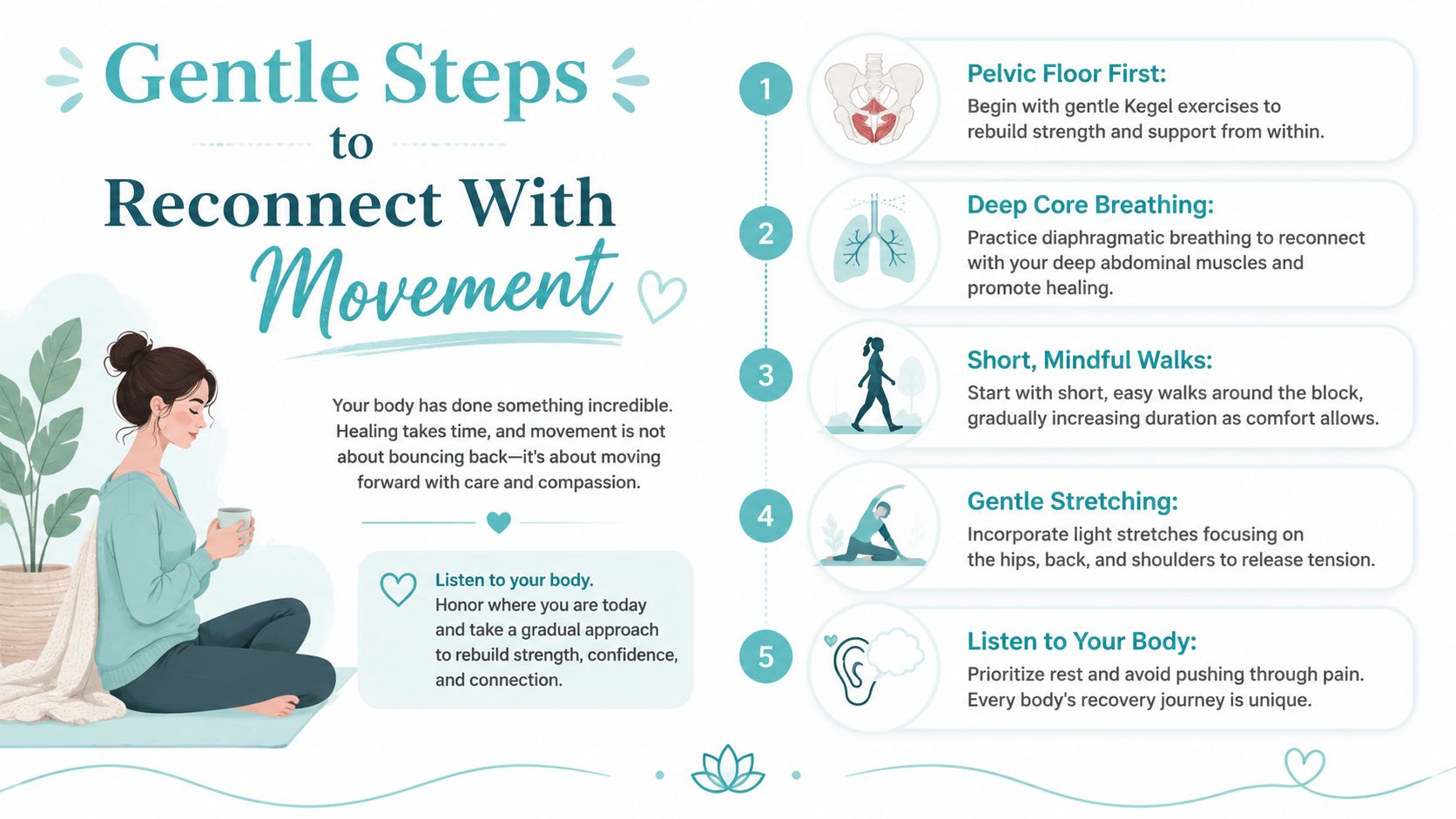
At 3 months postpartum, the goal is not to prove that your body can push through. The goal is to see how well your system handles pressure, load, and recovery. Your core, diaphragm, and pelvic floor work like a pressure team. Pregnancy and birth can throw off that timing, so rebuilding often starts with coordination before intensity.
Start with breath before effort
A good first check-in is simple. Can you breathe, move, and gently engage without bearing down, clenching, or bracing hard?
Try this once or twice a day:
- Sit supported or lie down. Let your shoulders, jaw, belly, and glutes soften.
- Inhale through your nose. Feel your ribs widen and your belly rise a little.
- Exhale slowly. As the air leaves, gently lift through the pelvic floor and draw the lower belly in a small amount.
- Repeat for a few breaths. It should feel quiet and controlled, not forceful.
If that goes well, use the same exhale when you stand up, lift your baby, or pick up the car seat. That is often more useful than adding harder exercises too soon.
Walking is a good test because it shows you the truth
Walking is helpful because it asks a lot from your body without looking intense. It tests posture, breathing, pelvic floor support, stamina, and how well you recover afterward.
Keep it simple:
- Start shorter than you think you should
- Walk at a pace where you can still talk
- Add time gradually, not all at once
- Notice how you feel later that day and the next morning
Here is the part many moms miss. A walk only counts as a good fit if your symptoms stay steady or improve after it. If you get more pelvic pressure, bleeding, back pain, dragging heaviness, or fatigue that spills into the next day, your body is asking for a smaller dose.
That does not mean you are failing. It means you found your current edge.
Signs to pause and reassess
Some exercises create more pressure than your body can manage well right now. Press pause if you notice:
- Doming or bulging through the abdomen
- Leaking urine or trouble holding gas
- Pelvic heaviness or pressure
- Pain in the pelvis, back, abdomen, or scar area
- A sense that everything feels worse later
Crunches, sit-ups, running, jumping, heavy lifting, and high-intensity classes are common places where these symptoms show up first. At 3 months postpartum, symptoms during exercise are not something to ignore and hope away. They are useful information.
If you want to understand what assessment and treatment can look like, this overview of postpartum pelvic floor physical therapy gives a clear picture of the issues often addressed.
Let daily life become part of rehab
Formal workouts are only one way to rebuild strength. A few supported squats while you hold the baby, a short walk, a gentle stretch after a feed, or exhaling as you lift the laundry basket all count.
Consistency matters more than intensity here.
If fitting movement into the day feels harder than the movement itself, a loose plan can help. Meal Flow AI's guide to SAHM schedules offers ideas for creating a flexible routine so movement has a realistic place, not a perfect one.
When to Call for Backup Your Guide to Pelvic PT
By 3 months postpartum, support is not “extra.” It's appropriate care. Updated postpartum guidance recommends ongoing contact after birth and a thorough visit by 12 weeks because physical, emotional, and chronic health concerns can still be active well beyond the old 6 week model summary of updated ACOG postpartum guidance.
That same guidance is one reason I want moms to stop apologizing for asking questions at this stage.
Common does not mean you have to live with it
A pelvic health physical therapist looks at how your muscles, connective tissue, breathing, posture, scar mobility, and daily movement patterns are working together. The goal isn't only symptom relief. It's helping you return to daily life and activity with better support and less fear.
If you want a deeper look at what treatment can include, this page on postpartum pelvic floor physical therapy outlines the kinds of issues that are commonly addressed.
Healing vs. help at 3 months postpartum
| Symptom | Typical healing at 3 months | Sign to see a pelvic PT |
|---|---|---|
| Pelvic floor awareness | You notice weakness but it's gradually improving | Leaking, urgency, or bowel control issues keep happening |
| Abdominal recovery | Your core still feels deconditioned | Doming, bulging, or poor control shows up with routine tasks |
| Scar healing | Mild awareness or tightness that is easing | Ongoing tenderness, pulling, numbness, or pain limits movement |
| Return to exercise | You can tolerate gentle movement with gradual progress | Walking or light exercise causes heaviness, pain, or symptom flare |
| Sex after birth | Apprehension is common | Pain, burning, or guarding makes penetration difficult or impossible |
| Daily function | Some fatigue is expected | Lifting, standing, or caring for your baby feels mechanically hard every day |
What an evaluation usually looks like
A good first visit should feel calm and collaborative. You'll talk through your symptoms, birth history, daily routine, goals, and what makes symptoms worse or better. Your PT may assess breathing, abdominal control, posture, hips, back, scar mobility, and pelvic floor function. Internal assessment may be offered when appropriate, but it should be explained clearly and done only with your consent.
You should leave with specific next steps, not vague reassurance.
That might include:
- Pressure management strategies for lifting, bowel movements, and exercise
- Targeted exercises for pelvic floor coordination, hips, and deep core support
- Scar mobility work if a C-section or perineal scar is contributing
- Return-to-activity guidance based on your symptoms and goals
Lake City Physical Therapy offers postpartum rehabilitation focused on pelvic floor symptoms, core recovery, pain, and graded return to activity for women in North Idaho and Eastern Washington.
If something still feels off at 3 months postpartum, trust that signal. You don't need to prove your symptoms are severe enough. You only need to notice that your body is asking for help.
If you want support sorting out leaking, pelvic pressure, pain, core weakness, or return-to-exercise questions, Lake City Physical Therapy can help you build a personalized postpartum recovery plan that matches where your body is right now.