4 Months Postpartum: What to Expect and When to Seek Care
At four months postpartum, many women are medically cleared for normal activity, but pelvic-floor dysfunction still affects 52.6% of women between three and six months after birth. That gap between clearance and comfort is exactly why a focused reassessment matters now.
Your baby may be sleeping differently, feeding with more intensity, and demanding to be carried everywhere. You may be back at work, exercising again, or trying to manage ordinary tasks while leaking urine, feeling vaginal pressure, avoiding sex, or noticing your abdomen bulge when you lift.
Those symptoms are common, but common doesn't mean permanent or unimportant. Four months postpartum is a decision point, not a finish line.
The 4-Month Postpartum Reality Nobody Prepares You For
At four months postpartum, your day may look ordinary while your body still feels unreliable. You lift your baby from the crib, carry the car seat, bend over the changing table, hurry to the bathroom, and try to walk before the next feed. The sharp soreness of the early weeks may have eased, but leaking, pressure, pain, or abdominal bulging can still appear during routine tasks.
The six-week appointment may have ended with reassurance that healing looked good and that you could gradually resume normal activity. Medical clearance answers whether activity is safe to begin. It does not confirm restored strength, pressure control, bladder control, sexual comfort, or confidence.

Why this window matters
Recovery remains active beyond the early postpartum check. A review of postpartum rehabilitation notes that pelvic-floor recovery may be maximized around four to six months postpartum, even though unrestricted activity is often allowed much earlier, and clear guidance on exercise frequency and progression remains limited (review of postpartum recovery and exercise).
Four months is therefore a decision point. You may be ready to increase activity, or you may need an assessment before adding impact, heavier lifting, or longer workouts. Persistent leakage, vaginal pressure, pain with sex, or symptoms that worsen later that day are useful clinical information, not signs that you must wait.
Clinical rule: At four months, ask whether your body can perform the tasks you want without leakage, pressure, pain, or a delayed flare.
Assessment should examine pelvic-floor function, abdominal coordination, breathing, lifting strategy, pain, and activity tolerance. Lake City Physical Therapy uses these findings to guide postpartum rehabilitation rather than applying the same progression to every mother. For a broader frame on recovery timelines, see Lake City's guide to how long postpartum recovery can take.
What MRI Evidence Shows About Your Body at 4 Months Postpartum
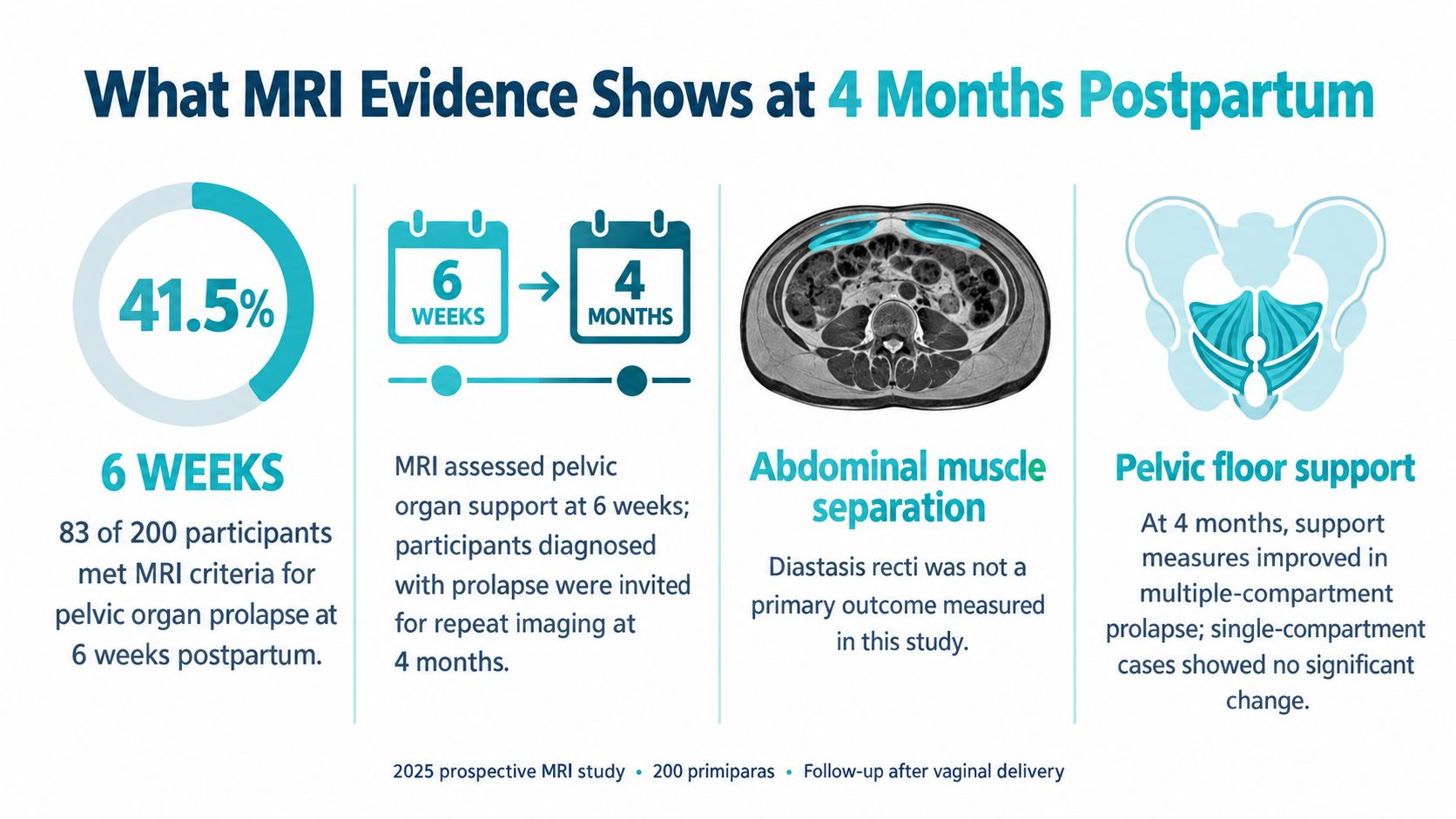
A 2025 prospective MRI study gives us a more precise view of why this stage deserves attention. Researchers followed 200 first-time mothers who underwent pelvic imaging six weeks after delivery. At that first assessment, 83 women, or 41.5%, met the study's MRI-based criteria for pelvic-organ prolapse, with cystocele among the most common findings (2025 prospective MRI study).
Of those diagnosed, 62 women, or 75%, returned for repeat imaging at four months postpartum. The follow-up identified 26 women with single-compartment involvement, including 25 cystoceles and 1 uterine prolapse, while 36 had prolapse affecting multiple compartments. These findings describe the study group, not every postpartum patient, and they shouldn't be treated as an individual diagnosis.
Improvement is not the same as resolution
The four-month images showed significant decreases in the M line, H line, and levator-plate angle compared with the six-week images. In women with multiple-compartment involvement, the prolapsed organs also moved upward. In plain language, pelvic support was changing and, in important ways, improving.
That doesn't mean every woman was symptom-free or that all structural changes had disappeared. Imaging captures anatomy under specific conditions. Your day-to-day experience also depends on muscle coordination, pressure management, bladder and bowel habits, tissue sensitivity, scar mobility, and the loads you place on your body.
A better interpretation is this:
- Recovery continues: Support structures may improve substantially between the early postpartum period and four months.
- Symptoms still matter: Pressure, bulging, leakage, bowel difficulty, and painful sex deserve assessment even when recovery is progressing.
- Function is the practical test: The question is whether you can lift, walk, exercise, and care for your baby without symptoms escalating.
The study supports a reassessment mindset. Four months isn't proof that healing has failed. It's evidence that your body may still be adapting, and that a persistent symptom can guide a more precise rehabilitation plan.
For a visual explanation of how imaging findings relate to postpartum anatomy, the following video provides additional context:
Symptoms That Are Common But Should Not Be Ignored
Urinary leakage often improves during the early months, but it remains clinically common around this stage. In a prospective postpartum study, prevalence was 66.7% between six weeks and three months and 52.6% between three and six months, with no significant improvement afterward through 12 months (prospective postpartum urinary incontinence study).
That pattern makes four months a useful time to stop guessing. Notice what triggers your symptoms, how often they occur, and whether they limit movement or intimacy.
Start with the pattern, not the label
Stress leakage happens with coughing, sneezing, lifting, running, jumping, or getting up quickly. Urgency leakage involves a sudden need to urinate that may be difficult to defer. Some women experience both. Each pattern can involve different bladder, breathing, pressure, and neuromuscular factors, so an identical set of forceful pelvic-floor squeezes isn't appropriate for everyone.
Also look for signs that don't involve urine. Vaginal heaviness, pressure, a bulging sensation, incomplete bowel emptying, constipation-related straining, pelvic pain, painful sex, or difficulty relaxing the pelvic floor all deserve attention. After a cesarean birth, a tight or sensitive scar can affect abdominal movement and comfort even when the incision appears healed.
| Symptom category | What to monitor | When to seek care |
|---|---|---|
| Urinary leakage | Coughing, lifting, walking, running, urgency, or mixed triggers | Leakage persists, limits activity, or is worsening |
| Pressure or bulging | Vaginal heaviness, a bulge sensation, or symptoms that increase later in the day | Pressure is persistent, increasing, or linked to standing or exercise |
| Bowel function | Straining, incomplete emptying, urgency, or fecal leakage | Symptoms interfere with daily life or continue despite routine changes |
| Abdominal function | Doming or bulging with lifting, rolling, sit-ups, or carrying | You can't coordinate breathing and abdominal movement without symptoms |
| Pain and sexual function | Pelvic pain, painful penetration, scar sensitivity, or pain after activity | Pain persists, limits intimacy, or produces a delayed flare |
If you're noticing pressure or a bulging sensation, review these signs of pelvic-organ prolapse and arrange an assessment rather than waiting for symptoms to become more pronounced.
Breastfeeding, Sleep, and Exercise at 4 Months Postpartum
Exercise decisions at this stage rarely involve exercise alone. Breastfeeding can increase energy and fluid demands, fragmented sleep can reduce coordination and recovery, and carrying a growing baby can add repeated lifting load before you feel ready for formal training.
A review of international guidelines found broad support for a gradual return to physical activity. One national guideline advised people after cesarean birth to wait three to four months before high-impact exercise, while the same review found that physical activity did not reduce milk volume, milk composition, or infant growth in the studies examined (review of international postpartum activity guidelines).

Think in terms of capacity
The breastfeeding myth that exercise will automatically dry up milk or harm the baby doesn't fit the available review evidence. You still need adequate food, fluids, and recovery, and many mothers find exercise more comfortable after feeding or expressing milk.
Sleep requires the same practical approach. Don't wait for perfect rest before moving, but don't treat exhaustion as irrelevant. A short walk, gentle strengthening session, or breathing-based mobility routine may be more appropriate than an intense workout when your sleep has been fragmented.
If nights are especially difficult, this resource on how to get sleep with newborn offers practical ideas that can support recovery beyond your exercise plan. Sleep, nutrition, feeding, and movement affect one another, so your training load should adjust when one of those variables changes.
Your exercise plan should fit the body you have today, not the recovery schedule you hoped to have.
For someone breastfeeding, sleep-deprived, or recovering from a cesarean birth, readiness may change from week to week. Use symptom response, energy, incision comfort, pelvic-floor control, and next-day recovery to decide whether to progress.
The Two Paths After 4-Month Clearance, Waiting vs. Assessing
At four months, you may be cleared for activity yet still notice leakage, pelvic pressure, pain with intimacy, abdominal heaviness, or difficulty lifting. Clearance answers whether routine medical recovery is progressing. It does not measure how your pelvic floor, abdominal wall, scars, or pressure control perform under load.
Two responses are common.
The first is passive waiting. You resume activity gradually, notice symptoms, and assume more time will solve them. You might stop exercising because leakage is discouraging, or continue through pressure because you were told it is normal. Neither response identifies your current capacity or the treatment that could help.
The second is active assessment. Treat four months as a decision point. Describe the symptom, identify when it appears, test the movement or load that provokes it, and match treatment to the finding. That may involve pelvic-floor coordination, breathing and pressure strategies, scar treatment, graded impact, strength training, or referral to another clinician.

Why waiting feels reasonable
Waiting makes sense when recovery is changing and daily demands already include feeding, appointments, work, and family care. Some symptoms do improve with time. Still, a symptom that is not worsening can remain a problem that limits exercise, intimacy, or lifting.
As noted earlier, pelvic-floor recovery may continue through four to six months even though activity is often unrestricted sooner. That gap makes an individual assessment more useful, particularly when symptoms persist or restrict your choices.
Waiting can also turn compensation into routine. You may avoid running because you leak, brace your abdomen throughout the day because lifting feels unstable, or avoid intimacy because penetration hurts. Assessment replaces guesswork with a graded plan and a clear response threshold.
What active assessment changes
An evaluation asks more useful questions than “Are you healed?” Can you manage pressure while lifting? Can the pelvic floor contract and relax? Can the abdominal wall control movement? Can you tolerate impact and recover without a delayed flare?
Better question: What does this symptom tell me about the next load my body can safely handle?
At Lake City Physical Therapy, the aim is not to label you as fragile. It is to identify the smallest effective adjustment, then build capacity while addressing the deficit. Persistent symptoms deserve attention, not permanent acceptance.
A Symptom-Based Roadmap for Returning to Exercise at 4 Months
A calendar can tell you how long it's been since birth. It can't tell you whether your body is ready for running, jumping, heavy lifting, or sport. Progression should follow symptom response and functional capacity, while accounting for your birth experience, complications, prior training, abdominal control, and pelvic-floor symptoms (clinical guidance on exercise after pregnancy).
Build the foundation first
Begin with pain-free walking and ordinary lifting. Can you carry your baby, rise from a chair, climb stairs, and complete household tasks without leakage, pressure, pelvic pain, abdominal doming, or a flare later that day or the next?
If not, start with breathing coordination, gentle strengthening, walking, and task-specific lifting practice. The goal isn't to avoid load. It's to teach your trunk and pelvic floor to respond to load without over-bracing or losing control.
Once daily activity is comfortable, progress through the following sequence:
- Resistance before impact: Add controlled squats, hinges, rows, presses, and carries with manageable loads. Exhale during the effort and monitor pressure, leakage, and abdominal movement.
- Low-impact conditioning: Use walking hills, cycling, swimming, or other comfortable cardiovascular work. Increase one variable at a time, such as duration or resistance.
- Impact preparation: Introduce marching, heel raises, small hops, or landing drills only when lower-load activity remains symptom-free. A pressure or bulging sensation means the dose is too high or the strategy needs refinement.
- Sport-specific work: Rebuild cutting, sprinting, jumping, lifting, or endurance demands gradually. Return to your actual sport rather than testing everything in one session.
Moderate-level evidence supports exercise and pelvic-floor muscle training for reducing urinary-incontinence symptoms and severity, while evidence for reducing pelvic-organ-prolapse symptoms is less certain. That means exercise can be useful, but it should be individualized rather than prescribed as a universal Kegel routine.
A postpartum trainer can help with programming, especially if you're unsure how to adapt your previous workouts. This guide to choosing a postpartum trainer can help you evaluate whether a trainer understands postpartum load management.
Modify, don't automatically quit: Symptoms that rise with load are a signal to reduce intensity, change technique, or seek assessment. They aren't proof that all movement is unsafe.
If leakage, pressure, pain, doming, or delayed symptoms continue, read about when you can exercise after birth and consider pelvic-health physical therapy before increasing impact.
Your Next Steps, What to Do This Week and How to Decide
Start with observation rather than a demanding workout. For several days, record five areas: leakage, pressure, abdominal function, pain, and sexual function. Note the activity that brings on each symptom, how intense it feels, and whether it settles quickly or remains noticeable later.
Use that information to choose your next move:
- No symptoms with daily activity: Continue gradual strengthening and low-impact conditioning, then test higher loads one at a time.
- Mild, predictable symptoms: Reduce the provoking load, work on breathing and coordination, and arrange an assessment if the pattern persists.
- Persistent or limiting symptoms: Schedule pelvic-floor therapy rather than waiting for another milestone.
- Pain, bulging, urinary retention, fecal leakage, or worsening symptoms: Contact a qualified healthcare professional promptly.
A pelvic-floor physical therapy assessment may include external and internal muscle testing when appropriate and with consent. It can also include posture and movement analysis, abdominal-wall coordination, breathing, lifting mechanics, scar mobility after cesarean birth, and a personalized home program.
Lake City Physical Therapy provides postpartum pelvic-floor and core rehabilitation, including symptom-focused care for incontinence, prolapse concerns, painful sex, and return to activity. If work is part of your next transition, this guide to navigating the return to work can help you plan around physical demands while you address recovery.
What Real Mothers Experience at the 4-Month Mark
Consider a composite example. A first-time mother received routine clearance at her early postpartum visit, but at four months she still leaked when lifting the car seat, felt occasional pelvic pressure late in the day, and experienced pain with sex. She assumed all three symptoms were part of being new to motherhood.
Her assessment separated the problems instead of treating them as one vague weakness. She needed better pressure management during lifting, improved pelvic-floor coordination, graded strengthening, and specific attention to painful tissue and movement patterns. Running was paused, but walking, controlled resistance work, and daily lifting practice continued.
Over time, her plan progressed according to symptoms rather than a fixed date. Leakage became less frequent, pressure no longer appeared with ordinary carrying, and intimacy was addressed as a rehabilitation concern rather than something she had to endure.
That's the central distinction at four months postpartum. Recovery can still be underway, and persistent symptoms can still deserve action. You don't need to prove that something is seriously wrong before asking for help.
Lake City Physical Therapy offers individualized postpartum pelvic-floor therapy for incontinence, prolapse symptoms, pelvic pain, cesarean scar concerns, and a graded return to exercise. Visit Lake City Physical Therapy to explore postpartum rehabilitation options and schedule an assessment that matches your current symptoms and goals.

