C Section Adhesions: A Guide to Symptoms & Relief
You expected the usual recovery. A sore abdomen. Fatigue. A scar that felt tender for a while.
What you did not expect was the strange pulling when you stand up straight, the bladder urgency that showed up months later, the deep ache with sex, or the sense that your core never quite came back online. Many women tell me the hardest part is not just the discomfort. It is the confusion. They are caring for a baby, trying to function, and wondering why something still feels stuck.
That stuck feeling can be real. One possible reason is c section adhesions, which are bands of internal scar tissue that can form after surgery. They are common after cesarean delivery, and the chance rises with each repeat surgery. In one study, adhesions affected up to 45% of women after one previous C-section and 85% after two or more (study details on repeat C-section adhesion prevalence).
If you have been told your incision looks fine, but your body does not feel fine, that disconnect matters. Surface healing and deeper tissue mobility are not the same thing.
Your Postpartum Story Unexplained Symptoms After a C-Section
A lot of women arrive at pelvic health care with a similar story.
The baby is no longer a newborn. The six-week check has long passed. Friends assume recovery is over. But when she rolls out of bed, she feels a tug low across her abdomen. When her bladder fills, she gets urgency faster than she used to. If she tries to return to lifting, running, or even a brisk walk, something in the scar area feels tight and protective.
She starts wondering if she is weak, if she waited too long to exercise, or if this is just motherhood now.
It may not be.
When symptoms do not match the usual recovery script
C-section recovery is not effortless. Pain early on is expected. Temporary numbness, guarding, and reduced abdominal strength are common too.
What deserves more attention is the pattern that lingers or appears later:
- Pulling that feels internal: not just skin sensitivity, but a deeper tethered sensation
- Bladder changes: urgency, pressure, or discomfort when the bladder is full
- Pelvic pain: aching, sharpness, or heaviness that seems hard to explain
- Movement avoidance: fear of twisting, stretching, standing tall, or exercising
These symptoms can come from several contributors, including pelvic floor tension, nerve sensitivity, abdominal wall weakness, and scar restriction. Adhesions are one of the possibilities that often get missed.
Why women often feel dismissed
Adhesions do not announce themselves clearly. A standard postpartum visit may focus on incision closure, bleeding, and infection. Those are important, but they do not fully answer questions about long-term mobility between the uterus, bladder, abdominal wall, and surrounding tissues.
So women get a confusing message: “Everything healed.” Yet they still feel limited.
If your symptoms are persistent, mechanical, and connected to movement, bladder filling, bowel function, or intimacy, they deserve a closer look.
That is where a more detailed pelvic health evaluation helps. The question is not whether you should have bounced back faster. The question is what your tissues are doing now, and what can improve.
What Exactly Are C-Section Adhesions?
C-section adhesions are bands of scar tissue that form inside the body after surgery. The simplest way to picture them is as internal glue.
Normally, the tissues in your abdomen and pelvis glide against each other. Your bladder needs to fill and empty. Your uterus changes over time. Your abdominal wall bends, twists, reaches, and carries load. These layers are designed for motion.
After surgery, the body tries to repair the area quickly. In that process, tissues that should move separately can stick together.

The short version of the biology
Surgery creates an intentional injury. Healing starts immediately.
Research describing C-section adhesion formation shows an adesiogenic process that involves increased extracellular matrix production, reduced matrix breakdown, and lower fibrinolytic activity during pregnancy, which encourages fibrin to persist and form scar bands between structures such as the uterus, bladder, omentum, and abdominal fascia (overview of adhesion formation and classification).
That is a dense sentence in medical language. In patient language, it means this: your body lays down repair material, and sometimes it does not clear away the excess efficiently. Instead of a flexible repair, it leaves behind sticky connections.
What adhesions can connect
Adhesions can form between nearby structures, including:
- Uterus and bladder: this can contribute to pressure, urgency, or pulling
- Abdominal wall and deeper tissues: this often shows up as restriction with standing tall, reaching, coughing, or exercise
- Bowel and surrounding tissue: this may affect comfort, bloating, or bowel ease
- Scar layers within the abdominal wall: this can make the incision feel tethered or thick
Some adhesions are thin and filmy. Others are dense and more limiting. The density matters because denser adhesions tend to create more surgical complexity and can produce a stronger sense of tension in daily movement.
Why the symptom can feel far from the scar
One reason adhesions confuse people is that pain does not always stay right on the incision.
A restriction low on the abdomen can change how you breathe, how your trunk rotates, how your pelvic floor responds, and how your bladder or bowel feels with filling and emptying. The body compensates. Muscles guard. Movement patterns shorten.
Think of a sweater snagged on a nail. The snag is in one spot, but the pull changes the shape of the whole fabric.
That is why a woman may report hip tightness, pelvic floor pain, abdominal doming, or painful intercourse without realizing the C-section scar is part of the story.
Understanding Your Risk for Developing Adhesions
Not every woman with a C-section develops troublesome adhesions. Some heal with minimal restriction. Others form scar tissue that affects comfort and function much more noticeably.
Risk is not about blame. It is about context.
The strongest pattern in the research
One major factor is the type of repeat C-section. In a 2024 study, adhesions affected 31.7% of women undergoing repeat C-sections, but the rate was much higher after emergency C-sections at 81.8% compared with elective procedures at 18.2% (repeat cesarean adhesion rates by emergency versus elective surgery).
That difference matters because emergency surgery often happens in less controlled conditions. Tissue may already be stressed by labor, urgent delivery needs can limit surgical flexibility, and the body may be dealing with more inflammation and strain at the same time.
Factors you cannot control
Some risks are not under a patient’s control. These include:
- Emergency circumstances: a fast delivery may be the safest option for parent and baby, even if it raises adhesion risk
- Number of prior C-sections: each additional abdominal surgery gives the body another opportunity to form internal scar tissue
- Individual healing response: some bodies create thicker, more reactive scar tissue than others
These are not signs that anything was done wrong. They are part of the medical and biological context.
Factors that may add complexity
The same study also identified other associations, including low socioeconomic status, gestational diabetes mellitus, anemia, and prior labor indications such as cervical dystocia, second-stage arrest, or failed induction with premature rupture of membranes. Another study described links between adhesions in repeat C-sections and higher BMI, more previous C-sections, and higher parity, with denser adhesions associated with longer operations, more blood loss, and higher risk of visceral injury. Those details matter most to the surgical team, but they also help explain why one woman’s recovery feels straightforward while another’s feels layered and stubborn.
What this means for you
Risk is useful when it guides better care.
If your history includes an emergency cesarean, multiple C-sections, difficult labor before surgery, or healing challenges during pregnancy, it makes sense to be more proactive about scar and pelvic health follow-up. That does not mean you will definitely have symptoms. It means your concerns deserve a lower threshold for evaluation.
A simple self-check can help:
| History question | Why it matters |
|---|---|
| Was your C-section unplanned or urgent? | Emergency conditions are linked with higher adhesion rates |
| Was this a repeat C-section? | Risk rises with prior surgeries |
| Do you feel internal pulling months later? | Persistent restriction may reflect deeper tissue involvement |
| Are bladder, bowel, or intercourse symptoms part of the picture? | Adhesions can affect more than the visible scar |
The useful question is not “Should I just push through?” It is “Does my recovery pattern suggest that a skilled pelvic health assessment would help?”
Common Symptoms and Their Impact on Daily Life
Adhesions do not feel the same in every body. Some women notice a very local tug at the scar. Others feel symptoms in the bladder, pelvis, low back, or with intimacy. The common thread is restriction. Something that should move freely no longer does.

Chronic pelvic pain
A woman may say, “It feels like a zipper inside me is too short.”
That description is more accurate than it sounds. Chronic pelvic pain related to adhesions often has a mechanical quality. Standing upright after sitting, reaching overhead, rolling in bed, or carrying a car seat can trigger a pulling or sharpness that does not feel muscular in the usual way.
For some, the discomfort is dull and constant. For others, it only appears when tissues are asked to lengthen or shift.
Pain can also create a second problem. The body learns to brace. The abdominal wall stiffens, the pelvic floor tightens, breathing becomes shallow, and the pain cycle expands.
Bowel and bladder dysfunction
Another woman may not come in because of pain at all. She comes in because her bladder feels different.
She notices urgency sooner than before. Fullness creates pressure low in the scar. Sometimes bowel movements feel harder to coordinate, especially if straining increases pulling across the incision.
When adhesions involve the tissues around the bladder, uterus, bowel, or abdominal wall, those normal fill-and-empty cycles can become less comfortable. The symptom is not always dramatic. It may just feel like your body lost its old ease.
If this sounds familiar, our page on pelvic pain after C-section symptoms may help you compare patterns.
Secondary infertility
This symptom is often the most emotionally loaded.
A woman may have conceived easily before, then struggle later and wonder what changed. Adhesions can affect pelvic mobility and create mechanical problems in the environment around the reproductive organs. Not every fertility challenge after a C-section is caused by adhesions, but they are part of the clinical picture providers should consider.
The key point is not to self-diagnose infertility from a scar. It is to recognize that persistent pelvic symptoms and a surgical history may deserve a broader workup than “keep trying.”
Painful intercourse
Dyspareunia after a C-section surprises many women. They assume a surgical birth should not affect sex in the same way a vaginal tear might.
But intercourse depends on pelvic floor relaxation, abdominal wall adaptability, organ mobility, and nervous system safety. When the lower abdomen feels bound down, the pelvic floor often responds by guarding. Deep penetration may feel sharp, achy, or like pressure in the wrong place.
A common pattern looks like this:
- At first: fear and tenderness lead to protective tension
- Later: the scar and surrounding tissues stay restricted
- Then: the pelvic floor joins in, creating a mix of internal and external discomfort
How daily life shrinks around the symptoms
The greater loss is not only pain. It is how much women stop doing.
They avoid lifting heavier laundry baskets. They put off returning to exercise. They choose clothes that do not press on the scar. They empty the bladder “just in case.” They tense before intimacy. They sit down to play with their child, then think about how they will get back up.
Symptoms from c section adhesions often show up first as life becoming smaller.
That is why treatment should not focus only on the scar’s appearance. It has to address comfort, confidence, movement, and function.
How Doctors and Therapists Diagnose C-Section Adhesions
Diagnosis can be frustrating because adhesions are not easy to confirm with routine care. A normal exam or standard imaging study does not always rule them out.
The first clue is usually the story
A skilled provider starts with pattern recognition.
Questions matter. When did symptoms begin? What movements trigger the pull? Is the discomfort tied to bladder filling, bowel activity, sex, exercise, or upright posture? Did symptoms appear after the first C-section, or worsen after a repeat procedure?
Then comes the physical exam. A pelvic health physical therapist may assess:
- Scar mobility: does the skin glide, or does it feel tethered
- Abdominal wall movement: can the tissues lengthen and rotate comfortably
- Breathing and pressure management: does the trunk stay guarded
- Pelvic floor tone: is there protective gripping or pain with assessment
- Functional movement: what happens with sit-to-stand, reaching, lifting, or core activation
That exam does not “prove” adhesions the way surgery can. It helps identify whether tissue restriction fits the symptom picture.
Why imaging often has limits
Many women assume an ultrasound or MRI should show the problem clearly. Sometimes imaging helps, but adhesions are often more difficult to visualize than people expect. They are bands and restrictions, not always a large obvious mass.
Because of that, laparoscopy is the gold standard for diagnosis, meaning a surgeon can directly visualize adhesions inside the abdomen. At the same time, external clues can be useful. Severe striae gravidarum has shown 87.2% specificity for predicting dense adhesions in one study, which gives clinicians one non-invasive sign to consider during evaluation (study on striae gravidarum as a clue for dense adhesions).
Clues that can raise suspicion
A diagnosis often rests on a combination of findings rather than one test.
| Clinical clue | What it suggests |
|---|---|
| Deep pulling at or around the scar | Restricted tissue glide |
| Bladder urgency with lower abdominal pressure | Possible involvement of nearby pelvic structures |
| Pain with extension, rotation, or upright posture | Mechanical tension through the abdominal wall |
| Severe stretch marks with repeat C-section history | Higher suspicion for dense adhesions |
A useful evaluation does not chase one perfect test. It gathers the story, movement findings, scar behavior, and symptom triggers into a coherent picture.
That is often enough to start conservative care, especially when symptoms and exam findings line up.
Your Path to Relief Treatment and Management Strategies
Relief usually starts with a better question.
Not “How do I force my core to get stronger?” but “What is blocking normal movement, and how do we restore it safely?” For many women with c section adhesions, the answer involves a mix of tissue work, movement retraining, pelvic floor downtraining, and gradual return to load.

Non-surgical care that often helps
Physical therapy does not dissolve adhesions like a chemical solvent. That is not how tissue works. What it can do is improve how the scar and surrounding tissues move, reduce guarding, calm pain sensitivity, and help the whole pressure system function better.
Common parts of treatment include:
- Scar mobilization: hands-on work to improve glide between skin, superficial fascia, and deeper layers
- Abdominal wall mobility: gentle loading, stretching, and directional movement to restore tolerance
- Pelvic floor treatment: downtraining when the muscles are gripping, then strengthening when appropriate
- Breathing and pressure work: reconnecting the rib cage, diaphragm, abdomen, and pelvic floor
- Functional retraining: lifting, rolling, carrying, walking, and exercise progressions
- Home work: specific self-mobilization and movement practice, not random internet exercises
At Lake City Physical Therapy, scar mobilization is one service used within postpartum rehab when incision restriction appears to be contributing to pain or dysfunction.
What does scar work feel like
Good scar treatment is usually more precise than people expect.
It is not aggressive rubbing over a numb incision and hoping for the best. Early on, treatment may focus on surrounding mobility, breath, and tolerance to light touch. Later, it often includes skin rolling, directional glide, tissue lifting, and movement paired with manual contact so the brain relearns that the area can move safely.
A few practical rules matter:
- Do not start by attacking the scar. If the area is highly reactive, begin with gentler surrounding work.
- Do not confuse soreness with progress. Tissue work should be tolerable and should settle, not flare for days.
- Do not skip strength forever. Mobility without functional loading leaves recovery incomplete.
Women who also struggle with lower abdominal fullness sometimes need a broader rehab plan that addresses pressure and core mechanics along with the scar. This article on the c-section pooch explains that connection well.
A realistic rehab timeline
Recovery is not linear, but this framework helps set expectations.
| Timeframe | Focus | Home Strategies & PT Goals |
|---|---|---|
| Early healing | Protection, breathing, comfort, gentle mobility around the area | Short walks, relaxed breathing, supported posture, reduce guarding |
| Once the incision is closed and medically cleared | Scar contact, desensitization, light mobility | Gentle scar touch, surrounding tissue glide, posture changes without bracing |
| Later postpartum rebuilding | Core coordination, pelvic floor balance, graded loading | Sit-to-stand mechanics, carrying strategy, trunk rotation, return to exercise progressions |
| Persistent symptoms months or years later | Tissue restriction, pain reduction, functional recovery | Targeted scar mobilization, pelvic floor treatment, bladder and bowel strategy, movement retraining |
A visual explanation can also help connect the scar, core, and pressure system:
When surgery becomes part of the plan
Some women need surgical treatment, often called adhesiolysis, when symptoms are severe, function is limited, or another medical issue makes direct treatment necessary.
Surgery can cut adhesions and improve mobility between structures. It can also create new scar tissue, because surgery itself is another healing event. That is the core trade-off.
The best candidates for surgery are usually women whose symptom pattern, imaging or surgical history, and overall medical workup support a clear mechanical problem that conservative care alone is unlikely to solve.
What works and what does not
A practical summary helps here.
| Approach | Usually helpful | Usually not enough on its own |
|---|---|---|
| Hands-on scar and tissue treatment | Yes, when paired with movement retraining | No, if done as passive treatment only |
| Pelvic floor therapy | Yes, especially with urgency, pain, or dyspareunia | No, if the abdominal scar is ignored |
| Core strengthening | Yes, once mobility and pressure strategy improve | No, if you only do planks and crunches through pain |
| Medications | Sometimes for symptom management | No, they do not restore tissue glide |
| Surgery | Sometimes necessary for selected cases | No guarantee unless followed by thoughtful rehab |
The best plan usually combines tissue mobility, nervous system calming, and progressive function. One without the others often stalls.
How to Reduce Your Risk The Pre-Surgery Conversation
Prevention starts before the incision is made.
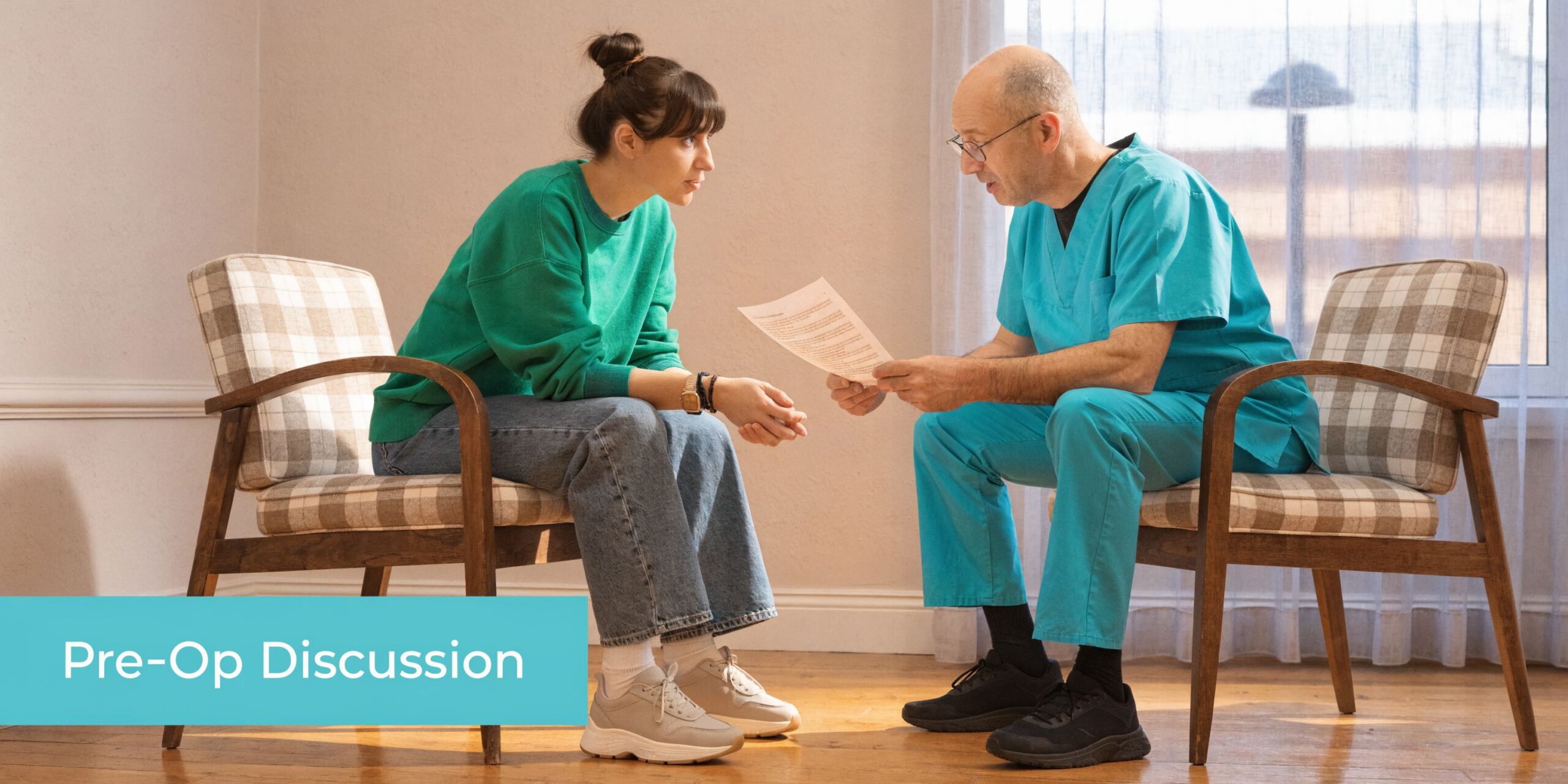
Most women are told how to prepare for surgery, what to pack, and what recovery may look like. Very few are told that some surgical choices can affect how much scar tissue forms later. That does not mean a patient should dictate technique in the operating room. It does mean she can ask informed questions.
One surgical choice worth discussing
Research reported by Stanford notes that closing the peritoneum during a C-section provides five times more protection against adhesion development compared with leaving it open (Stanford report on peritoneal closure and adhesion protection).
That is not a promise for any individual case. Surgery always involves trade-offs, and the operating surgeon has to make decisions based on anatomy, urgency, training, and safety. But this is a reasonable topic for a planned pre-op conversation, especially before a repeat cesarean.
Questions you can bring to your OB or surgeon
You do not need to sound like a medical journal. Simple questions work.
- “Are there surgical techniques you use to reduce adhesion risk?”
- “Do you close the peritoneum, and if not, how do you decide?”
- “Does my history make scar tissue more likely?”
- “If I have another repeat C-section, what could affect recovery long term?”
- “When should I start scar and pelvic floor rehab after delivery?”
These questions do two things. First, they tell your surgeon long-term recovery matters to you. Second, they open a more specific discussion than the usual “Will I be sore afterward?”
Why this conversation matters
Patients often think advocacy means resisting care. In reality, good advocacy means partnership.
For a planned surgery, that can include discussing:
| Topic | Why ask |
|---|---|
| Adhesion prevention | It affects future symptoms and repeat surgeries |
| Surgical closure approach | Technique can influence healing environment |
| Your prior C-section history | Past surgeries affect the internal tissue condition |
| Postpartum rehab timing | Early guidance may reduce fear and stiffness |
The first step in managing c section adhesions may happen before they form. An informed question can shape a more thoughtful recovery plan.
Even if your surgery was emergent and these conversations were not possible, that is not a failure. It only means prevention was not the main opportunity. Recovery still is.
Reclaiming Your Well-Being When to Seek Specialist Care
Persistent pain, bladder urgency, pain with sex, and a scar that feels stuck are not minor complaints. They are useful signals.
Specialist care makes sense if you notice any of the following:
- Pain that continues months after your C-section
- A pulling sensation with standing, twisting, reaching, or exercise
- Bladder pressure, urgency, or bowel discomfort linked to the scar area
- Painful intercourse or pelvic floor tension
- Fear of movement because the abdomen feels tight or unsafe
- Ongoing symptoms after surgery for adhesions
Women recovering after surgical lysis of adhesions often need a more specific rehab plan as well. If that is your situation, this page on pelvic pain after adhesiolysis may be helpful.
The bigger message is simple. Motherhood does not require accepting dysfunction as the price of delivery. A C-section can be life-saving and still leave behind issues worth treating. Both can be true.
With the right evaluation, many women can improve scar mobility, reduce pain, restore bladder and pelvic floor function, and return to exercise and intimacy with much more confidence.
If c section adhesions sound like part of your story, Lake City Physical Therapy offers women’s health physical therapy focused on scar mobility, pelvic floor dysfunction, postpartum recovery, and return to activity. A thorough evaluation can help sort out whether scar restriction, pelvic floor tension, core coordination, or a combination of factors is driving your symptoms.