When to Start Perineal Massage: A PT’s Complete Guide
Somewhere in the third trimester, many pregnant people hit the same moment. You are trying to remember your next appointment, decide whether you really need another birth prep class, and sort through a growing list of advice from friends, social media, and pregnancy apps. Then perineal massage comes up, and it often lands in one of two categories: either it sounds vaguely helpful or it sounds awkward enough to postpone.
Both reactions are normal.
Perineal massage is not a requirement for a good birth, and it is not a magic trick that guarantees you will avoid tearing. It is one practical way to prepare the tissues around the vaginal opening for the stretch of birth. Used at the right time, with the right technique, it can be a useful part of birth preparation, especially if this is your first vaginal delivery.
Preparing for Birth and Understanding Perineal Massage
By the time someone asks me about when to start perineal massage, they are usually not looking for another task. They want clarity. They want to know whether it is worth doing, whether they are already late, and whether it matters if they feel unsure about touching this area at all.
That is the right place to start.
Perineal massage means gently stretching and massaging the tissues at the lower part of the vaginal opening and the perineum, the area between the vagina and anus. The aim is simple. Help the tissue become more familiar with pressure and stretch before labor, so birth does not feel like the first time that area has ever been asked to lengthen.
For some patients, that idea feels empowering. For others, it stirs up tension, embarrassment, or a strong sense of “I do not want one more thing to do.” All of those responses are valid.
Why this matters in real life
The value of perineal massage is not just physical. It can also help you learn how your pelvic floor responds when you consciously soften instead of brace. That awareness can carry into pushing, birth positioning, and early recovery.
If you are also thinking ahead to healing after delivery, this complete guide to perineal care after birth gives a practical overview of what comfort and tissue care can look like postpartum.
Some people do best with simple self-guided instruction. Others want more support and a personalized assessment, especially if they have pelvic pain, prior scar tissue, or a history that makes vaginal birth preparation feel more loaded. In those cases, prenatal and postpartum physical therapy can help turn generic advice into a plan that fits your body.
A good perineal massage routine should feel like preparation, not punishment. If it feels confusing, forced, or sharply painful, the plan needs to change.
What this guide will help you sort out
A lot of online advice makes perineal massage sound one-size-fits-all. It is not. The timing matters, but so does your birth history.
A first-time mother often has a different reason to do this, and a different potential benefit, than someone who has already had a vaginal birth. Someone with old episiotomy scar tissue may need a targeted approach. Someone with no pain, no scar restriction, and a prior uncomplicated vaginal birth may not need the same level of focus.
That nuance matters more than perfection.
The Optimal Window to Begin Perineal Massage
The short answer to when to start perineal massage is between 34 and 35 weeks of pregnancy. That timing did not come from guesswork. It emerged from randomized controlled trials, and a 2020 meta-analysis summarized in this review found that starting around week 35 was associated with a relative risk of 0.91 for perineal trauma requiring stitches and a 15% reduction in episiotomy risk, with the episiotomy benefit particularly significant for first-time mothers.

That recommendation also makes sense clinically. Tissue needs time to adapt, but there is a point where starting earlier does not add useful benefit.
Why earlier is not automatically better
A lot of pregnancy advice rewards doing more and starting sooner. Perineal massage does not really work that way.
Starting too early usually adds effort without adding much value. The clinically useful window is late enough that the tissue adaptation is relevant to the birth ahead, but early enough that you have time to practice consistently. Think of it as a focused preparation phase, not a long training block.
That is why I usually discourage patients from treating week 28 or 30 as a deadline they somehow missed. If you are approaching the mid-30s in pregnancy, you are not behind. You are entering the window where this intervention makes the most sense.
The first-time mother versus repeat birth question
One-size-fits-all advice falls short here.
For first-time mothers, the evidence is strongest. If you have never had a vaginal birth, the perineal tissue has not been through that specific stretch before, and the measurable benefit in reducing episiotomy risk appears to matter most in this group. In practice, that means a steady routine starting at 34 to 35 weeks is usually a reasonable recommendation if there are no contraindications.
For someone who has already had a vaginal birth, the decision gets more individual.
Research has shown the benefit is largely concentrated in people having their first baby. That does not mean perineal massage is useless after prior births. It means the answer shifts from “everyone should do this” to “is there a specific reason this would help you?”
A practical way to think about timing by birth history
| Situation | Best timing approach |
|---|---|
| First pregnancy or first vaginal birth | Start at 34 to 35 weeks and stay consistent |
| Prior vaginal birth with no scar pain or pelvic floor tension | Consider whether it is needed at all, rather than doing it automatically |
| Prior tear, episiotomy, or noticeable scar sensitivity | Use the same late-pregnancy window, but with more targeted work |
| Prior cesarean and planning first vaginal birth | Often treat this more like a first vaginal birth, with individualized assessment |
If you want a broader look at preparing for late pregnancy and delivery, pregnancy care support can help put perineal massage in context with pelvic floor relaxation, pressure management, and birth positioning.
The best answer to when to start perineal massage is not just a week on the calendar. It is the right week for your tissue, your history, and your comfort level.
What works and what does not
What works
- Starting in the evidence-based window: Late enough to matter, early enough to build a routine.
- Being consistent: Occasional attempts are less useful than a regular, manageable pattern.
- Matching the plan to parity: First-time mothers usually have the clearest reason to do it.
What does not
- Starting very early because more must be better: It usually just adds fatigue.
- Assuming everyone needs the same plan: Repeat births are not all the same.
- Forcing the issue when the tissue is reactive: Pain, guarding, or scar sensitivity may need a more skilled approach.
A Step-by-Step Guide to Performing Perineal Massage
Many people do better with perineal massage once the process feels concrete. Vague instructions lead to tense hands, too much pressure, and a lot of uncertainty about whether you are even in the right place.
The core technique is specific. Effective perineal massage targets the 3 o’clock to 9 o’clock positions at the lower vaginal opening, about 1 to 1.5 inches inside, using one or two thumbs or fingers with U-shaped sweeping motions and downward and lateral pressure toward the anus for several minutes, as described in this perineal massage technique guide.
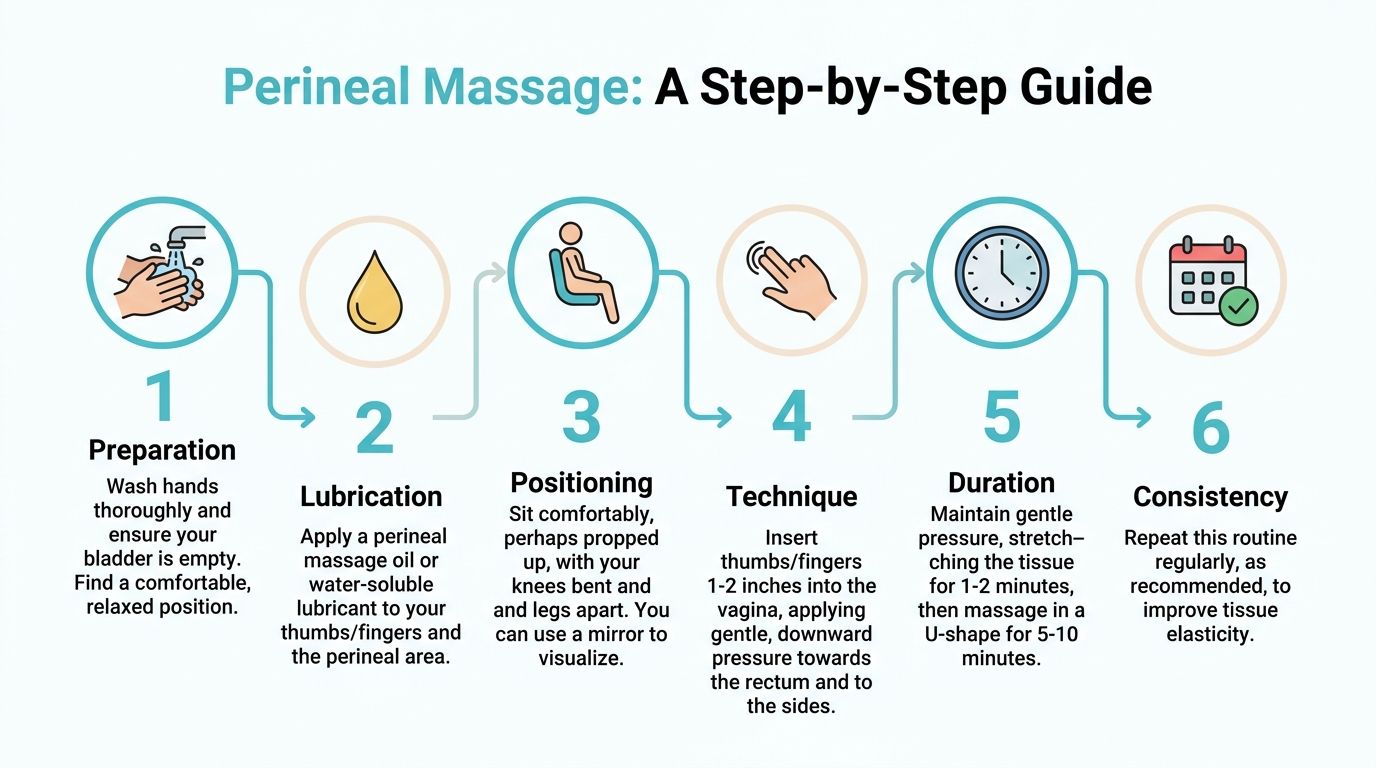
Step 1 Get set up before you start
Do a little preparation first. This is one of those situations where small details make the whole experience easier.
- Wash your hands well. Short nails are better.
- Empty your bladder. A full bladder makes the area feel more crowded and sensitive.
- Choose a lubricant. A water-based lubricant usually works well. Some people prefer a simple perineal massage oil if it feels comfortable on their skin.
- Give yourself privacy and warmth. You are more likely to relax if you are not rushing.
If your body tends to guard when you are uncomfortable, consider doing this after a shower or bath. Warmth can make pelvic floor relaxation easier.
Step 2 Find a position you can maintain
The ideal position is not the one that looks best in a diagram. It is the one that lets your belly, hips, and pelvic floor relax.
The most practical setup for many pregnant patients is reclined with pillows supporting the upper body and the knees open in a butterfly position. That gives you visibility, access, and less strain through the neck and shoulders.
Other options can work too:
- Side-lying if hip mobility is limited
- Standing with one leg elevated if reaching from a reclined position is difficult
- Partner-assisted positioning if your belly makes self-access awkward
A hand mirror can help the first few times. Not because you need to memorize anatomy, but because orientation reduces tension.
Step 3 Know where your target is
This is the part most guides rush through.
The tissue you are working with is the lower back wall of the vaginal opening, not the front wall and not the clitoral area. Think of the lower half of the vaginal opening. If the opening were a clock face, you are focusing on the area between 3 o’clock and 9 o’clock, with the deepest attention usually in the lower arc.
That matters because many people accidentally push upward or too far forward. That tends to feel more irritating and less useful.
If the pressure is aimed toward the front, the technique usually feels harsher and works worse.
Step 4 Use the stretch, then the sweep
Insert one or two thumbs, or fingers if a partner is helping, about 1 to 1.5 inches inside the vaginal opening.
From there:
-
Press downward toward the anus and slightly out to the sides.
You are looking for a broad stretching pressure, not poking. -
Hold the stretch.
Sustained tension gives the tissue time to soften rather than fight back. -
Add a U-shaped sweep.
Move from one side of the lower opening across to the other, staying in that lower semicircle. -
Notice whether one side is tighter.
Many people have asymmetry. One side may feel more guarded or tender. -
Breathe slowly and release your jaw.
Jaw, glutes, and pelvic floor often tighten together.
A mild burning or stretching sensation can be normal, especially at first. Sharp pain is not the goal.
Step 5 Work with scar tissue differently
If you have a history of a tear or episiotomy, the approach may need to slow down.
Scar tissue often feels less elastic, more tender, or oddly numb in one section. Instead of sweeping past that area quickly, hold light pressure and let the tissue accommodate. Then work along the scar and just beside it. The aim is not to aggressively “break up” anything. The aim is to help the tissue move more normally.
This is one reason people with prior birth injury often benefit from an assessment. Scar tissue can change both comfort and mechanics.
A lot of patients also like visual guidance before trying this on their own. This demonstration can help you picture the motion and setup more clearly:
If you want more guided movement and pelvic health instruction, pelvic floor video resources can support the bigger picture of learning how to relax and coordinate these tissues.
Common technique mistakes
Going too hard too fast
If you are bracing, holding your breath, or dreading the next repetition, the pressure is too much.
Massaging the wrong area
Too far forward is a frequent mistake.
Treating discomfort like failure
Some stretching sensation is common. Panic usually comes from not knowing that in advance.
Skipping because it feels awkward
Awkward does not mean wrong. Many individuals need a few sessions to feel more natural with it.
Your Routine How Often and For How Long
The best routine is the one you will keep. For perineal massage, that means short, regular practice instead of occasional marathon sessions.
The evidence-based protocol is 5 minutes of daily massage, or 3 to 4 times weekly as a minimum, starting at week 34 or 35 and continuing until delivery, with this consistent practice linked to a 15% relative risk reduction in episiotomy rates for first-time mothers in the guidance summarized here: perineal massage guide.

What a realistic weekly routine looks like
You do not need to make this elaborate. Most patients do better when they attach it to something they already do.
A few examples:
- After an evening shower
- Before bed on the same days each week
- After a few minutes of diaphragmatic breathing or gentle stretching
If daily feels manageable, use that. If daily sounds like the kind of plan you will abandon in three days, choose 3 to 4 times weekly and stick to it.
What you should feel
The first few sessions are often the most uncomfortable. Not because something is wrong, but because the tissue and nervous system are both new to the sensation.
Common early sensations include:
- Stretching
- Mild burning
- Tenderness in one side more than the other
- A feeling that your body wants to tighten instead of soften
That usually improves as you repeat the process. What should make you pause is sharp pain, lingering irritation, or worsening symptoms afterward.
A successful session often feels less like “I stretched harder today” and more like “my body fought me less today.”
Daily versus a few times per week
There is no prize for doing the maximum if it makes you avoid the routine altogether.
Use this simple guide:
| If this sounds like you | Better plan |
|---|---|
| You like habits and consistency | Short daily sessions |
| You feel overwhelmed by daily tasks | Schedule 3 to 4 sessions weekly |
| You are sore after each attempt | Reduce intensity, not necessarily total frequency |
| You forget unless it is anchored to another activity | Pair it with your shower or bedtime routine |
What not to do with your schedule
Do not save it all for the final days before your due date. Cramming does not give tissue much time to adapt.
Do not double up with long sessions because you missed a few days. That usually creates more irritation and less consistency.
And do not assume no change means no progress. Tissue adaptation can be subtle. Sometimes the first sign of progress is that the area feels less guarded.
Safety Precautions and Practical Modifications
Perineal massage is simple, but simple does not mean automatic. A safety-first approach matters more than enthusiasm.
Some people should pause and ask their obstetric provider before doing this. Others can proceed, but need modifications so the practice stays useful instead of frustrating.

When not to do perineal massage
Do not do perineal massage if you have:
- An active vaginal infection
- Thrush
- Genital herpes
- Specific instructions from your obstetric provider to avoid vaginal insertion or local tissue work
If you are not sure whether a symptom counts, ask. It is better to get a quick green light than to push through uncertainty.
The difference between pressure and pain
Patients often ask me where the line is. Here is the simplest answer.
Helpful pressure feels like stretch, fullness, or mild burning that settles as you breathe.
Unhelpful pain feels sharp, pinching, electric, tearing, or irritating enough that your whole body braces.
If you feel yourself clenching your glutes, curling your toes, or holding your breath, your body is telling you the input is too strong or too abrupt.
Modifications that make it easier
Not everyone can comfortably reach their perineum in late pregnancy. That is common, not a personal failure.
If your belly limits access
Try side-lying or standing with one foot elevated. Some patients can reach more easily from behind rather than from the front. Pillows can also change the angle enough to make access possible.
If your hips or back get cranky
Use more support. Recline more. Keep the session shorter. The pelvic floor relaxes better when the rest of your body is not working hard to hold you upright.
If self-touch feels emotionally hard
A partner can help, and partner-assisted massage can be just as effective as self-directed massage. What matters is communication. The pregnant person should stay in charge of pace, pressure, and whether the session continues.
A few rules help:
- Use clear feedback. “Less pressure,” “stay there,” and “move slightly left” are useful instructions.
- Go slower than you think you need to.
- Stop before irritation builds.
If you have old scar tissue
Scar tissue needs patience. A prior tear or episiotomy can leave one section stiffer than the surrounding tissue. In that case, broad sweeping alone may miss the problem area.
Try this approach:
- Start with global pressure to the lower opening.
- Pause at the stiff or tender spot.
- Hold steady pressure and wait for the tissue to soften.
- Add small movements around the scar instead of scrubbing over it.
Scar tissue often responds better to steady, specific contact than to aggressive massage.
What works versus what backfires
Usually helpful
- Short sessions
- Warm environment
- Lubrication
- Slow pressure
- Exhaling during the stretch
Usually unhelpful
- Trying to “push through” pain
- Rushing because you are uncomfortable
- Assuming more force equals better tissue change
- Continuing through active irritation or infection
A calm nervous system helps the tissue relax. That is not fluff. It is practical biomechanics.
When to Partner with a Pelvic Floor Physical Therapist
Some people can learn perineal massage easily from written instruction. Others hit a wall fast. They cannot tell whether they are doing it right, the tissue feels unusually painful, or a prior birth experience makes the whole process feel loaded.
That is where a pelvic floor physical therapist can make a meaningful difference.
Research has noted that while perineal massage guidance commonly points to 34 to 35 weeks, the benefit is “largely confined to women having their first baby,” and it may “not prevent birth trauma among women who had delivered vaginally before,” which supports a more individualized plan for multiparous patients, especially when pelvic floor tension or scar tissue is part of the picture, as discussed in this BMJ review available through PubMed Central.
Signs you would benefit from an assessment
You do not need a complicated problem to justify getting help. Good reasons include:
- Persistent pain during massage that does not settle with lighter pressure
- Uncertainty about the anatomy or technique
- A prior tear or episiotomy that still feels tender, numb, or stiff
- A history of painful intercourse, pelvic floor tension, or fear of vaginal exams
- A previous cesarean with plans for a vaginal birth, especially if this would be your first vaginal delivery
What a PT adds that a generic guide cannot
A pelvic floor PT can assess whether the issue is tissue mobility, muscle guarding, scar restriction, breath holding, or simple positioning. Those are not the same problem, and they do not respond to the same instruction.
Sometimes the recommendation is to continue perineal massage. Sometimes the better plan is to focus first on down-training, breathing, hip support, or scar work. For some repeat births, the conclusion may be that perineal massage is optional rather than essential.
That is the personalized part many online guides skip.
The deeper value of professional support
The benefit is not just technique correction. It is having someone help you match the intervention to your needs.
That often leads to less stress, less trial and error, and a clearer sense of what preparation is worth your time in the final weeks of pregnancy.
Frequently Asked Questions about Perineal Massage
Can I use a pelvic wand or vibrator instead of my fingers
Sometimes a tool can help with reach, but it should still allow controlled pressure to the lower vaginal opening. If a device makes it harder to feel where the pressure is going, it is usually not the best first choice. Fingers give the most feedback.
What if I absolutely cannot reach
That is common in late pregnancy. A partner can assist, or a pelvic floor PT can help you figure out positioning and alternatives. Side-lying or supported reclined positions are often easier than trying to force a standard setup.
Does perineal massage guarantee I will not tear
No. Birth involves many variables, including tissue behavior, baby position, pushing dynamics, and delivery conditions. Perineal massage is a preparation tool, not a guarantee.
Is it normal not to feel any change right away
Yes. Early changes are often subtle. You may notice less guarding, easier breathing during the stretch, or one side feeling less reactive before you notice obvious tissue softness.
Should I stop if it burns a little
Not necessarily. Mild burning or stretching can be normal, especially in the first few sessions. Sharp pain, pinching, or lingering irritation afterward is a reason to stop and reassess.
Is partner help less effective than doing it myself
No. Partner-assisted massage can work well. The key is slow pacing, enough lubricant, and clear communication from the pregnant person about pressure and comfort.
If you want a personalized plan for birth prep, scar mobility, pelvic floor relaxation, or postpartum recovery, Lake City Physical Therapy offers specialized women’s health care designed around your body, your history, and your goals.