Belly Binding After Childbirth: A PT’s Safety Guide
The most popular advice about belly binding after childbirth is also the least helpful. It’s often framed as an easy yes or no. Either it’s a must-have recovery tool, or it’s dismissed as useless hype.
Neither view is accurate.
A belly binder can help some women feel more supported in the early postpartum period. It can also create problems when it’s too tight, used for too long, or used in place of real rehabilitation. If you’ve had a C-section, the short-term benefits may be more meaningful. If you’re dealing with pelvic heaviness, leakage, pressure, or a significant abdominal separation, the wrong kind of compression can work against healing.
The better question isn’t “Should I belly bind?” It’s “What is my body healing from, what kind of support I need, and how do I use this tool without making things worse?”
The Truth About Postpartum Belly Binding
Belly binding after childbirth is everywhere. Social media promotes it as a way to “close the core,” flatten the stomach, support healing, and help your body feel put back together. Many women are also drawn to it because postpartum wrapping has deep cultural roots and a long history in traditional care.
Its popularity is real. In a survey of over 600 women, 82% planned to use an abdominal binder postpartum, according to a survey published on PubMed. That tells you something important. Women want support after birth, and many expect a binder to provide it.
Popular doesn’t always mean low-risk
What’s missing from most advice is nuance.
A binder may give you a held-together feeling. It may improve comfort with movement. It may even help you feel more secure in those first days when your abdomen feels unfamiliar. But widespread use doesn’t mean we have strong evidence that belly binding protects the pelvic floor or improves long-term recovery.
That matters because postpartum healing isn’t just about the abdominal wall. Your pelvic floor, breathing mechanics, connective tissue, posture, scar tissue if you had surgery, and movement patterns all affect how you recover.
Belly binding is a tool. It isn’t a treatment plan.
The claims that need more caution
The biggest problem isn’t that binders exist. It’s that they’re often sold as if compression alone can restore the body after pregnancy.
A wrap can’t heal a separated abdominal wall by itself. It can’t retrain your deep core. It can’t coordinate the diaphragm, abdominals, and pelvic floor. It also can’t tell you whether your body needs support, less pressure, or a completely different approach.
That’s why a rehab-based view is more useful than a trend-based one.
Consider these common claims more carefully:
- “It shrinks your waist back quickly.” A binder can change how your body looks under clothing. That’s different from restoring strength or tissue function.
- “It fixes your mommy tummy.” A persistent lower belly can reflect swelling, posture, breathing strategy, diastasis recti, scar restriction, core weakness, or pelvic floor dysfunction.
- “Tighter is better.” For some women, tighter means more downward pressure, more breath-holding, and more stress on healing tissues.
If you want to use a binder, the smartest approach is simple. Treat it as short-term external support, not as the thing that restores your core.
Your Postpartum Core Explained
Your postpartum core is less like a single muscle group and more like internal scaffolding that has been stretched, loaded, and asked to adapt for many months. After birth, that scaffolding doesn’t snap back into place on command. It needs time, pressure management, and retraining.

What changed during pregnancy and birth
During pregnancy, the abdominal wall expands to accommodate your growing baby. The connective tissue between the right and left sides of the rectus abdominis, called the linea alba, stretches. Your rib cage position changes. Your diaphragm has to work around a changing abdominal canister. Your pelvic floor supports more load for months.
Then birth happens, whether vaginally or by cesarean.
After that, many women feel loose, weak, unstable, or disconnected from their midsection. That sensation is real. It doesn’t mean your body is broken. It means the system that used to create pressure, support, and force transfer needs recovery.
Diastasis recti is part of the picture
One common issue is diastasis recti, or separation of the abdominal muscles. Over 60% of women experience diastasis recti after childbirth, as noted in this postpartum binder article from AltroCare.
That statistic gets attention because many women notice the visual signs first. A lower-belly pooch. A midline bulge. A sense that the core doesn’t respond the way it used to.
But the appearance isn’t the whole story.
Diastasis recti can also affect tension through the abdominal wall and how force transfers through the trunk. That can contribute to symptoms like:
- Core weakness during lifting, rolling, or standing up
- Back discomfort when your trunk can’t share load efficiently
- Coning or doming along the midline with effort
- A feeling of poor support when carrying your baby or returning to exercise
The pelvic floor is your foundation
If the abdominals are one part of the scaffolding, the pelvic floor is the base.
These muscles help support the pelvic organs, contribute to continence, and coordinate with breathing and deep core activation. They also experience a lot during pregnancy and childbirth. They may be stretched, overactive, weak, painful, poorly coordinated, or some combination of all four.
That’s why “supporting the core” with a binder can be helpful for one woman and aggravating for another.
Practical rule: If a support garment helps you move with less strain and better breathing, it may be useful. If it makes you brace harder, hold your breath, or feel more pelvic pressure, it’s the wrong input.
A healthy postpartum recovery plan respects the whole system. Not just the stomach you can see from the outside.
Potential Benefits A Look at the Evidence
Some of the claimed benefits of belly binding after childbirth are grounded in clinical reasoning. Others are mostly marketing. The difference matters.
Where the best evidence exists
The strongest evidence is for post-cesarean support, not for dramatic body reshaping.
A randomized controlled trial found that abdominal binders used after a C-section can reduce pain scores and increase early mobilization, helping new mothers walk farther and with less distress in the first day after surgery, according to this PMC article on post-cesarean abdominal binder use.
That makes sense mechanically. After abdominal surgery, many women guard the incision. They move more cautiously, brace more rigidly, and avoid upright activity because it feels vulnerable. A binder can provide external support to the abdominal wall and make movement feel safer.
For a woman recovering from a cesarean, that may translate to real short-term benefits:
- Less fear with movement
- More confidence when getting out of bed
- Better tolerance for walking
- Lower distress during early recovery
Those are meaningful outcomes in the immediate postpartum period.
Benefits that are real, but not curative
Even outside of a C-section recovery, some women describe a binder as calming or stabilizing. That can be useful when the abdomen feels heavy or unsupported.
The potential value usually falls into a few categories.
| Possible benefit | What it may help with | What it does not do |
|---|---|---|
| External support | Can make early movement feel more comfortable | Doesn’t rebuild muscle strength |
| Posture awareness | May cue you to stack your ribs and trunk better | Doesn’t correct posture automatically |
| Incision comfort | Can reduce the sense of pulling after cesarean | Doesn’t replace scar care or graded movement |
| Confidence | Some women feel more secure leaving the house or walking | Doesn’t prove better long-term recovery |
That “feeling supported” matters, but it has limits.
A binder may improve how you function today. It doesn’t guarantee how you’ll function in three months.
Claims that don’t hold up well
The weaker claims are usually the flashiest ones.
A binder is not a fat-loss device. It does not permanently “close” the hips, shrink the waist, or restore abdominal muscles through compression alone. It can temporarily change shape, much like any fitted garment can. That’s not the same as tissue remodeling or neuromuscular recovery.
Be skeptical of promises that a wrap will:
- Flatten your stomach on its own
- Prevent all abdominal separation
- Replace core work
- Make you ready for running or heavy exercise
- Undo the effects of pregnancy without rehab
Who may benefit most
In practice, the women most likely to find a binder helpful are often those who need short-term support for a specific reason.
That might include someone who:
- had a cesarean and wants incision support
- feels more comfortable walking with gentle abdominal compression
- needs a short-term bridge while relearning breathing and core control
- wants support during early daily activity, but not all day
A good binder helps you move better. A bad binder makes you dependent on it.
That distinction keeps expectations realistic. Used well, a binder can reduce discomfort and improve function in the short term. Used as a cure, it tends to disappoint.
Understanding the Risks and Who Should Avoid Binding
The biggest risk with belly binding after childbirth isn’t the concept of support. It’s how pressure gets managed.
If I had to simplify this into one image, I’d use a balloon. When you squeeze a balloon in the middle, the pressure has to go somewhere. If a binder is overly tight, the same thing can happen in the torso. Instead of creating balanced support, it can push force downward.

Why pressure matters
From a pelvic health perspective, a key risk of improper belly binding is increased intra-abdominal pressure. Overly tight compression can direct force downward onto the pelvic floor and may worsen prolapse symptoms or stress incontinence, especially if diastasis recti is present, as explained in this pelvic health discussion of postpartum belly binding.
That’s the part many women aren’t warned about.
If you already feel heaviness in the pelvis, pressure at the vaginal opening, urine leakage, difficulty emptying the bladder, or downward dragging with standing, tighter compression may not be the support your body needs. It may be the thing adding load to a system that’s already struggling.
Warning signs that the binder is too much
The fit should never feel like armor. If it does, step back.
Watch for these signs:
- You can’t take a full breath. Your diaphragm needs to move well for core recovery.
- You brace harder while wearing it. More gripping isn’t better control.
- You notice bulging above or below the wrap. That often means pressure is being displaced rather than managed.
- Pelvic heaviness increases. That’s a red flag.
- Leakage gets worse. Compression may be driving force downward.
- Your back or ribs feel stiff after wearing it. Sometimes the body starts substituting with rigid posture.
If a binder makes symptoms below the waistband worse, it isn’t supporting your recovery.
Who should be especially cautious
Some women need a more careful plan before using any wrap consistently.
Use extra caution if you have:
- Pelvic organ prolapse symptoms
- Stress urinary incontinence
- Marked diastasis with visible coning
- Pain with breathing or rib restriction
- A tendency to hold your breath during effort
- A cesarean incision that is sensitive, irritated, or not tolerating contact
Scar sensitivity after surgery deserves special mention. Some women benefit from a binder early on, but others find that scar compression, rubbing, or pressure worsens guarding. If your scar feels stuck, hypersensitive, or painful with movement, targeted care often helps more than strapping down the abdomen. Focused guidance on cesarean scar treatment can be much more useful than tighter compression.
What does safer support feel like
Safer support feels like a gentle hug.
You should still be able to inhale into your ribs and abdomen. Sit down without fighting the wrap. Stand up without feeling downward pressure. Move without needing to lock your ribs or clench your glutes.
If those things aren’t happening, the binder is probably asking your body to compensate instead of recover.
How to Use a Belly Binder Safely and Effectively
If you decide to try belly binding after childbirth, the goal isn’t maximum compression. It’s appropriate support with minimal trade-off. Most women need more practical guidance on this than they get.
Start with the sensation, not the product name
The right fit feels snug, grounding, and breathable.
The wrong fit feels restrictive, compressive, and performative. If you put it on and immediately think, “Wow, this is really squeezing me back together,” that’s usually not a good sign.
Use this quick test:
- Take a full breath in. Your lower ribs should still expand.
- Sit, stand, and walk. Movement should feel easier, not more rigid.
- Check above and below the binder. You don’t want tissue bulging out at the top or bottom.
- Notice your pelvic floor. No new heaviness, pressure, or leakage.
- Take it off and reassess. If you feel weaker, panicky, or dependent immediately, you may be overusing it.
Choosing Your Postpartum Support Binder
Different products do different jobs. A traditional bengkung-style wrap, a stretchy abdominal band, and a structured corset are not interchangeable.
| Binder Type | Best For | Pros | Cons |
|---|---|---|---|
| Soft elastic abdominal binder | Early postpartum support, especially after cesarean | Easy to apply, adjustable, commonly used in medical settings | Can be overtightened, may roll or bunch |
| Bengkung-style wrap | Women who prefer broad, customizable wrap support | Adjustable across multiple levels of the torso, can feel evenly supportive | Takes more time to put on, fit quality depends on wrapping technique |
| Structured shapewear or corset-style garment | Short periods when a woman wants a firmer feel under clothing | Strong sense of containment | Often too rigid for early recovery, can limit breathing and increase downward pressure |
Timing and duration matter
One of the most overlooked parts of belly binding is knowing when to stop.
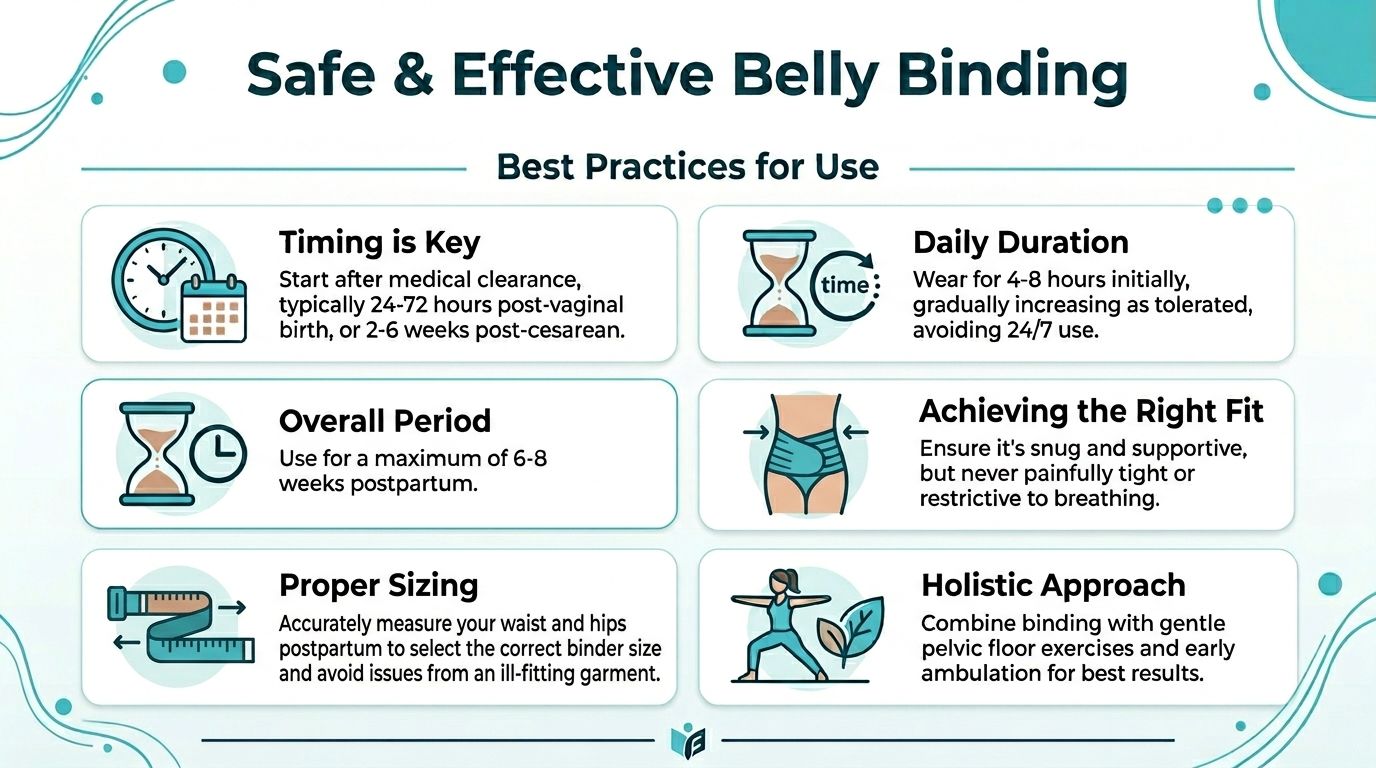
Experts advise discontinuing use after 6 to 12 weeks postpartum and limiting daily wear to 6 to 12 hours to avoid muscle atrophy, breathing restriction, and over-reliance on passive support, according to WebMD’s overview of postpartum belly wraps.
That doesn’t mean every woman should wear one up to that point. It means prolonged, all-day, ongoing dependence isn’t a good plan.
A practical approach is usually:
- Use it for specific windows of activity. Walking, errands, early household tasks, or the times of day you feel most fatigued.
- Take breaks. Your body needs opportunities to breathe, activate, and self-support.
- Reduce wear as control improves. The binder should become less necessary over time, not more.
Later in the day can be a better time than first thing in the morning for some women, because fatigue often exposes poor pressure management. If you only feel you “need” it after hours on your feet, that’s useful information.
A short visual guide can help if you’re deciding how to apply and pace its use:
A simple safety checklist
Don’t judge success by how flat your stomach looks in the mirror. Judge it by function.
Ask these questions instead:
- Can I breathe normally while wearing it?
- Can I relax my shoulders and jaw?
- Do I move with less pain or strain?
- Am I avoiding all core activity because the wrap is doing the work?
- Are my bladder, bowel, or pelvic symptoms unchanged or better, not worse?
Wear the binder for a task. Don’t let the binder become the task.
How to wean off
Many women never get clear advice on stopping, and that’s where overuse starts.
Weaning works better than going from constant use to none. Try a gradual reduction based on function:
- Wear it during your longest walk, but not during quiet time at home.
- Use it for an outing, then remove it once you return.
- Keep it for higher-demand tasks, not routine sitting or feeding.
- Pair reduced wear with breathing work and deep core activation.
The test is simple. If you can move, lift your baby, stand from a chair, and walk around the house without feeling like your abdomen has “fallen apart,” you’re ready for less binder time.
Beyond the Binder Active Postpartum Rehabilitation
A binder can support your body from the outside. Recovery has to happen from the inside.
That’s the shift many women need. Belly binding after childbirth may help you feel held together, but it does not rebuild the systems that create real support. Muscles still need to activate. Scar tissue still needs to glide. Breathing still needs to coordinate with the pelvic floor and deep abdominals.
What active rehab looks like
Early postpartum rehab usually starts with simple, low-load skills.
Not hard workouts. Not crunches. Not “bounce back” routines.
The basics often include:
- Diaphragmatic breathing so the ribs, abdomen, and pelvic floor can coordinate again
- Gentle deep core activation to retrain the trunk without excessive strain
- Pelvic floor work based on what your muscles need, which isn’t always more squeezing
- Positioning and movement strategies for rolling, lifting, feeding, and carrying
- Graded return to exercise rather than jumping into impact too soon
For some women, the most powerful early exercise is learning how to exhale during effort without bearing down.
Support plus skill beats support alone
A binder can sometimes improve body awareness. That can be useful if you’re learning how to control pressure during movement.
But the binder should support skill-building, not replace it.
For example, if you wear a wrap during a walk and notice that you can stack your ribs better and avoid overarching your low back, that’s useful feedback. The next step is learning to find that same organization without depending on the wrap every time.
This becomes even more important when you’re thinking about returning to workouts, running, or more demanding movement. A timeline alone won’t tell you if you’re ready. Your pressure management, symptom response, strength, and movement quality matter more. This is why guidance on how long to wait to exercise after pregnancy should always be paired with an individual assessment.
What doesn’t work
These common strategies usually stall recovery:
| Common mistake | Why it backfires |
|---|---|
| Wearing a binder all day | Reduces opportunities for your core to relearn support |
| Jumping into intense ab workouts | Can worsen doming, pressure, and pelvic floor symptoms |
| Constantly sucking in the stomach | Creates bracing, not functional core control |
| Ignoring pelvic symptoms because the abdomen is the visible issue | The pelvic floor often drives or contributes to the problem |
The strongest postpartum core isn’t the flattest one. It’s the one that can breathe, transfer load, and support you through real life.
That’s the standard worth aiming for.
When to See a Pelvic Floor Physical Therapist
Some postpartum symptoms improve with time, movement, and basic support. Others need a trained eye.
If a binder helps briefly but you still don’t feel right, that’s worth paying attention to. If it makes symptoms worse, that’s even more important.
Signs you shouldn’t ignore
A pelvic floor physical therapy evaluation is a good idea if you notice:
- Urine leakage with coughing, lifting, or exercise
- Pelvic heaviness or bulging
- Persistent low back, abdominal, pelvic, or scar pain
- Coning or doming through the midline with simple movement
- Pain with intercourse
- A feeling that your core never “came back online”
- Difficulty returning to walking, running, lifting, or workouts without symptoms
These issues are common after birth. They aren’t something you have to accept as your new normal.
What a specialist evaluates
A good postpartum evaluation goes beyond checking whether your abdominal gap exists.
It should also look at:
- breathing mechanics
- abdominal wall tension
- pressure management
- pelvic floor strength and coordination
- scar mobility if you had a cesarean
- movement strategies during daily tasks
- readiness for exercise and impact
That level of assessment helps answer questions a wrap never can. Do you need support, strengthening, down-training, scar work, better breathing mechanics, or a different return-to-activity plan altogether?
If you’ve never seen a specialist before, this guide to what to expect from pelvic floor physical therapy can make the process feel less intimidating.
Getting help early usually helps more
The earlier you address pressure, weakness, pain, or prolapse symptoms, the easier it usually is to build better habits before compensation becomes the default.
You don’t need to wait until things feel severe.
If belly binding after childbirth leaves you unsure whether you’re helping or hurting your recovery, that uncertainty alone is a good reason to get assessed by a women’s health physical therapist.
Lake City Physical Therapy helps women in North Idaho and Eastern Washington recover with personalized pelvic floor and postpartum rehab. If you’re dealing with leakage, prolapse symptoms, abdominal separation, cesarean scar issues, or you want a safer plan for returning to exercise, schedule an evaluation with Lake City Physical Therapy.