Postpartum Core Strengthening Exercises: A How-To Guide
Your baby is finally asleep. You stand up from the couch, shift the car seat with one hand, and feel that strange mix of weakness, heaviness, and uncertainty through your middle. Maybe your belly still feels unfamiliar. Maybe coughing makes you brace. Maybe you’ve tried a few random “ab workouts” online and immediately knew they weren’t right.
That feeling is common. Your abdominal wall, diaphragm, back muscles, and pelvic floor all changed during pregnancy and delivery. The issue isn’t that your core disappeared. It’s that the system that used to manage pressure, support your spine, and help you move efficiently needs to be retrained.
Most women aren’t getting enough guidance here. Postpartum physical exercise practice remains low globally, at 19.5%, and women with good knowledge are more than twice as likely to engage in recovery exercises according to this postpartum exercise review. That gap matters, because “you should strengthen your core” isn’t the same as knowing how to do it safely.
Your Body After Baby Rebuilding Your Core With Confidence
A lot of postpartum women assume core recovery means getting back to planks, crunches, or the workouts they did before pregnancy. Usually, that’s not the first job.
The first job is regaining connection. You want your breath, abdominal wall, rib cage, spine, and pelvic floor working together again. That’s what helps with lifting your baby, standing longer without back strain, returning to workouts, and feeling less vulnerable during everyday movement.
Why your core feels different
Pregnancy changes the way pressure moves through your body. Your abdominal wall lengthens. Your rib cage often widens. Your pelvic floor manages extra load for months, then delivery adds another major demand, whether you had a vaginal birth or a C-section.
After birth, many women notice:
- A weak or “open” feeling through the midline
- Trouble generating tension when rolling, standing, or carrying
- Back, hip, or pelvic discomfort during routine tasks
- Leakage, pressure, or heaviness with effort
- A sense that exercise feels different than it used to
None of that means you’ve failed recovery. It means the body needs a progression, not punishment.
Why random ab work usually misses the mark
Generic fitness advice often starts too far down the road. It focuses on intensity before control. That’s why some women feel more doming through the abdomen, more pelvic pressure, or more frustration after trying “core” work.
A better starting point is simpler and more specific. Learn how to breathe. Learn how to create support without bearing down. Learn how to tell when an exercise is helping versus when it’s too much.
If you’re also thinking ahead to broader strength training, a thoughtful beginner gym routine for women can be useful later, once your foundation is in place and your symptoms stay quiet.
Practical rule: Postpartum core strengthening exercises should make you feel more supported after the session, not more symptomatic.
If you’re looking at your abdomen and wondering what’s normal, this guide on your belly after baby can help you understand common postpartum changes before you jump into exercise.
What rebuilding actually looks like
Good postpartum rehab is usually less dramatic than social media makes it look. It often starts with small movements, careful breathing, and short sessions done consistently.
That can feel underwhelming at first. It works because you’re retraining pressure control and muscle timing, not just chasing fatigue.
You don’t need to “bounce back.” You need a core that handles real life.
The Pre-Workout Check-In Assessing Your Postpartum Core
Before you start postpartum core strengthening exercises, check how your body is responding today. That includes your abdominal wall, your pelvic floor, and your breathing pattern.
Diastasis recti affects up to 60% of women postpartum, and a 2019 randomized controlled trial found that a deep core stability program targeting the transverse abdominis and pelvic floor led to a highly statistically significant decrease in abdominal separation and improved quality of life in this trial on deep core stability exercise.
That matters because the right exercises can help. The wrong ones, or the right ones done with poor pressure management, can keep you stuck.

Check your abdominal wall
A self-check for diastasis isn’t perfect, but it can tell you useful things. You’re not only checking for a gap. You’re checking for tension and how your body manages pressure.
Try this:
- Lie on your back with knees bent and feet on the floor.
- Place your fingers at your midline, starting around the belly button.
- Gently lift your head and shoulders just enough to feel the abdominal wall engage.
- Notice width. How many finger widths fit between the two sides?
- Notice depth and tension. Do your fingers sink into a soft trench, or does the tissue firm up under them?
- Repeat above and below the belly button because the feel may change by location.
What you’re looking for:
- Better sign: the abdominal wall firms under your fingers, even if there’s still some separation.
- Less ideal sign: the midline stays very soft, bulges upward, or domes during effort.
- Stop sign: pain, visible pulling at a C-section incision, or worsening doming with small movement.
A wider gap alone doesn’t tell the whole story. A narrower gap with poor tension can still need attention. A slightly wider gap with good tension may function well.
Learn your pelvic floor cues
Most women are told to “do Kegels,” but very few are taught how to contract and relax the pelvic floor correctly. Both matter.
Use simple cues:
- For a contraction: think of gently closing and lifting around the vagina and anus.
- For relaxation: imagine the pelvic floor softening downward like a flower opening or a sit bone widening feeling.
The contraction should feel subtle. It shouldn’t involve gripping your glutes, squeezing your thighs, or holding your breath.
The relaxation matters just as much. If your pelvic floor never lets go, your core system can’t work smoothly. Women with pelvic pain, pressure, or painful intercourse often need this part more than stronger squeezing.
If you can’t inhale without tension in your jaw, upper chest, or belly gripping, start with relaxation before strengthening.
Practice 360-degree breathing
This is the foundation for almost every effective postpartum core exercise.
Think of your torso like a canister. The diaphragm is the top. The pelvic floor is the bottom. The abdominal wall and back help form the sides. You want pressure to spread through that whole space, not just push forward into the belly.
Try this in lying, side lying, or seated:
- Inhale through your nose. Let the rib cage expand sideways and into your back.
- Allow the pelvic floor to soften as you breathe in.
- Exhale gently. As the air leaves, feel a mild lift through the pelvic floor and a gentle lower abdominal connection.
- Keep the effort low. This is not a hard brace.
A useful self-check is one hand on the side ribs and one hand on the lower belly. The inhale should expand the ribs, not just push the abdomen straight up.
What to notice before exercise
Use this quick readiness screen:
| Check | Good to proceed | Regress or pause |
|---|---|---|
| Breathing | Rib cage expands without strain | Breath holding or chest-only breathing |
| Abdominal wall | No doming during small movement | Bulging or trenching with minimal effort |
| Pelvic floor | Can gently contract and relax | Can only grip, or feels heavy/irritated |
| Symptoms | No sharp pain, no increased heaviness | Pressure, leakage, dragging, or pain |
If you’re unsure when your body is ready to begin formal exercise, this overview on how long you should wait to exercise after pregnancy helps frame the decision around healing and symptoms, not pressure to rush.
Foundational Postpartum Core Strengthening Exercises
Early postpartum core work should feel controlled, steady, and almost boring. That’s fine. Boring basics build useful strength.
These movements train connection first. If you can’t keep pressure managed here, harder exercises usually create compensation instead of progress.

360 breathing with core connection
Start here if everything else feels confusing.
How to do it
- Lie on your back with knees bent, or sit supported.
- Inhale into the sides and back of your ribs.
- Exhale slowly through pursed lips.
- During the exhale, add a gentle pelvic floor lift and lower abdominal connection.
- Fully relax on the next inhale.
What you should feel
A mild wrapping tension low in the abdomen. Not a hard crunch. Not your shoulders working.
Common mistakes
- Sucking in the stomach: this often creates upper abdominal gripping.
- Holding the breath: pressure has nowhere to go.
- Trying too hard: more effort usually means less coordination.
Pelvic tilts
This is a simple way to reconnect your lower abdominals and pelvis.
How to do it
- Lie on your back with knees bent.
- Inhale to prepare.
- Exhale and gently tip your pelvis so your low back softens toward the floor.
- Inhale and return to neutral.
What you should feel
A small motion through the pelvis and a low abdominal assist. You shouldn’t feel a hamstring cramp or a forceful push through the feet.
Common mistakes
- Flattening aggressively: the motion is small.
- Driving with the glutes: save that for bridges.
- Rib flare: keep the front ribs quiet.
Heel slides
Heel slides add movement while asking the torso to stay organized.
How to do it
- Begin on your back with one foot planted and the other ready to slide.
- Inhale.
- Exhale, connect through the deep core, and slowly slide one heel away.
- Inhale to return.
- Alternate sides.
What you should feel
Your trunk staying steady while the leg moves. If your abdomen pops upward or your back arches, the lever is too long for your current control.
Common mistakes
- Moving too far: shorten the slide.
- Speeding through reps: slow gives you feedback.
- Pushing the belly out to stabilize: that’s compensation, not control.
Glute bridges
Bridges are useful because they train hip extension and core support together.
How to do it
- Lie on your back, knees bent, feet hip width apart.
- Inhale.
- Exhale and gently connect through your deep core.
- Press through your feet and lift your hips.
- Lower with control.
What you should feel
Glutes and hamstrings doing the work, with the rib cage stacked over the pelvis. The low back shouldn’t take over.
Common mistakes
- Lifting too high: stop before the ribs flare.
- Arching the back to get range: that shifts load away from the intended muscles.
- Bearing down: if you feel pelvic pressure, lower the height or return to pelvic tilts.
For women who want additional low-impact ideas later, a curated library of bodyweight exercises can help you build variety once your foundational control is consistent.
Modified dead bug
This is often a turning point. It exposes whether your core can stabilize while your limbs move.
How to do it
- Lie on your back with knees bent.
- Start with arms reaching to the ceiling, or one leg in tabletop if that feels manageable.
- Inhale to prepare.
- Exhale, engage gently, and lower one arm or heel at a time while keeping the trunk quiet.
- Return on the inhale.
What you should feel
Deep abdominal support without neck strain or a bulging midline.
Common mistakes
- Rushing to full dead bugs: most women do better with heel taps or arm-only lowers first.
- Neck tension: keep the head down unless specifically guided otherwise.
- Coning through the midline: shorten the movement immediately.
This short demo can help you visualize how controlled pacing and alignment should look:
A simple starting dose
If you want a basic structure, start with:
- Breathing practice: 5 slow breaths
- Pelvic tilts: 6 to 10 controlled reps
- Heel slides: 5 to 8 per side
- Bridges: 6 to 10 reps
- Modified dead bug: 4 to 6 per side
Your best early sessions often last only a few minutes. Short and clean beats long and sloppy.
Stop or scale back if you feel increased heaviness, leakage, abdominal doming, sharp pain, or a sense that you’re pushing pressure downward.
How To Progress Your Core Workouts Safely
Progression is where many postpartum plans fall apart. Some women move too fast because they feel restless. Others stay in the easiest phase so long that they stop rebuilding strength.
A better system is mastery-based progression. Time matters, but control matters more.
Structured 6-week progressive postpartum core programs that move from basic dead bugs to more complex exercises like bear walks and banded bird dogs report that 85% of women experience enhanced daily function and stability, with progression based on mastering form without compensation in this postpartum core workout progression guide.

The signs you’re ready to advance
Move to the next level only when you can do your current exercises with:
- Steady breathing
- No abdominal doming or sinking
- No pelvic pressure or heaviness
- No increased leakage
- No pain during or after
- Good control on both sides
If one symptom appears, that doesn’t mean you failed. It means the exercise, range, load, or position was too demanding for today.
Clinical cue: Advance the challenge only after your body stops “asking for help” from breath holding, rib flare, back arching, or pushing downward.
Phase one stability first
This phase includes the foundational work from above.
Your goal isn’t fatigue. Your goal is repeatable control. Once breathing and low-level limb movement feel automatic, add a slightly larger challenge.
Good next options:
- Marching bridge
- Heel taps from tabletop
- Bent-knee fallout
- Side-lying leg work with trunk control
These increase the demand without asking you to manage your whole body against gravity.
Phase two add asymmetry and anti-rotation
In this phase, many women start to feel more athletic again.
Useful progressions include:
| Progression | Why it helps | What must stay quiet |
|---|---|---|
| Bird dog | Trains trunk control during opposite arm and leg movement | Low back, ribs, abdomen |
| Bear hold | Builds deep support with more load through the trunk | Breath holding and pelvic pressure |
| Side plank variation | Challenges lateral core support | Neck gripping and rib flare |
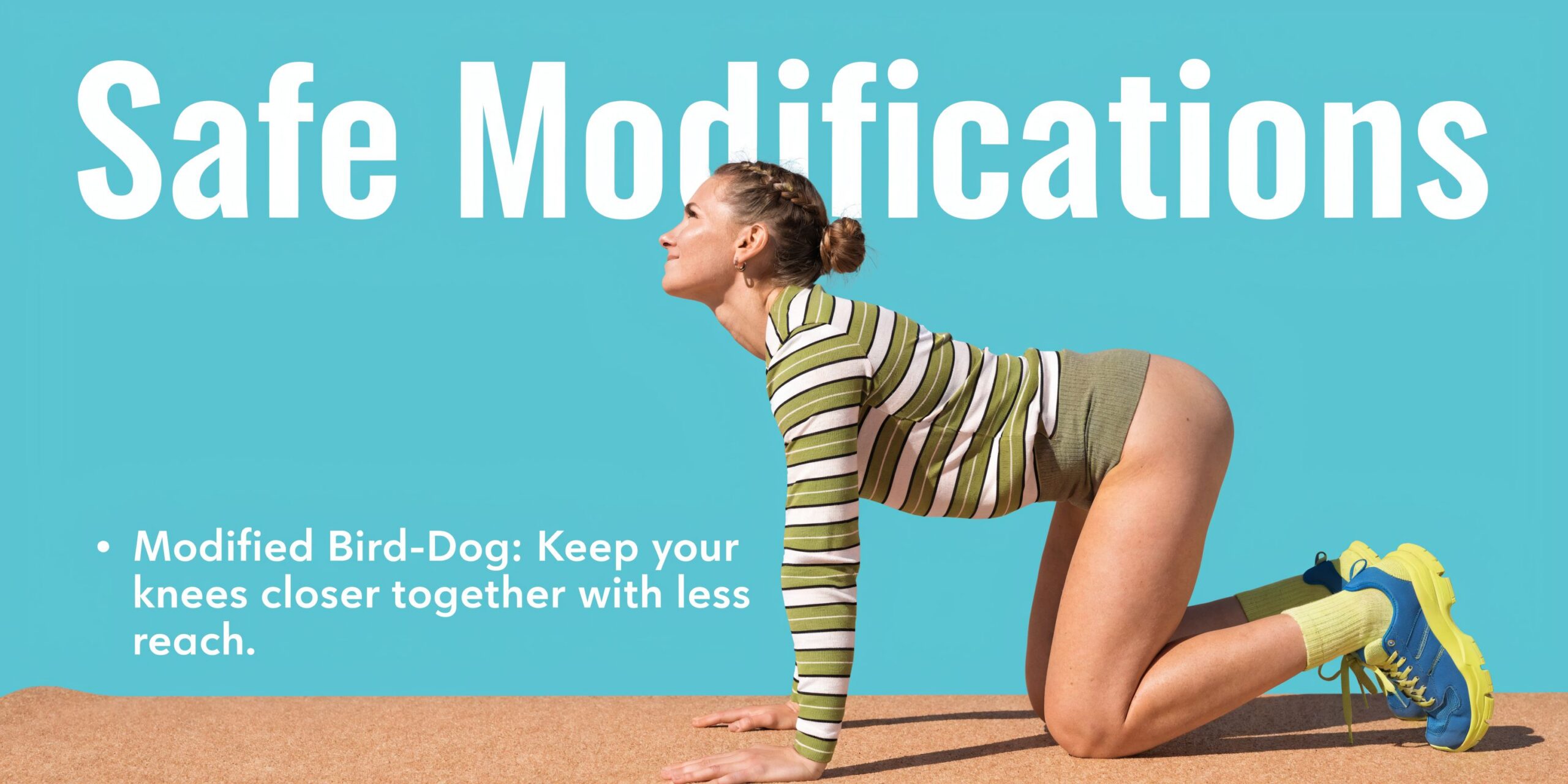
For bird dog, start with one limb at a time if needed. Reaching the arm only or sliding the leg back along the floor is still real work.
For bear hold, think hover, not maximum effort. If your abdomen domes or you bear down, go back to quadruped breathing and limb lifts.
Phase three dynamic load and return to fitness
This phase blends core control into more functional patterns. Examples include:
- Plank shoulder taps from an incline
- Farmer carry with stacked posture
- Squat to press with breath coordination
- Loaded step-up with exhale on effort
The point isn’t to collect hard exercises. The point is to keep pressure managed while life and exercise become more demanding.
If your goal is running, lifting, CrossFit, or impact work, this is also where sport-specific progression matters. Return-to-impact decisions should factor in symptom response, tissue healing, and movement quality. This resource on return to high-impact sport activities postpartum is useful if you’re wondering when “feeling okay” is enough and when your body needs more preparation.
What doesn’t work well
Some progression mistakes show up again and again:
- Using time alone as the benchmark: six weeks postpartum doesn’t automatically equal readiness.
- Jumping to planks and crunches first: these often expose pressure problems before the foundation is ready.
- Adding resistance before control: if form changes, the weight is too much.
- Ignoring symptoms later in the day: delayed heaviness, back pain, or leakage still count.
Progress should make daily life easier. You should notice better support when lifting your baby, getting out of bed, carrying groceries, or standing longer. That’s the kind of strength that lasts.
Modifications For Common Postpartum Concerns
Generic postpartum fitness advice usually falls short in this area. It may show a safe-looking exercise, but it doesn’t tell you how that exercise should change if you had a C-section, feel pelvic heaviness, or leak when you exert yourself.
That gap matters. Mainstream postpartum content often fails to address modifications for concurrent pelvic floor dysfunctions like prolapse or dyspareunia, even though standard core exercises frequently need adaptation to manage intra-abdominal pressure, as noted by Every Mother’s discussion of this content gap.
If you had a C-section
A C-section is abdominal surgery. Your plan should respect that.
Early on, choose positions and movements that reduce direct strain across the incision. Log rolling to get out of bed, hands supporting the abdomen during coughing, and smaller movement ranges are often more comfortable than trying to “work through it.”
Helpful adjustments:
- Use side lying or reclined positions if flat lying pulls at the incision.
- Start with breathing and gentle connection drills before leg-lowering work.
- Decrease range on heel slides and bridges if you feel tugging.
- Watch for scar sensitivity or guarding that changes how you move.
If the scar area feels stuck, hypersensitive, or you continue avoiding extension or rotation because it feels wrong, that’s a good time for an in-person assessment.
If you have prolapse symptoms or pelvic heaviness
For prolapse, pressure management becomes the center of everything.
That means exercises done on your back, side, hands and knees, or an incline may feel much better than standard planks, sit-ups, or anything that makes you strain. Exhale on effort. Keep the effort moderate. Avoid the urge to brace hard and push downward.
Try these modifications:
- Choose supported positions first: side lying, quadruped, reclined.
- Shorten work intervals: stop before fatigue changes your strategy.
- Use a smaller exhale with effort: forceful blowing can still create unhelpful pressure if it becomes a hard push.
- Raise your hands for planks or push-based movements: an incline often reduces symptoms.
If a movement causes vaginal heaviness, dragging, or pressure that lingers after you stop, that movement is too advanced right now.
If you’re dealing with incontinence
Leakage during exercise often means the system can’t manage load and timing yet. That doesn’t always mean the pelvic floor is “weak.”” Sometimes it’s delayed. Sometimes it’s overactive and poorly coordinated. Sometimes the breathing strategy is the main issue.
Helpful changes:
- Exhale before the hardest part of the movement.
- Reduce speed so the pelvic floor has time to respond.
- Use fewer reps with better control instead of chasing a full set.
- Return to lower-load positions if leakage starts during standing work.
For some women, the key is more lift. For others, it’s better relaxation between reps. If you’re gripping all day, more squeezing won’t solve the problem.
Some symptoms improve when an exercise gets easier. Others improve when you stop forcing it and let the pelvic floor lengthen first.
If sex is painful or the pelvic floor feels overactive
This is one of the most overlooked situations in postpartum exercise advice.
If intercourse is painful, tampons are uncomfortable, or you feel constant tension through the pelvic floor, don’t assume more Kegels are the answer. In many cases, the first step is downtraining. That means breath work, pelvic floor relaxation, hip mobility, and reducing gripping through the glutes and abdominals.
Good options often include:
- Supported diaphragmatic breathing
- Child’s pose or side-lying relaxation
- Gentle adductor and hip opening work
- Low-load core exercises with intentional release between reps
Red flags that mean stop and get help
Seek professional help if postpartum core strengthening exercises cause or worsen:
- Sharp abdominal, pelvic, or incision pain
- Pelvic heaviness that increases with activity
- New or worsening leakage
- Visible abdominal doming you can’t correct
- Painful intercourse or persistent pelvic pain
- A sense that you’re getting weaker, not stronger
This is one place where individualized care matters. A women’s health physical therapist can sort out whether the issue is pressure strategy, scar restriction, prolapse, pelvic floor overactivity, weakness, or a combination of several factors. Lake City Physical Therapy offers pelvic health and postpartum rehabilitation that includes this kind of assessment and exercise modification.
Your First 12 Weeks A Sample Core Recovery Plan
A good plan gives structure without pretending every body heals on the same clock. That’s especially important because public guidance often includes 6- or 12-week timelines but doesn’t give clear criteria for when someone should progress, which is a major gap highlighted in this discussion of postpartum progression benchmarks.nourishmovelove.com/postpartum-recovery-diastasis-recti-exercises/).
Use the table below as a template, not a rulebook. Stay in a phase longer if you still have doming, pressure, leakage, or pain. Move forward only when the current level feels solid.
Sample 12-Week Postpartum Core Recovery Schedule
| Phase | Focus | Sample Exercises |
|---|---|---|
| Weeks 0 to 6 after medical clearance | Reconnection, breathing, gentle pressure management, basic trunk control | 360 breathing, pelvic floor contract-relax practice, pelvic tilts, heel slides, supported glute bridges, modified dead bug variations |
| Weeks 6 to 12 | Strength building, anti-rotation control, more functional movement | Marching bridge, bent-knee fallout, bird dog progressions, side plank variations, bear hold preparation, incline plank shoulder taps |
How to use the plan week to week
A simple weekly rhythm works well for many women:
- Two to four short sessions focused on form
- One day between harder sessions if symptoms linger
- Brief breathing practice daily if that helps you reconnect
- Walking and normal daily movement as tolerated
Keep sessions short enough that your form stays clean. If your baby sleeps for ten minutes and you get through two exercises well, that still counts.
What success should feel like
In the first several weeks, success usually looks like:
- Better awareness of your deep core
- Less breath holding
- Easier transfers, lifting, and carrying
- Improved confidence during movement
- Fewer symptoms with basic activity
That’s real progress. Postpartum recovery rarely moves in a straight line, but it should trend toward more support, not more strain.
If you’re dealing with lingering abdominal separation, pelvic pressure, incontinence, painful sex, or you don’t know what level is appropriate for your body, Lake City Physical Therapy can help you sort out what’s driving your symptoms and build a personalized postpartum plan around healing, strength, and return to activity.com) can help you sort out what’s driving your symptoms and build a personalized postpartum plan around healing, strength, and return to activity.