Pain in One Leg Pregnancy: Causes, Relief, & When to Worry
You roll over in bed, point your toes, and suddenly one leg seizes with pain. Or maybe you stand up from the couch and feel a sharp streak from your buttock down the back of one leg. For a lot of pregnant women, that moment is scary because it’s hard to tell what’s normal, what’s annoying but manageable, and what needs urgent medical care.
Pain in one leg pregnancy can come from several very different problems. Some are common muscle and nerve issues that respond well to position changes, stretching, and physical therapy. Others need same-day medical attention.
As a women’s health physical therapist, I want you to know two things at the same time. First, one-sided leg pain is common in pregnancy. Second, it should never be brushed off without a quick check of the pattern. The location, timing, swelling, skin changes, and the kind of pain you feel all matter.
That Sudden Pain in Your Leg What Does It Mean
A common story goes like this. You’re in your third trimester, finally trying to get comfortable, and your left calf tightens so hard it wakes you up. The next day, maybe the pain changes. Now it feels more like a pulling sensation in your buttock and thigh when you walk. Later in the week, you start wondering whether this is “just pregnancy” or something you should call about.
That uncertainty is the hardest part.
Most one-sided leg pain during pregnancy falls into a few buckets. It may be a leg cramp, especially if it hits suddenly at night. It may be sciatic-type pain, which often starts in the low back or buttock and travels down the leg. It may also be pelvic girdle pain, where the pelvis gets irritated and sends pain into the thigh or leg.
But there’s one cause you can’t ignore. A blood clot in the leg, called deep vein thrombosis (DVT), can also show up as pain in one leg.
Practical rule: If the pain comes with one-sided swelling, warmth, redness, or doesn’t ease with rest, treat that as a medical issue first.
The good news is that the body usually gives clues. Your job isn’t to diagnose yourself perfectly. Your job is to notice the pattern and respond wisely. Once you understand why pregnancy changes the way your back, pelvis, nerves, and circulation work, the symptoms make a lot more sense.
Your Changing Body The Blueprint for Leg Pain
Pregnancy changes the way force moves through your body. From a physical therapist’s perspective, that matters because one-sided leg pain often starts with mechanics before it turns into a symptom you can clearly name.
A simple way to picture it is this. Your body is carrying more load, your base of support is adapting, and the muscles that usually keep your pelvis and spine steady have to do their job under different conditions. If one hip is stiffer, one glute is weaker, or one side of your pelvis is taking more of the load, that side often speaks up first.
Hormones change how steady you feel
Pregnancy hormones help your body prepare for birth. They can also make the joints of the pelvis and lower back feel less supported. The joints are not falling apart, but they may move a little more, and your muscles often respond by tightening to create stability.
That is why pain can show up as gripping in the buttock, deep aching along the outer hip, or tension that travels down into the thigh or calf.
This is also why pain may flare with asymmetrical movements. Getting out of a car, climbing stairs, standing on one leg to put on pants, or rolling in bed can all load one side of the pelvis more than the other. If you have also noticed sharp pulling low in the belly or groin, round ligament pain during pregnancy can overlap with these movement changes and make the whole area feel harder to sort out.
Posture shifts where the work happens
As your belly grows, your center of mass moves forward. Many pregnant women respond by leaning the trunk back a bit, locking the knees, or letting the ribs flare upward. None of that means you are doing something wrong. It means your body is finding a strategy.
But some strategies cost more.
When the low back compresses, the deep hip muscles may tighten. When the glutes are not sharing the work well, the hamstring or calf may pick up the slack. Over time, one leg can start to feel more loaded, more tired, or more irritated than the other. That is a common PT pattern, and it helps explain why pain is sometimes very one-sided.
Circulation changes the feel of your legs
Pregnancy also changes blood flow and fluid balance. The growing uterus can press on veins and make it harder for blood to return from the legs. That can leave the legs feeling heavy, full, swollen, or crampy, especially later in the day or after a long stretch of sitting or standing.
Muscle fatigue and slower circulation can happen at the same time, which is why the symptoms can feel mixed together.
Here is the PT view. Your nerves, muscles, joints, and circulation are all sharing one crowded workspace. If one system gets irritated, the others often react.
- Pain with rolling, stairs, or single-leg tasks often points to pelvic or hip mechanics.
- A pulling, tight, or overworked feeling often points to muscle compensation.
- Heaviness, swelling, or a visibly different leg needs more caution, because circulation may be part of the picture.
Pregnancy changes your mechanics. It does not mean your body is fragile. Once you identify which system is driving the pain, the next step becomes much clearer.
Decoding Common Causes of One-Sided Leg Pain

The most common non-emergency causes of one-sided leg pain in pregnancy usually involve nerves, muscles, or pelvic mechanics. They can hurt a lot, but they don’t all mean danger.
Sciatica and sciatic-like pain
True sciatic pain usually follows a line. It often starts in the low back or buttock and travels down the back or side of the leg. It may come with tingling, numbness, or a zinging feeling when you sit too long, stand up, cough, or turn in bed.
Pregnancy-related sciatica is often linked to postural changes. The growing uterus can increase lumbar lordosis by 30 to 50% and tighten the piriformis muscle, which can entrap the sciatic nerve in up to 37% of cases, leading to sharp, radiating pain, according to this pregnancy sciatica overview from UT Southwestern.
A lot of women use “sciatica” to describe any leg pain, but not all of it comes from the spine. Sometimes the nerve is irritated by a tight deep hip muscle rather than a disc problem.
Piriformis irritation
The piriformis is a small muscle deep in the buttock. When it tightens, it can irritate the sciatic nerve and create pain that feels surprisingly strong. This often gets worse after sitting, driving, or spending a lot of time in one position.
Typical clues include:
- Deep buttock ache that may spread down the thigh
- Pain with sitting more than walking
- Tenderness in one buttock rather than the whole leg
- Relief after gentle movement or stretching
Pelvic girdle pain that refers into the leg
Sometimes the leg isn’t the main problem. The pelvis is.
If the joints at the front or back of the pelvis are irritated, pain can refer into the buttock, groin, side of the hip, or thigh. It may feel sharp when walking, climbing stairs, getting dressed, or standing on one leg. If this sounds familiar, this guide to ligament pain during pregnancy can help you distinguish pelvic and ligament-related discomfort from nerve pain.
Leg cramps
Leg cramps are common, abrupt, and often dramatic. In pregnancy research, leg cramps affected 58% of pregnant women, with prevalence estimates ranging from 47.8% to 64.4% across studies. Among those affected, the mean pain intensity was 7.39 out of 10, and they happened most often during sleep (77%), as noted in the research above.
A cramp usually feels different from sciatica. It’s more like a forceful muscle grab, often in the calf. It may last briefly but leave soreness behind.
Quick pattern guide
| Cause | What it often feels like | Common trigger |
|---|---|---|
| Sciatica | Sharp, radiating, burning, tingling | Sitting, rolling, coughing, walking |
| Piriformis irritation | Deep buttock pain with leg referral | Prolonged sitting |
| Pelvic girdle pain | Achy or sharp pain with movement asymmetry | Stairs, turning, single-leg tasks |
| Leg cramp | Sudden muscle tightening, often in calf | Nighttime, pointed toes, fatigue |
Red Flags The Symptoms You Must Not Ignore
Most one-sided leg pain in pregnancy is musculoskeletal. DVT is the exception that must be ruled out quickly.
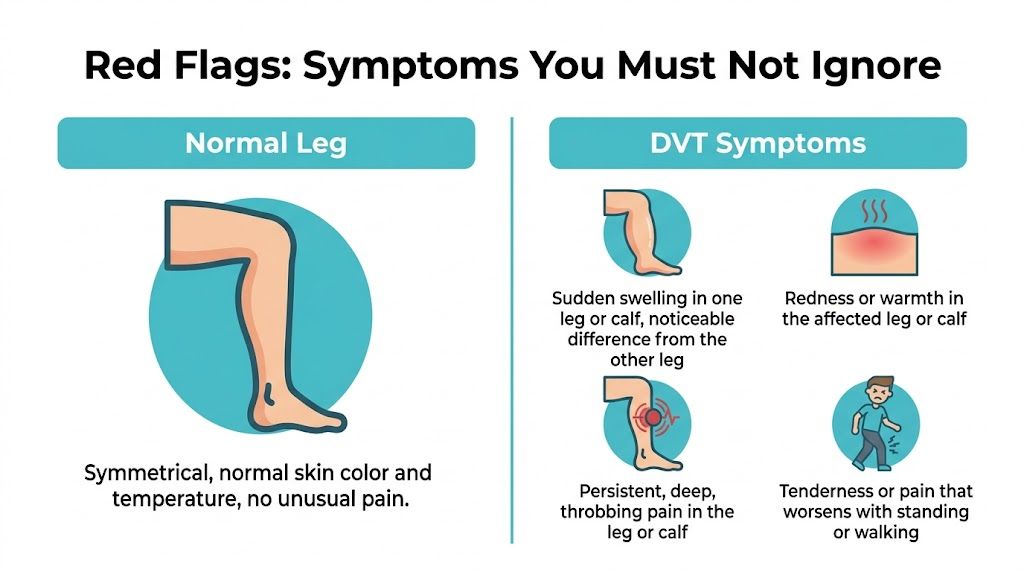
Pregnant women are up to 10 times more likely to develop a deep vein thrombosis than non-pregnant peers, and DVT affects 1 to 2 per 1,000 pregnancies. The left leg is more commonly affected due to anatomical compression, according to this clinical guide on left leg pain and pregnancy.
That doesn’t mean every left leg ache is a clot. It means you should not ignore a suspicious pattern.
What makes DVT feel different
A blood clot usually doesn’t behave like a simple cramp or a posture-based ache. It tends to be more constant. The leg may look or feel different from the other side.
Watch closely for these signs:
- One-sided swelling, especially in the calf or lower leg
- Warmth in the painful area
- Redness or color change
- Tenderness that doesn’t let up
- Pain that doesn’t improve with rest
- Pain with walking or standing that feels deep and concerning
If one leg suddenly looks bigger, warmer, or redder than the other, call your doctor or go to urgent care or the emergency room right away.
DVT red flags vs common pregnancy leg pain
| Symptom | Common Pregnancy Pain (e.g., Cramps, Sciatica) | Potential DVT Red Flag (Seek Urgent Care) |
|---|---|---|
| Pain pattern | Comes and goes, often tied to position or movement | Constant, deep, concerning pain |
| Swelling | Mild general swelling in both legs can happen | Swelling mainly in one leg or calf |
| Skin temperature | Usually normal | Noticeably warm area |
| Skin color | No major color change | Red or discolored skin |
| Relief with rest | Often improves with stretching, rest, or position change | Little or no improvement |
| Location | Buttock, back of leg, calf, or thigh depending on cause | Often calf or lower leg, usually one side |
Don’t try to stretch your way through red flags
This point often confuses readers. They think, “Maybe I should just hydrate, rest, and wait.” That’s reasonable for a typical cramp. It is not the right plan for possible DVT.
You don’t need to prove it’s serious before calling. You only need enough concern to get checked.
Safe Self-Care and Exercises for Leg Pain Relief

Once urgent causes have been ruled out, the next question is simple. What kind of movement helps, and what kind makes things worse?
From a physical therapist’s perspective, that matters because one-sided leg pain often comes from a body that is being pulled off center. As pregnancy progresses, joints get looser, your center of mass shifts forward, and one hip or side of the pelvis may start doing more work than the other. The result can feel like a calf cramp, buttock pain, or a pulling ache down one leg. Self-care works best when it matches the driver.
Start with calm, targeted movement
Use a gentle approach first. Your goal is to reduce tension, improve circulation, and help the irritated area settle down. You are not trying to force a big stretch or “fix” everything in one session.
- Calf stretch for cramps: Stand facing a wall, place the painful leg behind you, keep the heel down, and lean forward until you feel a mild stretch in the calf. Hold gently and breathe.
- Seated figure-four stretch for buttock pain: Sit tall, place one ankle across the opposite knee, and lean forward slightly until you feel a stretch deep in the buttock.
- Cat-cow for back and pelvic mobility: On hands and knees, round your back gently, then ease into a comfortable arch. Move slowly with your breath.
- Ankle pumps for circulation and stiffness: Point and flex the ankles several times, especially after sitting.
Each exercise has a different job. Calf stretching helps a tight muscle relax. Figure-four stretching can ease tension around the deep hip muscles that sometimes irritate the sciatic nerve. Cat-cow can reduce stiffness and help your pelvis find a more comfortable position. Ankle pumps are a simple reset if sitting makes your leg feel heavy or tight.
Use the “green light, yellow light, red light” rule
This is a helpful way to avoid overdoing it.
Green light: a mild stretch, less tension, easier walking, or symptoms that settle soon after.
Yellow light: soreness that feels a little stronger during the exercise but fades quickly.
Red light: sharp pain, pain that spreads farther down the leg, numbness, weakness, or symptoms that keep ramping up after you stop.
If you hit a red light, stop that exercise.
Positioning matters, especially at night
Many women notice their pain gets louder in bed because the pelvis can rotate and the top leg may pull the low back and hip into a strained position. A pillow between the knees often helps keep the pelvis more level, like placing a small support under a wobbly table leg. If you’re trying to improve your sleep setup, supportive pillows can help maintain a better side-lying position and reduce strain on the hips and legs.
Daytime setup matters too. Supportive shoes can reduce the stress that travels up from your feet into your knees, hips, and pelvis. Barefoot time on hard floors often irritates symptoms more than people expect.
Add short bouts of movement during the day
Pregnancy leg pain usually responds better to frequent resets than to one long workout. Try this simple pattern:
- Walk for a few minutes if walking feels comfortable.
- Stretch the tight area gently without pushing into pain.
- Change positions often so one side is not carrying the load all day.
- Build hip support if the pain seems tied to pelvic strain or instability. These hip strengthening ideas can help improve the muscle support around the pelvis.
That last point is easy to miss. If your glutes and deep hip muscles are not sharing the load well, the leg often pays the price. Better hip support can reduce the repeated tug on the back, buttock, and thigh.
For a guided movement option, this video can be a useful starting point:
Hydration can also help, particularly if your pain feels crampy. It will not solve every cause of one-sided leg pain, but it is a sensible habit that supports normal muscle function.
When to Call Your Doctor vs a Physical Therapist
This decision gets easier when you sort symptoms into medical risk versus movement-related pain.
Call your doctor or midwife right away
Contact your medical provider promptly if you have one-sided swelling, redness, warmth, or constant calf pain that doesn’t improve with rest. Those symptoms need medical screening first.
For suspected DVT, diagnosis relies on compression ultrasound, which has a sensitivity of over 95% for proximal clots. Immediate treatment with low-molecular-weight heparin is the standard approach to help prevent a potentially fatal pulmonary embolism, according to the NHS guidance on DVT in pregnancy.
Also call your doctor if your leg pain comes with chest pain, trouble breathing, major weakness, or you feel acutely unwell.
See a physical therapist when the issue is persistent or mechanical
Physical therapy makes sense when the pain:
- Keeps coming back with walking, sleeping, or sitting
- Feels linked to position or movement
- Limits exercise or daily tasks
- Seems to start in the back, buttock, pelvis, or hip
- Isn’t dangerous, but isn’t getting better
A doctor rules out medical problems. A women’s health physical therapist identifies the musculoskeletal driver. Those are different jobs, and both matter.
You don’t have to wait until the pain is severe. If it’s changing how you walk, sleep, or function, it’s worth addressing.
How Prenatal Physical Therapy Can Restore Your Comfort
When one-sided leg pain keeps showing up, the main question is usually not “How do I stretch more?” It’s “Why is this side getting overloaded?”
That’s where prenatal physical therapy helps.
What a good evaluation looks for
A women’s health physical therapist looks at the full chain. That includes how your pelvis moves, how your hips support you, whether one side is working harder than the other, how your posture changes in standing, and whether your symptoms behave like nerve pain, muscle guarding, joint irritation, or a mix.
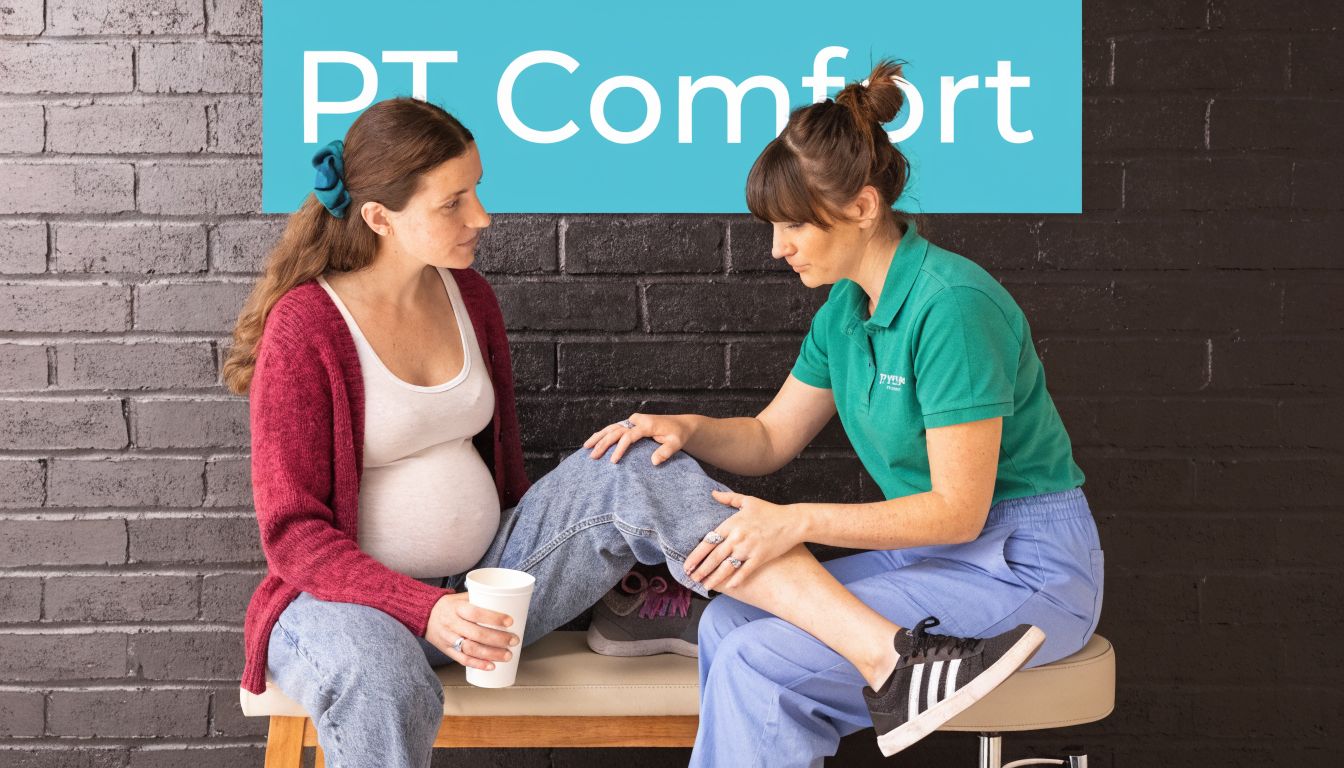
That matters because the same symptom, “pain in my left leg,” can come from very different mechanics.
What treatment often includes
Care is usually hands-on and practical. Depending on your presentation, treatment may involve:
- Manual therapy to calm overworked muscles and improve joint mobility
- Targeted exercises for glutes, deep core, and pelvic support
- Nerve-friendly movement strategies if symptoms radiate down the leg
- Walking, stair, and bed mobility coaching so daily tasks hurt less
- Home program adjustments that fit your trimester and energy level
The goal isn’t just pain relief in the moment. It’s helping your body distribute load better so the same tissues stop getting irritated.
Why specialized prenatal care matters
Pregnancy care isn’t general orthopedic care with a modified exercise sheet. It works best when the therapist understands pelvic health, prenatal biomechanics, symptom fluctuations, and postpartum recovery.
If you want a deeper look at why this type of care matters before and after delivery, this resource on physical therapy during and after pregnancy is a helpful next read.
Specialized care can also be more accessible than many women expect, with in-person and telehealth options in many practices. That can make a big difference when travel, fatigue, or childcare are real barriers.
Your Path to a More Comfortable Pregnancy
Pain in one leg pregnancy is common, but it deserves attention. The key is knowing the difference between a cramp, a nerve issue, a pelvic mechanics problem, and a symptom pattern that needs urgent medical care.
Use simple self-care when the pain acts like a musculoskeletal problem. Change positions often, support your sleep setup, move gently, and don’t push through sharp symptoms. If nighttime discomfort keeps interrupting rest, this guide on how to improve sleep quality naturally offers practical ideas that pair well with pregnancy-friendly positioning.
Trust your instincts if something feels off. If symptoms look like a DVT red flag, call your doctor. If the problem is ongoing, movement-based, or affecting daily life, physical therapy can help you get to the root cause and feel more confident in your body again.
If you’re dealing with ongoing leg pain during pregnancy and want expert, women’s health-focused support, Lake City Physical Therapy offers personalized prenatal and postpartum care across North Idaho and Eastern Washington, with telehealth options as well. Their team can help you understand the source of your pain, move more comfortably, and build a plan that fits your pregnancy and recovery.

