Expert Pelvic Floor Therapy for Incontinence
You’re crossing your legs before a sneeze. You know which grocery stores have the quickest bathrooms. You may have stopped jumping, running, laughing hard, or even drinking water before a car ride because leaking feels unpredictable.
A lot of women live this way far longer than they need to.
Urinary incontinence can feel embarrassing, but it isn’t a personal failure and it isn’t something you just have to “put up with.” In many cases, pelvic floor therapy for incontinence is a practical, non-surgical path toward better bladder control. It starts with understanding what your body is doing, then building the right plan for your specific pattern of symptoms.
Some people need help with weakness. Others need help with muscles that are too tense and don’t let go well. Some need both. That’s why pelvic floor therapy is much more than doing random Kegels from the internet.
If you’re new to all of this, the process can sound vague or intimidating. It doesn’t need to. Once you know what the pelvic floor does, what the first visit is like, which tools therapists use, and how treatment fits into real life, the whole thing becomes much less mysterious.
Reclaiming Your Confidence from Urinary Incontinence
For many women, incontinence begins subtly at first. A few drops during a workout. A leak when lifting a toddler. A sudden urge on the way to the front door that feels impossible to ignore. Then daily life starts shrinking around the problem.
You may plan clothing around “just in case.” You may skip exercise because running, jumping, or heavy lifts make you nervous. You may feel frustrated because everyone says leakage is common after birth, during menopause, or in sports, but common doesn’t make it easy to live with.
Pelvic floor physical therapy gives this problem a structure. Instead of guessing, you figure out why the leaks are happening. Then treatment targets the actual cause. That could mean improving support, retraining coordination, calming urgency, or teaching muscles to relax before they strengthen.
Incontinence often improves when treatment matches the real problem instead of the most obvious assumption.
That matters because two women can both say “I leak,” while needing very different care plans. One may leak when she coughs because pressure overwhelms her support system. Another may rush to the bathroom because her pelvic floor is gripping too much and not coordinating well with the bladder. The symptom sounds similar. The treatment isn’t.
The good news is that pelvic floor therapy is widely used as a first-line, conservative approach for urinary incontinence. For many women, it offers a path back to workouts, travel, sleep, intimacy, and everyday confidence without jumping straight to medication or surgery.
Why Leaks Happen Understanding Your Pelvic Floor
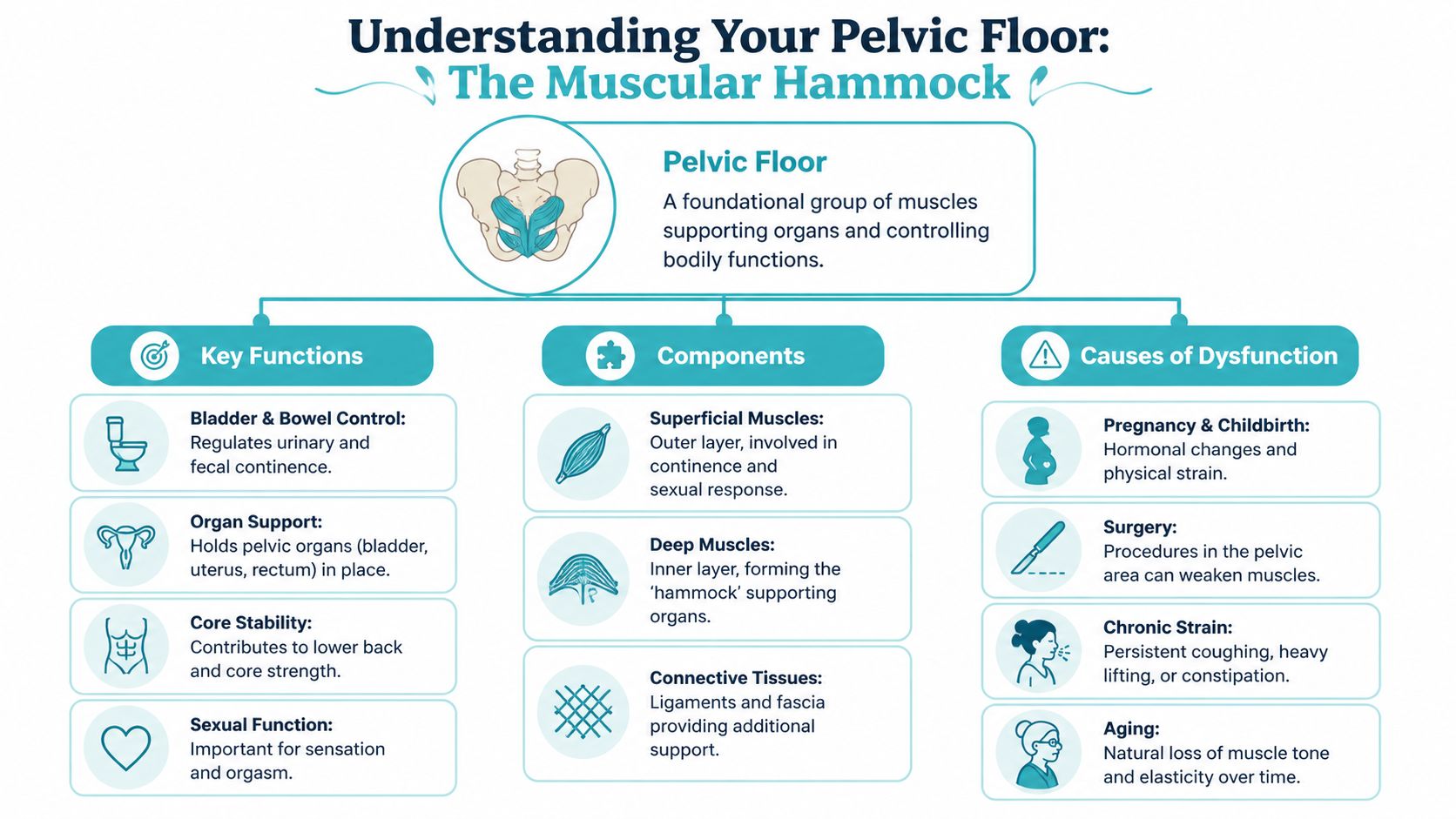
Your pelvic floor is often described as a muscular hammock. That’s a useful image because these muscles sit at the base of the pelvis and support the bladder, bowel, and reproductive organs. They also help with bladder control, core support, and sexual function.
When this system works well, it responds automatically. It lifts and supports when pressure increases. It relaxes when you need to urinate or have a bowel movement. It coordinates with your breathing, abdominal muscles, hips, and deep core.
When it doesn’t work well, leaks can happen for different reasons. Sometimes the muscles don’t generate enough support at the right moment. Sometimes they’re too tense and can’t relax or coordinate properly. Sometimes the issue involves habits, bladder sensitivity, scar tissue, recovery after childbirth, or the physical demands of sport.
The main types of urinary incontinence
Knowing the type of leakage helps you understand what treatment may focus on.
| Type | What it feels like | Common example |
|---|---|---|
| Stress incontinence | Leakage with pressure | Sneezing, coughing, jumping, lifting |
| Urge incontinence | A sudden strong need to go, then leaking | Hearing running water or putting the key in the door |
| Mixed incontinence | A blend of stress and urge symptoms | Leaking during exercise and also rushing to the bathroom |
| Overflow incontinence | The bladder doesn’t empty well, so leaking can happen | Dribbling or feeling like you never fully empty |
Stress incontinence is the one many women recognize first. If you leak with a laugh, a sprint, or a heavy deadlift, pressure inside the abdomen may be pushing down faster than the pelvic floor can respond.
Urge incontinence confuses people more often. They assume the problem must be “weakness,” but that isn’t always true. Some women with urgency have a pelvic floor that stays too tight, which can disrupt normal bladder signaling and coordination.
Why postpartum symptoms are so common
Pregnancy and delivery change the pelvic floor in mechanical and hormonal ways. Tissue support changes. Pressure changes. Breathing patterns often change too. That’s one reason postpartum incontinence is common, but treatability matters more than commonness.
A review discussed in Stanford Urology’s summary of pelvic floor physical therapy research notes that postpartum urinary incontinence affects 11-20% of women, and women with stress urinary incontinence who received pelvic floor physical therapy were eight times more likely to report being cured, with 56% reporting cure compared with 6% in control groups.
That doesn’t mean every postpartum leak is identical. One new mom may need pressure management and strength. Another may need scar mobility, breathing retraining, and relaxation first.
Common doesn’t mean normal
Women often dismiss leakage because they can trace it to a life event. “It started after my second baby.” “It only happens when I run.” “It’s probably just aging.” Those explanations may describe timing, but they don’t tell you the mechanism.
If you want a fuller look at the patterns behind symptoms, Lake City Physical Therapy has a helpful overview on what causes urinary incontinence in women.
Practical rule: If leakage changes what you wear, where you go, how you exercise, or how confident you feel, it deserves assessment.
What to Expect at Your First Physical Therapy Visit
The first appointment is usually the part people worry about most. They’re not sure what will be asked, whether the exam will be painful, or whether they’ll feel rushed or embarrassed. In a good pelvic health visit, the pace is respectful and your consent matters at every step.
Most first visits start with conversation, not an exam table.

The part where you tell your story
Your therapist will ask questions that connect your symptoms to real life. You might talk about when you leak, what triggers urgency, how often you urinate, what exercise feels like, whether you’ve had pregnancies or surgeries, and what you want to get back to doing.
Your goals matter here. “I want to jog without leaking” leads to a different conversation than “I want to make it through the night without getting up so often” or “I’m starting cancer recovery and things don’t feel normal anymore.”
Some women find it helpful to listen to a clinician explain these issues before they book. If you like audio resources, Peak Performance's pelvic floor episode offers a patient-friendly discussion of leakage, urgency, and pelvic floor health.
The external assessment
Before anyone discusses an internal exam, your therapist can learn a lot by watching how your body moves and breathes.
They may assess:
- Posture and rib position to see how pressure moves through your trunk
- Breathing mechanics because the diaphragm and pelvic floor work together
- Abdominal and hip function since the pelvic floor is part of a larger support system
- Movement patterns such as squatting, coughing, lifting, or stepping
This part often surprises patients. They expect only a pelvic exam, but your therapist is looking at the whole body because the pelvic floor doesn’t work in isolation.
The internal exam, if you consent
An internal pelvic floor exam can provide useful information about strength, coordination, tenderness, and resting tone. It is not the same as a gynecologic exam. It should be explained clearly before it happens, and you can decline it, postpone it, or stop at any point.
During an internal assessment, the therapist typically uses one gloved, lubricated finger to feel how the muscles contract, relax, and respond. They may ask you to breathe, cough, or gently squeeze and let go. The point is not to “push through” discomfort. The point is to gather information safely.
You are allowed to ask questions, pause, or say no at any time. That isn’t being difficult. It’s part of informed care.
If you want a more detailed preview, Lake City Physical Therapy explains the process in their guide to what a pelvic floor exam involves.
What you leave with
A strong first visit usually ends with a working explanation of your symptoms and a starting plan. You should know what your therapist thinks is contributing to the leakage, what the first home steps are, and what progress will likely look like.
That first day often brings relief for one simple reason. The problem finally has a name and a plan.
Your Personalized Pelvic Floor Therapy Toolkit
A good treatment plan doesn’t start with “just do more Kegels.” It starts with matching tools to the problem. Some women need more support. Some need less tension. Some need better timing. Most need a combination.

Manual therapy for tight or guarded muscles
If your pelvic floor is overactive, strengthening alone can make symptoms worse. This is especially relevant for women with urgency, pelvic pain, painful intercourse, or a sense that they can’t fully relax to empty.
Hands-on treatment may include soft tissue work, myofascial release, scar mobility work, and techniques that help reduce protective tension in the pelvic floor, hips, abdomen, or inner thighs. The goal is to improve mobility and help the muscles return to a more normal resting state.
According to Johns Hopkins Medicine’s pelvic floor therapy overview, therapy often addresses a hypertonic pelvic floor, which can paradoxically contribute to urge incontinence. The same source describes advanced pelvic floor physical therapy techniques such as myofascial release and biofeedback-guided eccentric contractions that can reduce excessive muscle tone by 20-40% and lead to 70-85% resolution of urge incontinence symptoms within 6-12 sessions.
That’s why “tight” and “strong” are not the same thing. A muscle can be tense and still function poorly.
Strengthening, but only when it fits
Kegels are one tool, not the entire toolbox. For some women, a well-timed pelvic floor contraction is useful. For others, the first step is learning how to let go.
Your therapist might use a progression like this:
-
Awareness first
Can you feel the pelvic floor contract and relax without squeezing everything else? -
Coordination next
Can you match the contraction to a cough, lift, or landing? -
Functional loading
Can you hold support during real tasks like carrying groceries, pushing a stroller, or running? -
Return to sport or activity
Can your body handle repeated impact, fatigue, and speed without symptoms returning?
This is why generic online advice falls short. The same exercise can help one person and aggravate another.
Lake City Physical Therapy also offers examples of pelvic floor exercises for women that show how therapy often includes the hips, core, breathing, and movement patterns, not just isolated squeezes.
Downtraining and breathing work
Downtraining is one of the most misunderstood parts of pelvic floor therapy for incontinence. People hear “therapy” and assume they’ll be told to tighten harder. But a pelvic floor that never softens can interfere with bladder emptying, contribute to urgency, and make the whole system less efficient.
Therapists often use:
- Diaphragmatic breathing to coordinate pressure and relaxation
- Position changes that reduce gripping
- Gentle lengthening drills to teach the muscles how to let go
- Relaxation cues that improve awareness between “on” and “off”
If your pelvic floor never fully relaxes, it can’t generate its best contraction when you need support.
Biofeedback as a muscle GPS
Biofeedback helps make an invisible muscle more understandable. Sensors measure muscle activity and display it on a screen, giving you real-time information about whether you’re contracting, relaxing, or bearing down by mistake.
For some patients, that visual feedback is the breakthrough. They realize what they thought was a Kegel was abdominal bracing. Or they see that they can contract but not fully let go afterward.
A short video can help make these treatment tools feel less abstract:
Biofeedback can also support home exercise. Emerging home devices that use EMG-style feedback and app guidance show promise, especially for women who don’t live near specialty care. But home tech works best when a clinician is helping you interpret the data and adjust the plan.
Bladder retraining and daily habits
Not every leak is solved by muscle work alone. Sometimes the bladder itself has developed patterns that need retraining.
A therapist may ask you to keep a bladder diary and then work on behavioral strategies such as:
- Timed voiding to reduce “just in case” bathroom trips
- Urge suppression using breathing and positioning instead of panic rushing
- Fluid habit review to identify patterns that irritate symptoms
- Pressure management during coughing, lifting, or exercise
This part of treatment can feel surprisingly liberating. Instead of fearing every urge, you learn what the sensation means and how to respond without automatically sprinting to the bathroom.
Tools change as you improve
The plan early on may look quiet and basic. Breathing. Mobility. Awareness. Short home practice. Later, it may shift toward strength, endurance, plyometrics, or return-to-running progressions.
That shift is a sign of progress, not inconsistency. Pelvic floor therapy for incontinence works best when it evolves with your body.
Who Benefits and What Results to Expect
The women who benefit from pelvic floor therapy aren’t all the same, and that’s one reason the results vary in feel and timing. Some notice quick changes in awareness or urgency control. Others improve more gradually as tissue tolerance, strength, and coordination build over weeks and months.
What matters most is not whether your story looks “serious enough.” It’s whether symptoms are affecting your life.
Postpartum mothers
Postpartum women often assume leakage is just part of recovery. Sometimes they’ve been told to wait it out. Sometimes they’ve been told to do Kegels without any assessment of whether the pelvic floor is weak, overactive, or both.
This group often benefits from a broad plan that may include pressure management, abdominal wall recovery, scar work, breathing, return-to-exercise progressions, and bladder retraining. The goal isn’t just “fewer leaks.” It’s restoring confidence in everyday movement.
Female athletes
Athletes are a distinct group because the demands are different. A body that can stay dry during walking may still leak during double-unders, sprinting, volleyball, or heavy lifting. Impact and repeated force expose coordination problems that don’t show up at rest.

Research supports treatment here too. In a study summarized in this review of urinary incontinence in female athletes, a 3-month personalized pelvic floor muscle training and rehabilitation program in young nulliparous volleyball athletes reduced the amount of urine leakage in 45.5% of athletes in the intervention group, compared with 4.9% in the control group.
For athletes, treatment often includes sport-specific retraining. A runner may need timing with foot strike and breathing. A CrossFit athlete may need strategies for bracing and force transfer. A volleyball player may need landing mechanics and repeated jump tolerance.
Oncology and menopause-related care
Women going through cancer treatment or recovering afterward often experience changes in tissue sensitivity, scar mobility, pelvic pain, lymphedema concerns, and bladder control. Menopause can also shift tissue quality, urgency patterns, and muscle responsiveness.
In these cases, pelvic floor therapy may move more carefully, but it still matters. Care often centers on comfort, coordination, symptom management, and safe return to daily activity rather than a one-size-fits-all strengthening approach.
What progress usually looks like
Progress rarely looks perfectly linear. You might first notice that urgency feels less intense. Then you stop leaking during a cough. Then you realize you made it through a walk, a long meeting, or a gym session without thinking about bathrooms.
A realistic way to understand this is:
| Early signs | Mid-course changes | Long-term goals |
|---|---|---|
| Better body awareness | Fewer leaks with daily tasks | Confidence during exercise or travel |
| Improved ability to relax or contract on cue | Less urgency and better bladder control | Durable symptom management |
| More understanding of triggers | Better tolerance for lifting, impact, or longer days | Independent self-management |
What to expect: Consistency matters more than perfection. The women who improve most are usually the ones who follow a plan that fits their real life, not an ideal routine they can’t sustain.
Starting Your Journey with Lake City Physical Therapy
You finally decide to get help after another day planned around bathroom access, extra clothes, or the quiet worry that a cough, lift, or workout might cause a leak. For many women, the hardest part is not the therapy itself. It is figuring out how to begin.
The first steps are usually practical. You may need to check whether your insurance covers pelvic floor therapy, whether your plan requires a referral, how many visits are allowed, and whether telehealth can be used for part of care. If insurance details feel like a barrier, a general resource such as this 2026 health benefits guide can help you prepare questions before you call your plan.
Care does not always have to look the same from start to finish. Some patients begin in the clinic for a hands-on assessment, then use telehealth for follow-ups, exercise updates, bladder retraining, and symptom review. Others need mostly in-person visits because scar mobility, tissue sensitivity, body mechanics, or an internal exam are part of the picture.
That flexibility matters in real life.
For someone in North Idaho or Eastern Washington, travel time, childcare, work hours, healing after birth, cancer treatment fatigue, or distance from a specialty clinic can shape what kind of plan is realistic. A good therapy plan works like a well-fitted shoe. It should match your body, but it also has to fit your daily life well enough that you can keep using it.
In-clinic care versus telehealth
In-clinic visits give your therapist the clearest view of how your pelvic floor and the rest of your body are working together. They are often the best fit when you need manual therapy, movement assessment, hands-on cueing, or a detailed pelvic floor exam.
Telehealth still has real value. It can support education, home exercise progressions, pressure-management coaching, bladder habit changes, and accountability between visits. Home tools may help some patients, but results tend to be better when a physical therapist is reviewing symptoms, adjusting the plan, and answering questions as they come up.
Practical steps before you book
A little preparation often makes the first call and first appointment feel less intimidating.
- Write down your symptoms in plain language, including when leaks happen and what they feel connected to
- Notice patterns such as urgency when you get home, leakage with coughing, or symptoms during lifting, running, or jumping
- List your goals so treatment can match your stage of life, whether that is postpartum recovery, returning to sport, getting through oncology treatment more comfortably, or making workdays easier
- Bring your questions about exams, privacy, comfort, prior surgery, pregnancy, menopause, or telehealth options
Care options with Lake City Physical Therapy
Lake City Physical Therapy provides pelvic health care for women in North Idaho and Eastern Washington, along with prenatal and postpartum rehab, oncology physical therapy, women’s sports physical therapy, telehealth, online scheduling, and educational resources. Their clinic locations include Coeur d’Alene, Hayden, Post Falls, Rathdrum, Liberty Lake, Spokane South Hill, Eagle, and Boise.
Some patients use in-person care to get a full starting assessment, then continue with a mix of clinic visits and virtual check-ins. Others stay local and do most of their care in person. The right format depends on your symptoms, your schedule, and what your body needs right now.
The goal is straightforward. Get assessed by a therapist who can tell whether your plan should focus on strength, relaxation, coordination, bladder retraining, pressure management, or several of those at once.
Frequently Asked Questions About Pelvic Floor Therapy
Is pelvic floor therapy painful
It shouldn’t feel like something you have to endure. Some areas may be tender, especially if muscles are tight or irritated, but treatment should stay within your comfort level and your therapist should explain what they’re doing as they go.
If something feels too intense, say so right away. Good pelvic floor care is collaborative.
Do I need a referral from my doctor
That depends on your state, your insurance plan, and the clinic’s intake process. Many women can begin physical therapy through direct access, while others may need a referral for insurance billing.
If insurance details are part of what’s slowing you down, a general resource like this 2026 health benefits guide can help you think through questions to ask your plan about coverage, referrals, and out-of-pocket costs. Since plans differ, the safest step is still to verify your own benefits before your first visit.
What if I’m pregnant or just had a baby
Pelvic floor therapy is often appropriate during pregnancy and postpartum when specific to that stage of recovery. During pregnancy, treatment may focus on preparation, pressure management, comfort, and symptom control. After birth, it may address leakage, scar mobility, abdominal wall recovery, return to exercise, and coordination.
If you’re newly postpartum, don’t assume it’s too early to ask questions. Early education can prevent months of guesswork.
Can therapy still help if I’ve had symptoms for years
Yes. Longstanding symptoms can still improve. Older patterns may take more patience because the body has practiced them for a long time, but it’s never “too late” to learn how the system is working and what needs to change.
Many women seek help only after years of adapting around leakage. That’s common. It’s also a good reason to start now instead of waiting for symptoms to become even more disruptive.
What if I’m too nervous for an internal exam
You can still start. A therapist can gather a lot of information from your history, breathing, posture, movement patterns, symptom triggers, and external assessment. Internal assessment can be discussed later, or not at all, depending on your comfort and clinical needs.
You do not need to feel perfectly ready to begin. You only need a place to start.
If urinary leakage, urgency, or pelvic floor symptoms are changing how you move through your day, Lake City Physical Therapy offers a way to get clear answers and a personalized plan. Whether you’re postpartum, returning to sport, navigating oncology recovery, or looking for pelvic health care closer to home in North Idaho or Eastern Washington, reaching out for an evaluation is a practical first step.

