Running Post Pregnancy: Your Safe Return Guide
The baby is finally asleep. You’ve laced up your shoes once or twice just to see how it feels. Maybe you’ve walked the block and felt a flash of your old self. Maybe you’ve also felt unsure, heavy, sore, or just frustrated that your body doesn’t feel predictable yet.
That mix of eagerness and uncertainty is normal. Running post pregnancy isn’t just about healing from birth. It’s about rebuilding your body’s ability to tolerate repeated impact while you’re also dealing with broken sleep, feeding demands, time pressure, and a nervous system that may still feel on high alert.
A lot of women are told to wait for a postpartum check, get “cleared,” and then listen to their body. That advice is incomplete. Clearance for exercise is not the same as readiness for running. Running asks much more of the pelvic floor, abdominal wall, hips, calves, and load management system than a general return to movement.
The better question isn’t “When can I run?” It’s “What does my body need to show me before I run?” That shift changes everything. It moves the process from guesswork to a plan.
The Eager Runner's Postpartum Dilemma
One of the most common postpartum moments looks like this. A mother who loved running before pregnancy starts feeling restless. She misses the mental clarity, the rhythm, the privacy of being inside her own body again. She also hears conflicting advice from friends, social media, and even medical visits. One person says six weeks. Another says wait longer. Someone else says just start slowly and see what happens.
Consequently, many women attempt to run before their bodies are prepared for the impact. This does not stem from carelessness. Instead, it arises from motivation, identity, and a lack of specific guidance.

The research shows how common that early return is. Nearly 50% of postpartum runners return to running less than 6 weeks after childbirth, and women who had musculoskeletal pain during pregnancy had an odds ratio of 3.08 for postpartum pain when they returned to running according to research on postpartum running after childbirth.
Those numbers matter, but the bigger clinical point is this. Early running isn’t automatically the problem. Unprepared running is the problem. A body that still leaks with coughing, struggles to control pressure through the abdomen, or can’t manage single-leg loading is more likely to protest once impact starts.
What women usually feel torn between
Most postpartum runners aren’t choosing between running and not running. They’re choosing between:
- Mental relief: Running may feel like stress release, identity recovery, or needed time alone.
- Physical uncertainty: The pelvis may feel different, the core may feel disconnected, and the body may fatigue faster than expected.
- Outside pressure: Family, social media, race goals, and old expectations can push the timeline.
- Fear of losing fitness: Many women worry that waiting means starting over.
Returning to running safely isn’t a sign that you’re behind. It’s what protects the ability to keep running.
The question that changes the process
A calendar can’t tell you whether your pelvic floor handles load well. It can’t tell you whether your abdominal wall coordinates with your breath. It can’t tell you whether your left hip is stable enough to absorb landing forces.
Readiness can.
That’s why a smart running post pregnancy plan looks at symptoms, strength, balance, impact tolerance, fatigue, and recovery capacity together. If those pieces are in place, progression is smoother. If they’re not, the body usually sends signals quickly.
Are You Ready? Your Core and Pelvic Floor Readiness Checks
Before you think about mileage, pace, or race entries, check the basics. Running is a series of repeated single-leg landings. If your system can’t manage pressure and force in simple tasks, a run will usually expose the problem.
Start with symptom honesty
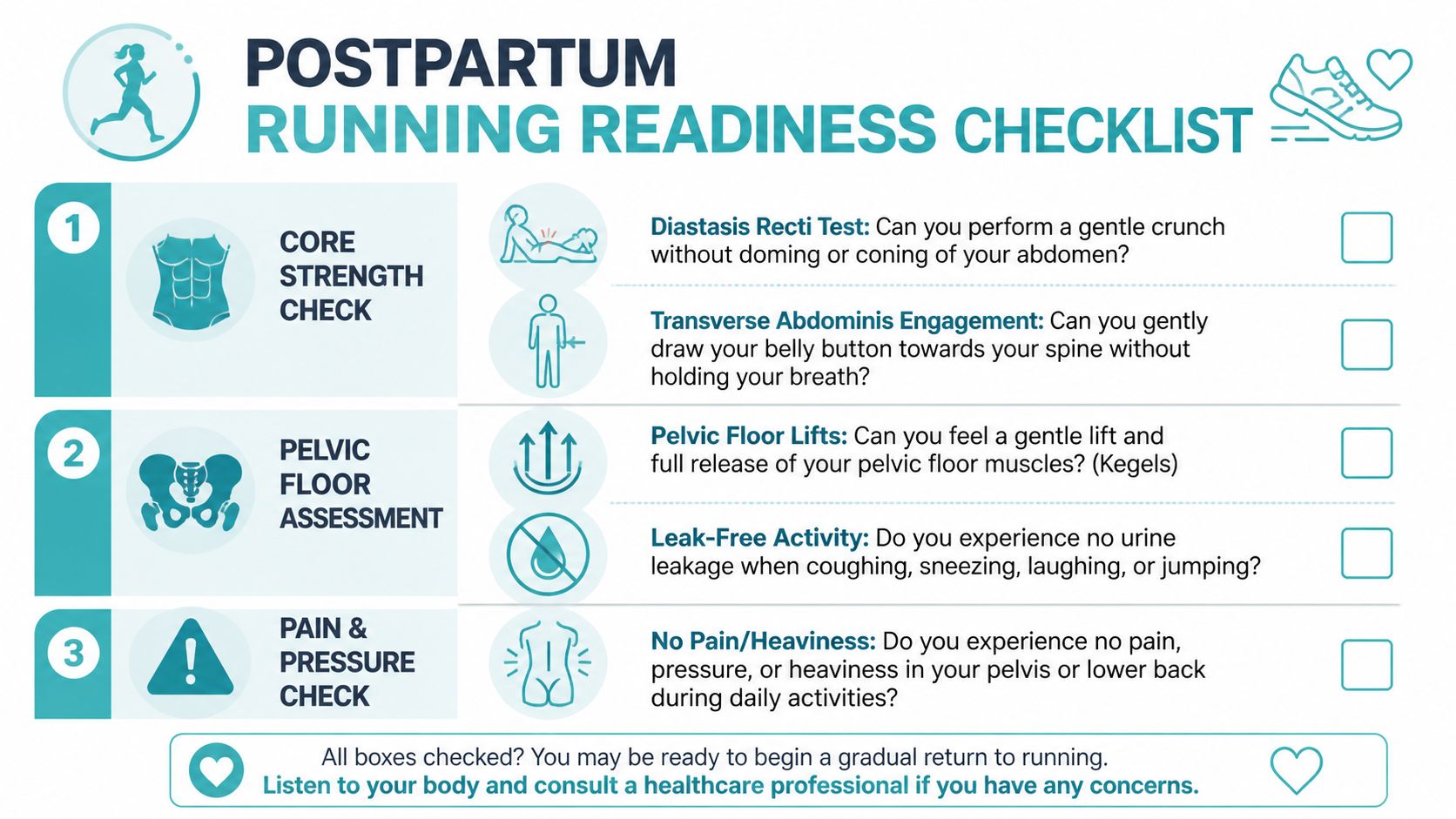
The first screen is not glamorous, but it matters most. Ask yourself:
- Leakage: Do you leak urine with coughing, sneezing, laughing, lifting, or quick movement?
- Pressure or heaviness: Do you feel dragging, bulging, or pressure in the vagina or pelvis?
- Pain: Do daily tasks trigger pelvic pain, back pain, hip pain, or abdominal discomfort?
- Abdominal control: Do you notice doming or coning through the midline when you sit up, get out of bed, or do core work?
If any of those are happening, running isn’t the next step. It doesn’t mean you’ll never run. It means your system needs more rehab first.
For a plain-language overview of what pelvic rehab can help with, this guide on support for postpartum pelvic health is a useful companion if you’re still figuring out whether your symptoms are something to address.
Core control matters more than crunch strength
A lot of women test their readiness with a plank, a long walk, or a hard workout. Those aren’t enough by themselves. The better screen is whether you can create pressure control without bracing, breath-holding, or visible abdominal distortion.
Try these checks:
-
Gentle crunch check
Lie on your back with knees bent. Exhale and lift your head and shoulders slightly. Watch your abdomen. If you see doming or coning along the midline, your pressure management likely needs work. -
Transverse abdominis engagement
In a comfortable position, gently draw the lower abdomen inward without sucking in hard or holding your breath. You should feel a subtle deep engagement, not a rigid grip. -
Breath and movement coordination
Exhale during effort. Try standing up from a chair, lifting a car seat, or doing a mini squat while breathing out. If you brace hard or lose control, your system may still be under strain.
If you need a practical place to build these patterns, these postpartum core strengthening exercises can help you reconnect strength with pressure control.
The benchmark tests that matter
Research-based consensus has given postpartum runners a much better checklist than “wait and see.” A consensus-based protocol recommends that postpartum women should be able to walk for 30 minutes, balance on each leg for 10 seconds, and perform 10 single-leg hops in place without pain, heaviness, or leakage according to this postpartum running readiness summary.
Those are the headline benchmarks, but I’d treat them as part of a fuller readiness cluster.
A practical self-check list
Use this before your first run:
- Walk comfortably for 30 minutes: No pelvic pressure, leaking, sharp pain, or symptom increase later that day.
- Stand on one leg for 10 seconds per side: You should feel steady, not wobbly and gripping through the toes.
- Do 10 single-leg squats per side: The knee should track with control, and your pelvis shouldn’t drop or twist dramatically.
- Jog in place for 1 minute: Symptoms during or after count.
- Complete 10 forward bounds: You want control, not collapse.
- Perform 10 single-leg hops in place per side: No leakage, heaviness, or pain.
Passing isn’t about doing them perfectly like an athlete in a lab. It’s about doing them with control and without symptoms.
Practical rule: If a test produces symptoms during the task, later that day, or the next morning, count it as a failed test.
What women often miss
Some women can “do” the movement, but they can’t recover from it well. That distinction matters. If hopping feels okay in the moment but you feel pelvic heaviness that night, your tissues still treated it as too much load.
Others try to bypass this phase by replacing strength with motivation. Motivation won’t stabilize the pelvis on repeated impact. It won’t restore calf endurance. It won’t coordinate breathing with abdominal support.
A good readiness screen looks at three things at once:
| Readiness area | What you want to notice | What suggests more prep is needed |
|---|---|---|
| Symptoms | No leaking, heaviness, or pain | Any pelvic floor or abdominal symptom during or after |
| Control | Steady single-leg balance and squat form | Wobbling, collapse, breath-holding |
| Impact tolerance | Hops and jogging in place feel manageable | Symptoms, guarding, delayed soreness that feels concerning |
When to stop self-testing
Self-checks are helpful, but they have limits. Get professional help if you have persistent leakage, pressure, prolapse symptoms, scar pain, painful sex, back or hip pain that keeps returning, or a core that still feels disconnected no matter how much exercise you do.
That doesn’t mean something is wrong with you. It usually means you need a more precise plan than the internet can give you.
Your Progressive Return to Running Plan
If you’ve passed the readiness checks and your daily activities are symptom-free, you can start reloading impact gradually. The key word is gradually. Most postpartum running problems come from changing too much at once. Too much total time. Too many days in a row. Too much pace too early. Too much confidence on a good day.
The evidence-based recommendation is straightforward. Guidelines recommend a gradual reload phase starting around 12 weeks postpartum, using run/walk intervals and increasing weekly volume by no more than 10 to 20% while prioritizing distance or time before speed or hills, as described in this guide to postpartum run progression.
The progression mindset that works
Think like a rehab professional, not like your pre-pregnancy training app.
Change one variable at a time:
- First change time
- Then change frequency
- Then change terrain
- Add speed last
That order matters because speed and hills multiply force demands quickly. A body that can tolerate easy flat running may still struggle with pickups, downhill impact, or pushing a stroller uphill.
A sample walk and run progression
Below is a simple starting framework. It isn’t the only way to do it, but it’s a safe structure for many women who are symptom-free and have passed baseline testing.
Sample Postpartum Walk/Run Progression Plan
| Week | Interval Plan | Total Time (excluding warm-up/cool-down) |
|---|---|---|
| 1 | Walk 4 min, run 1 min. Repeat 5 times | 25 min |
| 2 | Walk 3 min, run 2 min. Repeat 5 times | 25 min |
| 3 | Walk 2 min, run 3 min. Repeat 5 times | 25 min |
| 4 | Walk 1 min, run 4 min. Repeat 5 times | 25 min |
| 5 | Run 10 min, walk 1 to 2 min, run 10 min | 20 to 22 min |
| 6 | Continuous easy run if symptom-free | Start with a short easy run |
Keep the effort conversational. If you want to breathe harder, wait until easy running feels boring, stable, and consistently symptom-free.
Warm-up and cool-down are not optional
A short walk at the start helps you assess your body before impact. It also gives your rib cage, pelvis, calves, and hips a chance to organize movement.
Before the run segment, include a few drills:
- Marching: Focus on posture and weight shift
- Calf raises: Wake up lower leg loading
- Side steps: Turn on glutes and lateral hip support
- Jog in place: Confirm symptoms are still absent
Afterward, walk again until breathing settles. Then check in later that day. Delayed symptoms count.
If your body only tolerates the run while adrenaline is high, that’s not true tolerance.
What to do between running days
Postpartum runners often focus so hard on getting back to running that they skip the work that makes running possible. Your in-between days should support force absorption and pressure management.
Helpful non-running priorities include:
- Single-leg strength: Split squats, step-downs, single-leg sit-to-stands
- Hip strength: Lateral band walks, hip airplanes, side-lying leg work
- Calf capacity: Both straight-knee and bent-knee raises
- Core integration: Dead bugs, carries, exhale-based loading
- Walking: A low-drama way to build tissue tolerance
If you want more guidance on building impact gradually, this resource on returning to high impact sport postpartum gives a useful overview of the bigger progression.
Fueling changes the quality of your run
Under-fueled postpartum runners often describe the same pattern. The first part of the workout feels okay. Then form deteriorates, effort spikes, and recovery feels rougher than expected. That’s not always a training problem. Sometimes it’s a fueling problem.
Especially if you’re breastfeeding, don’t treat postpartum running like a side project your body should absorb without extra support. A simple snack before or after can help stabilize energy and make the session feel much better. If you need practical ideas, this roundup of runner fuel and snack options is a decent starting place.
When stroller running belongs
Stroller running is not just regular running with a baby in front. It changes arm swing, trunk rotation, stride pattern, and often pace. It also asks more from your upper body and core.
Add it later, not first.
Wait until you can:
- run comfortably without symptoms,
- maintain good posture without gripping through your ribs or shoulders,
- and handle normal easy runs on flat ground first.
If your body already feels barely in control solo, a stroller usually magnifies the problem.
What doesn’t work
The postpartum runners who struggle most usually fall into one of these traps:
- Testing fitness instead of building it
- Adding pace because easy feels slow
- Running on bad sleep and calling the heaviness “normal”
- Skipping strength because there isn’t time
- Using a pre-pregnancy plan on a postpartum body
What works is less exciting, but more effective. Build a base. Keep the effort easy. Progress one variable at a time. Respect symptoms early so they don’t become bigger setbacks later.
Listen to Your Body Red Flags and When to Pause
A successful return to running post pregnancy depends on what happens after the run as much as during it. Some symptoms show up right away. Others show up in the evening, the next morning, or after a few “good” runs in a row. That’s why symptom monitoring isn’t fear-based. It’s how you catch overload before it becomes a longer interruption.
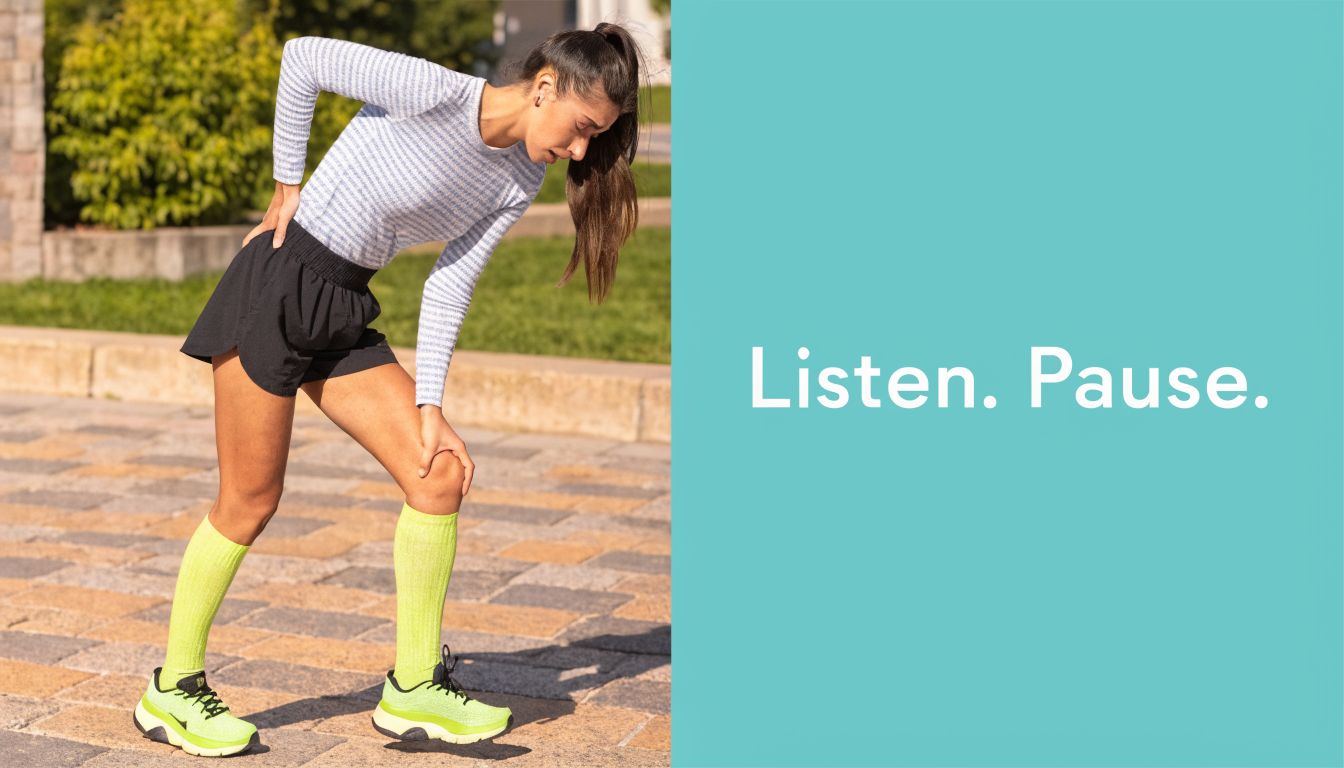
The caution is real. Some studies indicate that up to 80% of women report pain when they return to postpartum running, and pregnancy-related biomechanical changes such as altered gait and weakened abdominal muscles can increase injury likelihood, as summarized in this overview of postpartum running risks.
The three red flags that matter most
Here’s what deserves immediate attention.
- Leakage: Urine or stool leakage during or after running suggests that the system isn’t handling load and pressure well enough yet.
- Heaviness or dragging: A sense of pelvic pressure, bulging, or “something falling out” can point to pelvic floor overload.
- Pain: Pelvic, abdominal, low back, hip, pubic, or SI joint pain means some part of the movement or load dosage isn’t being tolerated.
None of these should be brushed off as “just postpartum.”
What each red flag often means
Leakage doesn’t always mean your pelvic floor is weak. Sometimes it’s poorly timed. Sometimes it’s overactive and not coordinating well. Sometimes your rib cage, breathing, and trunk strategy are raising pressure faster than your pelvic floor can respond.
Heaviness is often a tissue-load message. Your body is telling you the downward pressure is more than the current support system can manage repeatedly.
Pain is broader. It may reflect scar sensitivity, hip weakness, abdominal wall dysfunction, altered gait, reduced shock absorption, or training progression that outpaced tissue readiness.
Symptoms are not proof that you failed. They are useful data about what your body can and can’t tolerate yet.
The pause and regress framework
If symptoms appear, respond quickly and calmly.
| Symptom | What to do right away | What next |
|---|---|---|
| Leakage during run | Stop the run, walk home or finish with walking | Return to the prior stage and reassess impact drills |
| Pelvic heaviness later that day | Skip the next run | Regress volume and check pelvic floor symptoms in daily tasks |
| Pain above mild soreness | Pause impact work | Identify whether strength, mobility, or coordination is the missing piece |
A practical rule I use is simple. If a symptom appears, don’t progress the plan that week. If it repeats, step back.
Self-manage or get help
Some issues improve with a small reduction in load. Others need an evaluation.
You can usually self-adjust if:
- symptoms were brief,
- they resolved quickly,
- they clearly followed a jump in training,
- and they don’t show up in normal daily activities.
You should stop and seek a women’s health PT assessment if:
- leakage keeps happening,
- heaviness appears more than once,
- pain changes your gait,
- symptoms are getting worse instead of better,
- or you feel anxious every time you run because you don’t trust what your body is doing.
A helpful lens for soreness
Normal training response can include muscle fatigue in the calves, glutes, or general legs. Concerning response usually feels different. It’s sharper, more localized, more pelvic, or tied to pressure, instability, or compensation.
If you’re not sure, ask two questions:
- Does this feel like exercise fatigue, or does it feel like something is not being supported well?
- Did the symptom change how I moved, breathed, or finished the session?
Those answers are often more useful than pain scales alone.
Beyond the Run Holistic Recovery and Special Considerations
A lot of postpartum running advice focuses on sets, reps, and timelines. That’s not enough. The women who do well long term are usually the ones who treat recovery as more than a physical checklist.
Sleep, nutrition, lactation, stress, mood, identity, partner support, and birth experience all affect what your body can tolerate. A run isn’t happening in isolation. It’s landing on top of everything else your system is carrying.
Sleep and stress change load tolerance
A body on fragmented sleep is slower to recover and often less coordinated. You may notice heavier feet, sloppier form, more pelvic pressure, or less patience for pacing. The common mistake is to interpret that as laziness or lost fitness.
It’s often just overload.
On rough sleep weeks, the best adjustment may be one of these:
- Shorten the run: Keep the routine, reduce the dose.
- Swap impact for walking or strength: Maintain momentum without forcing impact.
- Keep the effort low: Easy means easy.
- Delay progression: A hard week at home is not the week to test more running.
Nutrition and lactation are part of readiness
Postpartum runners, especially breastfeeding runners, often underestimate how much recovery support they need. The body is healing, moving, and in many cases feeding another human. That combination raises the cost of training.
The literature around postpartum running also highlights that breastfeeding demands extra 500 calories and 24 oz of fluid daily, increasing dehydration and under-fueling risk for runners, as discussed in this postpartum return to running review.
That doesn’t mean you need a complicated meal plan. It does mean these basics matter:
- Eat consistently: Don’t squeeze a run into a long stretch without food.
- Hydrate early: Waiting until after the run often isn’t enough.
- Watch recovery signals: Headaches, unusual fatigue, irritability, and tanked workouts can all reflect poor fueling.
- Respect appetite shifts: Some women lose touch with hunger cues early postpartum.
Mental health belongs in the training plan
Running can support mental health. It can also become another standard you feel you’re failing to meet. I’ve seen women use runs as their only coping tool, then feel crushed when the body isn’t ready for the amount or intensity they want.
That’s where a biopsychosocial approach matters. A great running plan asks not only, “Can your body tolerate this?” but also, “Does this fit your actual life right now?”
If anxiety, low mood, intrusive thoughts, or persistent stress are affecting your recovery, outside support can make the whole process easier. For readers who want a starting point, mental health support Cheltenham is one example of the kind of counseling support that can complement physical rehab.
The strongest postpartum training plan is the one your body and nervous system can both sustain.
Special considerations after C-section or operative birth
Most running guides are too vague here. Operative deliveries deserve more specific discussion.
The evidence gap is real. There is insufficient literature to guide clinicians on return-to-run protocols for mothers after operative deliveries, and a C-section significantly alters the musculoskeletal milieu and abdominal wall integrity, according to this review on postpartum return to run after operative delivery.
That doesn’t mean you can’t return to running well after a C-section. It means the plan should be more individualized.
Common issues after operative birth include:
- Scar sensitivity or restriction
- Abdominal wall weakness or poor force transfer
- Guarding through breath and trunk rotation
- Difficulty reconnecting deep core work
- Pelvic floor symptoms that are overlooked because “I had a C-section”
A C-section doesn’t protect someone from pelvic floor problems. Pregnancy itself changes the system, and surgery adds another layer of abdominal and movement recovery.
How to modify the plan after C-section
The principles stay the same, but the details matter more.
Use a more deliberate build if you notice:
- pulling or pain around the scar with faster walking,
- poor tolerance to trunk rotation,
- fear of loading the lower abdomen,
- or breath-holding during effort.
In those cases, spend more time with:
- Scar mobility and desensitization
- Breath-led core engagement
- Rolling, sit-to-stand, and carry mechanics
- Progressive single-leg strength before impact
- Symptom checks after each increase in load
For some women, the hardest part isn’t strength. It’s trust. Surgical recovery can make the abdomen feel foreign for a while. That’s not weakness. It’s part of the rehab picture.
If C-section recovery, leakage, pressure, or abdominal coordination still feel unclear, postpartum pelvic floor physical therapy can help sort out which limitation is holding you back.
Finding Your Stride as a Runner and Mother
Running post pregnancy asks for patience in a season that often gives you very little spare patience. That’s one reason the process can feel so emotional. You’re not just rebuilding fitness. You’re renegotiating your relationship with your body, your time, and your expectations.
The women who return well usually stop chasing a date on the calendar. They look at symptoms, strength, sleep, recovery, and consistency. They let readiness, not pressure, drive the plan.
What actually builds a strong return
The pattern is simple, even if it isn’t always easy:
- Respect the foundation: Core, pelvic floor, hips, calves, and single-leg control come first.
- Progress slowly enough to stay in the game: Easy, repeatable training beats dramatic leaps.
- Pay attention to symptoms early: Leakage, heaviness, and pain are feedback, not background noise.
- Support the whole person: Sleep, food, hydration, stress, and mood affect what the body can handle.
- Individualize after operative birth: C-section recovery often needs more specific abdominal and movement rehab.
This isn’t about being cautious for caution’s sake. It’s about protecting your ability to run consistently, not just proving you can gut through one run.
A new running identity can still be a strong one
Many mothers worry that postpartum running will always feel compromised. In practice, it often becomes more intelligent. Women learn pacing better. They warm up with intention. They strength train because they understand why it matters. They stop treating symptoms as something to ignore.
That often creates a more durable athlete.
If you’re feeling behind, you’re probably not behind. You’re in a demanding rebuild. There’s a difference. The body that carried pregnancy and recovered from birth deserves a return-to-run plan that matches that reality.
If you want a personalized path back to running, Lake City Physical Therapy offers women’s health and sports physical therapy for postpartum recovery, pelvic floor symptoms, C-section rehab, and return-to-sport planning. Their team can help you assess readiness, address leakage or heaviness, rebuild core and hip strength, and create a running plan that fits your body and your season of life, whether you prefer in-person care or telehealth.

