Painful Intercourse After Childbirth: A Recovery Guide
The first time sex hurts after having a baby, most women don't think, “This is a common postpartum issue.” They think, “What is wrong with me?”
That moment often comes late. The baby is finally asleep. You've waited until the bleeding stopped, until the stitches seemed better, until someone casually told you that you were “cleared.” Then intimacy starts, and instead of relief or closeness, you feel burning, pulling, stabbing, or a deep ache that makes your whole body tense.
If that's where you are right now, painful intercourse after childbirth deserves more than a shrug and a suggestion to “give it time.” Some early discomfort can be part of healing. Pain that lingers, worsens, or makes you dread intimacy is a clinical problem with real causes and real treatment options.
You Are Not Alone in Postpartum Pain
You might be drinking coffee in the kitchen, replaying the experience in your head, wondering whether you waited long enough, whether breastfeeding is part of it, or whether this is just your body now.

That reaction is common, even if it's seldom spoken about. A landmark 2015 study found that nearly 85 to 90% of women have painful intercourse the first time they resume sex postpartum, and 23 to 25% still have persistent pain at 18 months according to this summary of the postpartum pain study.
Those numbers matter because they separate two truths that often get blurred together. First, you are not failing recovery if sex hurts after birth. Second, common does not mean you should accept it indefinitely.
Pain with intimacy after birth is a symptom. It is not a personality flaw, a relationship problem, or something you need to push through to prove you're healed.
Many new mothers are also navigating sleep loss, body changes, feeding schedules, and the emotional intensity of the first postpartum year. If you're trying to make sense of all of that at once, a broader guide on what to expect in the first year can help place intimacy changes in the larger postpartum picture.
The hopeful part is this. Painful intercourse after childbirth usually has identifiable drivers. Once you understand those drivers, treatment becomes much more targeted, and recovery stops feeling random.
Understanding the Causes of Painful Intercourse
Postpartum pain with sex usually isn't caused by one single thing. Most women have a mix of tissue healing, hormonal change, muscle guarding, and nervous system sensitivity.
Healing tissue can stay sensitive
If you had tearing, stitches, an episiotomy, or a C-section, your body had to heal from real injury. Even when skin looks closed on the outside, the tissue underneath may still feel restricted, tender, or less mobile.
Scar tissue can create a pulling sensation at the vaginal opening or deeper in the pelvis. Some women describe it as burning. Others say it feels like hitting a wall. Neither description is unusual.
Delivery type also doesn't tell the whole story. Vaginal birth can lead to perineal scar sensitivity. C-section birth can still contribute to painful intercourse after childbirth because the abdominal wall, breath mechanics, core pressure system, and pelvic floor all interact.
Breastfeeding changes the vaginal tissues
Hormones matter more than many women realize. One study found that 31.5% of breastfeeding women reported dyspareunia at 6 months compared with 12.7% of non-breastfeeding mothers, and the same source notes that low estrogen during breastfeeding can lead to vaginal dryness, thinner tissues, and a nearly 60 to 70% reduction in natural lubrication in this discussion of painful sex after birth.
A simple way to think about it is this. Estrogen helps keep vaginal tissue supple and better lubricated. When breastfeeding lowers estrogen, the tissue can behave more like dry, irritated skin than elastic, well-moisturized tissue. Friction that wouldn't have bothered you before can suddenly feel sharp and intense.
Common clues that hormones are part of the problem include:
-
Dryness even when aroused
You feel ready mentally, but the tissue still feels irritated or raw. -
Pain right at the entrance
Insertion burns or stings before anything deeper happens. -
Symptoms that started or worsened with breastfeeding
The timing often gives this pattern away.
The pelvic floor can become too tight, not just weak
This is the part many women never get told. After pregnancy and birth, the pelvic floor doesn't always become loose and weak. It can also become overactive and guarded.
That guarding response makes sense. Your body has been through strain, stretching, surgery, or trauma. Muscles often respond by tightening to protect the area. The problem is that tight muscles don't relax well during penetration.
When that happens, Kegels are often the wrong first move.
Clinical reality: A pelvic floor that's already tense usually needs relaxation, coordination, and downtraining before it needs strengthening.
Signs that pelvic floor overactivity may be driving pain include:
- You clench without meaning to when intimacy starts.
- Tampons, pelvic exams, or insertion feel difficult in general.
- The pain improves a little with slow breathing or worsens when you brace.
- You also notice urgency, constipation, or tailbone tension, which often travel with pelvic floor dysfunction.
Fear can amplify the pain cycle
After one painful attempt, many women start anticipating the next one. That anticipation is not overreacting. It is the nervous system learning to protect you.
Fear of pain often leads to shallow breathing, gripping through the hips and abdomen, less arousal, and less lubrication. Then penetration hurts again, which reinforces the fear. The cycle becomes physical and emotional at the same time.
That's why good treatment doesn't just say “relax.” It identifies what your body is protecting against and gives you a way to change it.
Your Postpartum Recovery Timeline and Red Flags
The old idea that sex should be fine at six weeks has never matched what women experience. A checkup can confirm that immediate medical healing is progressing, but it doesn't measure scar mobility, pelvic floor coordination, tissue irritability, readiness, desire, or comfort.
A more useful way to think about recovery comes from a 2022 study that found 79% of mothers had minimal pain that resolved, while 21% had moderate, persistent dyspareunia, as summarized in this review of postpartum pain myths. That matters because it tells you there isn't one universal timeline. There are different recovery paths.
What improvement usually looks like
For many women, the first attempts are uncomfortable but gradually less so. The pain becomes milder, less sharp, easier to predict, and less emotionally loaded.
If you're curious about comfort measures during tissue recovery, practical education on perineal healing after birth can help you understand what local healing often involves.
You may also want a realistic frame for postpartum recovery milestones in how long postpartum recovery can take, especially if your symptoms don't match the simple “six weeks and done” message.
Postpartum pain signals
| Symptom | Normal Healing Sign (Usually Decreases Over Time) | Red Flag (Warrants a Call to Your Provider) |
|---|---|---|
| Intensity of pain | Mild discomfort that steadily eases | Sharp, stabbing, or severe pain |
| Pattern over time | Slowly improving with each attempt | No improvement, or pain is getting worse |
| Location | Mild tenderness in a healing area | Burning at the entrance, deep pain, or pain in multiple areas |
| After effects | Brief soreness that settles | Lingering pain, spasms, or fear that lasts well after sex |
| Bleeding | Light sensitivity without new bleeding | Bleeding during or after intercourse |
| Body response | Able to relax with time and foreplay | Involuntary clenching or feeling like penetration “hits a wall” |
| Daily life impact | Concern, but still some confidence | Avoiding intimacy because you expect pain |
If pain is making you avoid sex, dread touch, or brace before penetration, that alone is enough reason to get evaluated.
The key question isn't “Is this common?” It's “Is this improving?” If the answer is no, waiting usually doesn't give you new information. Assessment does.
Evidence-Based Treatments That Actually Work
When painful intercourse after childbirth persists, treatment needs to match the cause. Generic advice doesn't work well here. “Use more lube” won't resolve scar restriction. “Do Kegels” won't help a pelvic floor that can't relax. “Just wait” won't retrain a pain response that has settled in.
Pelvic floor physical therapy is often the cornerstone
For women with longer-term symptoms, pelvic floor dysfunction is often the missing piece. One source notes that 18 to 25% of women still have persistent dyspareunia at 2 years postpartum, often tied to untreated pelvic floor dysfunction, and reports that specialized pelvic floor PT using downtraining and manual release resolves up to 85% of these chronic cases, often within 12 weeks in this overview of painful sex after giving birth.
That kind of care is very different from doing random exercises from social media.
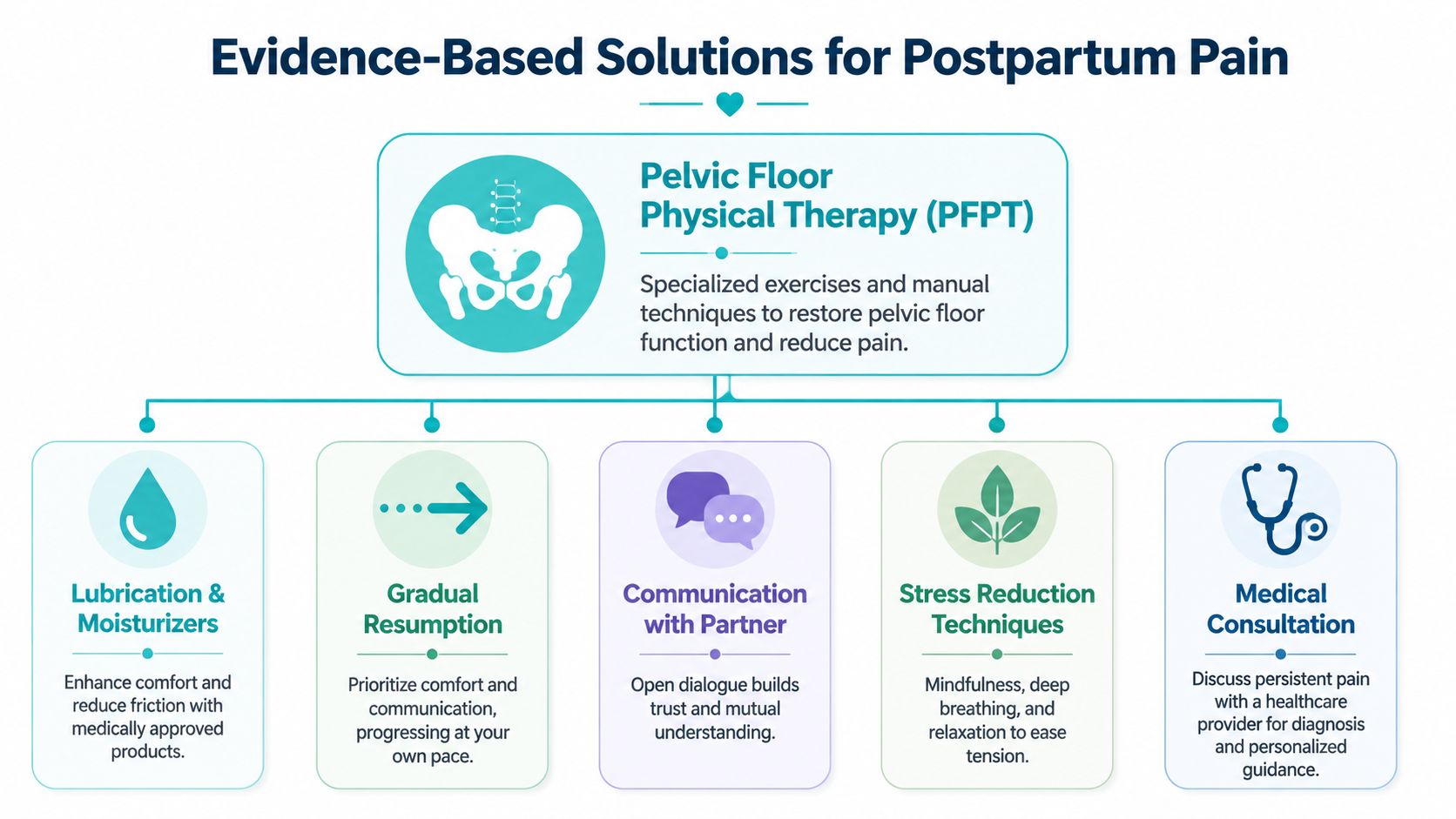
A good pelvic floor PT evaluation looks at more than the pelvic floor itself. It may include breathing mechanics, abdominal wall tension, scar mobility, hip rotation, posture, pressure management, and how your muscles respond to touch and stretch.
Treatment often includes:
-
Manual therapy
This can address tender points, restricted tissue, and guarding in the pelvic floor, perineum, abdomen, hips, or C-section scar. -
Downtraining instead of strengthening
If the muscles are overactive, the first goal is often to teach them how to let go. -
Breath and pressure work
Diaphragmatic breathing can reduce gripping through the abdomen and pelvic floor. -
Desensitization and graded exposure
This helps your nervous system stop treating penetration as a threat. -
Targeted home tools
Some women benefit from guided use of vaginal dilators or pelvic wands, but only after proper instruction.
If you want a clear picture of what this care involves, physical therapy for painful intercourse explains the process in more detail. One option in North Idaho and Eastern Washington is Lake City Physical Therapy, which provides pelvic floor treatment for dyspareunia and postpartum recovery, including telehealth access.
Medical support can make therapy work better
Physical therapy is central for many women, but it isn't the only piece.
Medical evaluation matters when symptoms suggest infection, granulation tissue, significant hormonal dryness, endometriosis, or a repair that healed with ongoing sensitivity. Your OB/GYN, midwife, or primary care clinician can help rule those in or out.
Common supports that often pair well with therapy include:
- Vaginal moisturizers for ongoing tissue comfort between attempts at intimacy
- Lubricants during sex to reduce friction
- Topical estrogen, when prescribed and appropriate, for breastfeeding-related tissue dryness
- Medication review if another treatment is affecting desire, arousal, or pain sensitivity
What usually doesn't help enough on its own
Women are often given advice that sounds reasonable but misses the mechanism of pain. These are the most common examples:
| Approach | Why it often falls short |
|---|---|
| Waiting longer | Time helps healing, but it doesn't reliably change scar mobility, muscle guarding, or fear-based tension |
| Doing Kegels automatically | Tight pelvic floors can become more painful when strengthened before they can relax |
| Pushing through pain | This trains your nervous system to expect pain and can worsen protective tension |
| Changing positions only | Position matters, but it won't fully solve dryness, scar sensitivity, or overactive muscles |
The best treatment plan usually combines tissue support, muscle retraining, nervous system calming, and a pace that feels safe to your body.
That combination is what moves recovery forward.
Self-Care Strategies for Resuming Intimacy
Professional help matters when pain persists, but there's also a lot you can do at home to create better conditions for comfort.

Start with less pressure, not more effort
The fastest way to make pain worse is to treat intercourse like a test of whether you're “back to normal.” A better approach is to remove the pass-fail feeling entirely.
Try these shifts first:
-
Name the goal clearly
The goal is comfort and connection, not getting through penetration. -
Redefine intimacy for now
Non-penetrative touch, massage, kissing, or mutual pleasure can rebuild trust in your body. -
Use a stop signal with your partner
Agree ahead of time on a word or phrase that means pause immediately, no questions asked.
Safety changes muscle tone. When your body believes it can stop at any point, it often guards less.
Make the physical setup easier
Small adjustments can change the entire experience.
-
Use generous lubricant
Don't use a tiny amount and hope for the best. Apply enough to reduce friction comfortably. -
Choose positions you can control
Many women do better in positions where they set depth and speed. -
Go slower than you think you need to
Tissue and muscles often need more time than desire does. -
Exhale during insertion
A slow breath out can reduce reflex tightening.
A brief guided exercise can help you relax your pelvic floor before intimacy. This video is a good place to start:
Calm the guarding response
If you notice your hips, jaw, belly, or thighs tightening, your pelvic floor is often doing the same thing.
Try this short routine before intimacy:
- Lie down with knees supported on pillows or the bed.
- Place one hand on your ribs and one on your lower belly.
- Inhale gently into the ribs, not by forcing the belly out.
- Exhale slowly and imagine the pelvic floor softening downward.
- Repeat for a few minutes before any touch or penetration.
You don't have to do this perfectly. The point is to reduce bracing.
Go only as far as your body can stay relaxed. Stopping early is progress if it prevents another painful, discouraging experience.
If these strategies help somewhat but not enough, that usually means you need more targeted treatment, not more willpower.
How to Get the Professional Help You Deserve
You should seek help if pain is persisting, if it's becoming a source of dread, or if you're avoiding intimacy because you expect it to hurt. You should also reach out if you have bleeding with intercourse, burning that doesn't settle, pain that feels deep or sharp, or a sense that penetration is blocked by muscle tension.
Start with a medical rule-out
Your first step may be your OB/GYN, midwife, or primary care provider. That visit helps rule out issues like infection, problematic scar healing, significant hormonal tissue changes, or other pelvic conditions that need medical management.
What to say can be simple and direct:
- “Sex is still painful, and it isn't improving.”
- “I think I may need a pelvic floor evaluation.”
- “I'm avoiding intimacy because of pain.”
Those statements are enough to open the conversation.
Ask specifically for pelvic floor physical therapy
If the medical exam doesn't fully explain the pain, or if your provider agrees the problem is muscular and functional, ask directly for pelvic floor PT. This is the specialty that addresses scar mobility, muscle overactivity, coordination, pressure management, and return to comfortable penetration.
For women looking for postpartum-focused care, pelvic floor physical therapy postpartum outlines what that pathway can look like.
Telehealth can also be a strong option, especially if getting out of the house with a new baby feels overwhelming. Even when hands-on treatment is part of the plan, virtual visits can still help with education, breathing work, body mechanics, guided relaxation, pacing, home tools, and follow-up support.
That access matters for mothers in rural areas, for women juggling childcare, and for anyone who has delayed treatment because logistics felt impossible.
Don't wait for the pain to become your new normal
The most common reason women delay care is that they assume they need more time. Sometimes they do. But if you're reading article after article because your gut tells you something isn't right, that instinct is worth listening to.
Painful intercourse after childbirth is easier to treat when you stop minimizing it.
Reclaiming Intimacy on Your Own Terms
Your body isn't broken. It's postpartum, and postpartum bodies sometimes need skilled help to recover fully.
Pain with sex after birth can be common at first. It is not something you're supposed to endure forever. The difference between temporary discomfort and persistent pain matters, and the right response is not pushing through. It's getting specific about the cause and matching it with treatment that fits.
That may mean tissue support, pelvic floor downtraining, scar work, medical care, slower pacing, clearer communication, or all of the above. Intimacy after birth often needs to be rebuilt, not rushed. If you and your partner want gentle ways to reconnect, you can rebuild intimacy with these research-informed tips in a way that supports healing rather than fighting it.
Pain is a signal. It is not a sentence. With the right support, many women return to intimacy with more comfort, more confidence, and much less fear than they thought possible.
If painful intercourse after childbirth is still part of your postpartum experience, Lake City Physical Therapy offers pelvic floor and postpartum rehabilitation with in-person and telehealth options across North Idaho and Eastern Washington. A focused evaluation can help identify whether scar tissue, muscle tension, dryness, pressure issues, or another factor is driving your pain so you can move toward treatment that fits your body.

