Finding a Pelvic Floor Therapy Doctor: A Complete Guide
You sneeze, and a few drops leak. You tell yourself it's normal after having a baby. Or normal with age. Or normal because you've been coughing a lot, lifting more, running again, or just trying to get through a busy week.
Maybe the problem isn't leakage at all. Maybe sex has become painful. Maybe you always feel pressure “down there.” Maybe you have to map every errand around the nearest bathroom. Maybe constipation has become a regular battle, or a scar still feels tight and strange long after surgery or birth.
If any of that sounds familiar, you're not overreacting, and you're not alone. These are medical issues. They're common, treatable, and worth talking about with a qualified pelvic floor therapy doctor, which usually means a physical therapist with advanced pelvic health training.
That Little Leak Is More Than Just Annoying
A lot of people wait far too long before asking for help.
They wear a liner and call it “manageable.” They stop jumping, running, or laughing too hard. They avoid intimacy because it hurts. They get used to a dragging, heavy feeling in the pelvis and assume their body is just different now.
That quiet adjustment is understandable. Pelvic symptoms can feel private in a way few other health problems do. Many patients feel embarrassed, uncertain, or worried they won't be taken seriously.
In fact, a 2024 Origin Physical Therapy report estimated that 40 million women need pelvic floor physical therapy, stated that one in three U.S. women experiences pelvic floor disorders each year, and noted there are likely fewer than 10,000 providers available to treat them. That gap helps explain why so many people normalize symptoms instead of getting care quickly.
What these symptoms often look like
Some problems are obvious. Others are easy to dismiss.
- Bladder changes: leaking with coughing, sneezing, exercise, or a strong urge to go
- Pain symptoms: discomfort with sex, tampon use, pelvic exams, or prolonged sitting
- Pressure and support changes: heaviness, bulging, or the sense that something is “falling”
- Bowel issues: straining, constipation, incomplete emptying, or difficulty relaxing
- Pregnancy and postpartum concerns: core weakness, scar sensitivity, pressure, or trouble returning to activity
These symptoms may feel personal, but they aren't unusual, and they aren't something you have to “just live with.”
Pelvic floor therapy sits in mainstream healthcare, not on the fringe. Johns Hopkins notes that pelvic floor therapy is used to prevent, treat, or manage symptoms such as pelvic pain, incontinence, prolapse, pregnancy and postpartum dysfunction, and recovery after cancer-related pelvic surgery, as summarized in the verified background above.
If you've been wondering whether your symptom is “serious enough,” the better question is simpler. Is it affecting your comfort, confidence, or daily life? If yes, it deserves attention.
Who Is a Pelvic Floor Therapy Doctor
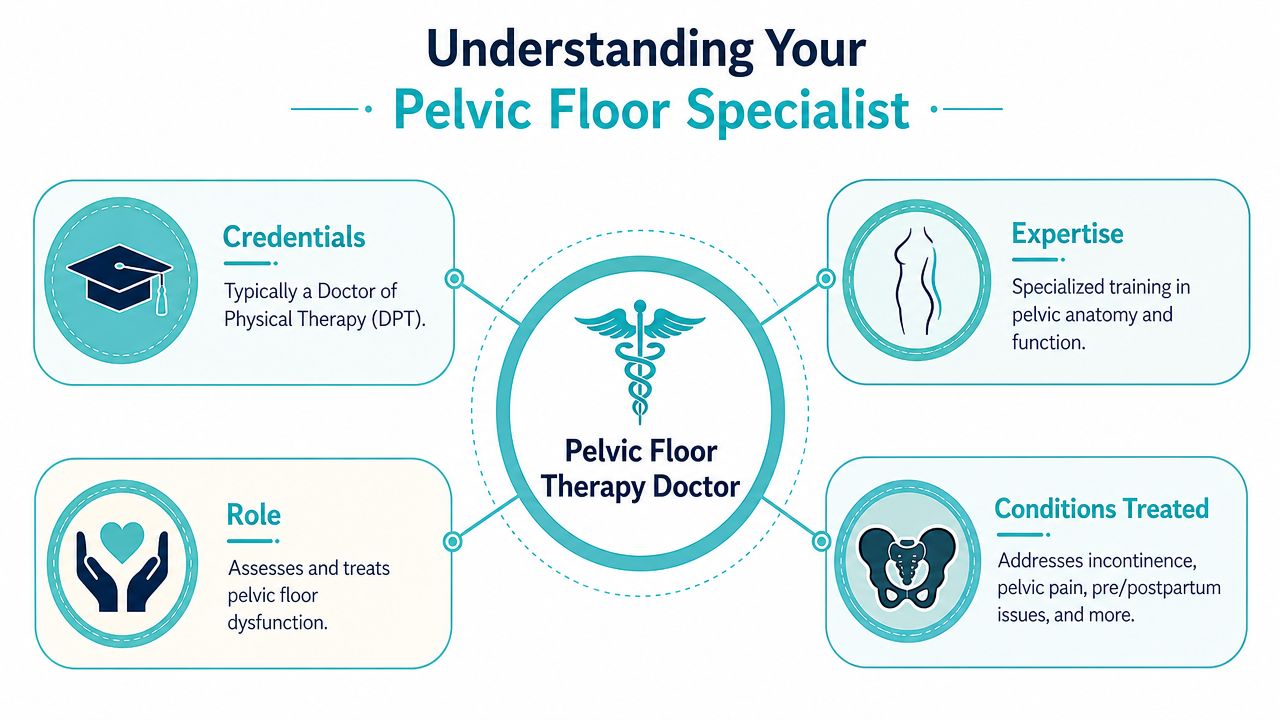
A pelvic floor therapy doctor is usually a Doctor of Physical Therapy, or DPT, with specialized training in pelvic health. They are not the same as your OB/GYN, urologist, or primary care doctor, though they often work alongside those providers.
Their focus is different. A pelvic health physical therapist looks at how the muscles, connective tissue, breathing mechanics, posture, movement patterns, and nervous system interact in the pelvis.
What the pelvic floor actually is
One helpful way to think about the pelvic floor is as a muscular hammock at the base of your pelvis.
These muscles help support pelvic organs, contribute to bladder and bowel control, assist with sexual function, and work with your core and diaphragm during everyday movement. If that hammock is weak, poorly coordinated, or too tight, symptoms can show up in several different ways.
That's why two people can both say “I think I have pelvic floor issues” and need completely different care.
How this differs from other doctors
Your OB/GYN or urologist may diagnose a condition, order testing, prescribe medication, or discuss procedures. A pelvic floor physical therapist evaluates function.
They want to know questions like:
- How do the muscles contract
- Can they relax when they need to
- Are they painful to touch
- Do breathing and abdominal pressure make symptoms worse
- Is posture or movement adding strain
If you want a deeper overview of what this specialty looks like in practice, this guide to a physical therapist for pelvic floor dysfunction gives a useful clinic-based perspective.
What training matters
Not every physical therapist treats pelvic health. This area requires extra study, clinical skill, and comfort discussing sensitive concerns with professionalism.
Practical rule: Look for a clinician who treats pelvic health routinely, explains things clearly, and makes consent part of every step.
A good pelvic floor therapist won't rush you. They'll listen carefully, connect symptoms that may seem unrelated, and build a plan around your body, your history, and your goals.
Conditions That Pelvic Therapists Treat
Many people hear “pelvic floor therapy” and think only of postpartum Kegels or bladder leakage. The actual scope is much wider.
A University of Iowa study published in 2022 analyzed medical records from more than 25,000 adult women and found that at least 32% had at least one pelvic floor disorder diagnosis. The same summary notes prevalence rises sharply by age, affecting about 10% of women ages 20 to 39 and nearly 50% of women over 80. That tells us this isn't just a postpartum issue. It's a lifespan issue.
Common signs patients don't always connect to pelvic therapy
Patients often arrive thinking they have one isolated problem. Then they describe a whole cluster of symptoms.
For example, someone with urgency may also have constipation. Someone with painful sex may also have tailbone pain or a history of abdominal surgery. Someone recovering after birth may feel pressure, leakage, and difficulty returning to exercise all at once.
Here's a broad look at what pelvic health clinicians commonly treat:
| Condition Category | Specific Issues | Who It Affects |
|---|---|---|
| Bladder dysfunction | Stress incontinence, urge symptoms, urinary frequency, difficulty emptying | Postpartum patients, athletes, perimenopausal and older adults, anyone with pelvic muscle coordination issues |
| Bowel dysfunction | Constipation, straining, fecal leakage, difficulty relaxing pelvic muscles | Adults with chronic bowel symptoms, people with pelvic pain, postpartum patients |
| Pelvic pain | Painful sex, pain with exams or tampon use, chronic pelvic pain, scar sensitivity | People with overactive pelvic muscles, endometriosis-related pain, surgical recovery patients |
| Pelvic organ support issues | Prolapse symptoms such as heaviness, pressure, or bulging | Postpartum patients, aging adults, people with chronic pressure-loading patterns |
| Pregnancy and postpartum recovery | Core weakness, pressure, leakage, pelvic pain, C-section or perineal scar concerns, return-to-exercise support | Pregnant and postpartum patients |
| Oncology rehabilitation | Scar mobility limits, pelvic pain, bowel or bladder symptoms, lymphedema-related function concerns after breast or gynecologic cancer care | Cancer survivors and patients in recovery |
| Athletic performance and return to sport | Pressure with lifting, leaking during impact, coordination problems with core loading | Runners, CrossFit athletes, dancers, volleyball players, triathletes |
It's not limited to women, and it's not limited to one life stage
Johns Hopkins notes pelvic floor therapy can be appropriate for people of all genders and ages, including children, as summarized in the verified background provided for this article. That matters because many readers assume pelvic therapy belongs to one narrow group.
It doesn't.
A college athlete with leaking during box jumps, a postpartum mother with heaviness, and an older adult with prolapse symptoms may all benefit from the same specialty, even though their treatment plans will look very different.
When symptoms are mixed, care still makes sense
You don't need to show up with a perfect self-diagnosis.
If your experience sounds more like “a little bit of everything,” that's still a valid reason to seek help. Pelvic health providers are trained to sort out patterns, identify what's driving symptoms, and explain the problem in language that makes sense.
What to Expect at Your First Evaluation
The first appointment is usually much less intimidating than patients expect. Most of the visit is conversation, education, and gentle assessment.

It starts with your story
Your therapist will ask about the symptoms that brought you in, but they'll also ask broader questions. When did it start? What makes it worse? What have you stopped doing because of it? Are there childbirth, surgical, orthopedic, bowel, bladder, or pain history details that matter?
This part matters because pelvic symptoms rarely exist in isolation. A leaking problem may connect to breath holding during lifting. Pelvic pain may connect to guarding, scars, or an inability to relax certain muscles.
If forms make you anxious, completing them ahead of time can help you feel more settled. Many clinics now use digital, HIPAA compliant patient forms so you can organize your history before the visit instead of trying to remember everything in the moment.
Then comes the physical assessment
After the interview, your therapist may look at things that don't seem pelvic at first glance. They may assess posture, rib cage position, breathing pattern, hip mobility, abdominal wall function, scar mobility, and how you manage pressure during movement.
They may ask you to do simple tasks such as:
- Take a deep breath: to see how your diaphragm and abdominal wall coordinate
- Gently contract your core: to watch for gripping or breath holding
- Squat, hinge, or stand on one leg: to identify movement habits that increase symptoms
- Cough or bear down: if appropriate, to understand how symptoms appear during pressure
Later in the evaluation, the therapist may recommend an internal pelvic floor exam. This is often the best way to assess muscle tension, coordination, tenderness, and strength, but it is always optional. Consent is ongoing. You can decline, ask questions, stop at any time, or choose to postpone it to a later visit.
You are in charge of the pace. A good therapist treats consent as part of the exam, not a one-time checkbox.
For a patient-friendly walkthrough of the appointment experience, this page on what to expect at pelvic floor therapy can help reduce uncertainty before you go.
A pelvic floor evaluation can also use specific clinical measures. A review of pelvic floor therapy documentation tools describes measures such as POP-Q staging for pelvic organ prolapse and Laycock grading for muscle strength, which help turn symptoms into trackable baselines.
Here's a short visual explanation of the process many patients find reassuring:
You should leave with clarity
By the end of the visit, you should understand three things:
- What the therapist thinks is contributing to your symptoms
- What the first phase of treatment will focus on
- What you can start doing at home right away
You do not need to memorize anatomy or become an expert in one day. You just need a plan that feels understandable and doable.
Personalized Pelvic Floor Treatment Approaches
The biggest myth about pelvic therapy is that it's just Kegels.
For some people, pelvic floor strengthening is helpful. For others, it makes symptoms worse. That difference is one reason self-prescribing exercises from social media can backfire.

Weak doesn't mean tight, and tight doesn't mean strong
A qualified therapist works out whether the main issue is hypotonic weakness, hypertonic overactivity, poor coordination, or some combination. According to pelvic PT guidance from Wellest Health, weakness may need progressive loading, while overactivity often needs down-training, relaxation, and mobility-based treatment rather than Kegels.
Patients often get confused by this point. A muscle can feel “strong” because it's constantly gripping, but that doesn't mean it functions well. In fact, muscles that can't let go often contribute to pain, urgency, constipation, and painful penetration.
What treatment may include
Pelvic floor therapy is usually a mix of hands-on care, movement retraining, behavior change, and education.
Common tools include:
- Manual therapy: gentle treatment to improve tissue mobility, reduce guarding, and address tender or restricted areas
- Breathing and pressure management: learning how your diaphragm, abdominal wall, and pelvic floor work together during daily tasks
- Strength and coordination work: targeted exercise for the pelvic floor, hips, trunk, and whole-body movement patterns
- Relaxation and down-training: strategies that help an overactive system let go
- Bladder and bowel retraining: practical changes in habits, timing, urges, and toilet mechanics
- Scar work and mobility: especially helpful after C-section, perineal tearing, abdominal surgery, or cancer-related treatment
- Biofeedback: technology that can help some patients understand whether they are contracting, relaxing, or compensating
Treatment should match your real life
A runner may need impact-specific retraining. A new mother may need help lifting a car seat without bearing down. A patient recovering from gynecologic cancer care may need support with scars, pain, and safe return to activity.
Good pelvic therapy doesn't hand every patient the same exercise sheet. It connects treatment to the exact tasks that matter in your day.
That's why home programs should feel focused, not overwhelming. Individuals tend to be more successful with a few well-chosen exercises and behavior changes they can stick with.
Progress often looks broader than symptom relief
Patients sometimes expect progress to mean one thing, such as “I stop leaking.” That's important, but it's not the whole picture.
Progress may also mean:
- Less fear: you stop planning your day around bathrooms
- More comfort: sex, sitting, or exercise no longer feels threatening
- Better control: you know how to relax, contract, brace, and breathe when needed
- More confidence: you trust your body again
That kind of change tends to last because it's built on understanding, not guesswork.
Finding a Provider and Navigating Your Care
Choosing the right provider matters almost as much as deciding to go.
You're looking for someone with pelvic health training, comfort treating your specific issue, and a communication style that makes you feel safe asking personal questions. If you're dealing with pregnancy, postpartum recovery, pelvic pain, prolapse, oncology rehab, or return to sport, ask whether the therapist regularly treats that area.
Questions worth asking before you book
A brief call or intake message can save a lot of uncertainty.
- Ask about experience: Does this therapist routinely treat your symptom profile?
- Ask about exam options: How do they handle consent, internal exams, and patient comfort?
- Ask about logistics: Do they offer in-person care, telehealth follow-ups, or both?
- Ask about payment: Will they verify benefits, provide cash-pay details, or explain out-of-network options?
Some patients start with telehealth because it feels easier to ask questions from home first. If that appeals to you, this overview of telehealth pelvic floor physical therapy shows how remote care can fit into the process.
Referral and scheduling details
Whether you need a referral depends on your state, your insurance plan, and the clinic you choose. The fastest way to clarify coverage is to call your insurer and ask specifically about pelvic floor physical therapy benefits, referral requirements, visit limits, and whether the clinic is in network.
If you're comparing clinics, organized booking tools can also make the process less stressful. A practical guide to the best appointment scheduling software can help you understand what smoother online scheduling usually looks like from a patient perspective.
One last tip. If you've been putting this off because it feels awkward, remember that pelvic health providers talk about these symptoms every day. For them, this is routine care. For you, it can be the start of real relief.
Your Questions Answered and Your Next Step
A few questions come up in almost every first conversation.
Is pelvic floor therapy painful
It shouldn't feel like you are being pushed through pain. Some assessment or treatment techniques may uncover tender areas, especially if muscles are guarded or tissue is sensitive, but your therapist should explain what they're doing, ask permission, and adjust based on your response.
How long will it take to feel better
That depends on what is driving the problem, how long symptoms have been present, your medical history, and how consistently you can follow through with treatment. Many patients notice early changes in awareness, confidence, or symptom patterns before they feel “fully better.”
Why has no one told me about this before
This is a real problem in pelvic healthcare. A 2025 systematic review on pelvic floor disparities found that research has focused more on identifying who experiences worse symptoms than on understanding why disparities happen, and it noted decreased physician-patient counseling on pelvic floor physical therapy as a key gap in care delivery.
In plain terms, many people aren't getting referred, counseled, or informed as early as they should.
If your symptoms were minimized before, that doesn't mean they were minor. It often means the referral pathway failed you.
What if I feel embarrassed
Almost everyone does at first. Then the conversation starts, the problem gets named, and the fear usually drops. Being embarrassed doesn't mean you should wait. It means you're human.

If you live in North Idaho, Spokane, or the Boise area and want specialized help, Lake City Physical Therapy offers women's health focused care for pelvic floor dysfunction, prenatal and postpartum rehab, oncology recovery, and women's sports physical therapy. Their team serves patients in Coeur d'Alene, Hayden, Post Falls, Rathdrum, Liberty Lake, Spokane South Hill, Eagle, and Boise, with telehealth options, online scheduling, bill pay, and educational resources including free ebooks.
If you're ready to stop guessing and start getting answers, Lake City Physical Therapy is a strong next step. Their pelvic health team provides compassionate, evidence-based care designed around your symptoms, your goals, and your stage of life, whether you're dealing with leakage, prolapse, painful sex, postpartum recovery, cancer rehabilitation, or return to sport.

