Pubic Bone Pain Postpartum: A PT’s Guide to Relief
You've finally made it home with your baby. You're learning feeds, diaper changes, and the strange rhythm of sleeping in fragments. Then you stand up from the couch, shift your weight, and feel a sharp pain right at the front of your pelvis. Maybe it catches when you roll in bed. Maybe getting out of the car suddenly feels ridiculous. Maybe stairs make you wince.
A lot of new mothers assume this is just one more postpartum ache they're supposed to ignore. It isn't always that simple.
Pubic bone pain postpartum is common, often frustrating, and too often brushed off with “give it time.” Sometimes time helps. Sometimes what helps most is knowing what kind of pain you're dealing with, what movements calm it down, and which symptoms mean you shouldn't wait.
That First Sharp Pain You Weren't Expecting
One of the most common stories I hear goes like this. A mother is a few days or weeks postpartum, trying to carry the baby from bedroom to kitchen, and she feels a stabbing or tearing sensation low in the front of the pelvis. Not the belly. Not the hips. Right at the pubic bone.
She tries to push through it at first. Then she notices a pattern.
Rolling over in bed hurts. Putting on pants while standing on one leg hurts. Getting in the car hurts. Taking a long stride hurts. Lifting the stroller from the trunk hurts. Even standing up after a feed can feel like the front of the pelvis is unstable or “splitting.”
That experience is real. It's not dramatic. It's not laziness. And it's not something you should have to tolerate because you had a baby.
For some mothers, the pain is more of an ache or deep soreness. For others, it's sharp enough to change how they walk. Many feel upset by how invisible it is. Family members may see a healthy baby and assume recovery is going fine, while the mother is inwardly planning every movement to avoid that next jab of pain.
You are not overreacting if walking, stairs, bed mobility, or caring for your baby feels harder because of pain at the front of your pelvis.
The hard part is that postpartum discomfort exists on a spectrum. Some symptoms fit a common recovery pattern. Others deserve prompt medical attention. Knowing the difference can save you weeks of unnecessary suffering and help you advocate for the right care.
Understanding Postpartum Pubic Bone Pain
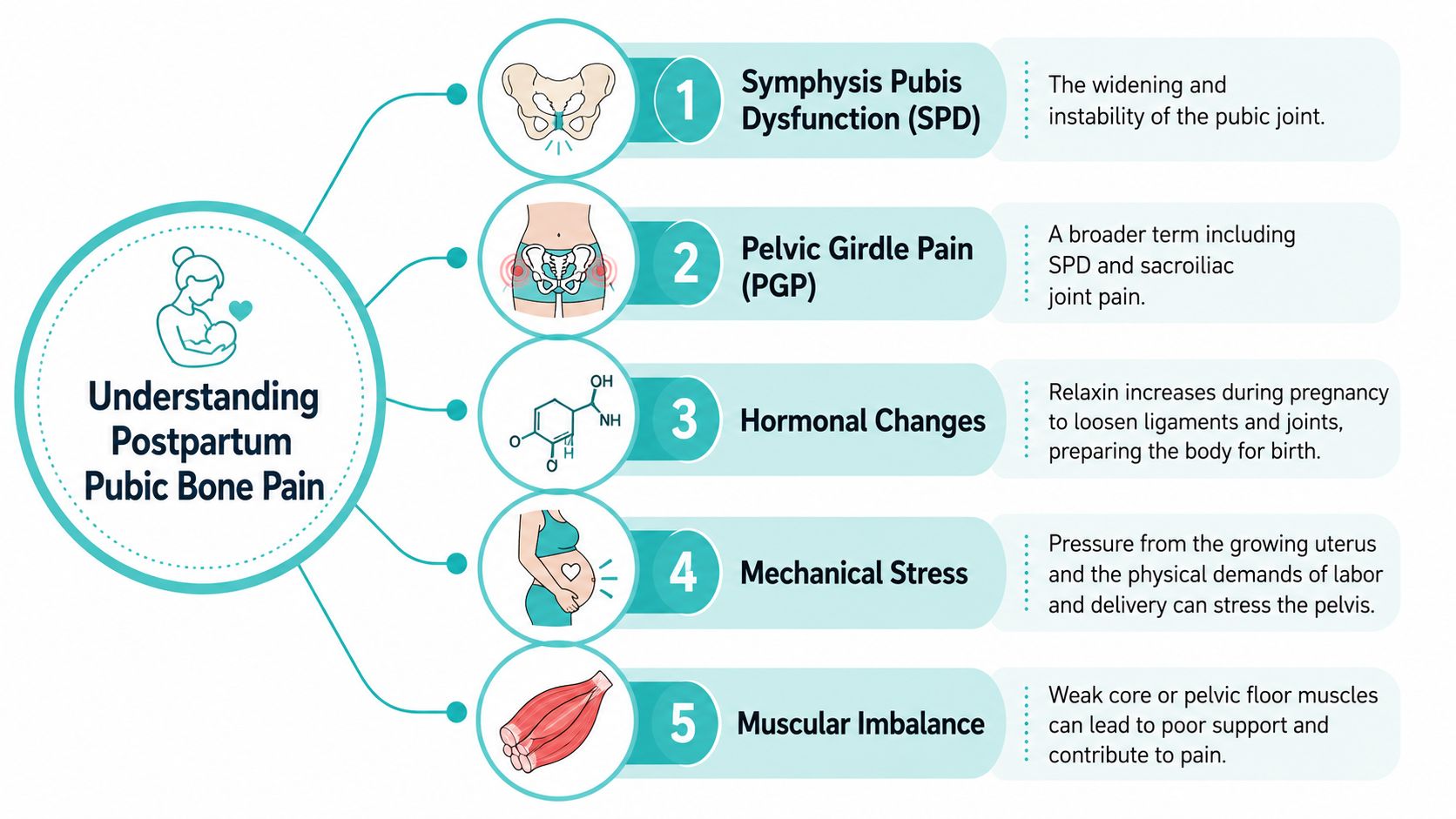
At the center of this issue is the pubic symphysis, the joint where the two halves of your pelvis meet in the front. I often describe it like two bookends connected by a tough but slightly flexible pad and supporting ligaments. During pregnancy and birth, those tissues have to adapt to weight, pressure, and motion.
Sometimes they adapt well and settle down after delivery. Sometimes they stay irritated, overly mobile, or strained.
What the terms actually mean
You may hear a few labels used interchangeably, which gets confusing fast.
- Symphysis pubis dysfunction usually refers to pain related to the pubic joint itself.
- Pelvic girdle pain is a broader term. It can include pain at the pubic symphysis, the sacroiliac joints in the back of the pelvis, or both.
- Postpartum pubic symphysis diastasis is a more severe separation or widening pattern. It's much less common than general pelvic girdle pain.
This isn't rare territory. One review reported pubic symphysis dysfunction in 31.7% of pregnant women, and postpartum pelvic girdle pain estimates ranged from 5% to 37% after delivery. The more severe form is far less common. A case-control study reviewing 35,799 pregnancies found 33 cases among 21,131 vaginal deliveries, an incidence of 0.156%, or about 1 in 641 vaginal births, as summarized in this clinical review of pubic symphysis dysfunction and postpartum separation.
Why it hurts
Pain at the pubic bone postpartum usually comes from a mix of factors rather than one single problem.
Some of the most common include:
- Joint irritation when the pubic symphysis has been strained during pregnancy or delivery
- Mechanical stress from walking, stairs, lunging, rolling, or standing on one leg
- Poor force transfer through the trunk and pelvis when the deep core, hips, and pelvic floor aren't coordinating well
- Muscle guarding in the inner thighs, lower abdominals, glutes, or pelvic floor
- Asymmetrical movement such as getting dressed standing on one leg or twisting while carrying the baby
In plain language, the front of the pelvis often gets angry when your body asks one side of the pelvis to do something different from the other. That's why movements like wide steps, getting out of a car, or climbing stairs can feel much worse than walking slowly on level ground.
What it is not
Not every postpartum pelvic pain issue is “just a separation,” and not all pain means major damage. Some mothers have more of a muscular overload picture. Others have broader pelvic girdle involvement with hip, sacroiliac, abdominal wall, or pelvic floor contributions.
That's why a general postpartum checklist can be helpful, but it won't replace a body-specific plan. If you want a broader look at healing basics beyond the pelvis, this guide for new moms' recovery is a reasonable companion resource. If your symptoms are centered more in the pelvis, this overview of pelvic pain after giving birth can help you connect the dots.
Immediate Self-Care and Pain Relief Strategies
When the pubic joint is irritated, your first job isn't to “stretch it out.” Your first job is to reduce shear and irritation so the area can settle.
That means making everyday movement less sloppy and less asymmetrical.
What usually helps
Think “small, aligned, supported.”
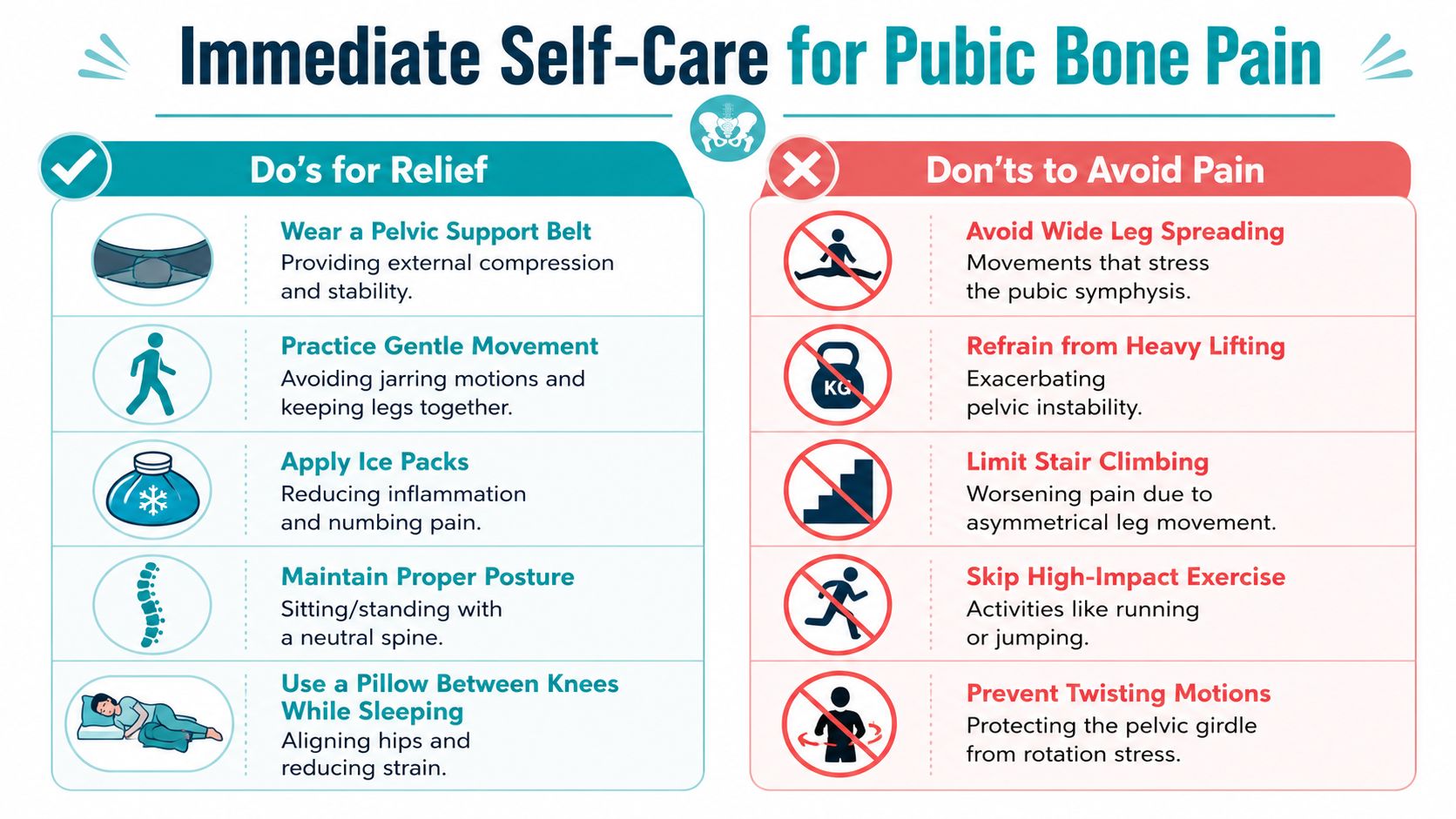
- Keep your knees closer together during transitions. This matters when rolling in bed, getting out of the car, and getting dressed.
- Use a pillow between your knees for side sleeping. It reduces pulling through the front of the pelvis.
- Take shorter steps if walking triggers pain.
- Sit down to get dressed instead of balancing on one leg.
- Use your arms to help with bed mobility rather than yanking yourself around through the pelvis.
- Consider a pelvic or SI belt if it makes you feel more supported while upright.
- Apply ice if the area feels acutely irritated after activity.
- Move gently, but regularly. Complete bed rest often makes people stiffer and less confident.
Practical rule: If an activity requires one leg to move far away from the other, twist sharply, or bear all your weight alone, it usually aggravates pubic symphysis pain.
Movement tweaks that make a real difference
For bed mobility, use a log roll. Roll your shoulders, trunk, and hips together as one unit. Let your legs move together, not one at a time.
For car transfers, back up to the seat, sit first, then swivel both legs in together. To get out, reverse it. Both legs move as a pair.
For lifting your baby, get close to the crib or bassinet, hinge at the hips, and avoid reaching with one leg turned out to the side. Small setup changes matter more than people expect.
A short demo can make those ideas easier to picture:
What tends to flare it
The biggest mistakes are usually simple.
- Don't push through sharp pain to prove you're fine.
- Don't stretch aggressively into positions that spread the knees wide.
- Don't return to impact exercise too early if walking itself still hurts.
- Don't carry heavy loads unevenly, especially on one hip.
- Don't do repeated stairs for exercise if each step spikes symptoms.
If your pain pattern also includes low back strain, you may find some overlap in these tips for relieving postpartum back pain, since pelvic mechanics and back mechanics often affect each other.
Rebuilding Your Foundation with Core and Pelvic Rehab
Relief strategies calm things down. They do not rebuild stability on their own.
That distinction matters. Many mothers improve enough to function, then plateau because they stopped at “avoid what hurts.” The pelvis needs more than protection. It needs a better support system.
Why rest alone often falls short
Most postpartum pelvic girdle pain improves over time, but not everyone bounces back quickly. About 20% of women who had pain during or immediately after pregnancy still report symptoms 2 to 3 years postpartum, and conservative care centers on physical therapy for functional stability plus muscle retraining. An SI belt can also help reduce the sensation of abnormal joint motion during recovery, as described in this overview of postpartum pelvic girdle pain and conservative management.
That's the reason I don't love the advice to “just rest and wait” when pain keeps interfering with movement. Rest can lower irritation in the short term. It does not automatically restore timing, strength, breathing mechanics, or load transfer.
What the rehab focus should be
The goal isn't to clamp every muscle down. It's to restore coordinated support.
A good rehab plan often includes:
| Focus area | Why it matters |
|---|---|
| Breathing mechanics | Better pressure management reduces strain through the abdominal wall and pelvic floor |
| Deep abdominal activation | The transverse abdominis acts like an internal support system for the trunk |
| Pelvic floor coordination | The pelvic floor should respond with the breath and the deep core, not grip all day |
| Glute strength | Strong hips reduce overload at the front of the pelvis |
| Movement retraining | You need stability during real tasks, not just on an exercise mat |
What works better than random exercise
The most helpful early exercises are usually simple and controlled. Think breath work, gentle deep core activation, isometric glute work, supported bridges if tolerated, and carefully selected hip strengthening. The right progression depends on irritability. If rolling in bed is still sharp, your body probably isn't ready for a generic online workout.
What usually doesn't work well:
- High-rep ab workouts that increase pressure without control
- Big stretching programs aimed at “loosening” an already irritated area
- Returning to running or jumping because you've been cleared in a general sense
- Kegels done in isolation when the bigger issue is coordination, not squeezing harder
The best postpartum rehab plan doesn't ask only, “Can you do this exercise?” It asks, “What happens when you carry the baby, stand from the couch, climb stairs, and sleep?”
If you're looking for a more exercise-focused starting point, these postpartum core strengthening exercises are a useful introduction. The key is progressing them based on symptoms, not based on impatience.
When to Call Your Doctor or Physical Therapist
This is the part many mothers need most. Yes, postpartum pubic bone pain can be common. No, that doesn't mean every case should be watched casually at home.
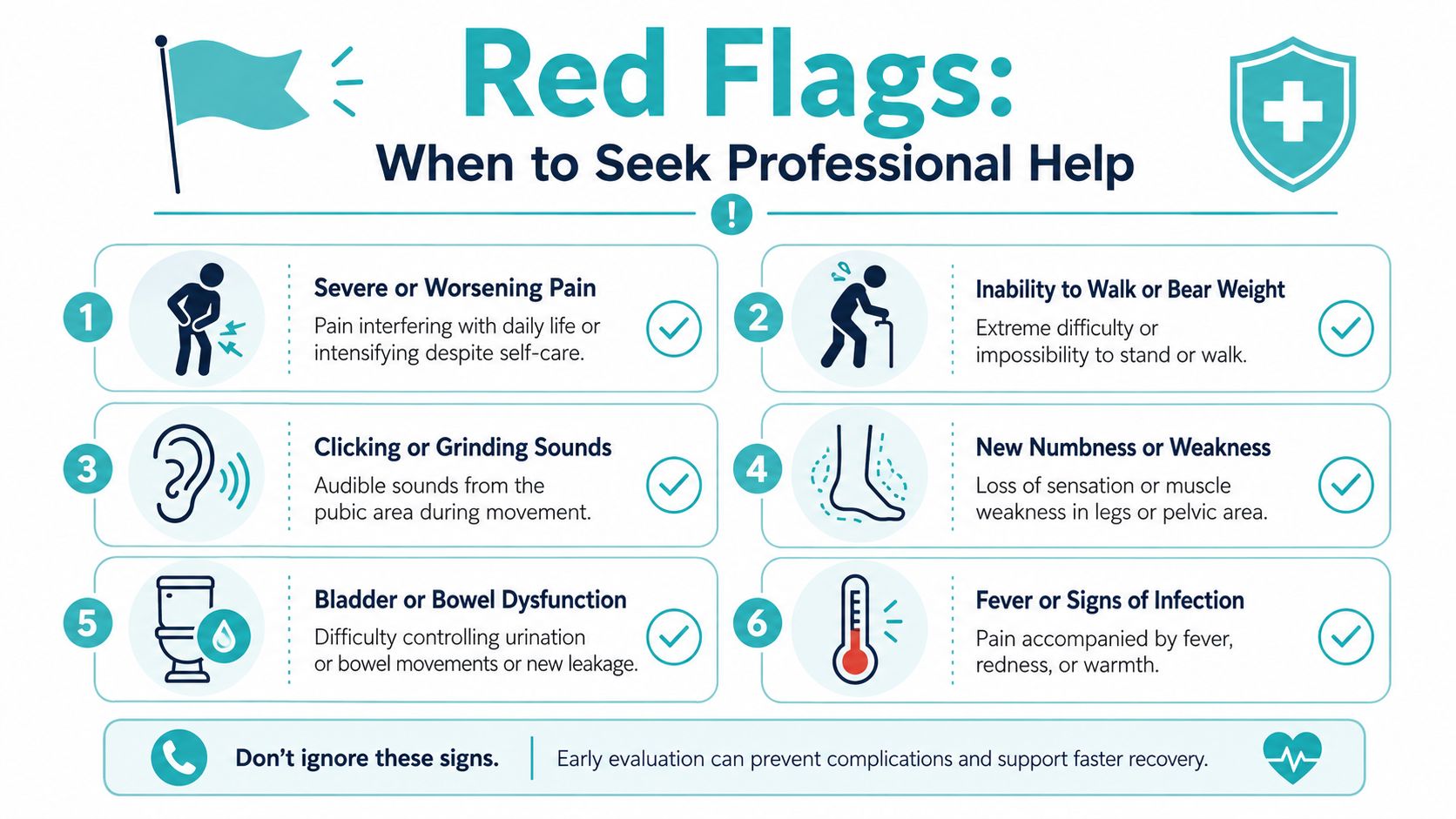
A major challenge is telling routine recovery pain from a more serious injury. Clinical guidance highlights inability to bear weight, sudden-onset pelvic pain, neurologic symptoms, or pain patterns that suggest something beyond routine postpartum soreness as reasons to seek medical review and possibly imaging, as outlined in this clinical discussion of postpartum pelvic girdle pain red flags.
Symptoms that should not be brushed off
Call your doctor promptly, or seek urgent evaluation, if you have:
- You can't bear weight well or walking is suddenly very difficult
- Pain came on suddenly and severely, especially after a pop, twist, or intense effort
- Numbness, tingling, or weakness in the legs or pelvic region
- Bladder or bowel changes, especially if they are new and not explained by usual postpartum recovery
- Fever, redness, or unusual warmth around the painful area
- Pain that keeps worsening instead of gradually settling
Those symptoms don't automatically mean something catastrophic is happening. They do mean “wait it out” is not the safest plan.
Symptoms that are common but still worth addressing
Some patterns are less urgent but still deserve care if they persist:
- pain rolling in bed
- pain with stairs
- pain getting in and out of the car
- pain with standing on one leg
- clicking or shifting sensations at the front of the pelvis
- coexisting leakage, heaviness, abdominal weakness, or pain during transitions
These are often treatable, but they rarely improve fastest when ignored.
Who to call for what
A quick comparison helps:
| Provider | Best role |
|---|---|
| OB-GYN, midwife, or primary care clinician | Medical evaluation, imaging decisions, medication guidance, ruling out more serious injury |
| Pelvic floor physical therapist | Movement assessment, load management, exercise progression, pelvic floor and core coordination, functional recovery |
If you're dealing with pelvic pain plus leaking, heaviness, or difficulty returning to normal movement, a postpartum-specific pelvic PT is often the right next step. This overview of postpartum pelvic floor physical therapy explains what that evaluation usually looks like.
Your Recovery Timeline What to Realistically Expect
Most mothers want a straight answer to one question. How long will this last?
The honest answer is that healing is usually favorable, but not always quick, and not perfectly linear.
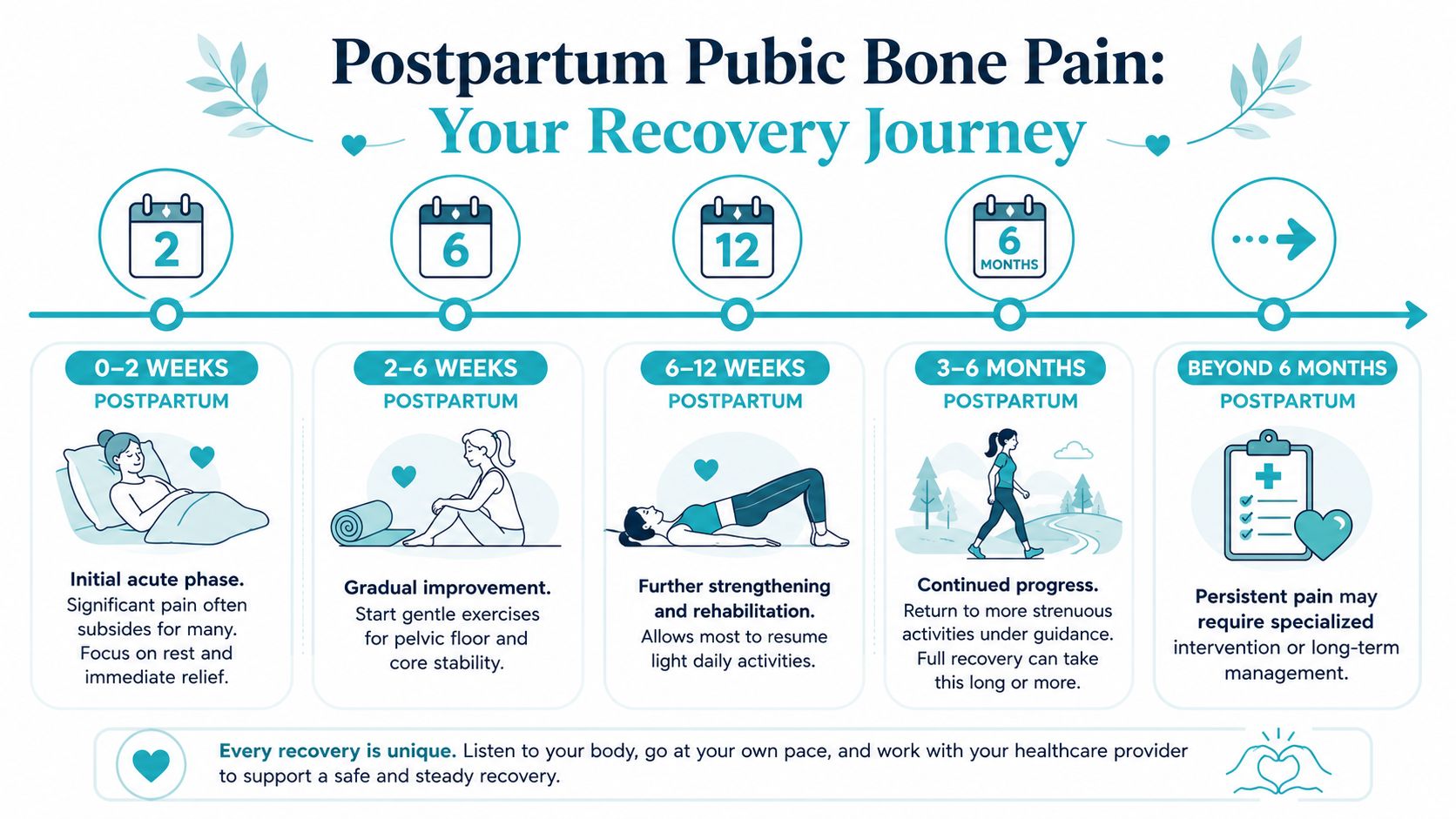
Most cases of postpartum pubic symphysis separation show near-complete closure and symptom resolution within 3 months, though some patients need physical therapy for up to 6 months. Guidance from Alberta also notes that a separated pubic symphysis may take 3 to 8 months to heal on its own and that pain commonly lasts about 2 months after childbirth, according to this clinical overview of postpartum pubic symphysis diastasis.
What recovery often feels like
The first stretch is usually about calming symptoms and making daily tasks manageable. That means smarter movement, less irritation, and enough support to care for yourself and your baby.
Then comes the awkward middle. You feel better, but not solid. Some days you think you're turning a corner, then one rough night, a long outing, or too many stairs brings symptoms back. That doesn't mean you failed. It usually means the tissues and the support system are still catching up.
Recovery from pubic bone pain postpartum is often uneven. Better days are a good sign, not proof that you should do everything at once.
A practical way to think about progress
Instead of asking only, “Does it still hurt?” ask:
- Are transitions easier?
- Can I walk with less guarding?
- Can I care for my baby with less planning around pain?
- Do flares settle faster than they used to?
Those are often the first real signs of progress.
The emotional side matters too. Persistent pain during early motherhood can stir anxiety, irritability, fear of movement, and a sense that your body is unreliable. If postpartum recovery is affecting your mental health in other ways as well, resources like this piece on finding hope with postpartum OCD can be a helpful reminder that struggling doesn't mean you're failing.
Move Forward with Confidence and Without Pain
Pubic bone pain postpartum is common, but it shouldn't be minimized. If your pain is sharp, function-limiting, or making you dread normal daily movement, that deserves attention.
The most useful approach is usually simple. Calm the irritation. Change the movements that keep provoking it. Rebuild core, pelvic floor, and hip support so the pelvis doesn't have to fend for itself. And if your symptoms sound like red flags, don't let anyone talk you into endless waiting.
You don't need to guess your way through this recovery. The right plan should help you move, lift, walk, sleep, and care for your baby with less pain and more confidence.
If pubic bone pain postpartum is limiting your recovery, Lake City Physical Therapy can help you figure out what's driving it and what to do next. Their pelvic health specialists create personalized postpartum rehab plans that address pain, movement, core function, and pelvic floor recovery so you can feel steady, strong, and supported again.