A Guide to Sensitive Personal Lubricant for Pelvic Health
You're standing in the pharmacy aisle, reading bottle after bottle, and every label sounds reassuring. Gentle. Natural. Intimate. Sensitive. But if you've ever had burning, dryness, pelvic pain, postpartum tenderness, or menopause-related irritation, you already know that a soothing label doesn't guarantee a soothing experience.
As a pelvic floor physical therapist, I see this confusion all the time. Patients often tell me they assumed lubricant was a simple purchase, then ended up with more stinging, more friction, or a flare in symptoms they were trying to calm down. The hard part is that lubricant can absolutely help, but only if the formula matches your tissue, your symptoms, and how you're using it.
Navigating the World of Personal Lubricants
Personal lubricant use is common, not unusual. About 65% of American women use personal lubricants during sex, according to Poison Control's overview of lubricant safety. That matters because it takes lubricant out of the “special case” category. This is routine sexual health care for many women.
The problem is that mainstream use hasn't created mainstream clarity. The same Poison Control overview notes that the FDA does not regulate personal lubricants with the same rigor as medications, so quality and formulation can vary. For someone with pelvic pain, recurrent irritation, or healing tissue, that gap matters.
A shelf full of options can look helpful and still be clinically messy.
If you're dealing with burning, dryness, or pain with penetration, lubricant choice is not a cosmetic decision. It's part of symptom management. That's one reason many patients start by browsing curated options like Healtsy personal care products, then bring a specific product into a visit so we can assess whether its ingredients and texture fit their needs.
Clinical perspective: A lubricant can reduce friction, but it can't override an irritating formula or a pelvic floor that's already guarding.
Patients with intercourse pain often think they've “failed” lubricant because it didn't solve the problem. More often, the issue is that the product wasn't a good match, or the pain has a deeper driver such as muscle tension, tissue sensitivity, scar restriction, or hormonal dryness. If painful sex is part of your picture, this guide on painful sex can help you recognize when lubrication is only one piece of the puzzle.
What Truly Makes a Personal Lubricant Sensitive
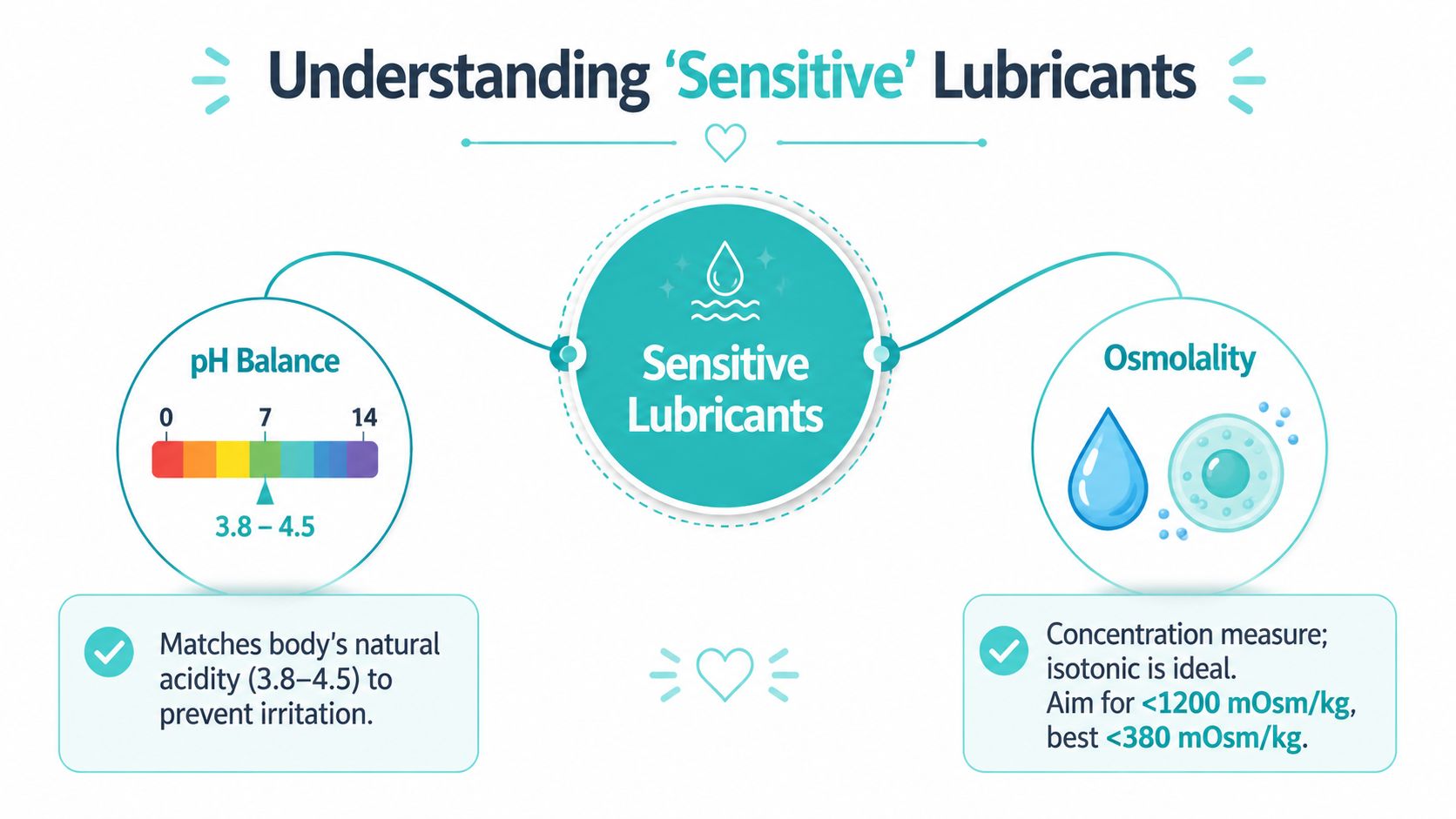
“Sensitivе” isn't a meaningful clinical word unless the product performs gently on tissue. The two most useful measures are pH and osmolality.
The World Health Organization recommends that lubricants intended for vaginal use have a pH around 4.5 and an osmolality below 1,200 mOsm/kg, with an even stricter target of below 380 mOsm/kg when feasible, according to this WHO-linked clinical review. Those numbers matter because they help define what “gentle” means.
Why pH matters
The vagina has its own normal acidity. A lubricant that's far outside that environment may feel fine at first and still leave you irritated later. In practice, that can show up as burning after sex, a “raw” feeling, or tissue that seems more reactive every time you try a new product.
For anal use, the target is different. The same WHO-linked clinical review notes that guidance for anal intercourse is closer to pH 5.5 to 7.0. This is one reason a product that feels fine vaginally may not be the best choice for anal use, and vice versa.
Why osmolality matters
Osmolality sounds technical, but the practical idea is simple. It reflects how concentrated a water-based lubricant is.
A highly concentrated formula can pull water out of delicate tissue. That contradicts the desired effect. Instead of soothing dryness, it can leave the area stingy, tight, or more irritated after the initial slickness wears off.
I often describe osmolality to patients as the lubricant's “water behavior.” A better-behaved formula is less likely to dehydrate sensitive tissue.
A lubricant can feel slippery in the first minute and still be a poor choice if it leaves tissue drier afterward.
What marketing gets wrong
Many labels push terms like “clean,” “natural,” or “hypoallergenic.” Those words don't automatically tell you whether the formula is well matched to vaginal tissue. A product can sound gentle and still be too concentrated, too alkaline, or loaded with ingredients that sensitive users don't tolerate well.
When I'm helping a patient choose a sensitive personal lubricant, I care much less about the front label and much more about these questions:
- Is the formula appropriate for vaginal or anal use
- Does the product disclose pH or osmolality
- Does the ingredient list suggest a high-irritation formula
- Does the person need brief glide or sustained friction reduction
That last point matters clinically. Someone with mild friction discomfort may do well with a simple formula that's easy to clean up. Someone with vestibular tenderness, postpartum dryness, or menopause-related tissue changes often needs more staying power and less friction over time.
What a good starting definition looks like
A sensitive personal lubricant is one that respects tissue chemistry, reduces friction, and doesn't create a second problem while trying to solve the first. That's a better standard than trusting the word “sensitive” on the package.
Decoding the Ingredient Label on Your Lubricant
When you turn the bottle over, the ingredient list can look intimidating. It helps to sort ingredients by function instead of by chemistry class memories. A lubricant formula has to do a few jobs at once. It needs a base, something that creates slip and texture, and a way to stay stable in the bottle.
A technical review notes that a sensitive lubricant is often built with 50 to 90% water and a relatively small amount of polymer, typically 0.1 to 3%, to create texture and viscosity, as described in Cosmetics & Toiletries' review of lubricant formulation. The same review flags several ingredient groups that are more likely to create problems for sensitive users.
Formulation friends
Some ingredients are there to create the feel you want without making the formula unnecessarily harsh.
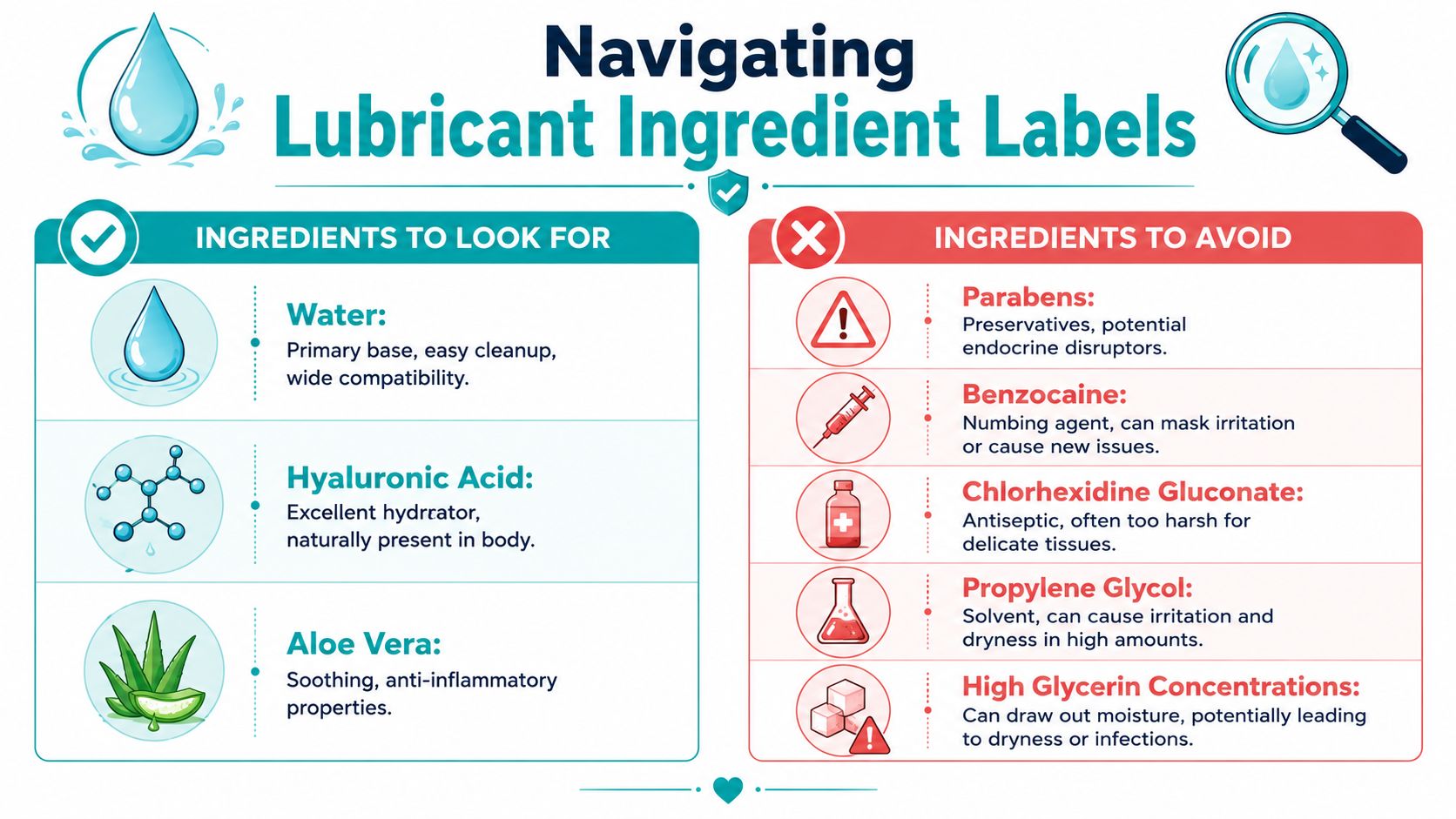
- Water as the main base: In many water-based lubricants, water does most of the heavy lifting.
- Low-level polymers: These are often what give a lubricant a cushiony or gel-like texture instead of a runny feel.
- Simple thickening systems: If you're highly reactive, simpler formulas are often easier to tolerate.
A simple ingredient list isn't automatically perfect, but it's often easier to troubleshoot.
Potential irritants to watch
The same formulation review identifies several ingredients that deserve extra scrutiny in a sensitive personal lubricant.
- Glycols including glycerin and propylene glycol: These can raise osmolality and may make irritation more likely in some users.
- Parabens: Some sensitive patients prefer to avoid them when tissue is already reactive.
- Chlorhexidine: This can be too harsh for delicate mucosal tissue.
- Nonoxynol-9: This is a known ingredient to avoid when irritation is already part of the story.
The practical question is not “Is this ingredient always bad?” The better question is “Does this ingredient make sense for my tissue and symptoms?”
How I teach patients to read labels
Start with the first several ingredients. Those usually tell you what kind of product you're dealing with. If the formula leans heavily on ingredients known to increase concentration or sting in sensitive users, I'm cautious. If the list is shorter and the formula appears built around a simple base plus thickener, I'm more optimistic.
Label rule: If you already have burning, recurrent irritation, or vestibular pain, don't gamble on a formula packed with likely irritants just because the bottle says “gentle.”
What doesn't work well is chasing trends without understanding function. “Natural” doesn't tell you enough. “Water-based” doesn't tell you enough either. You want a product whose ingredient list supports comfort, not just shelf appeal.
Comparing Water Silicone and Hybrid Lubricants
Base type changes how a lubricant feels, how long it lasts, and where it fits best in pelvic health care. There isn't one winner for every person.
For water-based lubricants, WHO procurement guidance targets an osmolality below 1200 mOsm/kg and a pH of 5.0 to 7.0, and notes that this can be achieved by keeping total glycol content under about 8.3%, according to the WHO procurement guidance document. In real life, that means some water-based products are thoughtfully built for tissue comfort and some are not.
Lubricant Type Comparison
| Feature | Water-Based | Silicone-Based | Hybrid |
|---|---|---|---|
| Feel | Often lighter, closer to natural moisture | More slippery and longer-lasting | In between |
| Reapplication | Usually needs more frequent reapplication | Usually lasts longer | Often less frequent than water-based |
| Cleanup | Easiest to wash off | Takes more effort to remove | Moderate |
| Vaginal sensitivity concerns | Depends heavily on pH, osmolality, and ingredients | Often useful when friction is the main issue | Depends on the water-based portion and additives |
| Toy compatibility | Common choice for silicone toys | Use caution with silicone toys | Check manufacturer guidance carefully |
| Best fit | Versatile, accessible, often first-line | Longer sessions, marked dryness, less frequent reapplication | People who want more glide without full silicone feel |
Water-based
Water-based lubricants are often the easiest starting point. They're common, easy to find, and usually simple to clean up. For patients using dilators, pelvic wands, or silicone toys, they're often the first category I consider.
The trade-off is that water-based products vary a lot. Some feel comfortable and tissue-friendly. Others dry quickly or leave a sticky finish. If a patient says, “I used lube but it got tacky and started burning,” that complaint often comes from this category.
Silicone-based
Silicone-based products usually last longer and provide better sustained glide. That can be very helpful for dyspareunia, menopause-related dryness, or any situation where friction builds over time.
The trade-off is compatibility and cleanup. They're not my default recommendation when someone is using silicone devices unless we've checked the manufacturer's guidance. They also don't wash away as easily, which some patients love and others dislike.
Hybrid
Hybrid lubricants try to sit in the middle. They can feel smoother and last longer than many water-based products while remaining lighter than full silicone.
Their weakness is predictability. The added ingredients matter, and some formulas still contain components that sensitive users don't tolerate well. Hybrids aren't automatically more advanced. They're just another category that needs careful label reading.
Choosing a Lubricant for Specific Pelvic Health Needs
The best lubricant is the one that solves the problem you have. That sounds obvious, but many people buy for the label instead of the situation.
Pelvic health guidance recommends a pH of 3 to 5 for vaginal use and 6 to 7 for anal use, and also notes that silicone may be preferred when longer glide is needed, while ultra-sensitive water-based options often use thickening agents like hydroxyethyl cellulose, according to this pelvic health guide from The Origin Way.
When sex feels sharp or burning
With dyspareunia, friction is often only part of the picture. A patient may also have pelvic floor overactivity, fear-based guarding, vulvar sensitivity, scar tension, or hormonal tissue change. In that setting, a thin lubricant that disappears quickly usually doesn't help enough.
I often think in terms of contact tolerance. If tissue is reactive, I want a product that reduces friction without adding sting. For some people that means a carefully selected water-based sensitive personal lubricant. For others, especially when glide needs to last, silicone makes more sense.
During postpartum recovery
Postpartum tissue can feel fragile, dry, or unexpectedly sensitive, especially if breastfeeding is part of the picture. Patients often tell me they expected discomfort from sleep deprivation or healing, but not from basic vaginal dryness.
Simpler formulas tend to do better. A water-based product with an uncomplicated ingredient list may be a comfortable starting point. If symptoms persist because the lubricant dries out too fast, a longer-lasting option may be worth considering.
Patients often also need more than lubricant alone. Vaginal dryness, scar sensitivity, and pelvic floor tension can overlap after birth. A pelvic health approach that includes both lubrication and tissue support is often more effective, and this resource on moisturizer for pelvic floor helps explain that difference.
In menopause-related dryness
Menopause changes tissue resilience. Patients often describe more friction, less elasticity, and symptoms that last after intercourse instead of resolving quickly.
For this group, sustained glide matters. Reapplying a light lubricant every few minutes isn't always realistic or comfortable. If intercourse is painful primarily because tissue is dry and friction-sensitive, a longer-lasting lubricant often works better than a watery formula that evaporates or absorbs quickly.
Some patients don't need “more lubricant.” They need a lubricant that stays where it's needed long enough to do its job.
With recurrent burning or a history of irritation
If you've had repeated episodes of burning with different products, don't keep testing random bottles. That pattern usually means your tissue is reactive, the formulations have been mismatched, or another condition is being missed.
In clinic, I look for common themes:
- Immediate sting on application: Often points to ingredient sensitivity or already-irritated tissue
- Burning after intercourse: Often suggests friction, dehydration of tissue, or both
- Symptoms with penetration even when lubrication is adequate: May point more strongly to pelvic floor tension or vestibular pain
For anal use
Anal tissue needs a different pH range and often benefits from more lasting slip. If a patient is trying to use one bottle for everything, I remind them that “all-purpose” is not always the most comfortable choice. The use case matters.
How to Patch Test and Use Your Lubricant Safely
A new lubricant should never go straight into full use if you already have sensitive skin, a history of burning, or pelvic pain. Patch testing won't catch every issue, but it can help you avoid obvious reactions.
A simple patch test process
- Apply a small amount to the inner thigh or inner wrist.
- Wait and observe for irritation, itching, redness, or burning.
- If that goes well, test externally on vulvar skin before using it internally.
- Use it in a small amount first during sexual activity or dilator work, rather than assuming more is always better on the first try.
If you feel clear burning, wash it off and don't talk yourself into trying again because the label sounded promising.
Safer use habits
A good lubricant can still underperform if it's used sparingly or only applied to one surface.
- Apply enough product: Friction control usually improves when you stop rationing it.
- Place it where friction happens: That may mean both the body and the object, toy, or partner.
- Reapply when glide changes: Don't wait until tissue starts feeling rubbed.
- Keep the bottle clean: Avoid contamination around the opening or cap.
If comfort drops midway through sex, don't push through it. Pause, reassess, and add more lubrication or stop.
A lubricant should make things easier. If every attempt still ends with irritation, don't assume the answer is a bigger bottle.
When to Partner with a Pelvic Floor Therapist
A lubricant can reduce friction. It cannot release an overactive pelvic floor, soften a painful scar, restore tissue mobility, or treat the underlying reason penetration hurts.

That's the point where pelvic floor therapy becomes useful. If symptoms keep returning, a good product choice is still worth having, but it shouldn't become the only strategy.
Signs lubricant isn't the whole answer
If any of these sound familiar, it's worth getting assessed:
- Pain with penetration despite using lubricant
- Burning that happens with multiple products
- Pelvic muscle tightness or a feeling of “hitting a wall”
- Postpartum pain that isn't improving
- Menopause-related dryness plus pain or tissue sensitivity
- Pain with dilators, tampons, or exams
- Ongoing symptoms after cancer treatment or pelvic surgery
A pelvic floor evaluation can sort out whether your main driver is muscle guarding, tissue sensitivity, scar restriction, hormonal change, or a combination. That distinction changes treatment.
There's also value in hearing how other clinicians frame addressing pelvic issues with physiotherapy because patients often feel relieved once they realize sexual pain is something providers assess and treat directly, not something they're expected to tolerate.
For a closer look at treatment options, physical therapy for painful intercourse is often the next practical step when lubricant alone hasn't solved the problem.
Video can also make the process feel less abstract:
The right sensitive personal lubricant can be a powerful tool. It can reduce friction, improve comfort, and help tissue tolerate intimacy better. But if your body keeps signaling pain, believe that signal. The goal is not to find a product that helps you endure symptoms. The goal is to understand why the symptoms are there and treat them well.
If you're dealing with painful sex, postpartum dryness, pelvic tension, or irritation that keeps coming back, Lake City Physical Therapy can help you get to the root of it with specialized pelvic floor care that's practical, compassionate, and individualized.

