Postpartum Incontinence Treatment: Regain Control
You sneeze while rocking your baby, and a few drops leak before you can react. Or you stand up after a feeding, feel a sudden rush, and wonder why your bladder seems to have its own plan now. A lot of new moms have this moment, then start changing clothes more often, mapping every bathroom in town, or avoiding exercise because they're worried it will happen again.
If that's where you are, I want you to hear this clearly. Leaking after birth is common, but it isn't something you're supposed to just accept. There's a real reason it's happening, and there's a practical path forward.
You Are Not Alone But You Do Not Have to Live With It
Many women tell themselves, “I just had a baby, so this must be normal.” That reaction makes sense. Your body went through pregnancy, delivery, sleep loss, healing, and constant lifting in a very short time.
But common and normal are not the same thing.
A major 2021 review found that the average prevalence of urinary incontinence from 6 weeks to 12 months postpartum was 31.0% among women after childbirth, which shows how widespread the issue is and how often it continues beyond the early recovery window without proper care (systematic review on postpartum urinary incontinence prevalence).
That number matters for one reason above all. You are not the only one dealing with this. If you leak when you laugh, cough, lift the car seat, jog, or hear running water, you are in very good company.
Common does not mean harmless
I also don't want you to dismiss it just because other moms mention it casually. When bladder symptoms linger, they can affect exercise, intimacy, sleep, errands, travel, and confidence. Some women stop doing the things that help them feel like themselves because they're always managing around leakage.
Important: Postpartum incontinence is a treatable medical issue, not a personality flaw, not something you caused, and not a test of whether you're “doing Kegels hard enough.”
The same season of life can also bring mood changes, overwhelm, and isolation. If you've noticed persistent sadness, anxiety, emotional numbness, or trouble bonding, it can help to review the signs of postnatal depression so you can get support for the whole picture, not just the bladder symptoms.
A better starting point than “just do Kegels”
Most women have already heard some version of this advice: squeeze, hold, repeat. The problem is that recovery is often more complicated than simple weakness. Some pelvic floors are weak. Some are tight and tired. Some can contract but can't relax. Some need coordination training more than brute strength.
That's why good postpartum incontinence treatment starts with understanding what your body is doing, not guessing.
Understanding Why Leaks Happen After Childbirth
Your pelvic floor works like a supportive hammock at the base of your pelvis. It helps support the bladder, bowel, and reproductive organs, and it needs to lift, lengthen, and respond quickly during everyday movement.
Pregnancy and childbirth can stretch that hammock, overload it, or make its timing less reliable. After delivery, some women have muscles that are weak. Others have muscles that grip all day and still don't support well because they've lost coordination. Nerves and tissues can also be irritated from the strain of carrying and delivering a baby.

Postpartum urinary incontinence is strongly linked to pelvic floor muscle weakness or poor coordination after childbirth, and a 2025 systematic review found that pelvic floor muscle training is the most consistently supported first-line intervention for that underlying problem (systematic review on pelvic floor interventions after childbirth).
If you want a broader overview of the mechanics behind bladder leakage in women, this guide on what causes urinary incontinence in women is a helpful companion.
The three patterns most moms notice
It helps to sort symptoms into patterns, because treatment often depends on which pattern fits you best.
- Stress incontinence happens when pressure rises faster than your pelvic floor can respond. You leak with coughing, sneezing, laughing, lifting, jumping, or running.
- Urge incontinence feels like a sudden, intense need to urinate, and you may leak on the way to the bathroom.
- Mixed incontinence is exactly what it sounds like. You leak with pressure and also have urgency.
Many women get confused here because they assume every leak means weakness. That isn't always true.
Weak, tight, and poorly timed are not the same thing
A muscle can be too weak to support well. It can also be so tense that it can't generate a strong, efficient contraction when you need one. Think of a fist that's already clenched all day. It isn't ready to do precise work.
Here's another way to picture it:
| Pattern | What it can feel like | What may be going on |
|---|---|---|
| Stress leakage | Leak with sneeze or lift | Support system isn't responding fast enough |
| Urgency leakage | Strong “gotta go now” feeling | Bladder signaling is overactive or poorly regulated |
| Mixed leakage | Both of the above | More than one system needs attention |
A pelvic floor that's always braced is not necessarily a strong pelvic floor.
Hormonal changes, tissue healing, scar sensitivity, constipation, heavy straining, and breath-holding during daily tasks can all make symptoms worse. So can the nonstop lifting, carrying, and rushing that new motherhood requires. That's why postpartum incontinence treatment works best when it looks at the whole system, not just one exercise.
What to Expect at Your Pelvic Floor Assessment
A first pelvic floor appointment should feel calm, respectful, and specific to you. It isn't a pass-fail test. It's a detailed check of how your body is functioning so treatment can match the actual problem.
Most visits begin with a conversation. Your therapist asks when the leaking happens, what kind of birth you had, whether you're dealing with urgency, constipation, pressure, pain, or a sense of heaviness, and what you want to get back to. For one mom that may be walking without worry. For another, it's returning to CrossFit or chasing toddlers without crossing her legs every time she coughs.
The history matters more than most people expect
Your symptom pattern gives important clues. Leaking only with impact suggests something different from leaking when you reach the front door and suddenly feel an overwhelming urge. Scar tissue, tearing history, pelvic pain, or a feeling of bulging can change the treatment plan too.
A good therapist also asks about breath-holding, bowel habits, sleep, hydration, lifting demands, and exercise history. Those details often explain why home exercises haven't helped.
What the physical exam may include
The exam usually combines outside observation with movement testing. Depending on your comfort and consent, it may also include an internal pelvic floor assessment.
That can sound intimidating, so here's what it's for:
- External assessment checks posture, breathing pattern, abdominal wall function, hip movement, and how you manage pressure when you sit up, squat, cough, or lift.
- Internal assessment can help identify whether the pelvic floor is weak, overactive, tender, poorly coordinated, or showing signs of prolapse support issues.
- Functional testing looks at what happens during the activities that trigger leakage in real life.
The goal isn't simply to ask, “Can you squeeze?” It's to find out, “Can you contract, relax, and respond at the right time?”
Some women discover they've been doing Kegels by tightening their glutes, inner thighs, or abdominals instead of the pelvic floor. Others learn they are squeezing correctly but never fully releasing, which leaves the system tired and inefficient.
That's why assessment is so valuable. It replaces guessing with a map.
Your Core Treatment Plan Pelvic Floor Therapy and Lifestyle Habits
When people think about postpartum incontinence treatment, they usually think of Kegels. Pelvic floor therapy is broader and more precise than that.
The strongest non-surgical evidence supports supervised pelvic floor physical therapy and electrical stimulation for postpartum stress incontinence. In a systematic review, their effect sizes (0.76 and 0.77) were higher than home physical therapy alone (0.44), which helps explain why guided treatment often works better than trying to piece together a program on your own (systematic review of treatments for postpartum stress urinary incontinence).
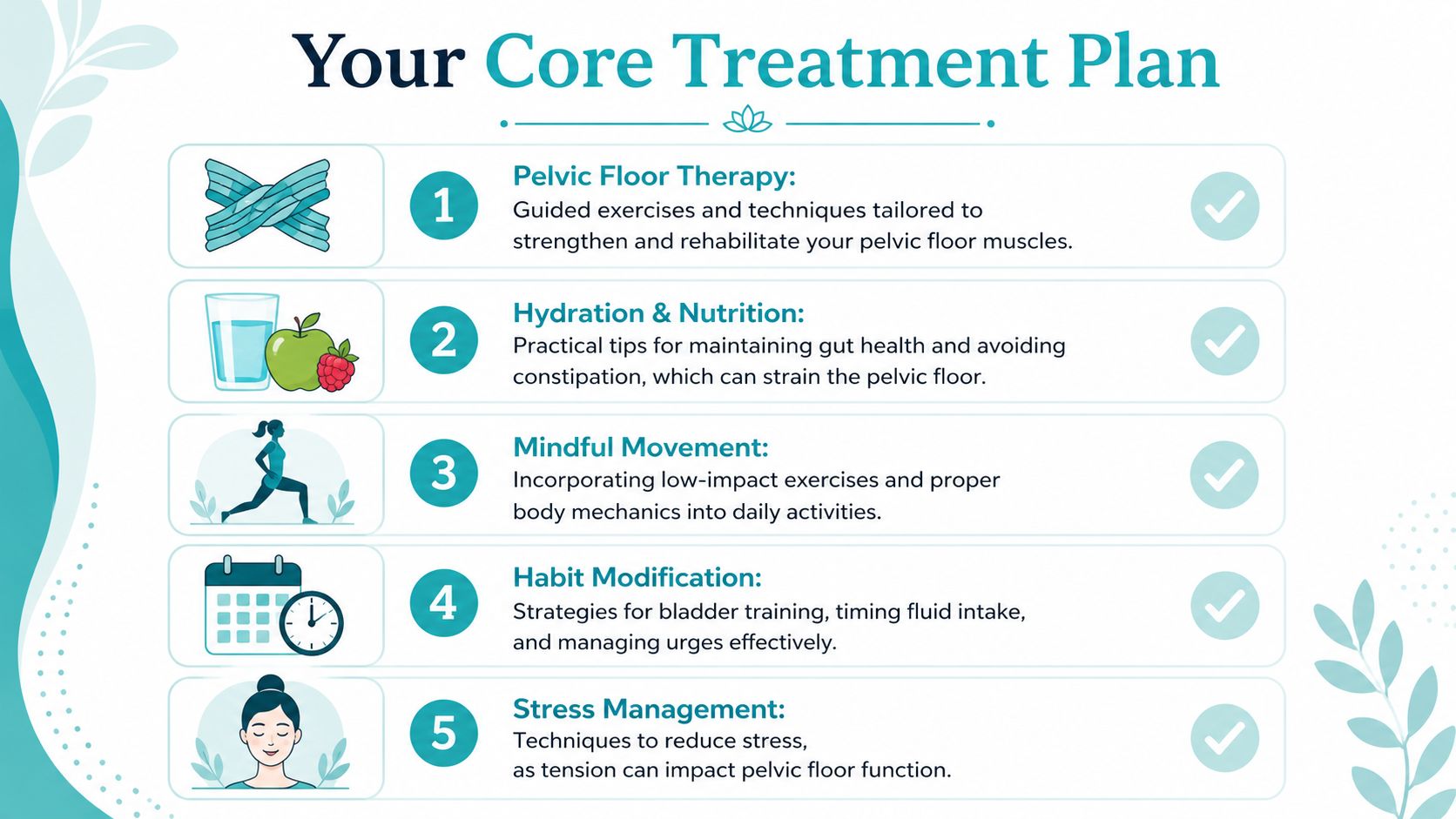
This visual gives a simple overview of the building blocks.
If you're looking for a postpartum rehab resource focused on rebuilding confidence in your body, the Milk&Lace postpartum confidence guide can be a useful read alongside clinical care.
You can also learn more about postpartum pelvic floor physical therapy if you want to see how this kind of rehab is typically approached.
Pelvic floor training is more than repeated squeezing
An effective program usually trains several skills:
- Awareness and coordination so you can find the right muscles without substituting with your abs or glutes.
- Endurance so the pelvic floor can support you during longer tasks like walking, standing, babywearing, or a workout.
- Quick response so the muscles react before a cough, laugh, or lift.
- Relaxation so the muscles can let go between efforts instead of staying clenched.
I often compare this to learning an elevator panel, not just an on-off switch. Your pelvic floor needs to go up, down, and pause at the right floor. If it only knows “squeeze harder,” it won't work well in daily life.
Bladder habits matter too
Many moms start drinking less because they think less fluid means fewer leaks. Usually that backfires. Concentrated urine can irritate the bladder, and going “just in case” all day can teach the bladder to demand emptying too early.
Helpful behavior changes often include:
- Timed voiding to gently space bathroom trips instead of responding to every urge.
- Urge control strategies such as stopping, breathing, and calming the nervous system before rushing to the toilet.
- Bowel support because constipation and straining increase pressure on healing tissues.
- Pressure management during lifting, standing up, pushing a stroller uphill, or picking up the car seat.
A short movement demo can make those pressure strategies easier to understand in practice.
Why supervision changes outcomes
Home exercises aren't useless. They're just limited if no one has checked your technique or matched the program to your symptoms.
Supervised care helps in a few ways:
- Your therapist can tell whether you actually need strengthening, down-training, coordination work, or a blend.
- The program can progress as your body heals and your goals change.
- You get feedback on real-life triggers like lifting, exercise, and urgency.
That's what many women miss when they've tried to “be good” about Kegels and still feel stuck.
Advanced Tools When Kegels Are Not Enough
Sometimes a woman does the basics faithfully and still leaks. That doesn't mean she failed. It usually means the problem needs a more targeted tool.
This is the part many online articles skip. They stop at “do Kegels,” even though persistent symptoms often involve timing, sensory awareness, support, or muscle recruitment that simple home exercises can't fully address.
Biofeedback helps you see what you've been trying to feel
Biofeedback gives you information about how your pelvic floor is working. Depending on the setup, your therapist may use sensors that show muscle activity on a screen. That visual cue can be a game changer if you aren't sure whether you're lifting, bearing down, or over-gripping.
For women who say, “I think I'm doing it, but I can't tell,” biofeedback can turn a vague body part into something understandable and trainable.
Sometimes the fastest progress happens when your body finally gets clear feedback.
Electrical stimulation can help wake up a sluggish system
Electrical stimulation, often shortened to e-stim, can help when muscles are very weak, poorly recruited, or hard to connect with voluntarily. It isn't a punishment and it isn't a shortcut. It's a way to help the nervous system and muscles practice the pattern they've been missing.
Women are often nervous about this tool because the name sounds intense. In reality, it's commonly used in rehab settings with very specific goals. It may help a pelvic floor that isn't generating a useful contraction on its own yet.
If you're curious about one commonly discussed device category, these Emsella chair reviews can help you understand how people think about stimulation-based options.
Support devices can reduce symptoms while you rebuild
A pessary is a support device placed in the vagina to help support pelvic organs and reduce leakage or pressure symptoms in some women. I like to explain it as external support from the inside. It doesn't replace muscle recovery, but it can make movement more manageable while you work on healing.
This matters for mixed or more persistent symptoms, especially when there's a feeling of heaviness, bulging, or leakage with activity that isn't improving quickly enough with exercise alone.
A therapist or medical provider may also change your program if they find signs like:
- Persistent urgency that doesn't calm with bladder training
- Symptoms of prolapse support issues
- Pelvic pain or scar sensitivity that makes strengthening difficult
- Poor relaxation that causes you to brace instead of coordinate
These tools aren't signs that your case is severe. They're signs that treatment is becoming more precise.
The Full Pathway From Physical Therapy to Medical Referral
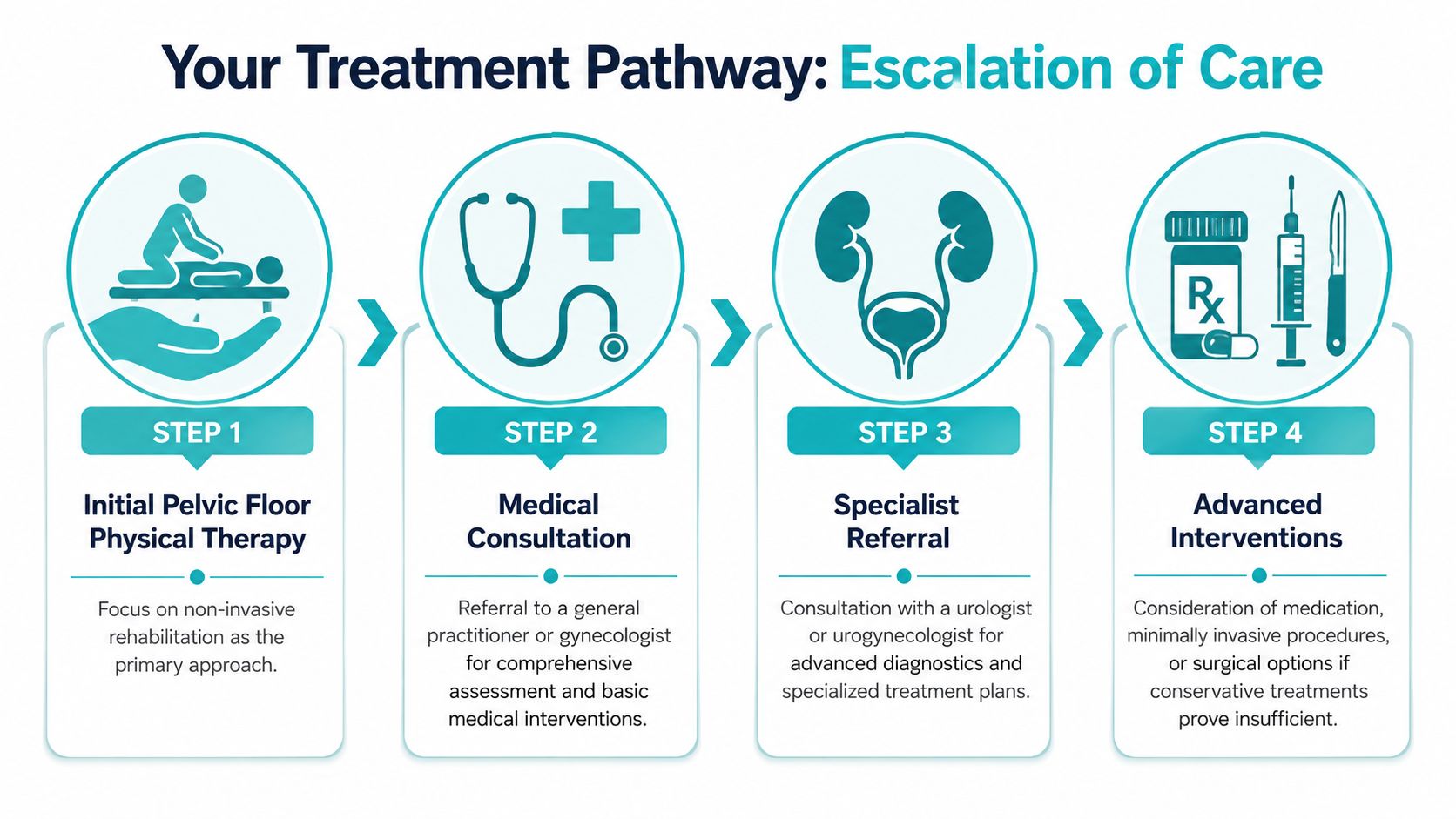
Most postpartum incontinence treatment should follow a stepwise path, not a panic path. You don't jump straight from “I leaked when I sneezed” to surgery. You start with the least invasive options that address the most common drivers of symptoms.
Clinical guidance from the University of Colorado describes postpartum incontinence care as a stepwise escalation process. First-line care includes pelvic floor therapy or exercises, bladder training, nerve modulation, electrical stimulation, and pessary support, while surgery is reserved for persistent symptoms after conservative therapy fails (clinical guidance on incontinence after childbirth).
What escalation actually looks like
Here's the practical version:
| Step | What usually happens |
|---|---|
| Start conservative | Pelvic floor rehab, bladder retraining, pressure management, symptom tracking |
| Add support | Devices or more targeted rehab tools if symptoms are mixed or persistent |
| Seek medical input | A physician or urogynecologist evaluates ongoing urgency, prolapse, pain, or significant leakage |
| Consider procedures | Medication or surgery may be discussed if conservative care hasn't solved the problem |
When it makes sense to ask for a medical referral
A pelvic floor therapist may suggest a medical consultation if your symptoms stay stubborn despite consistent rehab, or if your presentation suggests something beyond routine postpartum weakness.
That may include:
- Ongoing mixed incontinence with both pressure leaks and urgency
- A feeling of bulging or heaviness
- Significant pain
- Difficulty emptying the bladder
- Symptoms that interfere with daily life despite a well-executed therapy plan
Practical rule: Start with conservative care, but don't stay in limbo if you're not improving.
Medication may be part of care in some cases, especially for urgency-related symptoms. Surgical options may also help selected women with persistent stress leakage. The important point is sequence. Conservative rehab isn't the “small” option. It's the standard first step because it addresses the mechanics that often drive the problem in the first place.
How to Find the Right Therapist in North Idaho and Washington
Not every physical therapist treats the pelvic floor, and not every pelvic floor therapist specializes in postpartum care. If you want effective help, look for someone who treats this issue regularly and can assess more than simple muscle strength.
A strong fit usually includes experience with postpartum recovery, urinary incontinence, prolapse-related symptoms, abdominal wall rehab, and return-to-exercise planning. Advanced training in women's health or pelvic health is a good sign too.
What to ask before you book
You don't need to sound like a clinician. Just ask practical questions.
- Do you treat postpartum urinary leakage regularly?
- Do you perform pelvic floor assessments, including internal assessment when appropriate and with consent?
- How do you treat mixed symptoms, urgency, or heaviness, not just stress leaks?
- Can you help me return to exercise, lifting, or running?
- Do you offer telehealth if I need flexibility with a newborn?
Those questions quickly tell you whether a clinic understands the difference between generic rehab and targeted postpartum incontinence treatment.
Local access matters when consistency matters
When you're caring for a baby, convenience isn't a luxury. It's part of whether treatment happens. Clinics that offer multiple locations, scheduling flexibility, and telehealth can make the difference between “I should do this someday” and “I'm getting help this month.”

In North Idaho and Eastern Washington, it helps to look for providers with dedicated women's health and pelvic floor expertise, especially if you're dealing with more than one issue at once. Leakage plus urgency, pressure, painful scar tissue, or trouble returning to sport often needs a broader skill set than a basic exercise handout.
Lake City Physical Therapy serves women across Coeur d'Alene, Hayden, Post Falls, Rathdrum, Liberty Lake, Spokane South Hill, Eagle, and Boise, and also offers telehealth. That kind of access can be especially helpful in postpartum life, when travel, feeding schedules, and childcare can all complicate care.
The biggest thing I want you to take from this is simple. If your symptoms are still shaping your choices, it's time to stop guessing and get assessed. You deserve a plan that fits your body, your symptoms, and your goals.
If you're ready for a clear, personalized next step, Lake City Physical Therapy offers women's health and pelvic floor care for postpartum incontinence, prolapse, pain, and return-to-activity recovery across North Idaho and Eastern Washington, with telehealth options available too.

