Symphysis Pubis Dysfunction: A PT’s Guide to Relief
You roll over in bed, swing one leg out of the car, or try to put on pants standing up. Then you feel it. A sharp pain right at the front of your pelvis, sometimes deep in the groin, sometimes like a pulling or stabbing sensation that makes you stop mid-movement.
A lot of women have this moment in pregnancy and wonder if something is wrong. The good news is that this pattern is recognizable, common, and treatable. If the pain is centered around the pubic bone and gets worse with walking, turning in bed, stairs, or standing on one leg, symphysis pubis dysfunction may be the reason.
This can feel scary when it starts. It can also be frustrating because the pain often shows up during ordinary tasks, not just workouts. But there's a path forward. With the right understanding, smart activity changes, and targeted rehab, many women can calm symptoms during pregnancy and rebuild strength for life after delivery, including a return to higher-impact activity.
That Sharp Groin Pain During Pregnancy Might Be SPD
Sarah was in her second trimester when she first noticed it. She got out of the passenger seat, planted one foot, and felt a sudden jab in the front of her pelvis. Later that night, turning over in bed hurt again. By the next week, climbing stairs and getting dressed were setting it off too.
She assumed it was “just pregnancy pain,” but the location was specific. It wasn't round ligament pain off to the side of the belly. It wasn't only low back pain. It was right around the pubic bone, with a sharp, unstable feeling during uneven movements.
That story is common. Many pregnant women describe pain that seems to appear out of nowhere, then starts affecting basic tasks. One of the most confusing parts is that symptoms can change day to day. You may feel decent in the morning and then suddenly flare after walking through a store, lifting a toddler, or taking a longer stride than usual.
What SPD usually feels like
Symphysis pubis dysfunction often shows up as pain in the front of the pelvis, but people describe it in different ways:
- Sharp pain at the pubic bone when taking a step, rolling in bed, or separating the legs
- Aching in the groin or inner thighs after activity
- A sense of instability like the pelvis isn't moving smoothly
- Pain with one-leg tasks such as getting dressed, climbing stairs, or getting in and out of the car
Some women first wonder whether they're dealing with another common pregnancy discomfort, such as round ligament pain in pregnancy. That confusion makes sense because pregnancy can create several overlapping aches and pains. The pattern of SPD tends to stand out because asymmetrical movement is such a strong trigger.
SPD can be intense, but it doesn't mean your body is failing. It means your pelvis needs more support, better load sharing, and a smarter plan.
Why reassurance matters early
A lot of women wait too long to get help because they think they just need to tolerate it. That usually leads to more guarding, more fear of movement, and more irritation with daily life. Early guidance can make a big difference.
The other important point is this. Pain during pregnancy isn't always something you should push through. When the pubic joint gets irritated, the goal isn't to stop moving completely. It's to move in ways that reduce strain while building better support around the pelvis.
Understanding What Is Happening to Your Pelvis
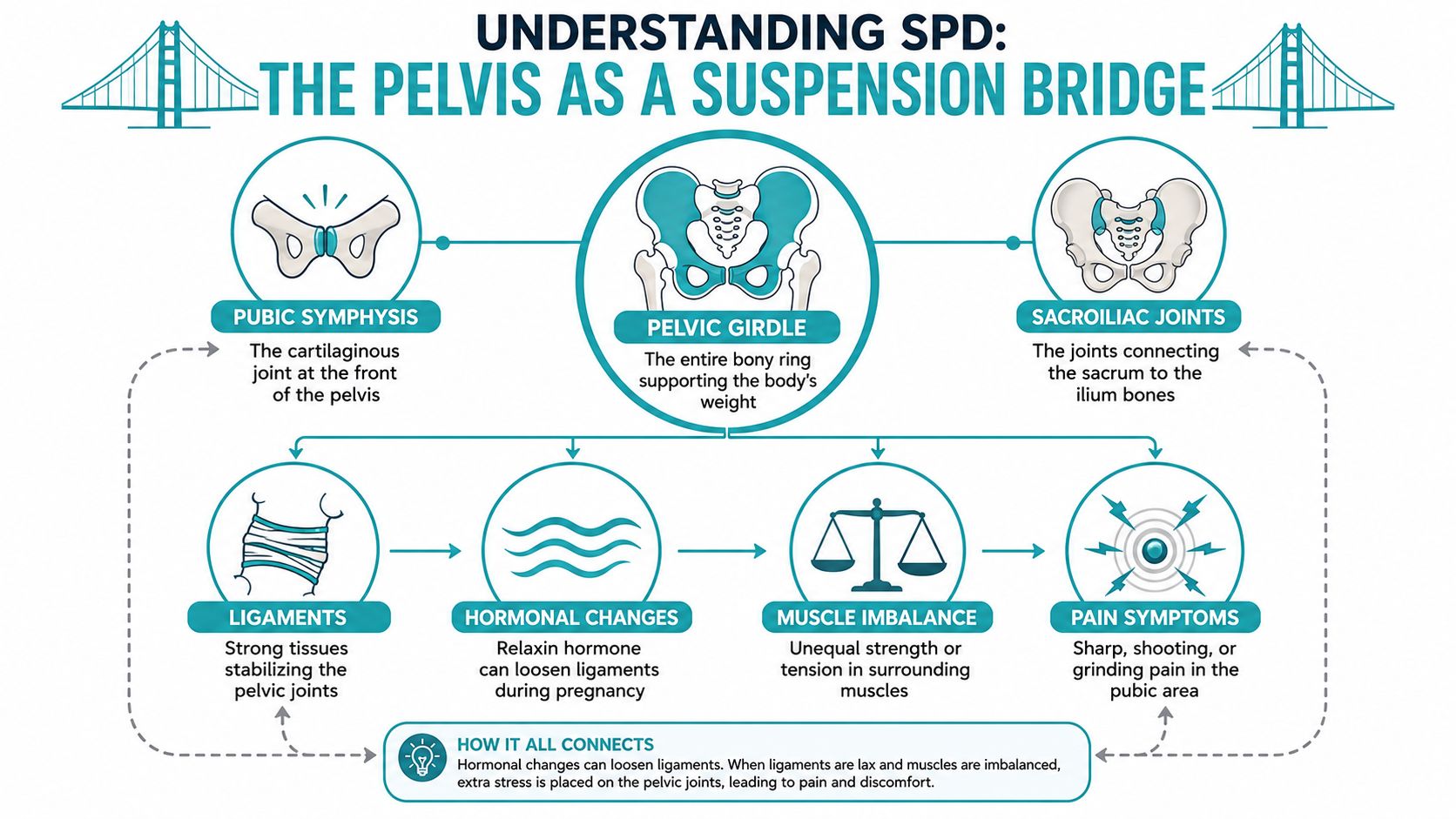
The pelvis works like a ring. At the front is the pubic symphysis, a cartilaginous joint that connects the two sides of the pelvis. At the back are the sacroiliac joints. Ligaments and muscles help the whole system transfer force when you walk, stand, turn, or carry weight.
A simple way to think about it is a suspension bridge. The bridge needs a little flexibility so it can respond to changing forces, but it also needs tension, balance, and support. If the cables loosen too much or the load becomes uneven, parts of the bridge start taking more strain than they should.
Why pregnancy changes the system
During pregnancy, hormonal changes prepare the body for birth. One of the key effects is increased ligament laxity. In SPD, that normal softening can become too much for the way your body is loading the pelvis.
Symphysis pubis dysfunction is diagnosed in approximately 25% of all pregnancies globally, and it happens when pregnancy-related ligament relaxation makes the pubic symphysis joint unstable, leading to pain that can radiate into the upper thighs and perineum, according to this summary of symphysis pubis dysfunction.
That doesn't mean the hormone itself is “bad.” It means your support system has to adapt. If muscles around the hips, deep core, pelvic floor, and trunk aren't controlling force well, the front of the pelvis can become irritated.
How instability turns into pain
Here's where many people get confused. The pain isn't always from a dramatic injury. More often, it comes from repeated shear and stress across a joint that's moving more than it likes.
Common examples include:
- Rolling in bed because one side of the pelvis moves before the other
- Walking with longer strides because each step creates more motion through the front joint
- Standing on one leg while dressing because the pelvis has to stabilize on a narrow base
- Getting out of a car when the legs separate and the pelvis twists at the same time
A useful way to think about symptoms
Try this simple comparison.
| Movement pattern | What the pelvis prefers | What often aggravates SPD |
|---|---|---|
| Getting out of bed | Legs move together | One leg moves first |
| Walking | Short, controlled steps | Long strides |
| Transfers | Symmetrical movement | Twisting and uneven loading |
| Exercise | Stable, guided motion | Wide stances or impact before control is ready |
Practical rule: when symptoms are active, your pelvis usually tolerates symmetry, smaller movements, and good support better than wide, uneven, or hurried movement.
Once you understand the mechanics, SPD feels less mysterious. The pelvis isn't broken. It's irritated and less stable than usual, which means targeted rehab can help.
Recognizing SPD Symptoms and Getting a Proper Diagnosis
You roll over in bed and feel a sharp catch at the front of the pelvis. Later, getting out of the car hurts. By evening, even putting on pants while standing on one leg feels risky. That pattern often points toward symphysis pubis dysfunction, or SPD.
The words people use are different. Some say stabbing. Some say grinding, pulling, or a bruised feeling right over the pubic bone. What matters more than the exact word is the pattern. SPD tends to show up with movements that load the pelvis unevenly or ask one leg to do the work while the other moves.
Symptoms that fit the pattern
A few signs commonly raise suspicion for SPD:
- Pain at the pubic bone that feels sharp, aching, or sore
- Groin or inner thigh pain that increases with walking, stairs, or turning
- Pain during single-leg tasks such as dressing, climbing stairs, or stepping into a car
- Difficulty rolling in bed or changing positions
- Clicking, popping, or a shifting sensation at the front of the pelvis
- A waddling or shortened walking pattern because longer steps aggravate symptoms
That said, front-of-pelvis pain is not always SPD. Hip joint irritation, sacroiliac joint pain, adductor strain, low back pain, and nerve-related symptoms can overlap. A good exam helps separate these possibilities so you are not left guessing.
What a skilled exam looks for
A physical therapist usually starts by narrowing down three things: where the pain is, which movements trigger it, and how your body handles load. That process matters because SPD is diagnosed from the whole clinical picture, not from one symptom alone.
Your exam may include:
- Questions about symptom behavior, such as whether pain is worse with walking, stairs, bed mobility, or getting dressed
- Gentle palpation around the pubic symphysis and nearby muscles to identify the most irritated area
- Observation of walking, transfers, and single-leg standing to see how the pelvis responds to everyday movement
- Screening of the hips, low back, and sacroiliac joints so other sources of pain are not missed
A helpful way to think about the exam is this: your therapist is checking whether the pubic symphysis is the main pain generator, or whether it is only one part of a larger movement problem.
If pelvic floor symptoms are also part of the picture, such as pressure, heaviness, or pain with muscle tension, a provider trained in pelvic floor physical therapy during pregnancy can assess how those muscles are contributing to support and symptom flare-ups.
Why diagnosis can feel confusing
Many pregnant women say, "My groin hurts when I walk," and that description is real, but it is not specific enough by itself. Several conditions can create pain in the same neighborhood.
This table shows how a clinician starts sorting it out:
| Question | Why it matters |
|---|---|
| Where is the pain most intense? | Pain directly over the pubic bone points more toward SPD |
| What movement brings it on? | Turning, stepping, stairs, and single-leg loading fit the SPD pattern |
| Does the area feel unstable, click, or catch? | That can suggest irritation at the pubic symphysis |
| Are there numbness, tingling, or strong back symptoms? | Those findings may point to a different source |
| Do symptoms settle when movement becomes more symmetrical? | Better tolerance with legs moving together supports the diagnosis |
One exam finding rarely gives the full answer. A clear diagnosis comes from matching your history, symptom pattern, movement assessment, and physical findings.
That clarity matters during pregnancy, and it matters even more postpartum if your goal is more than basic pain relief. The right diagnosis helps shape a plan that starts with calming symptoms now, then builds toward strength, impact tolerance, and a safe return to running or sport later on.
Evidence-Based Conservative Management for SPD
Most SPD cases respond well to conservative care, especially when treatment matches how irritable the joint is and what your body can tolerate right now. The goal is straightforward. Calm the joint down, improve how force moves through the pelvis, and rebuild confidence with everyday movement during pregnancy and higher-load activity after birth.
Your pelvis works like a ring. If one part is getting tugged, twisted, or loaded unevenly, the front joint often becomes the sore spot that lets you know. Good treatment lowers that strain first, then builds the muscle control and movement tolerance you will need later if your goal is not only less pain, but a safe return to running, jumping, or sport postpartum.
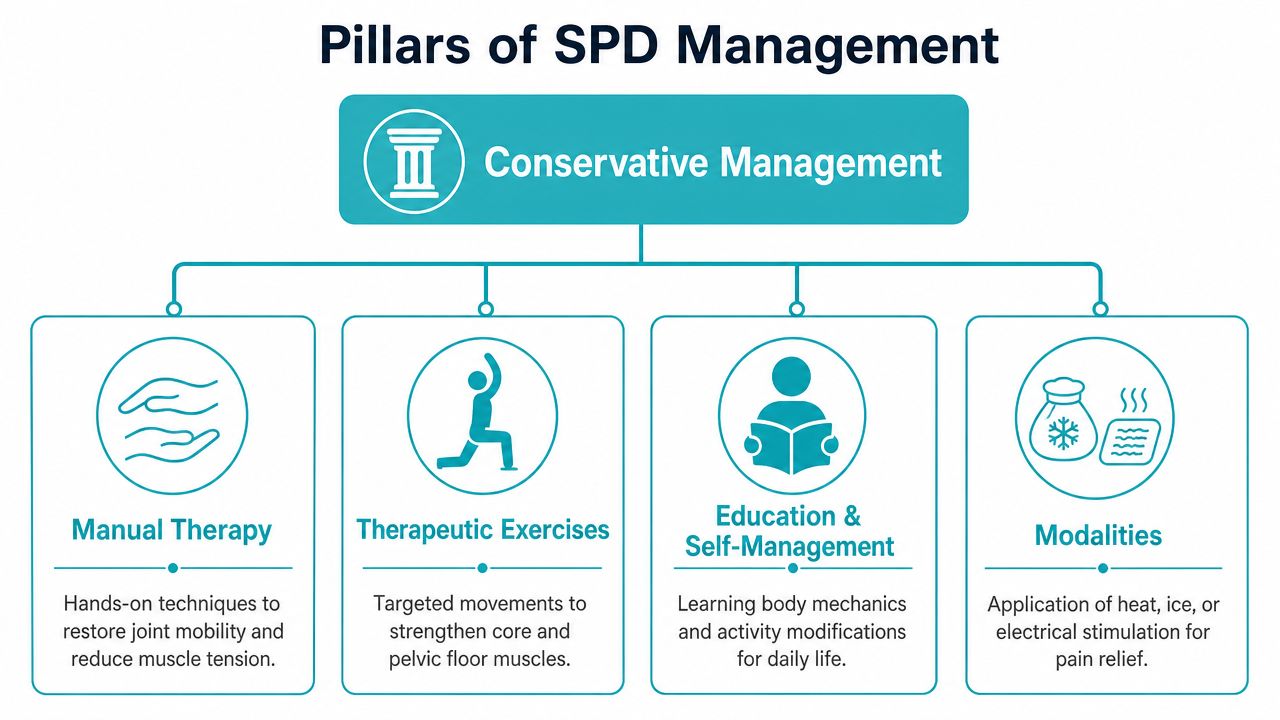
Manual therapy can reduce guarding
When SPD is painful, the muscles around the pelvis, hips, inner thighs, abdomen, and lower back often tighten up to protect the area. That guarding can make walking, rolling in bed, and standing on one leg feel even sharper.
Hands-on treatment can help settle those muscles and make movement feel less threatening. A physical therapist may use soft tissue work, positional adjustments, or gentle mobility techniques to improve comfort. The point is to create a better starting point for movement, not to "put the pelvis back in place."
Exercise builds support you can use in real life
Support belts and activity changes can help symptoms, but lasting improvement usually comes from better muscle timing and load sharing. Early rehab often looks modest from the outside, and that is often the right choice.
Small, well-tolerated exercises tend to work better than aggressive strengthening at first. If the pubic joint is irritated, the body usually responds best to controlled movements that improve coordination between the deep abdominals, pelvic floor, hips, and glutes.
Examples often include:
- Breathing with gentle abdominal support to improve pressure control
- Pelvic floor and trunk coordination drills so support turns on before movement
- Hip stability exercises in positions that do not provoke the joint
- Sit-to-stand, bed mobility, or step-up practice to make daily tasks less painful
- Postpartum reloading progressions that prepare the pelvis for impact if return to sport is the goal
If you want a fuller picture of how the whole system is evaluated and treated, this guide to pelvic floor physical therapy during pregnancy adds useful context.
Support tools can buy you breathing room
A pelvic support belt can reduce symptoms during walking or longer periods on your feet by adding compression and improving comfort. It does not fix the root problem by itself, but it can make it easier to stay active while rehab starts working.
Clothing comfort matters too. Pressure across the lower abdomen and pelvis can be irritating for some pregnant women, so simple waistband solutions for pregnancy can make day-to-day movement more tolerable.
Heat, ice, pacing, and short-term exercise changes can also help. These tools are most useful when they support a larger plan, not when they replace it.
What treatment often looks like in practice
| Treatment element | What it targets | Why it helps |
|---|---|---|
| Manual therapy | Muscle guarding and painful movement | Improves comfort so walking and exercise are easier to tolerate |
| Stabilization exercise | Deep trunk, pelvic floor, hips, glutes | Improves how load is transferred across the pelvis |
| Movement retraining | Transfers, rolling, stairs, single-leg tasks | Reduces repeated stress on the pubic joint |
| Support belt | External compression during activity | Helps some women stay more active with less pain |
| Postpartum progression | Strength, impact tolerance, symmetry | Prepares the body for running and sport, not just basic daily function |
A good plan should feel specific to you.
If an exercise causes a clear pain spike each time, it is probably too much for the current stage. If symptoms are settling and movement is becoming easier, the next step is gradual progression, not endless rest. That step-by-step approach is what helps many women move from immediate pain relief during pregnancy to full athletic function after delivery.
Pain-Relief Strategies and Daily Activity Modifications
When SPD is flared up, little decisions matter. How you get out of bed. How you sit down in the car. Whether you stand on one leg to put on leggings. These aren't minor details when the front of the pelvis is irritated.
The fastest way to reduce day-to-day pain is usually to stop feeding the aggravating pattern. That doesn't mean resting all day. It means moving with less asymmetry and less shear.
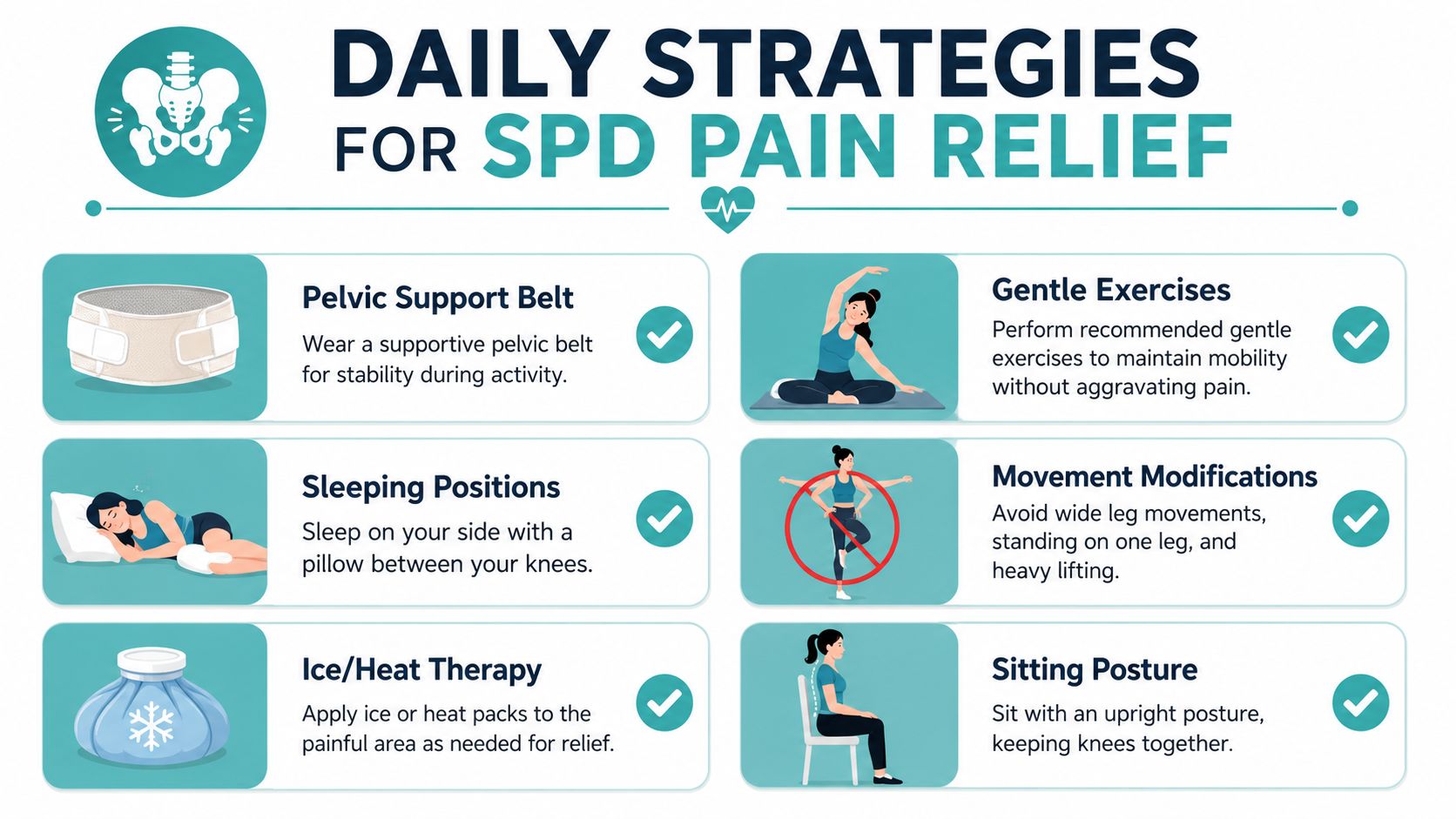
Daily changes that often help right away
- Keep your knees together when getting in and out of bed or the car. Move both legs as a unit when possible.
- Sit down to dress. Standing on one leg to put on pants, socks, or shoes is a common trigger.
- Shorten your stride when walking. Smaller steps often reduce pubic joint stress.
- Avoid wide stances during exercise, housework, or getting up from the floor.
- Use a pillow between your knees when side sleeping. Many women also like support between the ankles.
- Break up standing time if prolonged standing ramps up symptoms.
This movement demo can help you visualize one way to reduce strain during daily activity:
A few real-life examples
If getting out of the car hurts, swivel both legs together instead of stepping out one at a time.
If rolling over in bed hurts, squeeze a pillow gently between the knees and roll the shoulders, trunk, and legs together.
If lifting a small child hurts, bring them close before lifting and avoid twisting while carrying them on one hip.
Helpful tools without overcomplicating it
Some women feel better with a pelvic support belt during walking or errands. Others also benefit from clothing adjustments that reduce abdominal pressure and improve comfort. If your regular clothes are getting tight and irritating your midsection, practical waistband solutions for pregnancy can make everyday movement more manageable without forcing you into restrictive waistbands.
You don't need a dozen gadgets. You need a few supports that make movement easier and more repeatable.
A quick symptom guide
| Situation | Try this instead |
|---|---|
| Getting dressed | Sit on the bed or a chair |
| Rolling in bed | Keep knees together with pillow support |
| Car transfers | Pivot the whole body, move both legs together |
| Standing tasks | Use a footstool or sit when possible |
| Walking flare | Reduce distance or shorten stride |
Some pain relief comes from treatment. A lot of it comes from removing the small movements that keep poking the joint all day.
These changes aren't forever. They're temporary ways to calm symptoms so rehab can work.
Your Recovery Timeline and Return to Activity
The question nearly everyone asks is, “Will this go away after the baby is born?” In most cases, symptoms improve. Recovery isn't always instant, but the outlook is generally encouraging.
For the more severe postpartum form involving separation of the pubic symphysis, prognosis is very good for most patients, and many recover fully without persistent pain. According to the NCBI overview of postpartum pubic symphysis diastasis, symptoms often regress within the first 1 to 6 months, most case reports show near-complete closure and symptom resolution within 3 months, some patients may continue physical therapy for up to 6 months, and 25% of women still have pain at 4 months postpartum.
What that means in real life
Those timelines don't mean everyone should expect the exact same course. They do tell us that persistent pain early postpartum doesn't automatically mean permanent pain. Tissues and movement patterns often need time, guidance, and progressive loading.
A practical way to think about recovery:
- Early phase involves calming pain and restoring comfortable daily movement
- Middle phase focuses on rebuilding coordination, strength, and pelvic control
- Later phase adds impact, speed, heavier loading, or sport-specific work only when the body is ready
Why athletes need more than generic advice
Many SPD guides stop too early. They explain how to get through pregnancy or manage basic postpartum pain, but they don't tell runners, CrossFit athletes, dancers, or field sport athletes how to return to higher-level activity with confidence.
That gap is real. A Hinge Health review of SPD notes that there is a major lack of data-driven guidance on postpartum return-to-sport timelines for athletes, and emerging data suggests recurrence is high without targeted hip stability and core retraining.
That lines up with what many active women experience. They feel better walking, assume they're healed, then symptoms return when they try sprinting, heavy lifting, double-unders, or plyometrics.
A better return-to-sport approach
A smarter plan is criteria-based, not calendar-based. Instead of asking, “Has it been enough weeks?” ask:
| Question | Why it matters before impact |
|---|---|
| Can you walk briskly without pubic pain? | Walking tolerance is a baseline load test |
| Can you do single-leg tasks without instability? | Running and jumping demand that control |
| Can your hips and trunk manage force evenly? | Weak or delayed control can drive recurrence |
| Do symptoms stay calm after exercise? | Next-day flare tells you the load was too high |
If you're postpartum and still dealing with pubic pain, this article on pubic bone pain postpartum can help you compare what you're feeling with common recovery patterns.
For athletes, “return to exercise” and “return to sport” are not the same thing. Walking, spinning, jogging, lifting, sprinting, and jumping place very different demands on the pelvis.
The right progression builds capacity in layers. Control first. Then strength. Then impact. Then speed and sport-specific demands.
How Lake City Physical Therapy Can Guide Your Recovery
When you're dealing with symphysis pubis dysfunction, reassurance helps. Specific guidance helps more. You need someone who understands pregnancy, postpartum healing, pelvic health, and the demands of returning to an active life.
That combination matters because SPD sits at the intersection of several systems. The pelvis has to transfer force well. The deep core and pelvic floor have to coordinate. Hips need strength and timing. Daily movement patterns need to stop irritating the joint. If your goal is returning to running, CrossFit, volleyball, dance, or lifting, rehab also needs to account for impact and performance.

Lake City Physical Therapy focuses on women's health, prenatal and postpartum rehab, pelvic floor therapy, oncology rehab, and women's sports physical therapy. That means care can be individualized to where you are right now, whether that's trying to sleep without sharp pubic pain, walking comfortably in late pregnancy, or rebuilding for high-impact sport after delivery.
Care is available across multiple clinics, including Coeur d'Alene, Hayden, Post Falls, Rathdrum, Liberty Lake, Spokane South Hill, Eagle, and Boise. Telehealth options are also available for women who need remote support or more flexible scheduling.
If you've been trying to manage this on your own, the next step doesn't need to be complicated. A skilled evaluation can identify whether your pain pattern fits SPD, what movements are keeping it irritated, and what your body needs next.
The main takeaway is simple. SPD is painful, but it's manageable. With the right treatment and progression, many women move from pain relief to real strength and confidence again.
If you're ready for expert help, Lake City Physical Therapy offers specialized prenatal, postpartum, pelvic floor, and women's sports rehab with in-person clinics and telehealth options. You can explore services, find your nearest location, and book an appointment online to start a clear recovery plan.