Rib Pain During Pregnancy: Causes and Expert Relief Guide
You're 30-plus weeks along, you turn in bed, and a sharp ache catches under your ribs. Sitting a little longer makes it tighter. A deep breath feels limited. You may even start wondering whether this is just “part of pregnancy” or something that needs a call. Rib pain during pregnancy can feel surprisingly personal, because it touches everything, sleep, breathing, getting dressed, and even how you sit at your desk or in the car.
The good news is that this symptom usually has a mechanical explanation, and that matters because mechanical problems are often workable. If you've been looking for a calm, practical explanation of what's happening and what helps, you can think of this as a guided walk-through, not a scare page. For general wellness habits that support a more comfortable day, you might also learn about wellness routines while you're figuring out what your body needs right now.
If your pain is mostly on one side and you're trying to make sense of that pattern, a helpful place to compare notes is this guide on pain in ribs on the right side during pregnancy.
What Rib Pain During Pregnancy Actually Feels Like
The most common story sounds ordinary until it happens to you. You're sitting on the couch, you reach for a water glass, and there's a sharp or dull pull under one rib. Or you lie down at night and suddenly notice the ache more because your body is finally still.
The feeling is often a mix, not one clean symptom
Some people describe stabbing pain, others say it feels bruised, tight, or like they can't take a full breath without pressure. It can sit under the breast, wrap around the side, or travel toward the back. The exact spot matters less than the pattern, especially if it shows up when you twist, hunch, or try to get comfortable.
A lot of readers worry that because the pain is in the rib area, it must be a lung, heart, or organ problem. Sometimes it is worth checking, and the red flags matter, but a large share of rib discomfort in pregnancy is tied to how the trunk is loading, moving, and breathing. That's why the pain may flare when you sit slumped, then ease when you change position.
Practical rule: if a movement reliably changes the pain, your body is often pointing toward a mechanical problem, not a mystery.
A women's-health physical therapist can be helpful here, as they examine how your rib cage, spine, breathing, and posture work together rather than focusing solely on the painful spot. For some readers, this broader perspective is what first makes the symptom understandable.
How Your Rib Cage Changes to Make Room for Baby
Think of the rib cage like a barrel with moving parts. It isn't a fixed box, it's a flexible structure with hinges at the spine and front of the chest, and pregnancy asks that barrel to make space from the inside out. As the abdomen grows, the body doesn't just “stretch,” it also changes how the ribs stack over the pelvis.
Why the pressure shows up under the ribs
As pregnancy progresses, the diaphragm shifts upward, the lower ribs can flare outward, and the soft tissue between the ribs may feel more irritated when you breathe, twist, or side-bend. That changes the sensation of each breath and makes the lower rib cage feel more exposed. The growing uterus adds to that pressure from below, so the rib area ends up doing more work than usual.
This adaptation is normal, and in many ways it's useful. Your rib cage has to keep working so you can breathe, carry, and later recover after birth. But normal adaptation can still feel uncomfortable, especially when your trunk is already dealing with balance changes, a changing center of mass, and less room in the abdomen.
Why the timing matters
Rib discomfort commonly begins around weeks 24 to 28 and often worsens in the third trimester, peaking around weeks 32 to 36 before improving as the baby drops lower (pregnancy rib pain timing). That timeline helps explain why many people feel blindsided. The body can cope with the first changes, then the pressure becomes more noticeable as the baby and uterus keep growing.
The key idea is simple, your ribs are not failing, they're adapting under load.
Common Causes and Patterns of Pregnancy Rib Pain
The easiest way to sort rib pain is to ask what seems to provoke it. In most cases, the answer falls into one of three patterns, mechanical, positional, or nerve-related. That doesn't replace a medical evaluation when needed, but it helps you notice whether the pain is behaving like a loading problem, a baby-position problem, or something that feels more referred from elsewhere.
Mechanical loading pain
This is the most common pattern. As the uterus enlarges and the fetus rises, the trunk changes how it carries weight, the lower rib cage gets more pressure, and the muscles between the ribs can get irritated. Pain that increases with slumping, standing for a long time, or rotating to reach the back seat often fits here. Pregnancy-related rib pain is usually a mechanical loading problem rather than a dangerous primary rib disorder (mechanical rib loading in pregnancy).
Positional discomfort
Sometimes the baby's position is part of the story. A head, shoulder, or general body position tucked high under one side can make one area feel crowded, pokey, or tender. If the pain seems to change when the baby moves, or if one side is clearly more sensitive than the other, that positional piece may be part of it.
Nerve or referral patterns
Not every rib-area pain starts in the rib cage itself. Sometimes the thoracic spine, surrounding joints, or soft tissue can refer pain toward the ribs. If deep breathing, certain reaches, or a long day at the computer make the symptom spread, that broader pattern matters. If you're comparing discomfort that seems tied to movement with other pregnancy aches, the discussion of ligament pain during pregnancy can help you separate “normal but annoying” from a pattern that deserves a closer look.
A quick self-check can help:
- Mechanical: Does it change when you sit, stand, twist, or lift?
- Positional: Does the pain line up with where the baby feels most active or pressed in?
- Referred: Does the discomfort seem to come from the back, side, or chest wall rather than one exact rib?
A Trimester-by-Trimester Symptom Timeline
Rib pain is often described as very common in pregnancy, and it tends to show up more in the third trimester, when the growing uterus and fetal position can press more under the rib cage. A timeline makes the pattern easier to understand and easier to sort out from other causes.
| Trimester | Typical timing | Common drivers | What usually helps |
|---|---|---|---|
| First | Less typical | Early posture changes, hormone-related loosening, reflux-like chest discomfort | Gentle posture awareness, symptom tracking, provider check if pain is unusual |
| Second | Often begins here | Growth pressure, baby position, trunk compensation | Position changes, side-lying support, breathing, movement breaks |
| Third | Often strongest here | More rib cage pressure, less abdominal space, sharper posture strain | Frequent repositioning, pillow support, gentle mobility, medical review for red flags |
The first trimester is not the usual time for strong rib pain, so symptoms here deserve a little more attention. Early hormone changes can make joints feel looser, and the chest area can feel irritated if reflux or posture changes are part of the picture. If the discomfort feels out of step with the rest of your pregnancy symptoms, it is reasonable to mention it to your provider.
The second trimester is often when the rib cage starts to feel the workload. The uterus grows, the trunk has to adjust, and many pregnant people begin to compensate without realizing it, especially when they sit long hours or guard one side of the body. A long car ride, a bra that digs in, or repeated twisting can turn a mild ache into a sharper complaint.
By the third trimester, the rib cage often has less space to move comfortably. The diaphragm, spine, and upper back all have to share that smaller working area, so the ribs can feel squeezed from several directions at once. That is why frequent repositioning, pillow support, and gentle mobility often help more than trying to push through the day with the same habits.
The pattern can also change from day to day. If the pain eases when the baby drops lower, that does not mean the earlier discomfort was in your head. It usually means the whole-trunk mechanics changed, and the rib cage finally got a little more room to work with.
Safe Self-Care, Posture, and Daily Modifications
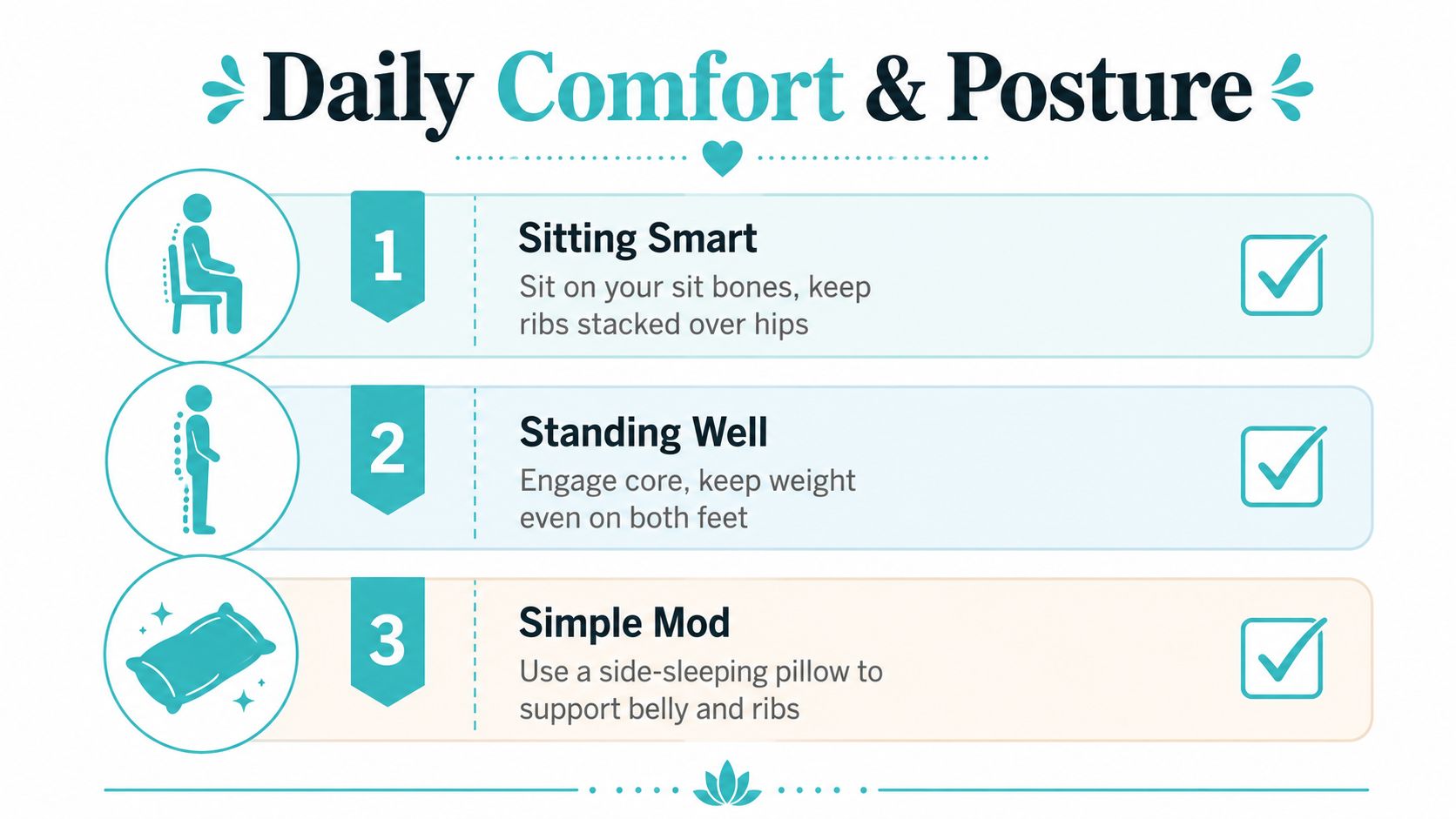
The goal with day-to-day comfort is to stop feeding the pain with small habits that pile up. You don't need perfect posture, you need less rib compression, less twisting strain, and more room to breathe. A few practical changes can make ordinary tasks feel less punishing.
Make the boring moments easier
At a desk or kitchen table, sit on your sit bones and let your back of waist feel long, not collapsed. If your ribs are drifting forward over your belly, try gently stacking ribs over hips again. That one cue can reduce the “hinged open” feeling that some pregnant people notice after a long day of sitting.
Getting out of bed matters too. Roll to your side first, use your arms to push up, and avoid curling your trunk hard against your ribs. That keeps the chest wall from taking a sudden crunch every morning.
Support the places that get overloaded
A bra that fits well can change how your upper trunk feels, and seatbelts can be adjusted so they sit correctly without digging into the rib cage. If you sleep on your side, use pillows to support your belly and keep your hips stacked, because a twisted spine often makes the rib discomfort worse. If you're already thinking about support options, wrapping a pregnant belly is a conversation worth having with a clinician who knows prenatal mechanics.
A small setup change often helps more than pushing through one more hour in a bad position.
If you sit a lot, add movement snacks. Stand up, take a few breaths, walk to the hallway, and let your rib cage expand without forcing a giant stretch. The point is to interrupt the long, compressed posture before the pain becomes the loudest thing in your day.
Gentle Exercises and Breathing Strategies for Rib Relief
If daily modifications are the background work, this is the active piece. The goal isn't to stretch aggressively or “crack” the ribs into place. It's to remind the trunk that the ribs can move, the breath can be easier, and the spine doesn't have to guard every inch of space.
Start with one easy side-lying opener
Lie on your side with a pillow under your head and another between your knees. Let the top arm rest forward, then slowly open that arm and chest a little, like a book opening halfway. Take 3 to 5 easy breaths there.
What you want is a gentle stretch across the side ribs, not a pinch in the front of the chest or a pulling sensation in the belly. Stop if the movement makes you dizzy or increases pain sharply.
Use a towel or strap for a seated chest-and-side stretch
Sit tall, hold a towel lightly overhead or out to the side, and shift just a little away from the tighter side. Keep the movement small. Two or three slow breaths is enough to start.
If it feels right, the stretch should seem broad and slow, not urgent. You're trying to create space, not force a range your body doesn't want today.
Try a wall-supported rib mobility drill
Stand with your back near a wall, feet a comfortable distance away, and let one hand rest on your side ribs. Breathe into the hand so the ribs widen sideways and back, then relax. A few rounds can help the chest wall remember that breathing doesn't have to lift only upward.
The reason this matters is simple. 360-degree breathing can support rib comfort now and also help with later pelvic floor coordination, because the diaphragm and pelvic floor work together as a pressure system. One isn't doing the job alone.
The video above can be a useful visual if you learn better by watching the setup once before trying it yourself.
Keep the effort light
None of these should feel like a workout. A mild stretch, easier breathing, or a sense that the rib cage is less guarded is the right direction. If a movement causes sharp pain, makes you short of breath, or leaves you feeling worse afterward, stop and reassess.
Red Flags and When to Seek Medical or PT Care
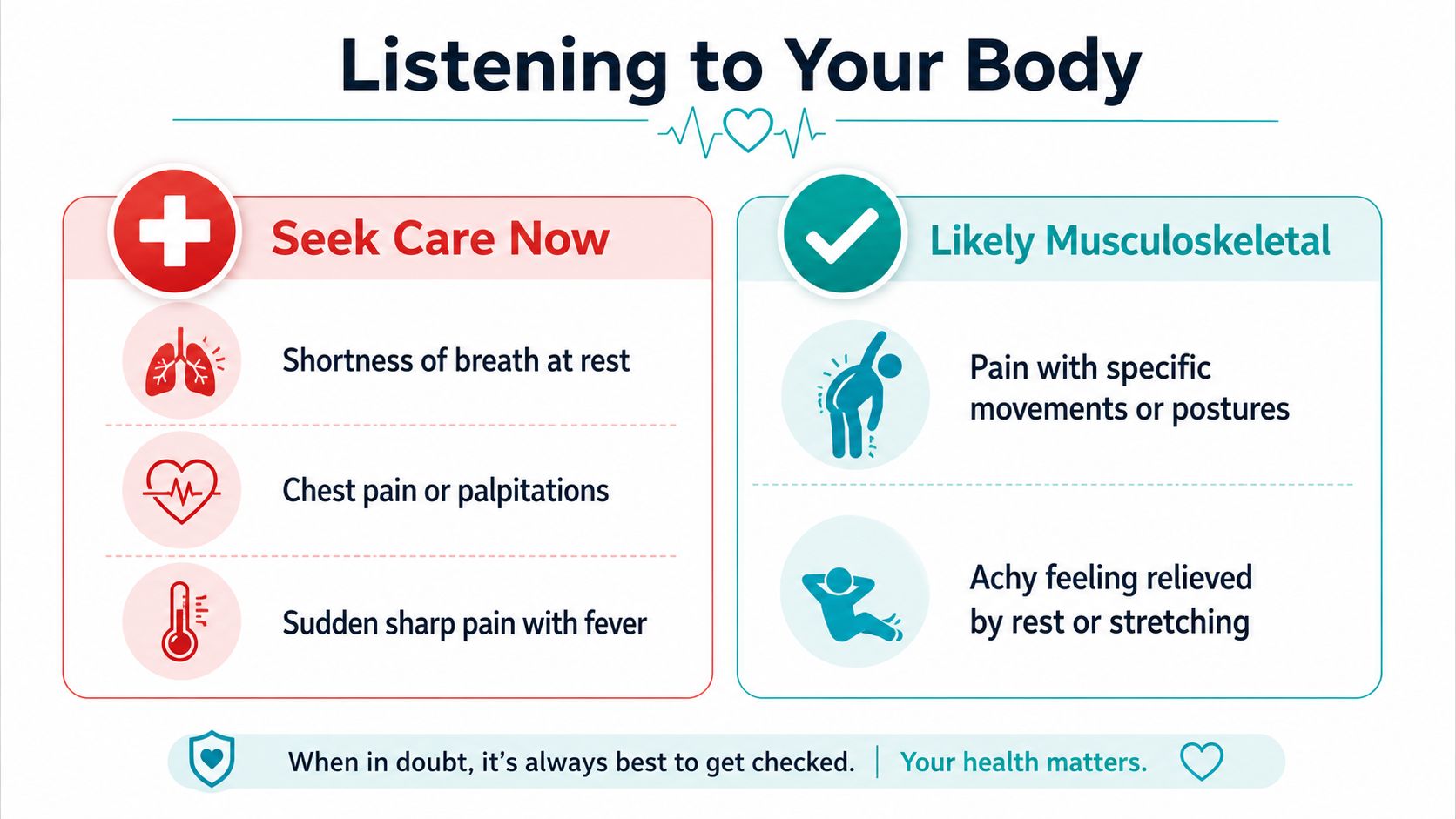
Rib pain during pregnancy sits on a spectrum. Some aches are part of the usual strain on the rib cage and trunk, while other symptoms need prompt medical review because they can signal something more serious. The warning signs that deserve same-day attention include shortness of breath, palpitations, coughing up blood, severe pain, headache with visual spots, dizziness, vaginal bleeding, or abdominal pain. The HSE red-flag symptoms list is a useful reminder of those patterns, and the infographic below shows how urgent symptoms differ from pain that is more likely musculoskeletal.
When the pattern looks more musculoskeletal
Mechanical rib pain usually has a clear pattern. It often shows up after certain postures, twisting, reaching, lifting, or long periods of sitting, then settles when you change position, rest, or breathe more freely. That pattern points to the trunk, ribs, and breathing muscles working under load, which is very different from a symptom that appears suddenly and feels out of proportion to movement.
A women's-health physical therapy visit is worth considering when the ache keeps returning, rib flare seems to change how you breathe, or the discomfort continues after delivery instead of easing. A PT can look at the ribs, spine, breathing pattern, and the way your whole trunk is managing pressure, then build a plan around your daily life, not just around exercise. If you are also sorting through support garments while your body changes, nursing bra fit tips can help reduce one more source of rib compression.
If the pain keeps returning despite better positioning, the trunk mechanics probably need a more specific look.
That is the point where self-care may not be enough on its own. You do not need to wait until the pain is severe to ask for help, especially if it is disturbing sleep, making breathing feel guarded, or changing how you move through the day.
How a Women's Health Physical Therapist Can Help
A prenatal physical therapy visit usually starts with a conversation, not an exercise sheet. A clinician will ask where the pain lives, what makes it worse, what helps, and whether it's changed with posture, sleep, coughing, or daily tasks. From there, they can assess how your ribs, spine, and breathing pattern work together, because rib pain is often a whole-trunk mechanics problem, not just a simple “baby pushing on ribs” issue (thoracic mobility and rib pain guidance).
What the visit can include
A women's-health PT may use manual therapy for the thoracic spine or rib joints, gentle mobility work, and breathing retraining to reduce guarding around the chest wall. They can also match the home plan to your actual life, which might mean car-seat posture, sleep setup, desk habits, or how you get through a workday without flaring symptoms.
If you're keeping notes from appointments, it helps to store healthcare documents securely so you can track what changes, what helps, and what still needs attention after birth.
Why this matters after delivery too
Rib discomfort doesn't always stop the day the baby is born. If thoracic restriction, shallow breathing, or rib flare hang around, they can affect core recovery, breathing mechanics, and the way you return to lifting, feeding, and everyday activity. That's one reason this topic belongs in prenatal and postpartum care, not just in a late-pregnancy discomfort bucket.
Lake City Physical Therapy offers pelvic floor physical therapy and prenatal/postpartum care, so rib symptoms can be addressed alongside the broader recovery picture when that fits your situation. A visit can also include education on labor positions and early postpartum pacing, which helps turn a painful mystery into a plan.
If your ribs have been bothering you for more than a few days, or the pain keeps interrupting sleep and movement, book an evaluation with a women's-health physical therapist this week. You deserve a clear answer, a calm exam, and a plan that fits your body right now.
A CTA for Lake City Physical Therapy.

