Prenatal Pelvic Floor Exercises That Actually Work
You're probably here because something small changed. A cough leaked a little urine, a long day left you feeling heavy, or you just want to do the right thing before baby arrives and you're tired of random advice that all sounds the same. Prenatal pelvic floor exercises can help, but only if they're done with the right mix of strength, relaxation, breath, and pressure control.
That mix matters more than most quick Kegel lists admit. The pelvic floor isn't just a set of muscles to squeeze harder, it's a support system that has to contract, relax, and respond to pressure as your body changes. If you're looking for a local assessment because you want hands-on guidance, find pelvic floor therapy in Kansas City is one option to compare as you decide what kind of help makes sense for you.
Why Your Pelvic Floor Deserves Attention Before Baby Arrives
The first time many people think about the pelvic floor is after a sneeze, a laugh, or a shift in bed that brings a strange heaviness. That moment can feel embarrassing, but clinically it's useful. It tells you the system that supports the bladder, uterus, and rectum is being asked to handle more pressure than it wants to handle alone.
A good prenatal routine isn't about squeezing as hard as possible. It's about teaching the pelvic floor to support pressure during daily life, then let go fully when the body needs to soften for birth and recovery. That's why technique matters so much, and why a program that ignores breath or body position usually falls short.
What a useful routine should actually feel like
The right work feels controlled, not gripping. You should be able to contract, breathe, and release without your belly bulging, your glutes clenching, or your breath freezing. If it feels like a strain, a brace, or a hard tuck under the pelvis, that's usually pressure being pushed the wrong way.
Practical rule: if you can't relax between reps, you're not training control, you're training tension.
Position matters too. Lying down can make the first attempt easier, sitting often makes the contraction more honest, and standing shows you what happens when gravity joins the party. That's one reason prenatal pelvic floor exercises work best when they're treated as a skill, not a rep count.
Finding the Right Muscles Without Bearing Down
The most common mistake I see is simple, and it's not the pelvic floor at all. People brace their abs, squeeze their buttocks, hold their breath, and call it a Kegel. That pattern can make the outside of the body feel busy while the pelvic floor stays undertrained or overworked.
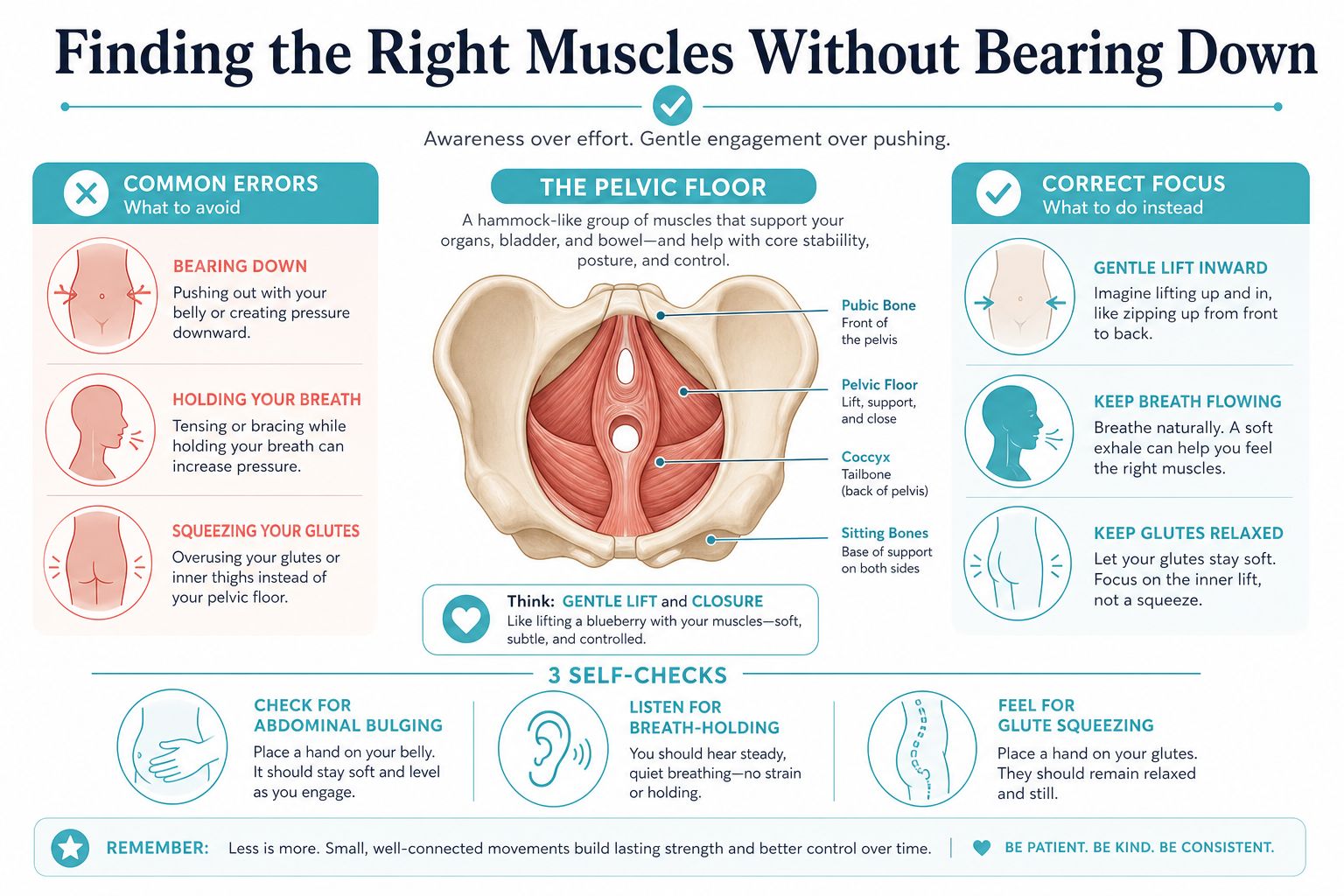
Three ways to check your form once, then stop testing
Use the stop-the-stream cue only as a learning tool. If you briefly interrupt urine flow once, it can help you identify the muscles, but don't turn that into a regular exercise. Repeatedly stopping urination can interfere with normal bladder emptying.
Try the visual lift cue next. Imagine the muscles around the vagina and anus gently drawing inward and upward, like an elevator moving one floor at a time. If you see your belly doming or your ribs flaring, back off and make the effort smaller.
The finger cue is another one-time check if you need it. A clean finger placed at the vaginal opening should feel a gentle lift and squeeze inward, not a push down. If the body bears down, the pelvic floor is doing the opposite of what you want during pregnancy.
Breath leads the rep
Exhale on the lift. Inhale on the release. That rhythm keeps pressure from getting trapped inside the abdomen and makes the exercise more functional for coughing, lifting, and getting off the floor.
The release matters as much as the squeeze. A full release should feel like the pelvic floor softens and widens, not like it stays half-on all day. If you can't tell the difference between on and off, the routine needs to be smaller, slower, or checked in person.
For a clearer visual on form, the exercise demo at how to strengthen pelvic floor muscles can help you compare what you feel with what you see.
Your First Safe Routine
A beginner routine should feel almost plain. No special equipment, no chasing fatigue, just a pattern you can repeat tonight and judge objectively tomorrow morning. The aim is to build endurance, quick response, and real-world control without aggravating symptoms, while also leaving room for the pelvic floor to relax fully between efforts.
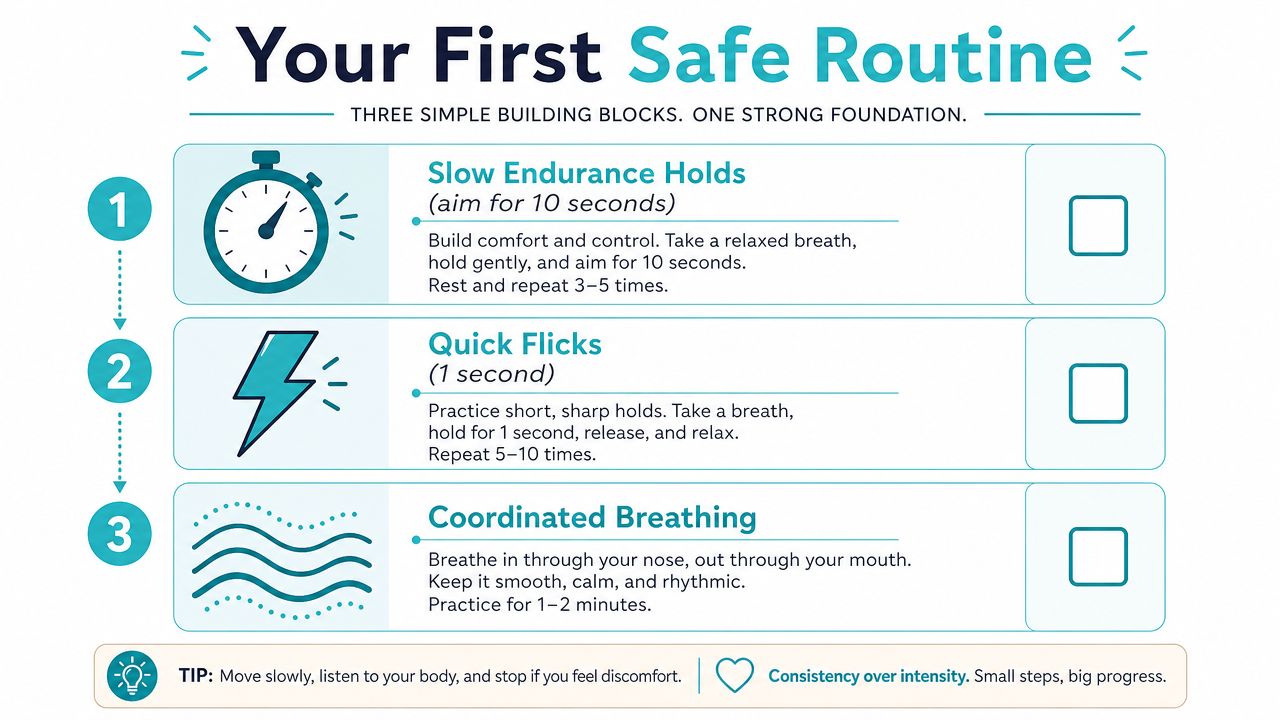
The daily structure
A simple starting dose is 3 sets of 8 squeezes every day, with quick contractions first and slower holds after that, while keeping the breath steady and letting the muscles fully release between reps. The NHS gives the same basic structure and asks patients to build slow contractions toward 10 seconds (NHS pregnancy exercise guidance). Tommy's gives the same daily target of 3 sets with 8 quick and 8 slow squeezes, which is a useful reminder that regular practice matters more than turning this into a hard workout.
If you tolerate that well and want a more endurance-focused version, a clinical benchmark uses 10 long contractions and 10 quick contractions, three times per day, with long holds gradually working toward 10 seconds and no breath-holding (hospital guidance video). That option fits better when the first routine feels easy, but it is not better if it makes you brace, grip your abdomen, or lose the release.
What to do in a real set
Start with one gentle lift on the exhale. Hold just long enough to keep the lift, then fully let go on the inhale. Repeat until you finish the set, and make the release as complete as the contraction.
Then switch to quick flicks. These are short, crisp contractions meant to answer sudden pressure, like a cough or sneeze. They should stay small and clean, not turn into a hard brace or a long squeeze.
Before you lift the laundry basket, cough, or sneeze, lightly brace the pelvic floor first, then move with the task.
That pre-contraction is one of the most useful parts of the routine. It teaches the pelvic floor to respond to real-life pressure spikes, not just perform well on the mat.
If you want a clearer visual while you practice at home, the exercise library at pelvic floor videos can help you compare what you feel with what you see.
Adapting the Routine by Trimester and Position
The same exercise can feel different depending on how far along you are and how you're positioned. Early pregnancy is often the easiest time to learn the skill, mid-pregnancy is usually where you can start making the work more functional, and late pregnancy is when comfort and pressure management matter more than chasing a perfect rep.
Earlier evidence suggests PFMT started in the middle of pregnancy can help a meaningful minority of pregnant and postpartum women avoid urinary incontinence. That gives you a practical reason to begin before leakage becomes the only cue that your pelvic floor needs attention.
Positions that change the challenge
| Position | Best For | What It Trains | Cue |
|---|---|---|---|
| Side-lying | Learning the motion, low-energy days | Gentle awareness, easier release | Keep the ribs quiet and breathe out on the lift |
| Seated | Building honest control | Better isolation, less cheating from the glutes | Sit tall without tucking under |
| Standing | Daily-life carryover | Pressure management against gravity | Exhale before you lift or cough |
| Hands-and-knees | Awareness and coordination | Reduced load, easier relaxation | Let the belly stay soft while you contract |
Side-lying is usually the easiest place to start when you are tired or uncertain about the movement. Seated work often reveals whether you are lifting the pelvic floor or recruiting your butt, thighs, or breath-holding to do the job. Standing adds the reality of gravity, so it shows you whether you can keep the lift when pressure rises during coughing, lifting, or transitioning out of a chair. Hands-and-knees can make the whole effort feel lighter, which helps some patients notice both the contraction and the full release.
How the trimester shift usually looks
In the first trimester, the biggest win is learning what a correct contraction feels like. That is the window to build the habit before fatigue, pressure, and body changes make everything more complicated.
In the second trimester, many people do better with mixed positions and slightly longer holds. You are trying to keep the pattern functional, not perfect, so standing work and position changes earn their place here.
By the third trimester, shorter sessions can work better than ambitious ones. Some days, side-lying or seated practice will feel better than standing, and that is fine. If the routine makes you strain, back off and shorten the hold. If you feel pressure dropping downward, leaking, or a lot of abdominal gripping, that is a sign to simplify the position and reduce the effort before you keep going.
The Late-Pregnancy Shift Toward Relaxation
More squeezing is not always the answer late in pregnancy. Birth asks the pelvic floor to lengthen, soften, and open, so a plan that only trains contraction misses half the job. That's the piece many generic Kegel lists skip.
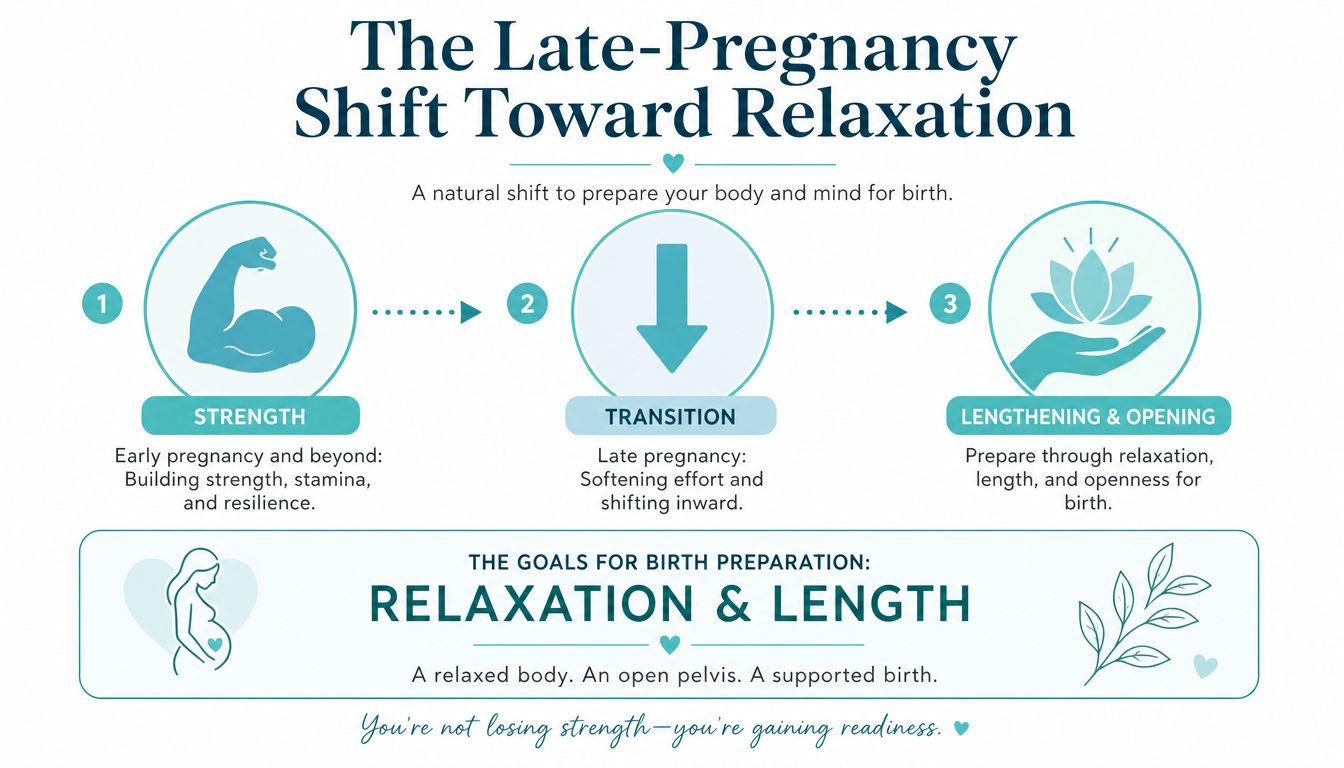
What relaxation work looks like
Diaphragmatic breathing is the simplest place to start. Let the inhale expand the ribs and belly, then let the exhale soften the pelvic floor without forcing it. That pattern helps the body practice pressure release instead of only pressure control.
Supported deep squats can be useful if they're comfortable and well tolerated. They encourage hip opening and a sense of downward length, which can be helpful when the body feels tight or guarded.
Perineal stretching or massage later in pregnancy is another option, especially when the tissue feels stiff or you're preparing for vaginal birth. The evidence around birth prep is still evolving, but many pregnancy education resources pair these strategies with breathing and pelvic floor relaxation rather than more repeated squeezing.
A short evening reset
- Two minutes of breathing: Inhale into the ribs, exhale and soften the pelvic floor.
- One supported squat hold: Stay only as long as it feels easy to breathe.
- A few gentle relaxation reps: Think open, widen, and melt, not push.
Consumer-facing pregnancy guidance also encourages ongoing pelvic floor exercises during pregnancy and using the contraction before coughing, sneezing, or lifting (Pregnancy, Birth and Baby pelvic floor guidance). The useful takeaway is balance. Train the lift, but don't lose the ability to release.
What the Evidence Shows
The research base is stronger than the advice many pregnant patients hear in a rushed visit. A randomized controlled trial in primiparous pregnant women found that pelvic floor muscle training, when built into a general exercise class and done consistently through pregnancy, helped prevent urinary incontinence trial summary and review. Broader reviews point in the same direction. Structured PFMT started in pregnancy can reduce the chance of leaking later on, especially for women who begin pregnancy without symptoms.
That pattern fits what I see in clinic. The people who do best are usually the ones who learn how to contract and fully release, coordinate the work with breathing, and keep the effort small enough that they are not bracing through the ribs, belly, or glutes. A program that only chases stronger squeezes misses half of what the pelvic floor needs.
The practical trade-off is simple. If you are continent, healthy, and able to find the muscles without bearing down, home practice is a reasonable place to start. If you already have pelvic pain, pressure, heaviness, constipation, trouble emptying, or you cannot tell whether you are squeezing or pushing down, an in-person pelvic health assessment is the better first step. That kind of screening matters because the same exercise that helps one body can irritate another.
Evidence summaries also suggest PFMT in pregnancy may lower the risk of urinary incontinence and some severe perineal injuries, while not changing every delivery outcome in a predictable way. That is useful because it keeps expectations realistic. The goal is not a perfect birth plan or a guaranteed symptom-free postpartum period. The goal is to give the pelvic floor better control, better pressure handling, and a better chance of recovering well.
Public guidance is useful when it is treated as a floor, not a script. The NHS pregnancy exercise guidance supports regular pelvic floor work during pregnancy, and the basic message matches the clinical evidence, consistency matters more than occasional strong effort. A review summary from the PAAH Journal points in the same direction, showing that pregnancy PFMT can help some women avoid later incontinence PAAH Journal summary. If you want help matching that evidence to your symptoms, a pelvic floor physical therapy during pregnancy visit can sort out whether self-management is appropriate or whether you need a hands-on exam first.
The bottom line is straightforward. Train the lift, train the release, and keep breathing through both. That is what the evidence supports, and it is what most pregnant bodies tolerate best.
Troubleshooting, Red Flags, and When to See a Specialist
If the exercise feels wrong, trust that feeling. The most common technical errors are breath-holding, butt clenching, bearing down, and over-gripping the lower abs, and each one can be corrected by making the effort smaller and pairing the lift with a longer exhale. If you can't stop your ribs from flaring, your effort is probably too big.
Stop self-guided work and get assessed if you notice any of these
- Pelvic pain or painful sex: Pain is not a normal training response, and it often means the plan needs to change.
- A heavy or bulging vaginal sensation: That can point to prolapse symptoms that deserve an in-person evaluation.
- Trouble emptying the bladder or bowel: Straining or incomplete emptying changes the picture and shouldn't be ignored.
- Leaking that worsens despite consistent training: If the pattern is getting worse, you need a different approach, not more random reps.
- Any symptom that feels wrong: Pregnant bodies give useful feedback. Don't override it.
Some reputable pregnancy resources advise stopping an exercise and talking with a healthcare provider if it causes pain, and clinical guidance increasingly pairs pelvic floor work with breathing and mobility instead of a one-size-fits-all Kegel prescription (BMC pelvic floor exercise guidance). If you already have pelvic pain, prolapse symptoms, painful sex, or bladder emptying problems, an in-person pelvic health assessment is the smarter first step.
A prenatal pelvic floor evaluation usually checks how you breathe, how you manage pressure, whether you can relax as well as contract, and whether the exercises are matching your symptoms. A pregnancy-focused service such as pelvic floor physical therapy during pregnancy can help sort out whether you need strengthening, down-training, or both.
Start this week with one short daily set, track whether symptoms improve, worsen, or stay the same, and note any red flags immediately. If the answer is unclear after a few days, book a pelvic health assessment rather than guessing through it.
A CTA for Lake City Physical Therapy if you're pregnant and unsure whether your pelvic floor needs strengthening, relaxation, or both. Their pelvic health team can assess symptoms, review technique, and help you choose the right next step instead of leaving you to sort it out alone.

