Perineum Tear Healing: A Practical Guide to Recovery
You lower yourself onto the toilet carefully, one hand on the wall and the other protecting the sore area between your vagina and anus. Eleven days after birth, you expected to feel tired, but you may not have expected sitting, urinating, or having a bowel movement to require this much planning.
That experience is common, but it deserves a more useful explanation than “give it six weeks.” Perineum tear healing has two layers: the wound must close, and the muscles, scar tissue, nerves, and pelvic floor must regain comfortable function. The skin may look healed while sitting still hurts, sex feels impossible, or your bowel and bladder control don't feel familiar.
The First Two Weeks After a Perineal Tear
In the first two weeks, many new mothers notice that the smallest tasks suddenly require strategy. Sitting down, standing up, emptying your bladder, or passing stool can feel sharp, burning, or heavy. That does not automatically mean something is going wrong. Early healing is often loud.
This phase is driven by inflammation, swelling, bruising, and the first stage of tissue repair. A small first-degree tear may behave more like a painful scrape. A second-degree tear reaches the perineal muscle, so the area can protest with walking, coughing, rolling in bed, and bowel movements. The outside view does not always match the deeper work your body is doing.
Location changes the experience too. A tear in the vaginal lining, an injury through the outer perineal skin, and a tear involving muscle can look similar at a quick glance but recover differently. According to a Cochrane review of perineal tear repair, first- and second-degree tears occur in approximately 50% of women after vaginal birth.
You can also expect postpartum bleeding to shift over time. It often moves from heavier red bleeding toward lighter brownish or pink discharge as lochia changes. Swelling and tenderness commonly increase a bit after activity. The pattern that matters is the overall direction. Day by day, the area should feel less reactive, even if progress is uneven.

What your body is asking for
The first two weeks work like a protection phase after a sprained ankle. The tissue needs support, reduced pressure, and time to knit together before it can tolerate more load. Rest helps, but total stillness is not the goal. Short walks around your home can support circulation, while long periods standing, repeated stair trips, or pushing through rising pain can leave the area more swollen and sore.
A few small adjustments usually help:
- Use cold briefly: A wrapped cold pack can calm swelling and numb discomfort. Keep a layer between the pack and your skin, and follow your maternity provider's instructions.
- Change positions often: Side-lying or leaning onto one hip can reduce direct pressure when sitting feels too intense.
- Rinse instead of rubbing: A peri bottle with clean water can make urination sting less and reduce friction from wiping.
- Keep bowel movements soft: Fluids, fiber, and any stool-softening medicine your clinician recommends can lower the strain on healing tissue.
- Choose breathable clothing: Loose cotton underwear and clothing can reduce rubbing and help the area stay more comfortable.
Later in this early window, a warm postpartum sitz bath can support perineal comfort if your clinician says it is appropriate. Warmth may soothe the area after the strongest swelling settles. It is not a substitute for medical review if pain is worsening, the wound seems to separate, or you notice fever or foul-smelling discharge.
One more point matters here. Skin can close before function fully returns. In these first two weeks, better signs of recovery include less guarding, easier bathroom trips, and a little more tolerance for sitting and walking, not just a wound that looks calmer.
Understanding Perineal Tears by Degree
Your perineum is easier to understand if you picture a house. The outer skin is like siding, the perineal muscles are the framing, and the anal sphincter is part of the foundation that helps control gas and stool. Damage deeper in that structure changes the repair and follow-up needs.
The four degrees in plain language
First-degree tears affect superficial skin or vaginal lining. They may heal with minimal intervention, although soreness can still interfere with sitting or urination.
Second-degree tears extend into the perineal muscle. They often need stitches because the muscle edges need to be brought together, and they can create more soreness with movement, coughing, bowel movements, or changes in position.
Third-degree tears reach the anal sphincter complex. These are called obstetric anal sphincter injuries and require specialist repair and structured follow-up because continence depends on more than surface closure.
Fourth-degree tears extend through the sphincter and into the rectal lining. They require surgical repair and careful monitoring of wound healing, bowel function, pelvic-floor coordination, and symptoms during sexual activity.
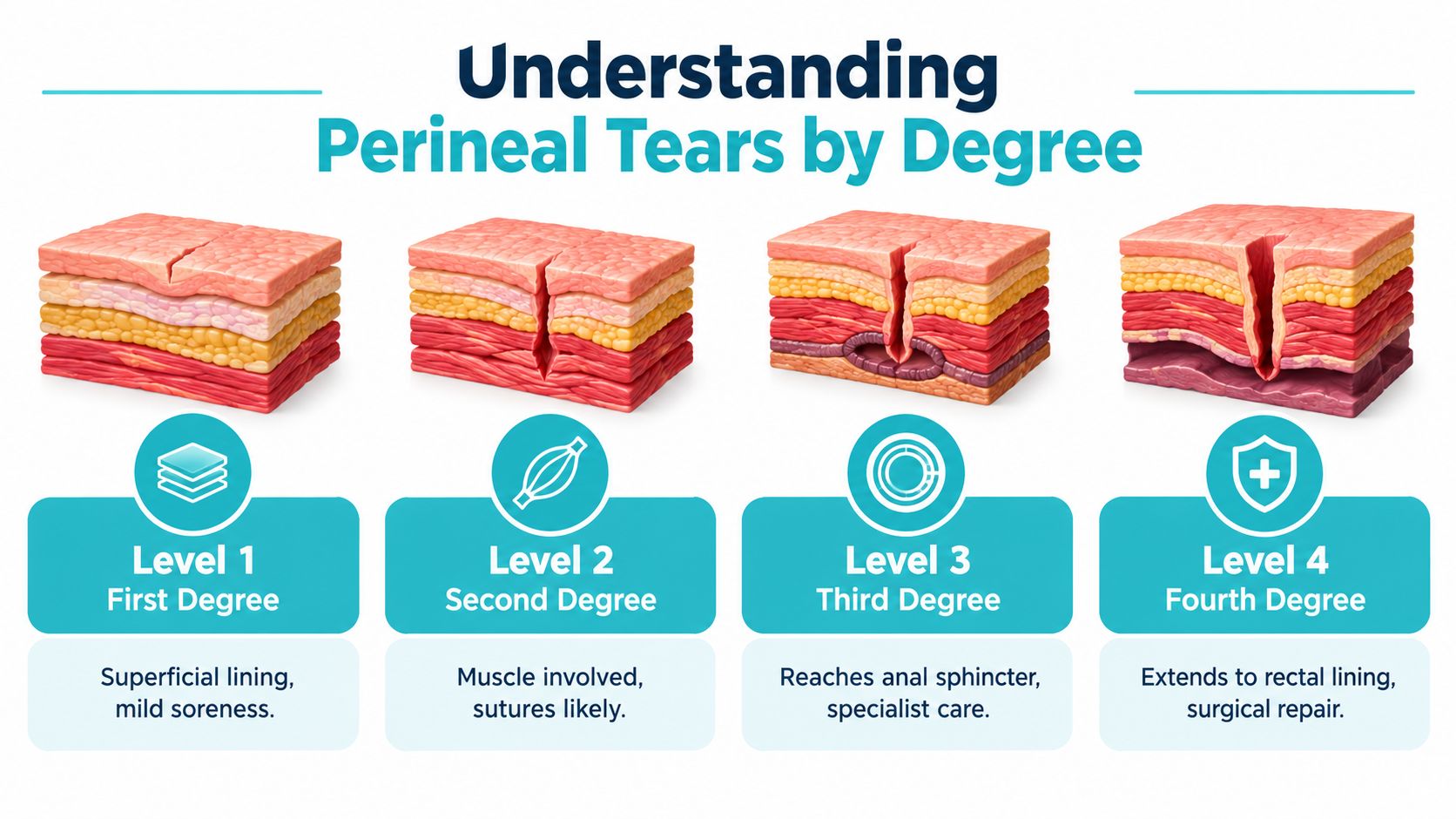
A provider's classification is more than a label. It tells you which tissues were injured and helps determine whether routine postpartum care is enough or whether specialist follow-up is needed. Third- and fourth-degree injuries may require assessment of continence, sphincter function, scar sensitivity, and pelvic-floor coordination even when the wound looks closed.
The outside appearance can mislead you. A small-looking opening may hide deeper muscle injury, while a larger superficial area may involve less structural damage. Don't use a mirror to decide whether you should return to exercise, penetration, or lifting. Use your symptoms, examination findings, and the guidance from your obstetric or pelvic health provider.
You can also use education to understand what happened anatomically. This visual guide to perineal massage may help you understand when scar care becomes appropriate, but don't massage an open, infected, or actively bleeding wound unless your clinician specifically directs you.
The important distinction is simple: first and second degree describe lesser trauma that doesn't involve the anal sphincter, while third and fourth degree involve a different level of clinical risk and follow-up.
The Healing Timeline From Week One to Six Months
At one week postpartum, many mothers wonder whether what they feel is normal. You sit down and feel a sting. You stand up and feel heaviness. You look at the area and hope that if it appears more closed, recovery must be nearly done. In reality, healing moves in stages, and each tissue has its own pace.
Week one and week two
In the first two weeks, the body is closing the wound, calming swelling, and protecting the area. Pain with urination, bowel movements, walking, or changing positions is common. The pelvic floor often reacts like a muscle group guarding a sprained ankle. It tightens to protect you, even when that tightness later adds more soreness.
Early comfort can also vary based on how the tear was repaired. Research on repair methods found that at two weeks, some women with sutured second-degree tears reported more pain than women whose tears were managed without sutures or with adhesive methods, as summarized in earlier evidence on repair methods and early pain. That does not mean stitches were a mistake. It means early pain is shaped by both the depth of injury and the way tissue was brought back together.
Some symptoms begin after the wound closes. A scar can feel stuck, dry, sharp, or overly sensitive, especially with sitting, wiping, or touch. If you want a broader explanation of why this happens, scar tissue pain after surgery explains how scarred tissue can stay uncomfortable after the surface has healed.
Around six weeks
For many first- and second-degree tears, the tissue is largely healed by around six weeks (RCOG guidance on perineal tears). That checkpoint matters, but it is not the same as being ready for every activity. A closed wound may still sit within muscles that are tight, weak, poorly coordinated, or afraid to lengthen.
This is why the six-week visit should be specific. Tell your provider if you still have tenderness, burning, scar sensitivity, urinary urgency, leakage, constipation, gas control problems, pain with sitting, or pain with sex. These symptoms give more useful information than appearance alone.
A postpartum recovery guide for the months after birth can help you place that visit in context. Recovery usually unfolds more like a gradual return of function than a single day of clearance.
Three to six months
By three to six months, your daily life becomes the true test. Lifting the car seat, taking longer walks, exercising, working, or trying penetration may reveal problems that were easy to miss while you were resting more.
A healed wound can still belong to a body that needs rehabilitation.
At this stage, progress depends on tissue mobility, pelvic-floor relaxation, strength, coordination, and confidence returning together. Some mothers feel steadily better. Others plateau. If symptoms are lingering, getting clearer, or affecting continence, comfort, or intimacy, they deserve assessment and a treatment plan rather than more waiting.
Pain Management and Conservative Self-Care
Your first-week routine should reduce pressure, protect the wound, and prevent pain from driving constant pelvic-floor clenching. You don't need every postpartum product. You need a few tools used consistently and safely.

A practical comfort routine
- Start with cold for swelling: Use a wrapped cold pack for short periods, then remove it. Numbness isn't the goal, and direct ice can injure sensitive skin.
- Offload the perineum: Side-lying often feels better than sitting. If you need to sit, choose a supportive cushion and change position frequently. A donut cushion can sometimes concentrate pressure around the opening, so stop using it if it makes symptoms worse.
- Clean with water: During urination, pour lukewarm water over the vulva with a peri bottle. Pat gently rather than rubbing.
- Make bowel movements easier: Follow your clinician's advice about stool softeners or laxatives, drink regularly, eat fiber-containing foods, and place your feet on a small stool so your knees are higher than your hips. Relaxed breathing can reduce pelvic-floor bracing.
- Use medication safely: Ask your obstetric provider or pharmacist which pain medicines fit your health history and breastfeeding plan. Don't assume that an over-the-counter product is appropriate just because it is widely available.
- Keep activity gentle: Short, easy walks can be useful, but pressure, throbbing, or increased bleeding after activity means you need to scale back.
Pain relief also has a nervous-system benefit. When you expect every movement to hurt, the pelvic floor may remain guarded, which can make sitting, bowel movements, and penetration harder later. Psychological strategies can complement physical care, and a CBT for chronic pain guide explains how pain-focused thoughts and protective behaviors can be addressed without dismissing the physical injury.
Contact your provider if pain is escalating instead of easing, if medication isn't controlling it, or if you notice wound separation, fever, foul discharge, or new bowel-control symptoms. Self-care supports healing, but it can't diagnose an infection or deeper repair problem.
Pelvic Floor Rehabilitation That Actually Works
Many new mothers are told to do Kegels as soon as possible. That advice can miss the central problem: a painful pelvic floor may already be working too hard.
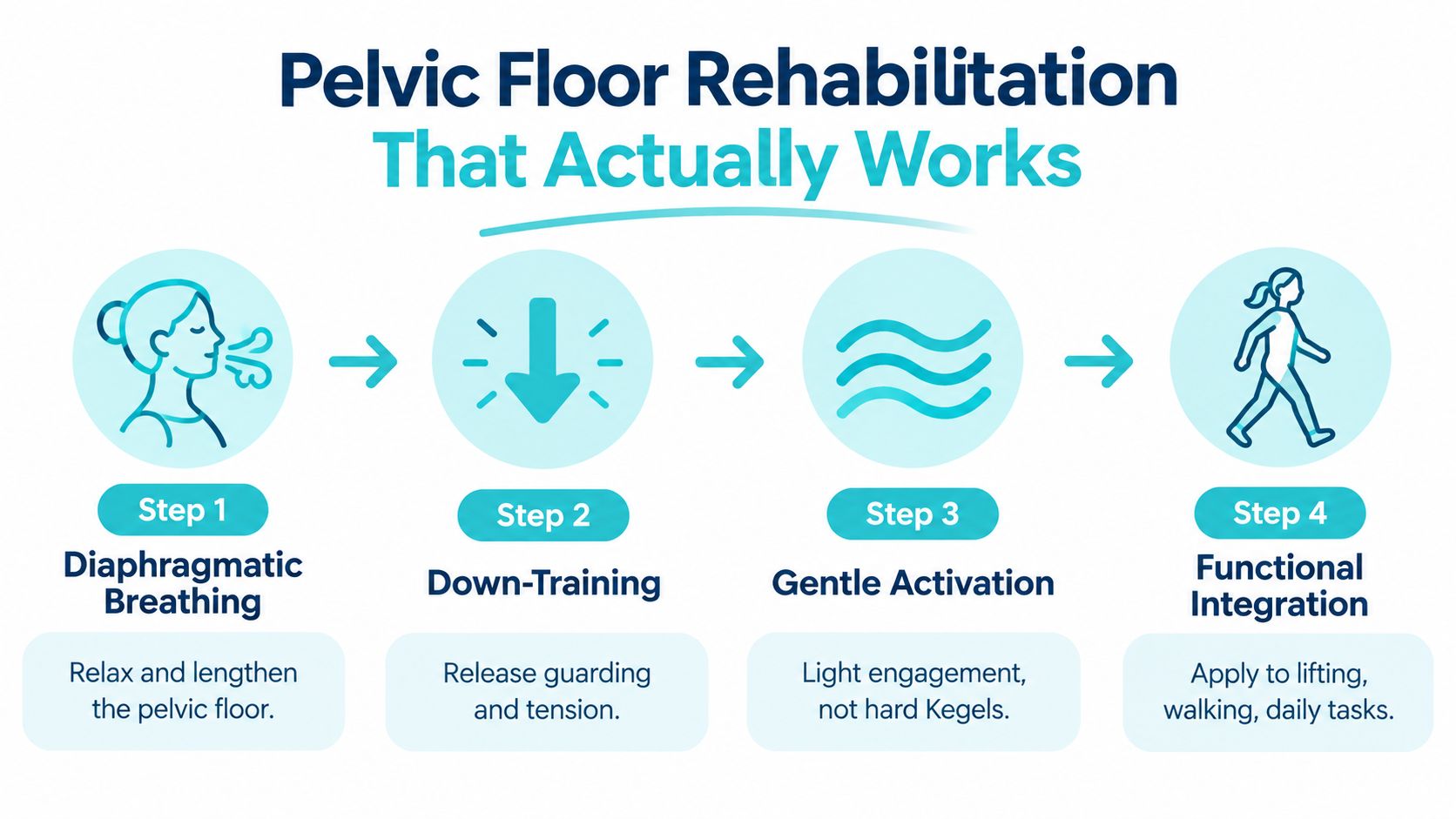
A muscle that stays clenched can't coordinate well. Repeated hard squeezing may increase pressure, tenderness, or pain with penetration when what you need first is the ability to relax. Rehabilitation should begin with awareness and release, then build toward controlled activation and functional strength.
Start by lowering tension
Once your provider says gentle movement is appropriate, try slow diaphragmatic breathing. Let your ribs expand as you inhale and imagine the vaginal and anal openings softening. On the exhale, allow the body to return naturally without gripping.
Next, practice a pelvic-floor drop. This isn't pushing or bearing down. It's the sensation of letting the pelvic floor lengthen while keeping your jaw, abdomen, and buttocks relatively relaxed.
Build capacity in stages
After you can relax without provoking symptoms, a pelvic health PT may introduce gentle pelvic-floor activation. The goal isn't maximum force. You're learning to contract lightly, release fully, and coordinate that action with breathing and movement.
Progress may then include:
- Breathing and release: Improve rib movement, pelvic-floor lengthening, and pressure management.
- Light activation: Practice short, controlled contractions followed by complete relaxation.
- Scar mobility: Once the tissue is fully healed and your clinician clears it, gentle scar work may reduce restriction and sensitivity.
- Hip and trunk loading: Rebuild strength for lifting, carrying, stairs, and longer walks.
- Impact progression: Return gradually to jogging, jumping, or sport based on symptoms, pelvic pressure, leakage, and examination findings.
A pelvic-floor evaluation looks at more than squeeze strength. Your therapist may assess breathing, coordination, muscle tone, scar mobility, hip and trunk function, bladder and bowel symptoms, and how your body responds to movement. An internal examination should be explained beforehand and requires your consent. You can decline it, pause it, or ask for another approach.
Ask for a referral if pain persists beyond the expected early phase, if you can't relax the pelvic floor, if sex remains painful, or if leakage, urgency, pressure, or bowel-control changes interfere with daily life. Targeted rehabilitation is the bridge between a closed wound and a body that works comfortably again.
Returning to Intimacy Without Fear
You may reach the point where the stitches look closed, bleeding has settled, and everyone assumes sex should feel normal again. For many new mothers, that is not how recovery works. Skin can heal before the deeper layers stop guarding, before the scar softens, and before the pelvic floor knows how to relax under pressure.
Pain with sex after birth is common, and it does not mean you are failing recovery. One prospective study found that postpartum perineal pain was nearly universal right after vaginal birth, then declined to 8.0% at seven weeks and 0.7% at six months (study of postpartum perineal pain and dyspareunia). Separate cohort data in first-time mothers found dyspareunia in 41% at three months and 22% at six months after birth, and second-degree tears and obstetric anal sphincter injuries were linked with higher odds of pain during sex at three months (cohort findings on postpartum dyspareunia).
That gap matters. A wound can be closed while function is still catching up. Comfortable intimacy depends on tissue mobility, pelvic-floor coordination, lubrication, and a sense of safety in your body, not just on calendar time.
A gentler return
Begin with contact that asks less of healing tissue. Talk with your partner before anything physical starts. Decide what feels okay, what is off limits for now, and how you will pause if your body tightens or pain appears. Closeness, external touch, massage, and other non-penetrative intimacy often help you rebuild trust in the area before you add stretch and friction.
If and when you try penetration, set it up to be as easy as possible. Use generous lubricant, especially if breastfeeding has made the tissue drier. Choose a position where you control depth and speed. Go slowly enough that you can notice the difference between pressure, stretch, and pain. Burning, sharp pain, pulling, or involuntary clenching are signs to stop, not push through.
Several things may be contributing at the same time:
- Scar sensitivity: The scar can stay tender, firm, or reactive to pressure.
- Pelvic-floor overactivity: The muscles may grip to protect the area.
- Hormonal dryness: Breastfeeding can reduce lubrication and comfort.
- Fear and anticipation: Expecting pain can trigger guarding before touch starts.
- Altered tissue mobility: The scar and nearby tissue may not move well yet.
You do not need to prove that you are healed by tolerating intercourse. If sex keeps hurting, a pelvic health clinician can assess the scar, muscle tone, and coordination, then guide a gradual return that helps your body feel safe, mobile, and comfortable again.
Warning Signs That Need Medical Review
Most postpartum discomfort gradually settles, but some symptoms should prompt a call rather than a wait-and-see approach. Your provider may need to examine the wound, check for infection, assess the repair, or arrange specialist care.
Contact your maternity provider promptly for
- Wound separation: A gap, sudden opening, or sensation that stitches have released needs examination.
- Increasing pain: Pain that becomes stronger instead of easing, particularly after the early recovery period, shouldn't be written off as normal.
- Infection signs: Fever, worsening redness or swelling, foul-smelling discharge, or a wound that looks unhealthy requires medical attention.
- Nonhealing tissue: Persistent bleeding from the wound, drainage, or tissue that remains open needs review.
- New urinary problems: Difficulty emptying your bladder, new retention, or worsening leakage should be assessed.
- Bowel-control changes: New fecal urgency, inability to control gas, or stool leakage is never something you need to accept without intervention.
Clinical reviews report that approximately 6% of women experience short-term wound complications after childbirth-related perineal trauma (BMJ clinical review of perineal trauma). The same review emphasizes that problems such as fecal incontinence may appear years after an obstetric anal sphincter injury, so a normal-looking wound doesn't eliminate the need to report later symptoms.
Seek urgent care for severe uncontrolled pain, heavy bleeding, fainting, high fever, or rapidly worsening swelling. If you had a third- or fourth-degree tear, keep every recommended follow-up appointment even when you feel well. Continence and pelvic-floor function require more than visual inspection.
New bowel leakage is a medical symptom, not a postpartum personality change. Tell your provider.
When Pelvic Floor PT Is the Right Next Step
Pelvic floor physical therapy isn't a last resort. It's a specialty that can address the gap between a repaired tear and comfortable function, whether your main concern is scar pain, painful sex, urinary leakage, bowel urgency, or difficulty relaxing.
A first evaluation usually starts with your birth history and symptoms. The therapist may watch your breathing, posture, walking, lifting mechanics, and abdominal pressure. An internal assessment may be offered to evaluate muscle tone, tenderness, coordination, scar mobility, and strength, but it should only happen with your informed consent.
For third- and fourth-degree injuries, objective follow-up matters because symptoms and anatomy don't always match. Guidance reports that 60–80% of women are asymptomatic 12 months after external anal sphincter repair, while endoanal ultrasound has identified residual sphincter defects in 19–36% of women in recent randomized trials (RCOG guidance on obstetric anal sphincter injuries). Those findings support combining symptom screening with examination and, when indicated, specialist testing.
Ask your obstetric provider for a referral if symptoms persist around the postpartum checkpoint, affect daily activities, or make intimacy feel unsafe. You can also contact a pelvic health clinic directly to ask about evaluation requirements, insurance, telehealth options, and whether the therapist treats postpartum perineal injuries.
Perineum tear healing is layered. Skin closure needs wound care, scar restriction may need mobility work, guarded muscles need down-training, and continence problems may require specialist assessment. Patience matters, but patience alone shouldn't be the entire treatment plan.
Lake City Physical Therapy provides prenatal and postpartum pelvic floor rehabilitation for concerns such as perineal tears, scar mobility, painful sex, and incontinence. If sitting, walking, bowel control, or intimacy still feels difficult, visit Lake City Physical Therapy to explore an individualized evaluation and treatment plan.

