Vaginal Pain During Ovulation: What It Means
You notice a sudden twinge low on one side of your abdomen around the middle of your cycle. It feels deep, perhaps almost vaginal, and you're left wondering whether it's ordinary ovulation or something to worry about. The location can be confusing: pain felt inside the pelvis doesn't always start in the vagina, and the timing alone can't confirm its cause.
A useful first distinction is whether the discomfort feels deep and one-sided, superficial at the vaginal opening, or linked to penetration or movement. The pattern can help you decide what to monitor and what to get checked, without assuming either that something is seriously wrong or that you should put up with it.
What Mid-Cycle Vaginal Pain Feels Like
“Vaginal pain” can mean a deep ache while you're sitting, tenderness when you touch the opening, or discomfort with penetration. In a pelvic health assessment, those descriptions help separate pain from deeper pelvic structures from surface irritation or muscle-related pain. The details matter more than the label.
A brief, one-sided ache near the middle of your cycle may be mittelschmerz, the medical term for ovulation-related pain. According to Cleveland Clinic's overview of ovulation pain, it affects up to 40% of people who ovulate, usually occurs on one side of the lower abdomen around mid-cycle, and can last minutes to hours or sometimes one to two days. That pattern can be reassuring, but calling it mittelschmerz doesn't rule out other causes.
Deep pain and surface pain aren't the same
Deep pain may feel like a sharp twinge, pressure, or a dull ache that's difficult to pinpoint. It can arise from the ovary or nearby pelvic structures and feel as though it's inside the vagina. Pain at the opening, especially with touch or entry, points toward a different assessment, including local irritation and pelvic-floor muscle tension. Pelvic-floor involvement can also contribute to deeper discomfort, so location alone cannot settle the cause.
A pelvic floor physical therapist assesses whether muscle tenderness, tension, or difficulty relaxing contributes to the symptoms. That assessment complements medical evaluation when an ovarian or other pelvic cause is suspected.
Timing helps narrow the possibilities. A brief ache that returns at a similar point in your cycle and resolves may fit ovulation-related discomfort. Persistent, severe, unfamiliar pain, or pain linked to penetration, deserves broader assessment rather than continued tracking alone.
A helpful first question: Does the pain feel deep and one-sided, or is it at the vaginal opening and brought on by touch or entry?
Record that distinction alongside cycle timing and what triggers the pain. A symptom diary gives a clinician a clearer pattern to assess without requiring you to diagnose yourself.
How the Ovary Produces That Mid-Cycle Sensation
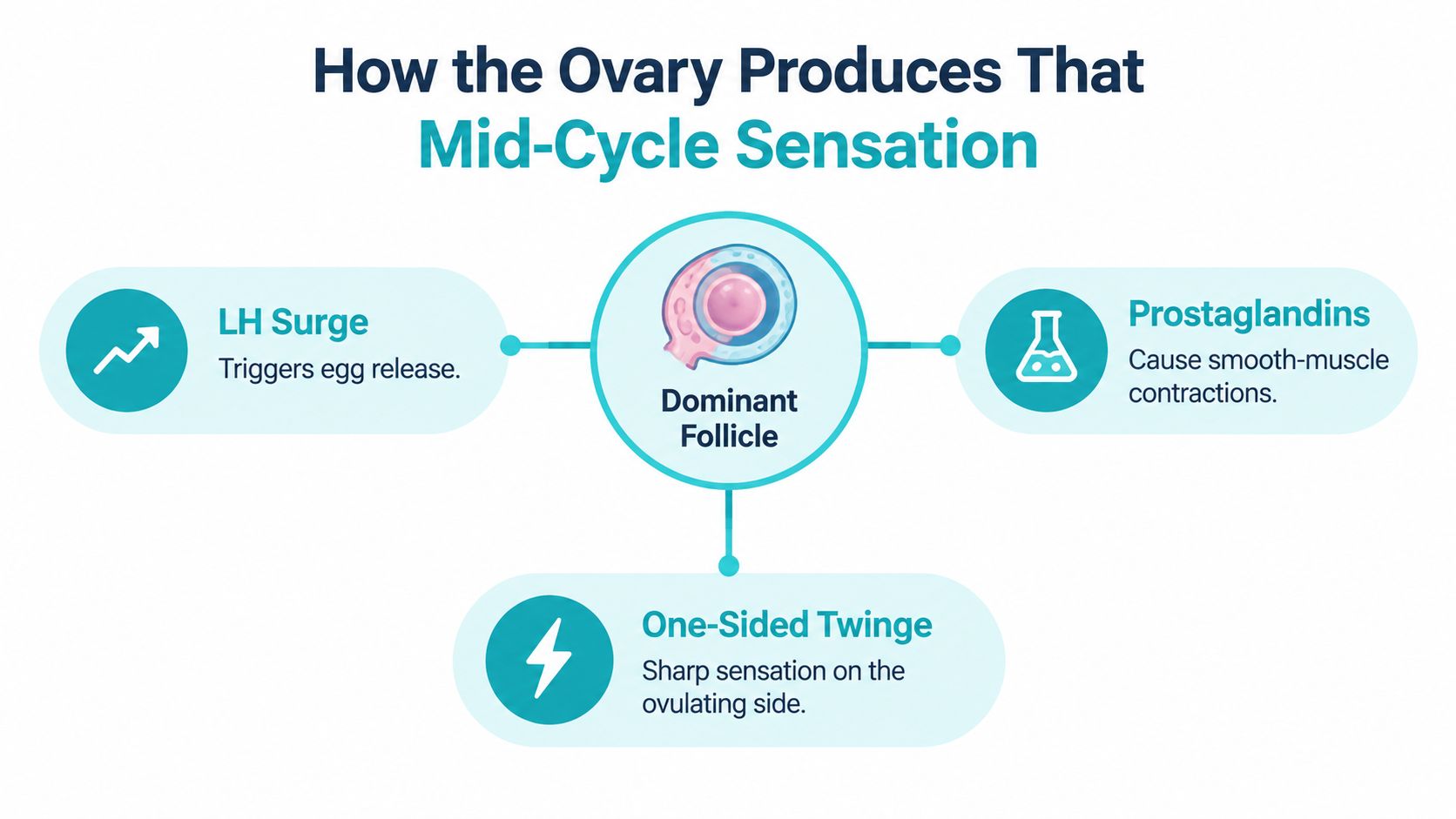
Around ovulation, a dominant follicle develops in an ovary and prepares to release an egg. A rise in luteinizing hormone, or LH, helps trigger that release. This is a physical process involving the ovary and nearby tissue, so a mid-cycle twinge isn't necessarily an ordinary muscle cramp that happens to coincide with ovulation.
Evidence summarized by the National Center for Biotechnology Information indicates that the LH rise may increase smooth-muscle activity around the follicle through a prostaglandin-mediated pathway. In plain language, chemical signals may encourage the tissue around the follicle to contract. That activity could contribute to a sharp or sudden sensation, which follicle enlargement alone may not fully explain.
Why the pain may feel sharp or poorly localized
When the egg is released, the ovary and surrounding structures undergo changes that can irritate nearby tissue. The result may feel like a brief jab, a dull ache, or a deeper pelvic sensation. Because pelvic organs and muscles share overlapping nerve pathways, the nervous system doesn't always map an internal signal neatly to the structure where it began. Pain that seems vaginal may therefore be felt from an ovarian or other pelvic source.
The pelvic floor, bladder, and bowel can also contribute to pain in the same region. A muscle that stays tense or reacts during penetration may create a sensation that overlaps with cycle-linked discomfort. Bladder or bowel symptoms can be useful clues, too. The goal isn't to decide the cause based on one sensation, but to notice how the pain behaves.
The timing matters, but it isn't the whole story
A repeated mid-cycle pattern can support an ovarian explanation, especially when the pain is one-sided and settles on its own. But cycle timing doesn't prove that the ovary is the only source. Recording the location, duration, and triggers helps distinguish pain that tracks with ovulation from pain that follows movement, penetration, or bladder and bowel activity.
Common Causes of Midcycle Vaginal and Pelvic Pain
Several conditions can feel similar around mid-cycle. Where the pain is, what brings it on, and how long it lasts are practical clues, though none can confirm a diagnosis by themselves.
| Cause | Where it hurts | How it feels | Timing | Triggers |
|---|---|---|---|---|
| Mittelschmerz | Often one side of the lower abdomen or deep pelvis | A brief twinge, sharp pain, or dull ache | Around mid-cycle, with a tendency to settle | May occur without a clear activity trigger |
| Ovarian cyst complication | Often one-sided and deep | A cyst rupture may cause abrupt, severe pain | Sudden onset; symptoms may need urgent assessment | Can begin without an obvious trigger |
| Endometriosis or adenomyosis | Pelvis, sometimes with pain during sex or menstrual symptoms | May be recurring, deep, or disruptive | Can relate to the cycle but isn't limited to a brief mid-cycle window | Penetration or other pelvic activity may aggravate it |
| Pelvic-floor muscle overactivity | Vaginal opening, pelvic muscles, or deeper pelvis | Tightness, tenderness, or pain with entry or movement | May persist beyond the ovulation window | Touch, penetration, exercise, or sustained muscle guarding |
What the pattern can suggest
Mittelschmerz is more plausible when a one-sided ache appears around the middle of the cycle and then resolves. Pain that starts suddenly and severely is different: a ruptured ovarian cyst can cause abrupt pain, sometimes with vaginal bleeding, nausea, vomiting, or signs of irritation inside the abdomen. Ovarian torsion is also time-sensitive, particularly when a cyst enlarges the ovary (Merck Manual guidance on female pelvic pain).
Endometriosis and adenomyosis can be part of the picture when pain recurs, affects sex, or accompanies other cycle-related symptoms. They warrant discussion with a clinician, particularly if the pain interferes with daily activities. For more background on these conditions, see Lake City Physical Therapy's guide to endometriosis and adenomyosis.
Pelvic-floor muscle overactivity deserves consideration when pain is reproducible with vaginal entry, movement, or muscle tension, rather than appearing only as a deep one-sided ache. A pelvic-floor assessment can help identify whether muscles and connective tissue are contributing alongside, or instead of, an ovarian source.
Building Your One-Cycle Symptom Map
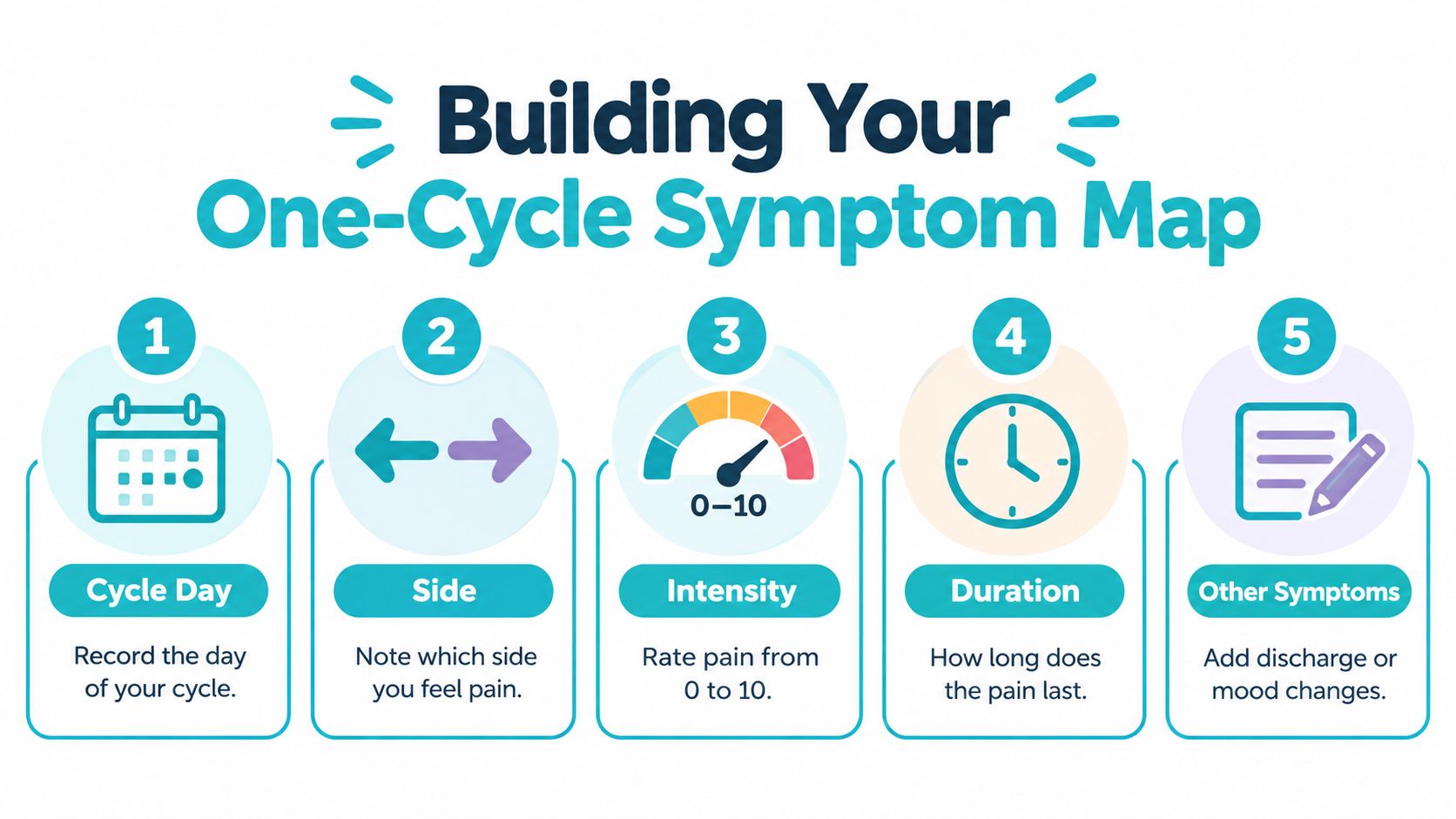
A symptom diary is most useful when it captures more than “it hurt around ovulation.” Start a note on your phone or use a paper calendar, then record the details as they happen. You don't need to predict ovulation perfectly. The point is to see whether pain repeatedly follows a similar pattern and whether anything besides cycle timing affects it.
Record what helps a clinician reason
- Cycle day: Note the first day of your period and the day the pain starts. This helps show whether the discomfort repeatedly appears near the middle of the cycle.
- Side and location: Write “left lower abdomen,” “deep pelvis,” or “vaginal opening” rather than “vaginal pain.” Location helps distinguish a deep sensation from entry pain.
- Intensity: Rate the pain from 0 to 10, and describe what you could or couldn't do during the episode. A 2024 cross-sectional study of 100 nonpregnant female students of reproductive age found that 88% of participants reporting mittelschmerz described it as mild on the Wong-Baker Faces Pain Rating Scale; this is a descriptive finding from that study, not a rule for everyone (the study's findings).
- Duration and associated symptoms: Record when it begins and eases, plus any spotting or changes in bowel or bladder symptoms.
- Triggers: Note whether penetration, exercise, sitting, or a particular movement brings the pain on or makes it worse.
If you want general guidance on keeping a cycle record, this resource on cycle tracking advice from XO can help you get started. For an appointment, bring the diary rather than trying to recall every detail from memory.
Quick checklist: cycle day, side and exact location, pain rating, duration, bleeding, bowel or bladder changes, and whether sex or exercise reproduces the pain.
Red Flags That Mean Stop Tracking and Start Calling
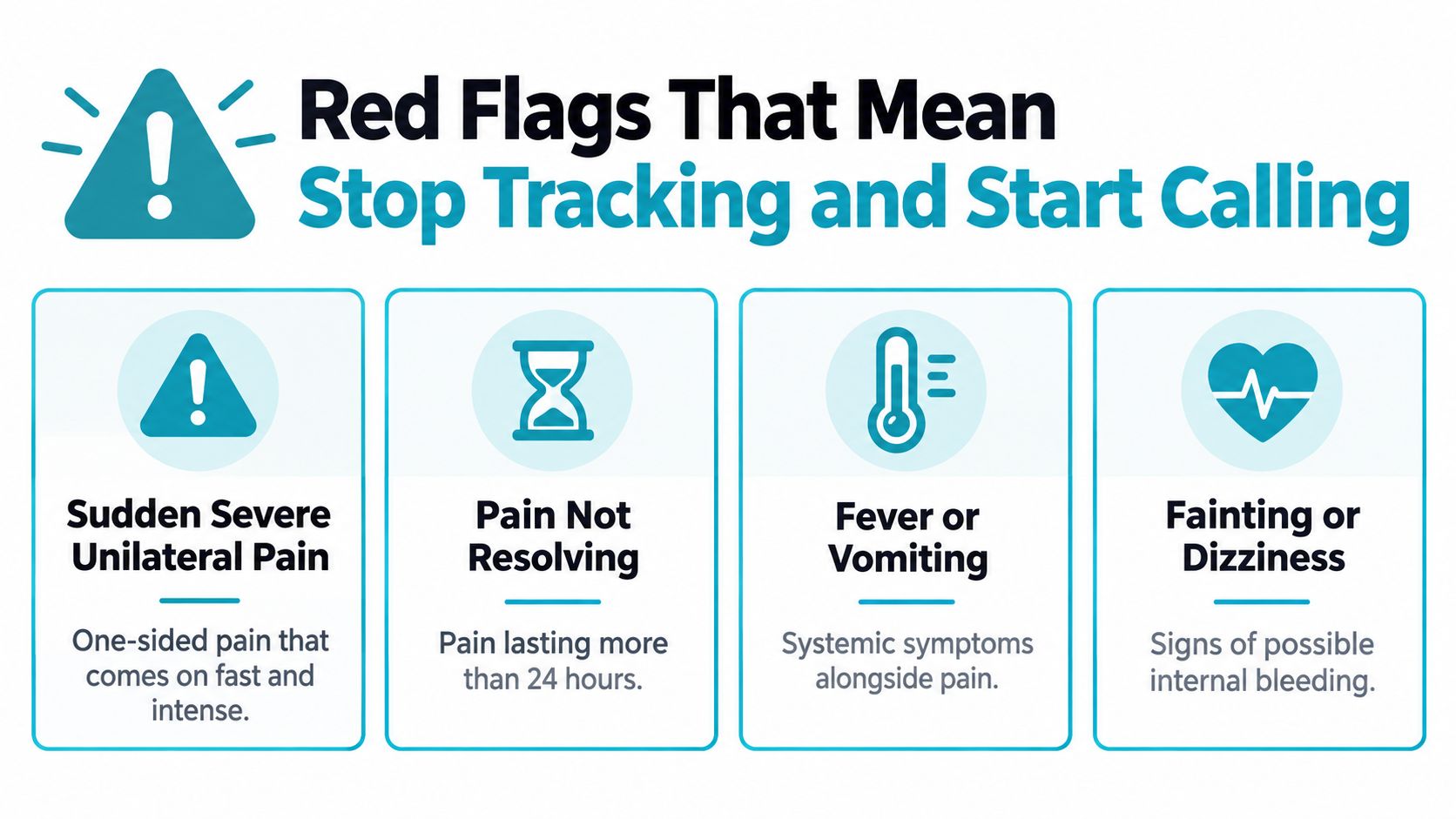
A mid-cycle pattern can be reassuring, but it doesn't make severe or unusual pain harmless. Stop treating the episode as something to track if the pain comes on suddenly and intensely, worsens, or comes with symptoms that suggest a more urgent problem.
Seek urgent assessment for severe or escalating symptoms
Contact a medical professional promptly, or seek emergency care, for sudden severe one-sided pain, pain that isn't relieved by appropriate over-the-counter medication, faintness, heavy or unusual bleeding, fever, or severe nausea or vomiting. These symptoms can overlap with complications that need timely evaluation, so don't wait for a diary to reveal a pattern.
The urgency depends on how you feel now. Severe pain, fainting, heavy bleeding, or repeated vomiting calls for urgent evaluation rather than a routine appointment. If pain is new, worsening, or recurring outside the expected mid-cycle window but you don't have emergency symptoms, contact your primary care clinician or OB/GYN to discuss it.
If pregnancy is possible, test and seek medical advice
Pregnancy testing is recommended for reproductive-aged patients with pelvic pain even when pregnancy seems unlikely, because an ectopic pregnancy can initially resemble ordinary ovulation pain (Cleveland Clinic's overview of ovary pain). Don't use a familiar mid-cycle date as a reason to rule it out.
When you call, describe the onset, side, intensity, bleeding, and any dizziness, fever, or vomiting. Call emergency services or go to an emergency department for severe symptoms or faintness; for concerning but less intense pain, contact your OB/GYN, primary care office, or urgent care for direction. Tracking is useful only while it's safe to wait.
Self-Care and Pelvic Floor Therapy Approaches
If your familiar mid-cycle ache is mild and easing, try a heating pad or a comfortable resting position. Hydration and gentle movement may help if they feel soothing; movement that increases pain is a reason to stop. An over-the-counter pain reliever may be appropriate, but check the label and your medical guidance, especially if pregnancy is possible or you have medication, kidney, stomach, or bleeding concerns.

The image shows a woman kayaking outdoors. Choose movement for comfort, rather than pushing through a painful episode.
Relief does not establish the cause.
Use your symptom map to separate a deep, cycle-linked ache from pain at vaginal entry or pain triggered by penetration. Record whether comfort measures help and whether symptoms settle within your usual ovulatory window. Entry pain, muscle tension, or symptoms continuing beyond that window can warrant assessment of pelvic-floor contributors.
What a pelvic-floor PT assesses
A pelvic-floor PT reviews your pain pattern and checks how muscles rest, contract, and release. Depending on your symptoms and consent, assessment may include muscle tone, coordination, tenderness, trigger points, breathing, movement, and scar mobility. Bowel and bladder symptoms, prior surgery, and pain with entry versus deeper penetration also help guide the assessment. You can ask questions and discuss consent before any internal examination.
Treatment should match those findings. Kegels may be poorly suited to muscles that are already overactive or guarding, and repeated contractions can feel worse. A therapist may instead use down-training, breathing, relaxation, graded movement, and appropriate hands-on techniques to address muscle tension and coordination.
Entry pain can involve pelvic-floor dysfunction, vulvodynia, vaginismus, or inadequate lubrication. Deep pain can involve endometriosis or an ovarian or other pelvic structural issue (American Family Physician's review of chronic pelvic pain). Location helps guide care, but does not confirm a diagnosis: therapy can address muscle contributors while gynecologic evaluation investigates deeper causes.
For suspected tight or overactive muscles, read about hypertonic pelvic floor symptoms and care. Lake City Physical Therapy offers pelvic-floor physical therapy for pelvic pain in North Idaho and Eastern Washington, including evaluation of tight or overactive muscles.
Therapy remains one part of care and does not replace urgent assessment for red flags. The video below offers another look at movement and pelvic-health care.
When to See a Specialist and How to Advocate at the Visit
An OB/GYN or primary care clinician can assess persistent, recurrent, or unexplained pelvic pain and decide whether examination, testing, or imaging is appropriate. A pelvic-floor PT can evaluate muscle tension, coordination, and pain with entry or movement. Sudden severe pain, faintness, heavy bleeding, fever, or severe vomiting calls for urgent or emergency assessment, not a routine therapy appointment.
Bring your symptom map, any prior imaging results, and details about past pelvic or abdominal surgery. Be direct: “The pain is deep and one-sided,” or “It happens with vaginal entry and continues afterward.” Then ask, “Could this be coming from my ovary, pelvic floor, or another source?” If pain with sex or muscle guarding is part of the pattern, you can ask whether a pelvic-floor assessment is appropriate. Learn what to expect from a pelvic-floor exam.
For ongoing pain, keep asking for a plan if an initial exam or scan doesn't explain what you feel. A normal result may not identify every pain contributor. The useful next step is a clinician who considers timing, location, triggers, and associated symptoms together.
Lake City Physical Therapy offers pelvic-floor physical therapy for pelvic pain and overactive pelvic-floor muscles, with clinics across North Idaho and Eastern Washington and telehealth options. If pain with sex or recurring cycle-linked pelvic discomfort is affecting your daily life, contact Lake City Physical Therapy to explore whether an evaluation may fit your needs.

