Prolapse Symptoms and Treatment: A Patient’s Guide
You notice a dragging sensation during a workout, or feel tissue near the vaginal opening while showering. Then you start wondering whether lifting your child, going for a run, or having sex will make things worse. A new pelvic symptom can turn ordinary activities into decisions you never expected to make.
Understanding prolapse symptoms and treatment starts with separating what your examination shows from what your body is struggling to do. You don't need to choose between ignoring the problem and having surgery. You need an assessment, realistic options, and goals that reflect your life.
What Pelvic Organ Prolapse Actually Feels Like
The sensation may be less dramatic than the word prolapse sounds. You might describe vaginal fullness, pelvic heaviness, or the feeling that something is sitting lower than it used to. Someone else may notice a bulge but have little discomfort.
Pelvic organ prolapse means that pelvic organs descend toward or into the vagina as their supporting tissues lose support. It's a change in support, not a sign that your organs have become disconnected. The practical question is how that change affects comfort, emptying your bladder or bowel, intimacy, and activity.
U.S. survey data suggest that approximately 3% of women report vaginal bulging, while examination identifies some degree of prolapse in roughly 41%–50%, a distinction described in the clinical overview of pelvic organ prolapse. These aren't interchangeable measures: finding descent on an examination doesn't automatically mean someone needs treatment.
Anatomy isn't the whole experience
Consider two hypothetical patients with similar examination findings. One notices pressure only during a demanding workout and wants help returning to training. The other avoids leaving home because bladder emptying feels unreliable and the bulge is uncomfortable.
Their treatment priorities should differ. The first may need activity-specific rehabilitation and a discussion about support during exercise. The second needs a closer assessment of bladder function and options that address daily discomfort.
A useful starting point: Describe what the symptom stops you from doing, not just where you feel it.
Before an appointment, think about:
- The sensation: Is it heaviness, pressure, visible tissue, or something else?
- The context: Does it appear during lifting, toileting, intimacy, or ordinary daily activity?
- The impact: Are you changing your plans, avoiding movement, or worrying about emptying?
You don't have to use anatomical language correctly to get useful care. Saying that you can't comfortably finish a walk is clinically meaningful. A treatment plan should address that limitation rather than treating an examination finding in isolation.
The Symptom Domains and Types of Prolapse
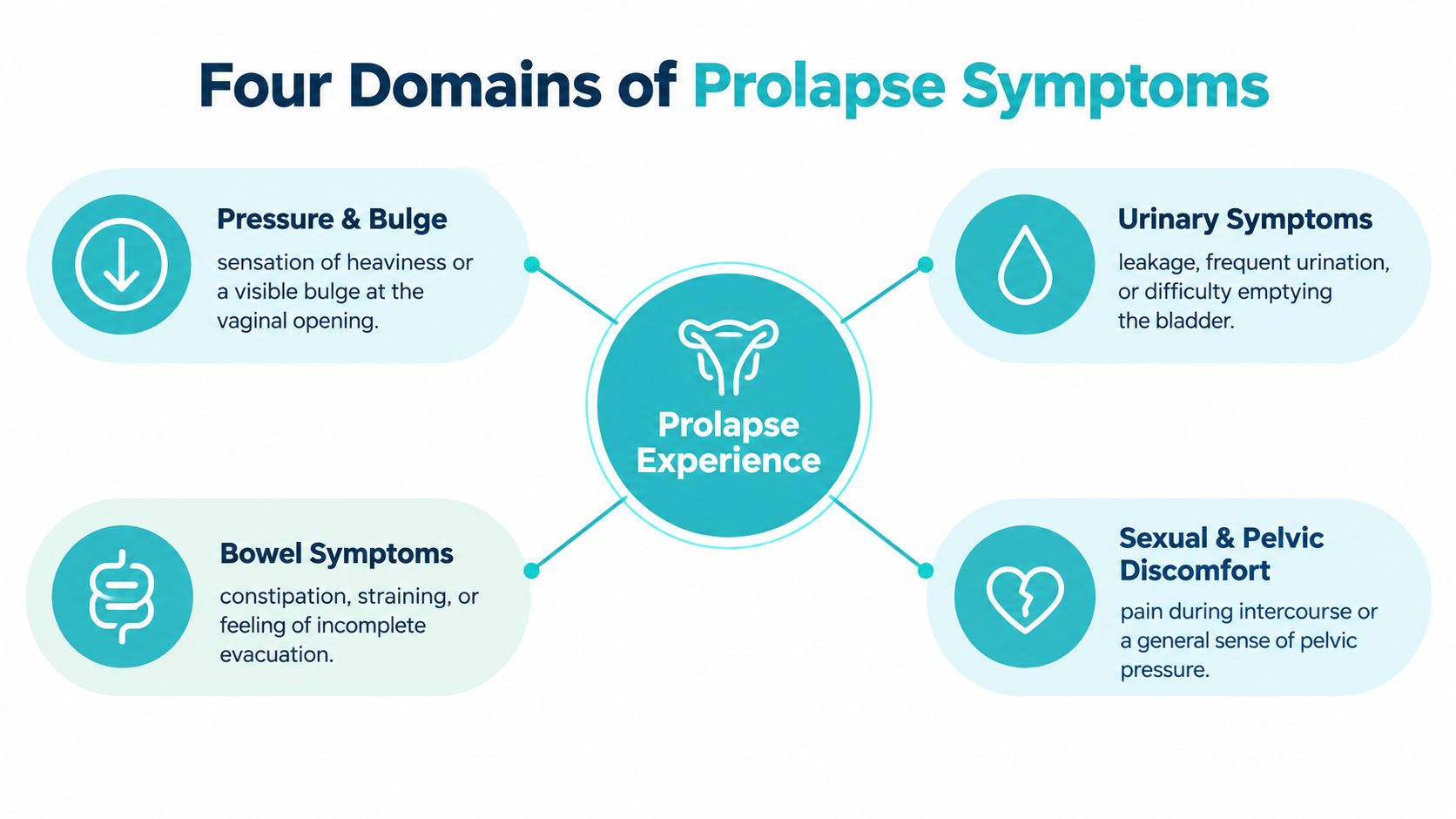
A vaginal bulge deserves attention, but it isn't the only symptom worth discussing. Clinicians assess vaginal, urinary, bowel, and sexual symptoms because an anatomy-only conversation can miss the problems affecting daily life.
Use this symptom map to organize what you're noticing before your appointment.
Describe function before naming the compartment
- Vaginal pressure or protrusion: Explain whether you feel internal heaviness, tissue at the opening, or discomfort that interferes with movement.
- Urinary function: Mention leakage and difficulty emptying. Do not dismiss incomplete emptying because you are not leaking.
- Bowel function: Constipation, straining, fecal leakage, and difficulty completing a bowel movement belong in the conversation.
- Sexual symptoms: Pain, pressure, or avoiding intimacy because of discomfort are treatment concerns, not secondary details.
Bowel symptoms deserve particular care because not every digestive problem comes from prolapse. If you also experience IBS-type symptoms, you can track IBS triggers with GutRx as a separate symptom-organizing resource. Bring those observations to your clinician without assuming that digestive symptoms identify a prolapse compartment.
How clinicians describe the location
The anterior compartment is the front vaginal wall, associated with bladder support. The posterior compartment is the back wall, associated with rectal support. The apical compartment concerns support at the top of the vagina, including the uterus when present.
These labels describe where support has changed. They don't prove that every urinary symptom comes from anterior prolapse or every bowel symptom comes from posterior prolapse. Muscle coordination and other conditions may need assessment alongside the prolapse.
A POP-Q examination documents support in these compartments so a clinician can compare your symptoms with the anatomical findings. The helpful question isn't which type you have. Ask which findings plausibly explain your difficulties, which need further investigation, and what treatment is expected to change.
How Prolapse Is Diagnosed and Staged
A useful evaluation begins with your history, not an immediate instruction to do Kegels. Expect questions about your symptoms, pregnancies, previous pelvic surgery, bowel habits, bladder emptying, pain, and current activities. Tell the clinician if your symptoms aren't present during the appointment but regularly appear elsewhere.
It helps to describe a specific task: carrying laundry, completing a run, passing stool, or having intercourse. That gives the clinician something more actionable than a general statement that your pelvic floor feels weak.
What to expect during the assessment
A pelvic examination helps the clinician observe support and assess how the pelvic floor responds to contraction, relaxation, and straining. Ask why a position or maneuver is being used, especially if it doesn't resemble the activity that triggers your symptoms. You can request explanations, discuss comfort, and ask to pause.
For a plain-language introduction, read what a pelvic floor exam involves before your visit. Being prepared can make it easier to discuss sensitive symptoms and understand what the examiner is assessing.
POP-Q staging describes anatomical descent using standardized measurements. Rather than memorizing a measurement grid, ask your clinician to explain where the tissue sits in relation to the vaginal opening and how that finding relates to your symptoms.
- Clarify the finding: Which compartment has reduced support?
- Clarify the consequence: Does it help explain your emptying difficulty, pressure, or activity limitation?
- Clarify the plan: What would justify observation, rehabilitation, a pessary discussion, or specialist referral?
Know when not to wait
A routine appointment is appropriate for many bothersome but stable symptoms. However, inability to urinate, severe bleeding, ulcerated tissue, or an acute prolapse that cannot be reduced warrants urgent assessment. Don't wait for a physical therapy appointment to evaluate those problems.
The urgency guidance and symptom-based referral criteria are described in the clinical guidance on pelvic floor training and prolapse management. This article is educational, and an examination is needed to determine what's happening in your situation.
Treatment Options From Conservative to Surgical
Treatment usually progresses according to symptom burden, response to care, and personal preference. That doesn't mean everyone must try every conservative option before discussing surgery. It means the clinician should explain what each option can accomplish and what maintenance, limitations, or further treatment it may involve.
Physical therapy develops muscle function and movement skills. A pessary provides support while worn. Surgery changes anatomical support. They address different parts of the problem, and they aren't always mutually exclusive.
Comparing Conservative and Surgical Prolapse Treatments
| Option | Best Fit | Average Symptom Improvement | Key Trade-Off |
|---|---|---|---|
| Pelvic floor physical therapy | People seeking improved function, symptom management, and activity guidance | Variable; no single average applies to an individualized program | Requires practice and reassessment; anatomical correction isn't guaranteed |
| Vaginal pessary | People seeking removable support without surgery | Meaningful improvement reported in the comparison described below | Fitting, ongoing review, and tolerability matter |
| Surgery | People with significant ongoing symptoms or quality-of-life limitations who want surgical consultation | Greater reported improvement in the comparison described below | Recovery, procedural risks, and recurrence or retreatment remain considerations |
In a comparison involving 539 women, 335 (62.2%) initially chose a pessary and 204 (37.8%) chose surgery; at 24 months, improvement was reported by 74.4% of pessary users who continued treatment and 83.8% of surgical patients, while approximately 1 in 5 initial pessary users switched to surgery; a separate NIH-supported comparison reported three-year failure rates of 28% for sacrocolpopexy, 29% for transvaginal mesh, and 43% for native-tissue repair, as summarized in the provided evidence on conservative and surgical prolapse outcomes.
Those results need context. Improvement among people who continued pessary treatment doesn't describe everyone who initially tried one. Surgical “failure” also included symptoms, anatomical measurements, or retreatment, so it shouldn't be interpreted as meaning every patient had the same experience.
Choosing the trade-off you can live with
A pessary may suit someone who wants nonsurgical support or wants to explore relief before deciding about an operation. Ask who manages fitting and follow-up, what discomfort should prompt review, and how it might fit your exercise or intimacy goals.
Surgical discussions may include native-tissue repair, sacrocolpopexy, or mesh-based procedures. The comparison above isn't a recommendation or a menu of procedures equally appropriate for every patient. Ask a urogynecologist which approaches are suitable and currently available in your setting, what material would be used, and why.
Better average outcomes don't automatically identify the better choice for you. Your willingness to manage a device, undergo surgery, or accept residual symptoms matters.
Conservative care isn't a lesser choice, and surgery isn't an admission that rehabilitation failed. Both deserve clear expectations and shared decision-making.
What Pelvic Floor Therapy Can and Cannot Do
If exercises don't put the organs back into place, are they still worthwhile? Yes, when they improve the symptoms or activities that matter to you. A persistent examination finding doesn't erase better bladder control, more comfortable movement, or less distress.
This distinction is central to setting useful expectations for rehabilitation.

Training is more than squeezing
NICE recommends supervised pelvic floor muscle training for at least 16 weeks as a first option for symptomatic stage 1 or 2 prolapse; the supplied evidence also describes a Cochrane review of six trials finding a 17% greater chance of prolapse-stage improvement versus no treatment, with variable results and a limited evidence base, alongside the NICE recommendations for pelvic floor dysfunction management.
A supervised program assesses whether you can contract appropriately, sustain a contraction, and then release it. It also considers timing during coughing, lifting, and exertion. The aim is coordinated support, not keeping the pelvic floor clenched throughout the day.
Repeated Kegels aren't universally appropriate. Someone with pain, constipation, painful intercourse, or difficulty relaxing may need a different starting point from someone whose main difficulty is reduced strength or endurance. More repetitions aren't automatically better treatment.
Measure outcomes that matter
Useful rehabilitation goals might include:
- Comfort during activity: Completing a walk or modified workout with less pressure.
- Improved control: Managing leakage or toileting difficulty more effectively.
- Better coordination: Breathing and recruiting the pelvic floor without constant gripping.
- Confidence: Understanding how to adjust activity rather than avoiding it out of fear.
For patients accessing disability-related services, coordinated allied health for NDIS from Core Nursing Solutions Pty Ltd is a resource to explore when organizing broader support. Any pelvic health program still needs assessment and goals specific to the individual.
The following video can accompany education, but it can't determine which exercises suit your pelvic floor.
Therapy can't promise complete anatomical reversal or make every prolapse symptom disappear. If you're practicing the agreed program without useful progress, request reassessment rather than indefinitely repeating the same routine.
Daily Habits and Self-Care That Support Recovery
Daily self-care should make movement and toileting more manageable, not turn your life into a list of forbidden activities. Your therapist can help you test strategies against actual symptoms instead of applying blanket rules about lifting or exercise.
A quiet pause may help you notice breathing and unnecessary gripping before practicing a movement. It's a preparation strategy, not an anatomical treatment.

Make everyday tasks part of rehabilitation
Practice pressure management during a real task. Bring a lifting example to your therapist, such as picking up a child or moving a loaded basket. Ask them to observe your breathing, effort, and pelvic floor response rather than relying on a generic instruction to tighten everything.
Address straining at the toilet. Discuss stool consistency, bowel routines, fluid intake, and fiber with your clinician. Don't assume that a universal hydration or fiber target will solve your particular bowel problem, and don't treat persistent emptying difficulty by pushing harder.
Adjust exercise rather than abandoning it automatically. For running or CrossFit, discuss the movement, load, duration, and recovery that currently feel manageable. Postpartum return to activity should account for symptoms and function, not whether a calendar milestone has passed.
Use symptoms to guide the next adjustment
- Before activity: Notice your baseline pressure, discomfort, and bladder symptoms.
- During activity: If symptoms appear, try the modification agreed with your therapist rather than forcing the original session.
- After activity: Record whether heaviness or leakage changes and how that affects the rest of your day.
- At reassessment: Bring the pattern, not just the conclusion that exercise is unsafe.
Practical rule: A symptom is information to discuss and respond to, not automatic proof that you've damaged your pelvic floor.
This week, choose a troublesome lift to review, start noting bowel-related straining, and record your response to a familiar activity. Those observations can make your next appointment more productive than trying an assortment of exercises without knowing what each is meant to address.
Building Your Care Plan and When to See a Specialist
Can you safely wait? Sometimes, provided observation includes assessment and clear reasons to return. A review reports that up to 40% of women with asymptomatic prolapse remained stable or improved over as long as 60 months, supporting individualized observation rather than inevitable-progression messaging in the review of prolapse treatment and watchful waiting.
That finding isn't permission to ignore emptying problems, bleeding, pain, or worsening function. Structured observation means agreeing with your clinician on what to monitor and when to reassess.
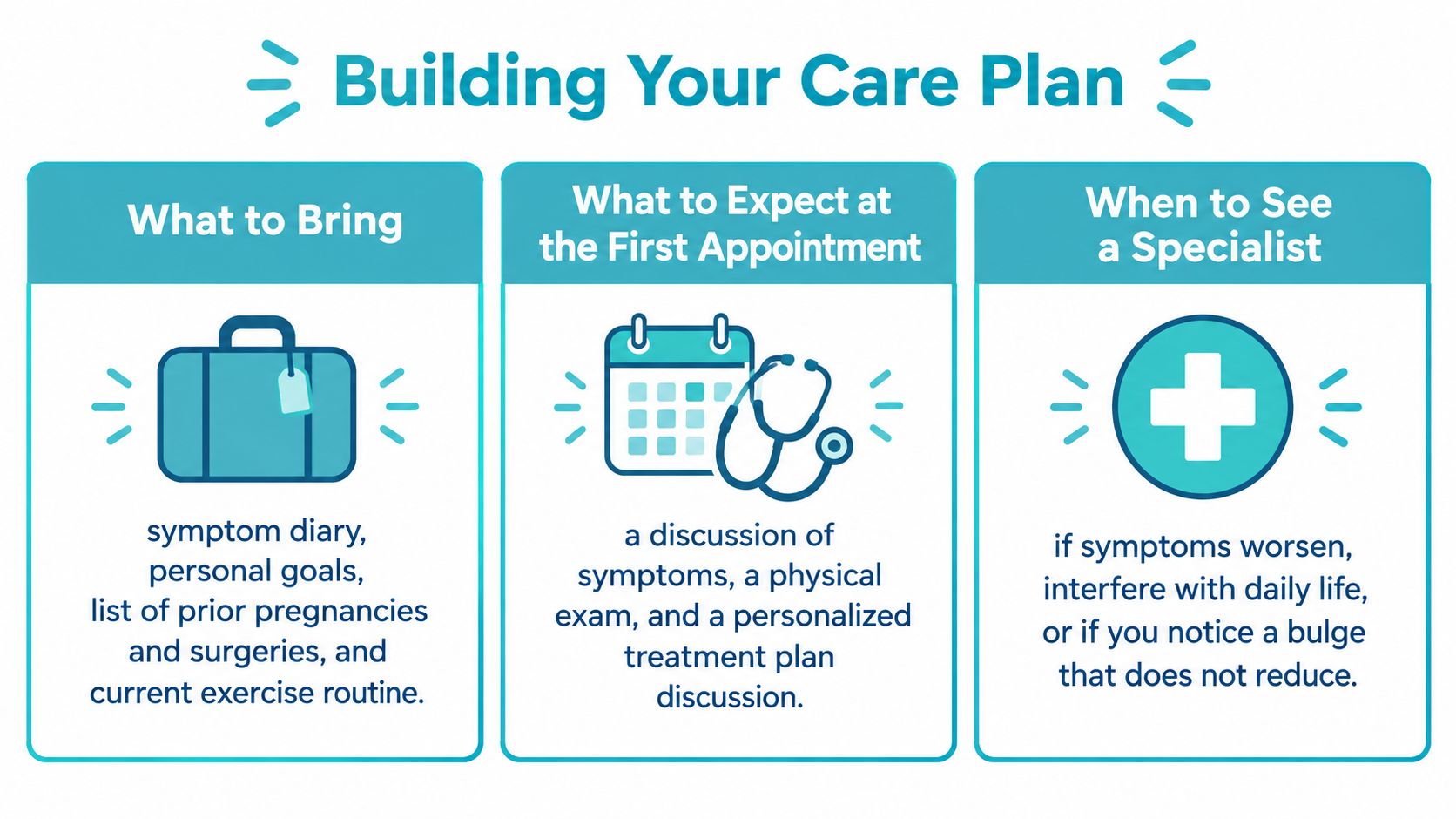
Use this checklist to prepare for a care-planning visit.
Bring your priorities, not just your diagnosis
- A symptom record: Include triggers, emptying difficulties, discomfort, and activity limitations.
- Relevant history: Note pregnancies, births, previous operations, and treatments you've already tried.
- Functional goals: Be specific about returning to running, lifting at work, comfortable intimacy, or daily caregiving.
- Treatment preferences: Explain whether you're interested in rehabilitation, removable support, surgical consultation, or observation.
Pessary fitting may take more than one attempt, and regular review matters. Support lasts while the device is in place; reducing prolapse can also reveal or cause stress urinary leakage. Ask for urinary symptoms to be assessed before and after fitting rather than assuming any new leakage means the whole approach is unsuitable.
Match the professional to the next decision
A pelvic health physical therapist can assess muscle function and activity strategies. A gynecologist or urogynecologist can evaluate medical concerns, pessary options, and surgical suitability.
The regional pelvic floor therapy team provides prolapse rehabilitation, postpartum care, and return-to-sport support through clinics in Coeur d'Alene, Hayden, Post Falls, Rathdrum, Liberty Lake, Spokane South Hill, Eagle, and Boise, with telehealth options. Rehabilitation is one pathway within coordinated care, not a substitute for urgent medical assessment or a surgical opinion when needed.
Frequently Asked Questions About Prolapse
Does prolapse always get worse?
No. Its course varies, as the observation evidence above illustrates. Ask your clinician what monitoring makes sense for your symptoms and which changes should prompt reassessment.
Can I exercise and lift with prolapse?
A diagnosis alone shouldn't determine your entire activity plan. Have a pelvic health clinician assess the tasks you want to do and help you select manageable loads, movement strategies, and progressions. Don't push through worsening symptoms without reviewing the plan.
What should I know about intimacy?
Pain or pressure during sex deserves assessment rather than an instruction to tolerate it. Describe the sensation and when it occurs so your clinician can consider prolapse alongside muscle coordination and other contributors. Your comfort is a legitimate treatment goal.
How soon after birth should a new bulge be evaluated?
Contact your maternity or medical clinician when you notice a new bulge, troublesome pressure, or emptying difficulty rather than waiting for an arbitrary recovery deadline. Seek urgent assessment for the warning signs described earlier. A postpartum pelvic health evaluation can then help guide rehabilitation and return to activity around your findings.
Lake City Physical Therapy offers individualized pelvic floor assessment, prolapse rehabilitation, and postpartum and return-to-sport care. Visit Lake City Physical Therapy to explore appointment options and bring your symptom record and activity goals so you can discuss a practical next step.

