Lymphedema in Cancer Patients: Risk, Signs and Treatment
Approximately 31% of responding cancer survivors reported lymphedema symptoms in a 2025 study published in Acta Oncologica. That finding concerns reported symptoms, not confirmed diagnoses, but it challenges the idea that treatment-related swelling is a rare problem confined to breast cancer recovery.
Lymphedema in cancer patients can affect an arm, leg, breast, trunk, face, neck or genital region. Understanding your risk means looking beyond surgery alone, including your radiation treatment, the area treated and whether you can access ongoing monitoring. A practical plan should help you recognize changes without making you afraid to move or resume everyday life.
Who Develops Lymphedema After Cancer Treatment
The lymphatic system works like a network of drainage channels, returning excess tissue fluid to the circulation. Removing lymph nodes or treating them with radiation can leave fewer effective routes for fluid to leave a limb or nearby region.
When the remaining pathways can't keep up, fluid and proteins accumulate in the tissues. Persistent accumulation can eventually change the skin and underlying tissue, which is why lymphedema involves more than appearance alone.
Reported lymphedema incidence by cancer type
A 2024 systematic review of cancer-related lymphedema reported incidence ranges of 2% to 74% for breast cancer, 8% to 45% for gynecologic and urologic cancers, 71% to 90% for head and neck cancer, and 2% to 29% for melanoma, summarized below.
| Cancer type | Reported incidence range | Main drivers |
|---|---|---|
| Breast cancer | 2% to 74% | Lymph-node removal, radiation and breast surgery; individual factors also contribute |
| Gynecologic and urologic cancers | 8% to 45% | Pelvic and inguinal-node treatment |
| Head and neck cancer | 71% to 90% | Treatment affecting drainage in the neck and face region |
| Melanoma | 2% to 29% | Lymph-node involvement and surgery |
These aren't universal personal-risk estimates. Studies followed patients for different lengths of time and used different diagnostic thresholds. Some counted changes detectable only with testing, while others counted clinically apparent swelling.
The location of treatment matters as much as the cancer label. A person treated around the groin may need lower-body assessment, while someone treated for head and neck cancer needs evaluation beyond the limbs. A normal-looking arm doesn't answer every question about lymphatic function elsewhere.
Turn your treatment history into a useful question
Find your cancer group in the table, then write down:
- Surgery: What operation did you have, and where?
- Lymph-node treatment: Were nodes sampled, removed or included in radiation?
- Radiation: Which body regions were treated?
- Current concerns: Has clothing fit, movement or tissue texture changed?
Bring that list when asking about baseline measurements and follow-up. For broader recovery planning, post-treatment support at Sunridge Medical is an additional resource to discuss alongside your oncology team's recommendations. General recovery support shouldn't replace a focused assessment of new swelling.
How Breast Cancer Lymphedema Develops Over Time
The National Cancer Institute's PDQ review reports a pooled lymphedema prevalence of 21.4% among breast cancer patients, with a 95% confidence interval of 14.9% to 29.8%. The same review describes risk generally rising for as long as two years after diagnosis or surgery.
“Prevalence” describes how many people in a studied population have a condition. It doesn't tell an individual patient exactly what will happen, and the confidence interval reflects uncertainty around the pooled estimate.
Your treatment pathway helps explain why your risk may differ from someone else's. Axillary lymph-node dissection, which removes a larger group of underarm nodes, carries a higher risk than sentinel lymph-node biopsy, which samples selected nodes. Removing more nodes, mastectomy, radiation, and overweight or obesity are additional recognized risk factors.
Why an initially normal arm doesn't end monitoring
Early recovery and long-term lymphatic function aren't the same thing. An incision may heal and shoulder movement may improve even though the remaining drainage pathways have limited reserve.
Consider a hypothetical patient whose arm looks unchanged at her early postoperative visits. Later, she notices that carrying groceries produces unfamiliar heaviness and that her sleeve feels different. Those changes deserve assessment even if she hasn't developed obvious enlargement.
A simple explanation of how the lymph system works can help families understand why delayed symptoms aren't necessarily evidence that the patient did something wrong.
Practical rule: Report a new change from your usual baseline, rather than waiting until swelling looks severe.
Risk factors aren't instructions to avoid treatment
Cancer treatment decisions balance disease control, treatment benefits and potential complications. A higher lymphedema risk doesn't mean a necessary operation or radiation course was inappropriate.
Instead, use your treatment details to ask for a more specific survivorship plan:
- After sentinel-node surgery: Ask what symptoms should prompt reassessment despite the lower relative risk.
- After axillary dissection: Ask whether objective surveillance is available and who will coordinate it.
- After regional radiation: Make sure the rehabilitation clinician knows the treatment field.
- When weight or fatigue is a concern: Request supportive, achievable activity guidance rather than blaming yourself.
The purpose of risk information is to guide follow-up, not to predict a fixed outcome or discourage daily activity.
How Clinicians Measure and Stage Lymphedema
Clinicians assess lymphedema through your treatment history, symptoms, physical examination and repeatable measurements. They also consider other explanations for swelling, including postoperative fluid collections, infection, vein problems and changes related to cancer itself.
An assessment should document where the changes occur and how they affect everyday tasks. Difficulty fastening a bra, bending a knee or reaching overhead may matter even when a size change seems modest.
A measurement visit may look like this.
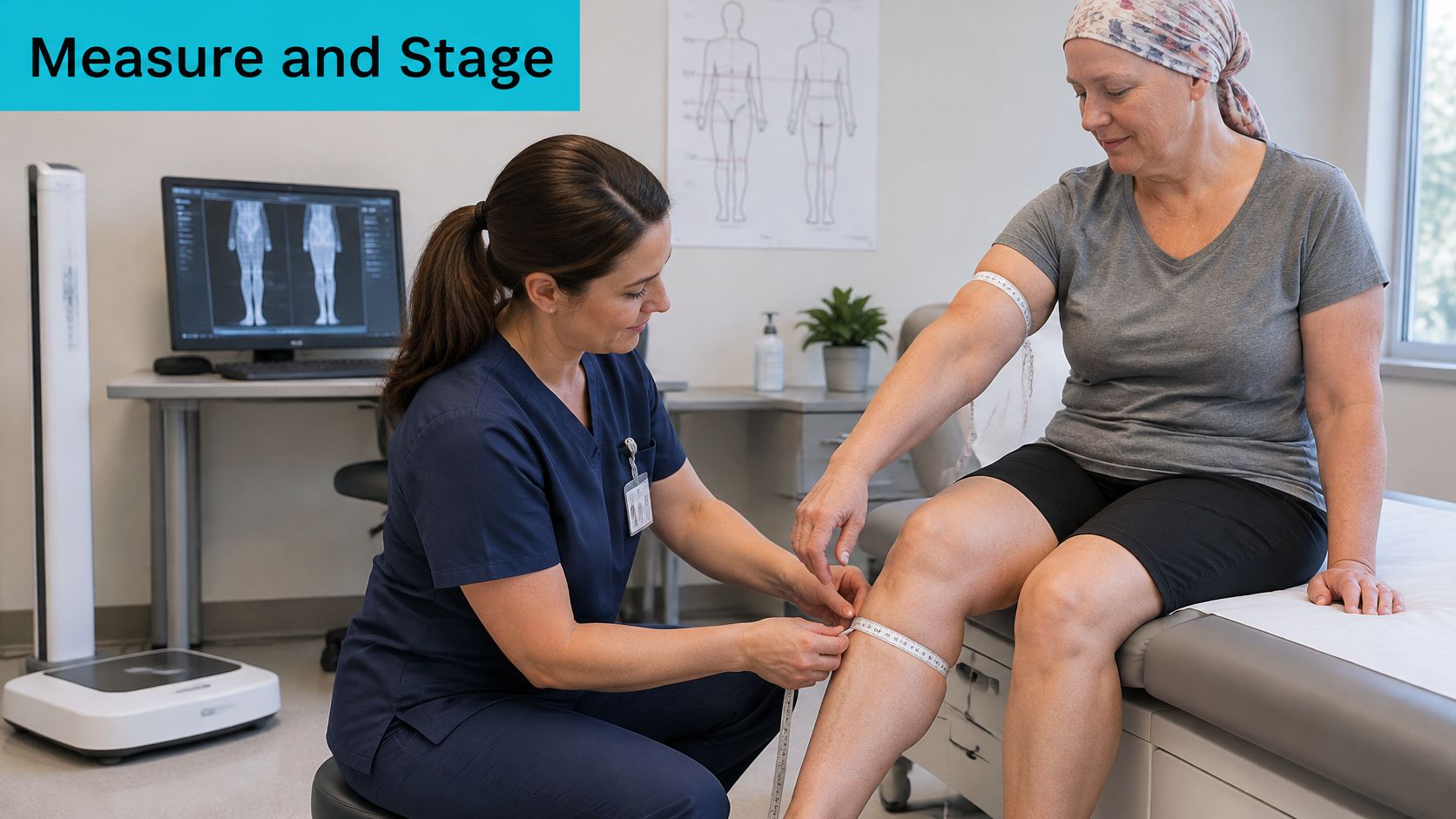
What the measurement tools tell clinicians
- Circumference measurements: A tape measure records limb size at consistent anatomical points.
- Limb-volume assessment: Water displacement or an optical device called a perometer can estimate overall limb volume.
- Bioimpedance spectroscopy: This test assesses electrical properties of tissue to help identify extracellular-fluid changes.
- Hands-on examination: The clinician checks skin condition, tissue firmness, mobility and whether gentle pressure leaves an indentation, called pitting.
Comparing both sides can help, but natural asymmetry and treatment affecting both sides complicate interpretation. Your own pretreatment or earlier measurements may be more useful than a single comparison with the opposite limb. No isolated measurement should substitute for clinical judgment.
Lymphedema stages and what each means for care
| Stage | Swelling pattern | Typical response |
|---|---|---|
| Stage 0, latent | No visible swelling; lymph transport is impaired | Objective assessment may identify changes before visible enlargement |
| Stage I | Pitting swelling that improves with elevation | Early compression and individualized care may control swelling |
| Stage II | Swelling persists; tissue begins to harden | Often needs complete decongestive therapy |
| Stage III | Markedly hardened tissue, often non-pitting, with skin changes | Requires specialist care and an individualized reduction plan |
Stage describes the condition of the tissue, not just how large a limb is. Two people with similar arm-size differences may need different treatment because one has soft, fluid-dominant swelling while the other has firmer tissue and skin changes.
Ask for a documented baseline, consistent repeat measurements and a written stage when a diagnosis is established. Keep a copy of the findings so another clinician can compare them if your care moves between oncology, primary care and rehabilitation.
Early Signs and How Often to Be Checked
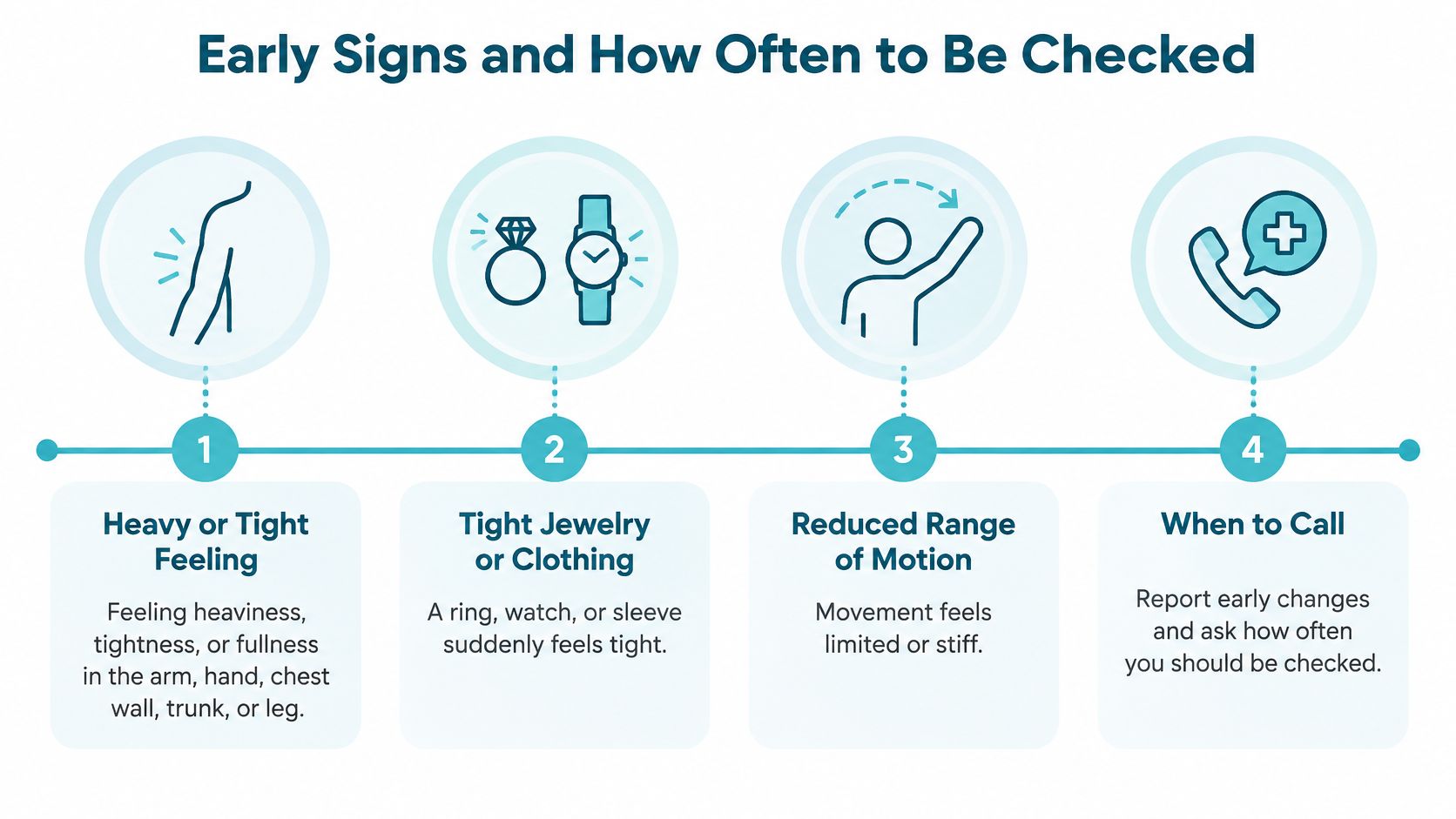
Contact your care team about changes such as:
- Heaviness or fullness: An unfamiliar weighted or tight feeling in the arm, hand, chest wall, trunk or leg.
- A change in fit: A ring, watch, sleeve, shoe or bra suddenly feels tighter.
- Reduced movement: Reaching, bending or gripping feels stiffer or more difficult.
- Skin changes: The skin feels thicker, stretched or less mobile than usual.
You don't need to see obvious swelling before asking for help. Early lymphatic changes can develop during an otherwise symptom-free period.
Use these signs as reminders of what to report, not as a self-diagnosis checklist.
Suggested surveillance after breast cancer treatment
A review of survivorship surveillance recommendations describes checks every three to four months during the first postoperative year, then every six to twelve months for at least two to three years, and notes that 2025 NCCN survivorship guidance recognizes bioimpedance spectroscopy when available.
| Period | Suggested frequency | Notes |
|---|---|---|
| First postoperative year | Every three to four months | Establish a consistent record during early recovery |
| Years two and three | Every six to twelve months | Continue checking for delayed changes |
| After the monitoring period | Individualized | Based on risk, symptoms and available resources |
Early appointments help clinicians distinguish a changing pattern from a single unusual measurement. Continued follow-up matters because discharge from surgical care doesn't necessarily mark the end of lymphatic risk.
When possible, obtain baseline measurements before surgery or radiation. BIS can support detection of fluid changes before visible swelling, but a clinic without BIS can still provide useful examination and standardized measurements.
Match monitoring to the treated region
The schedule above comes from breast cancer recommendations. The available sources don't establish an equivalent interval for gynecologic, urologic or head and neck cancer survivors.
Ask your team when reassessment should begin and how long it should continue. Head and neck survivors need attention to the face, neck and swallowing-related structures; survivors treated around pelvic or inguinal nodes need assessment for leg and genital swelling.
Early detection doesn't automatically mean lifelong compression. It creates an opportunity to choose proportionate education, monitoring and treatment.
How Complete Decongestive Therapy Works
Complete decongestive therapy, or CDT, is a coordinated conservative approach to managing lymphedema. It combines skin care, compression, therapeutic movement, education and, when appropriate, manual lymphatic drainage.
The National Cancer Institute's clinical lymphedema guidance explains that compression helps reduce excess tissue-fluid formation, limits backward lymph flow and supports the muscle pump. Compression is not just about squeezing a limb smaller; correct fit and pressure distribution are essential.
The treatment usually moves from reducing swelling to maintaining control.
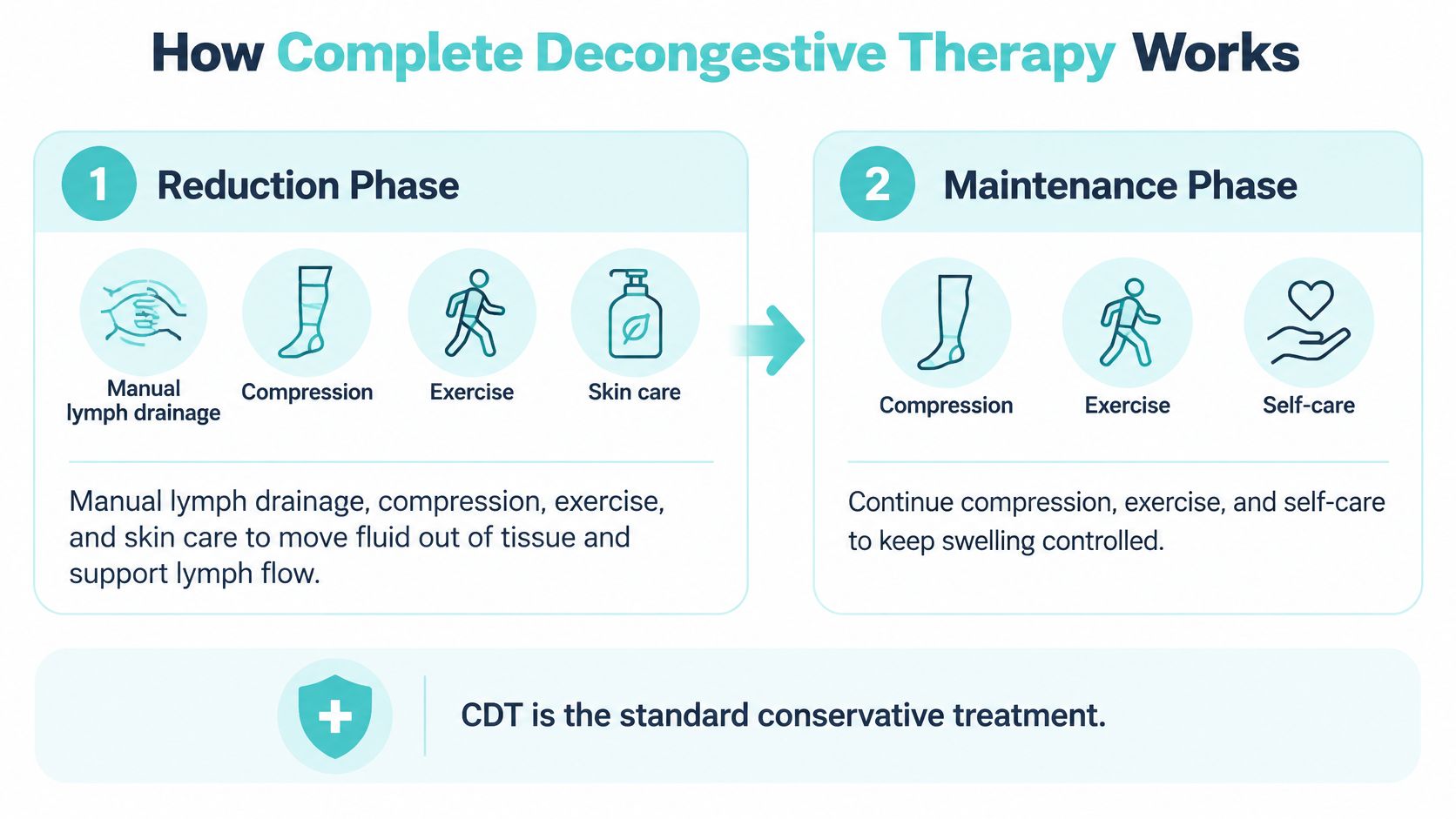
Reduction phase
The therapist selects components according to your swelling, circulation, skin, wounds and cancer-treatment restrictions.
- Protect the skin. Gentle cleansing and appropriate moisturizing support the skin barrier. Any wound or radiation reaction needs its own care instructions.
- Use specialized drainage when indicated. Manual lymphatic drainage is a light technique designed around functioning pathways. It isn't deep-tissue massage, and it isn't necessary in the same form for every patient.
- Apply therapeutic compression. Multilayer short-stretch bandaging may be used to help control swelling between appointments. Learn the application method rather than improvising tight wraps.
- Move within the treatment plan. Comfortable movement while appropriately compressed helps muscles assist fluid return.
- Track the response. Repeat measurements, tissue examination and functional goals guide decisions about when to transition.
There isn't a universal treatment duration. The reduction phase should end because the clinician identifies a meaningful, stable response and a workable maintenance plan, not merely because a preset calendar period has passed.
Maintenance phase
Maintenance often includes a fitted garment, an individualized home program and reassessment when symptoms or garment fit change. Some people need custom garments; others can use an appropriate ready-made option.
Flat-knit garments may provide useful containment for established, firmer swelling. The therapist should select the construction and fit based on your limb shape, tissue condition and ability to put the garment on.
Self-drainage may be taught when appropriate, but it shouldn't become an exhausting routine with no clear purpose. Ask which components matter most for your situation and how you'll know they're helping.
A garment that causes pain, numbness, unusual color changes or new pressure injury needs prompt professional review. More pressure isn't automatically better.
Safe Exercise and Skin Care After Treatment
Resting indefinitely isn't a lymphedema-management plan. Appropriate movement helps preserve strength, mobility and independence, while prolonged avoidance can make ordinary tasks harder.
The safety conclusion for resistance exercise is specific: supervised, progressive training is supported for people with or at risk for breast-cancer-related lymphedema. That doesn't mean every unsupervised workout is appropriate immediately after treatment.
Build activity around your recovery
- Start with comfortable movement after clearance. Active shoulder, elbow, wrist, hip or ankle motion can address the region affected by treatment. Walking is often a practical starting activity.
- Develop aerobic tolerance. Cycling, walking or aquatic exercise may suit different patients. Don't enter a pool with an unhealed wound or without clearance when treatment precautions apply.
- Introduce resistance gradually. A therapist can choose starting loads, check technique and adapt exercises around reconstruction, radiation effects or restricted movement.
- Watch the delayed response. Record unfamiliar heaviness, swelling, discomfort, skin changes and changes in function after activity, not just during the session.
- Adjust to your whole health picture. Fatigue, neuropathy, heart or lung limitations, pain and ongoing treatment may change what a sensible session looks like.
If your therapist has prescribed exercise compression, use the fitted garment as instructed. Don't buy a tighter sleeve because you assume it will make a workout safer.
The useful comparison is with your own usual response. A task that suddenly feels different deserves a change in plan, not an attempt to push through it.
Keep skin care simple and consistent
- Moisturize intact skin daily. Use a gentle product, and follow the oncology team's instructions for an active radiation field.
- Clean small skin injuries promptly. Wash minor cuts gently and protect them with a suitable dressing. Get advice for burns, bites or injuries that aren't healing.
- Reduce avoidable irritation. Choose jewelry and clothing that don't create focal constriction, rubbing or deep marks.
- Inspect areas you can't easily see. A mirror can help with the back of a leg, chest wall or skin folds.
For breast-treatment-specific considerations, the guide to skin care after breast cancer provides additional context. Skin products and hands-on techniques should always respect incision healing and radiation precautions.
Book a Lymphedema Assessment Before Symptoms Progress
Arrange an assessment when you notice a persistent change, even if swelling isn't obvious. If you're awaiting treatment and haven't had measurements, ask whether a baseline can be documented before your care begins.
Access affects what happens next. The AACR Cancer Disparities Progress Report describes differences in survivorship outcomes associated with socioeconomic disadvantage, race and insurance, alongside barriers to monitoring. These associations aren't proof of an individual biological cause, but they show why follow-up can't depend on patients having unlimited money, transport or specialist access.
An early assessment begins with the changes you've noticed.
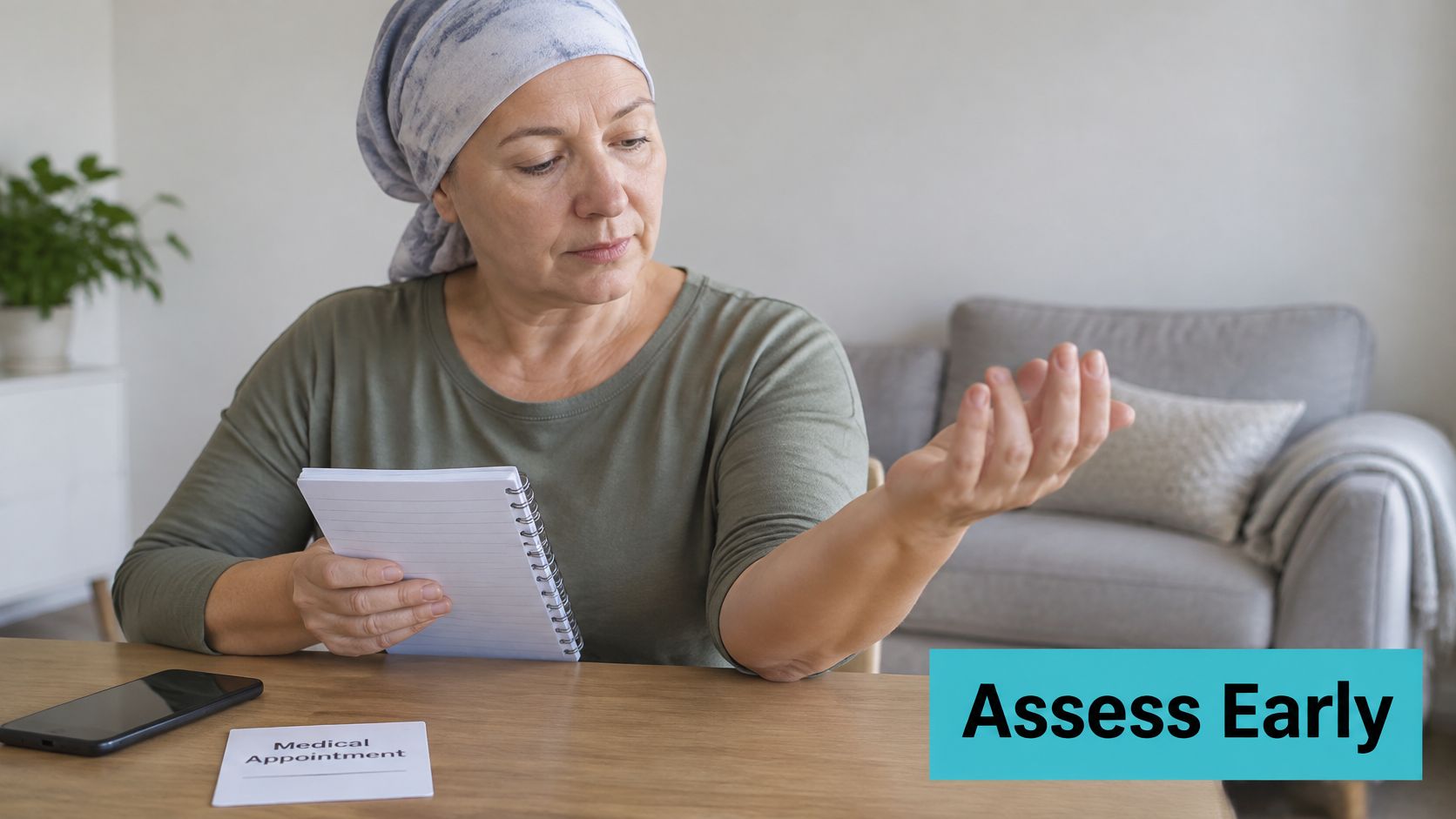
A realistic plan when specialists are far away
- At home: Keep a dated symptom log, noting location, clothing fit and tasks that have become difficult. If a clinician teaches home measurements, use the same landmarks and technique.
- In primary care: Request an examination and documented measurements when feasible. New heaviness or tightness should prompt referral rather than indefinite observation.
- Through your cancer center: Ask for a certified lymphedema therapist or oncology physical therapist through oncology, primary care or hospital rehabilitation.
- Before traveling: Ask the clinic and insurer about garment coverage, BIS coverage and options for remote follow-up.
Your oncologist helps interpret symptoms in the context of cancer treatment. Primary care can investigate other medical causes, while rehabilitation clinicians assess swelling, movement and self-management needs.
At Lake City Physical Therapy, we offer Lymphedema Physical Therapy, Oncology Physical Therapy and Telehealth. Physical therapy can help address swelling, pain, mobility and fatigue; our guide to physical therapy after cancer treatment explains its broader role.
The following video is an additional educational resource.
Know when routine rehabilitation isn't enough
Seek same-day medical evaluation for rapid enlargement, redness, warmth, fever, suspected cellulitis, new numbness or weakness, or a substantial decline in function. These changes may reflect infection, a blood clot or another condition requiring medical assessment, not just a lymphedema flare.
For your first appointment, bring your cancer type, surgery and radiation dates, available baseline measurements, and a symptom list. Ask who will record follow-up findings and who you should contact between visits.
Lake City Physical Therapy offers lymphedema and oncology rehabilitation to help you manage swelling, restore movement and build a practical home-care plan. Visit Lake City Physical Therapy to request an assessment and discuss in-person or telehealth options for your cancer recovery.

