Breastfeeding and Vaginal Dryness: Causes and Fixes
Lactation raises prolactin, which suppresses ovarian estrogen, so vaginal tissue can lose thickness, blood flow, and lubrication even without an injury.
This isn't a rare postpartum problem: a systematic review indexed by PubMed found vaginal atrophy, meaning thinning and related tissue changes, in 63.9% of postpartum lactating individuals. That medical term can sound alarming, but it describes tissue responding to a different hormonal environment, not proof of permanent damage.
Understanding breastfeeding and vaginal dryness starts with hormones, but choosing treatment takes another step. A dry vaginal lining, a tense pelvic floor, and a sensitive birth scar can feel surprisingly similar. Your comfort depends on identifying which tissues need help, not just adding more lubricant or waiting until you wean.
Why Breastfeeding Lowers Estrogen and Dries Tissue
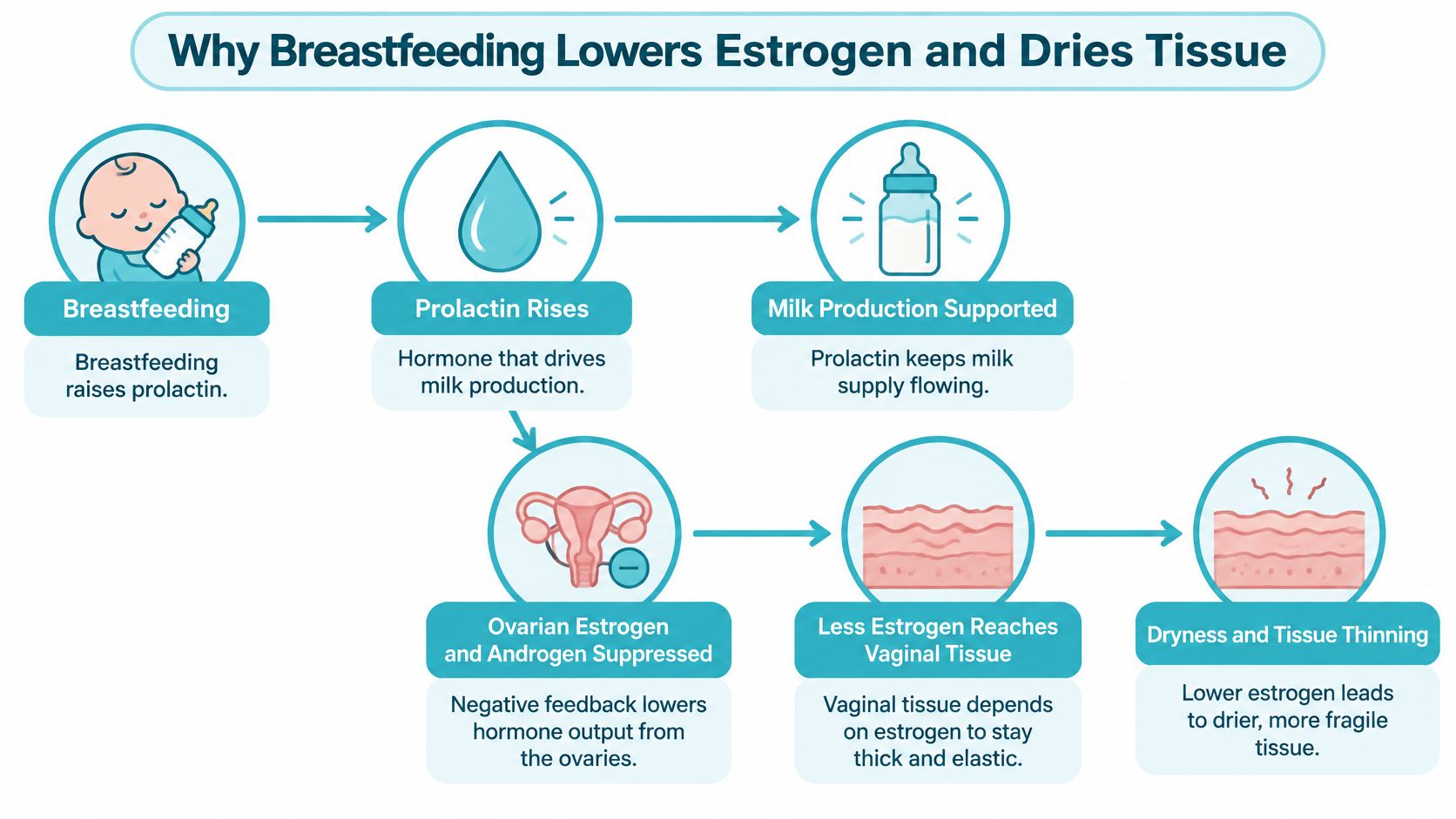
Breastfeeding raises prolactin, the hormone that supports milk production. Through hormonal feedback, prolactin also suppresses the ovaries' production of estrogen and androgens. Lower estrogen availability can change vaginal tissue maintenance, secretions, and genital blood flow.
A 2024 review in Sexual Medicine Reviews, which searched PubMed, Google Scholar, and Scopus through November 2023, described the resulting cluster of vaginal, sexual, and urinary symptoms as genitourinary syndrome of lactation. The name distinguishes lactation-related symptoms from the better-known menopause-related syndrome, even though both involve reduced estrogen signaling.
Think of estrogen as a steady water supply to a garden. Lactation turns the tap down, so the soil becomes drier without anyone digging it up or damaging it. The analogy isn't exact, but it explains why discomfort can develop even when a postpartum examination finds no tear or obvious wound.
Follow the hormonal chain
The sequence helps separate the cause from the symptoms:
- Milk production increases hormonal demand. Prolactin supports the work of making milk.
- Ovarian hormone output decreases. The feedback involved in lactation reduces estrogen and androgen secretion.
- Vaginal tissue receives less estrogen support. The lining may become thinner, with less secretion and lubrication.
- Contact becomes less comfortable. Friction can produce burning, soreness, or a sensation of tightness.
The hormonal pathway looks like this:
Dryness is a physiological symptom, not evidence that you aren't attracted to your partner or aren't trying hard enough to relax. Arousal and tissue lubrication are related, but they aren't interchangeable.
This explanation also isn't a diagnosis for every postpartum discomfort. Infection, skin conditions, contraceptive effects, healing injuries, and muscle tenderness can coexist with hormonal changes. Tell your clinician what you're feeling rather than assuming breastfeeding explains everything.
A useful starting point: Describe dryness as a symptom you want assessed, not a postpartum inconvenience you've already decided to tolerate.
How Common Dryness Is at Each Postpartum Stage
Postpartum dryness and painful sex by timepoint
| Postpartum timepoint | Breastfeeding women | Non-breastfeeding women | What it measures |
|---|---|---|---|
| 3 weeks | 13.3% (20 of 150) | 3.8% (3 of 80) | Vaginal dryness |
| 6 weeks | 17.5% (25 of 143) | 2.3% (2 of 87) | Vaginal dryness |
| 3 months | About 60.0% | Not reported in this summary | Dyspareunia, or painful intercourse |
| 6 months | 39.7% | Not reported in this summary | Dyspareunia, or painful intercourse |
| 12 months | 28.5% | Not reported in this summary | Dyspareunia, or painful intercourse |
The early dryness comparisons come from a longitudinal postpartum analysis available through Duke University: reported dryness affected 13.3% versus 3.8% at three weeks and 17.5% versus 2.3% at six weeks, comparing breastfeeding with non-breastfeeding women. Separately, a clinical summary of a systematic review reported dyspareunia estimates of 60.0%, 39.7%, and 28.5% at three, six, and twelve months postpartum, respectively.
What these comparisons tell you
The early rows compare the same symptom between feeding groups. They support an association between breastfeeding and dryness while lactation is becoming established. They don't establish when an individual's symptoms will peak or how long they'll last.
The later rows measure painful intercourse, not dryness. They aren't follow-up measurements from the same early-postpartum comparison, and they shouldn't be read as a single recovery curve. Someone can have painful intercourse without dryness, or dryness without attempting intercourse.
The missing comparison cells matter, too. “Not reported” doesn't mean non-breastfeeding women had no pain. It means this summary doesn't provide that comparison.
Use the timeline to start a conversation
The routine postpartum visit is a useful opportunity to discuss lubrication, entry pain, and involuntary tightening. It's not a deadline for resuming intercourse, and you don't need to wait for that appointment if symptoms are troubling you.
Breastfeeding status is one clue among several. Delivery injuries, medications, hormonal contraception, infection, and dermatologic conditions may also contribute, so a clinician should consider your full history.
Bring up symptoms if you notice:
- A change from your usual comfort. Ordinary contact or sexual activity now feels dry or irritating.
- Difficulty returning to intimacy. Pain, rather than preference alone, is limiting what feels possible.
- A pattern that isn't improving. Symptoms recur despite adjusting products or activities.
The practical conclusion is reassuring but specific: these complaints are common enough to ask about directly, and important enough to evaluate individually.
Symptoms and How They Change Intimacy
Say you're trying intimacy again after giving birth. You want closeness, but contact at the vaginal opening starts to burn, and your body tightens before you've decided what to do. Your partner notices the tension and wonders whether you've changed your mind.
That moment doesn't tell you whether the problem is tissue dryness, muscle guarding, or both. It does tell you that continuing through pain isn't a useful test of readiness.
Recognize more than a dry feeling
Symptoms may include:
- Reduced lubrication. You feel interested but don't become as physically lubricated as expected.
- Burning or stinging. Contact feels raw, especially at the opening.
- Superficial pain. Penetration hurts near the entrance rather than deep inside the pelvis.
- Tissue sensitivity or spotting. Light bleeding after contact needs assessment rather than an automatic assumption of dryness.
- Urinary discomfort. Urgency or burning can accompany genital symptoms, but infection needs consideration.
- Changes in desire. Anticipating discomfort can make initiating intimacy less appealing.
Pain that begins before contact, or a sensation that the opening closes involuntarily, raises a different question from friction alone. A clinician assessing painful intercourse after childbirth can help distinguish these patterns.
Take pressure out of the encounter
Fear of another painful experience can lead to bracing. Bracing can make contact harder, which reinforces the expectation that it will hurt. This is a physical protective response, not a personal failure.
Agree on a clear stop signal before intimacy begins. Choose touch that doesn't require penetration, and let either partner change plans without treating that change as disappointment.
Wanting closeness and not wanting painful penetration are completely compatible.
Hormone-related symptoms may ease as ovarian activity recovers, often around reduced breastfeeding or weaning, but the timing isn't predictable. Becoming established with breastfeeding doesn't guarantee immediate relief, and symptoms can persist for months. You don't have to postpone care until feeding ends.
Pelvic Floor Problems That Feel Like Dryness
Think of a door that won't open easily. Dryness resembles a sticky hinge that needs lubrication; pelvic floor guarding resembles someone holding the door shut. Adding oil won't release the hand.
The analogy explains why a lubricant can help one person considerably and do little for another. It also explains why several problems may need treatment together.
Match the pattern to the tissue
| Possible source | Clues worth describing | What an assessment should clarify |
|---|---|---|
| Hormone-sensitive vaginal tissue | Surface burning, friction, rawness, improvement with lubricant | Whether dryness or tissue changes are present |
| Pelvic floor overactivity | Blocking, involuntary tightening, difficulty inserting a finger or tampon, pain before contact | Whether muscles can relax and lengthen comfortably |
| Scar sensitivity | A distinct tender spot near a healed tear, episiotomy, or surgical scar | Whether scar tenderness or restricted movement contributes |
These are clues, not home diagnostic tests. Improvement with lubricant suggests friction matters, but it doesn't rule out muscle tenderness. Likewise, localized scar pain doesn't establish that a scar is the only source.
A cesarean birth doesn't exclude pelvic floor symptoms. Pregnancy, abdominal recovery, and protective movement patterns can all be relevant to the assessment.
Make a simple pain map
Use what you've already noticed rather than repeatedly provoking pain:
- Where does it hurt? Identify the opening, one side, a scar, the lower abdomen, or deeper pelvic tissue.
- When does it begin? Before contact, at entry, with movement, or afterward?
- What changes it? Note whether lubricant, position, slower movement, or stopping helps.
- What do the muscles do? Notice breath-holding, buttock clenching, or involuntary tightening.
A postpartum pelvic floor physical therapy assessment can evaluate muscle coordination, tenderness, strength, and relaxation. Weakness and excessive tension aren't opposites that exclude each other; a muscle can be poorly coordinated and still hold too much resting tension.
Treatment should follow the finding. Automatically adding Kegels may be unhelpful when the immediate problem is difficulty relaxing. Scar work also needs appropriate healing and guidance, rather than forceful massage over a painful area.
Your most useful contribution is a clear description. The clinician's job is to connect that description with examination findings and choose care accordingly.
Self-Care Steps That Help Right Away
Start with nonhormonal care and fewer irritants. Practical measures discussed in the postpartum study available through Duke University include water- or silicone-based lubricant, regular vaginal moisturizers, slower arousal, and nonpenetrative intimacy, with assessment when pain or tightening persists.
Keep the routine simple rather than adding several new products at once.
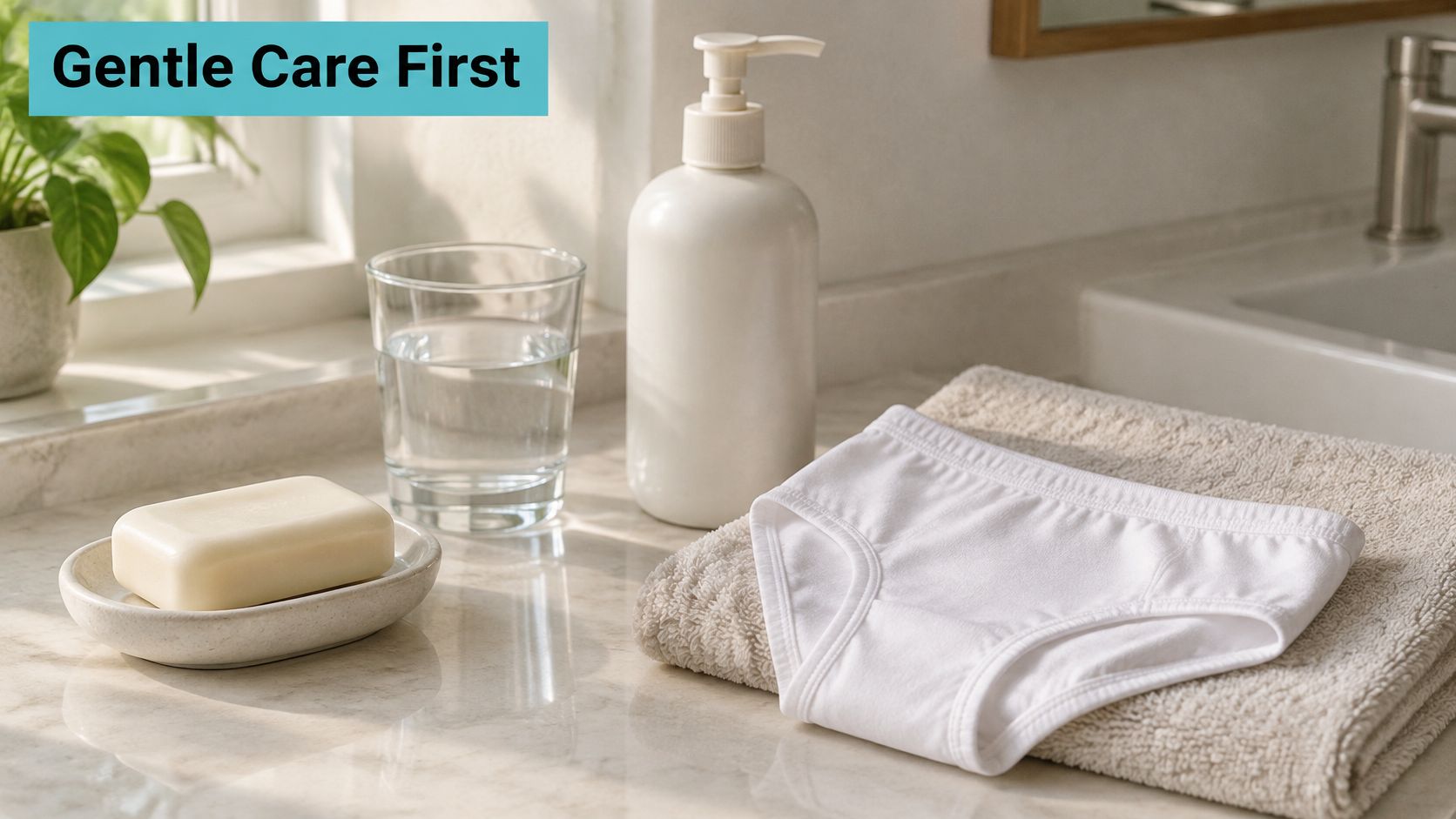
Build a gentle routine
-
Remove likely irritants. Skip scented vulvar washes, fragranced wipes, douches, and products that sting. Wash externally with lukewarm water, adding a gentle fragrance-free cleanser only if tolerated; ordinary soap and body lotion don't belong inside the vagina.
-
Use lubricant before friction starts. Apply a generous amount of water- or silicone-based lubricant to the contact surfaces and reapply when needed. Water-based products are easy to wash off; silicone lasts longer, including around water, but check compatibility with silicone toys, and remember that oil-based products can weaken latex condoms.
-
Separate moisturizer from lubricant. A vaginal moisturizer supports comfort between sexual encounters, while lubricant reduces friction during them. Choose a product specifically labeled for vaginal use and use its recommended schedule, rather than substituting a cosmetic body lotion.
-
Allow more time without making arousal a task. Try unhurried touch and stop before discomfort escalates. Longer foreplay can help, but it won't necessarily overcome hormone-related tissue changes.
-
Choose comfortable forms of closeness. Kissing, massage, and external touch can preserve intimacy without repeatedly irritating sore tissue. Nonpenetrative intimacy is an option in its own right, not a consolation prize.
-
Record the response. Note the product, activity, location of discomfort, and whether symptoms settled afterward. Stop products that burn rather than assuming irritation means they're working.
Choose products with a clear purpose
A guide to sensitive personal lubricant can help you think through formulation and comfort. For another plain-language perspective on everyday care, Momotaro Apotheca discusses vaginal comfort during postpartum recovery; treat commercial product suggestions as possibilities, not proof that they suit your tissue.
If you prefer a video format, this is another resource to review alongside your individualized care plan.
Look for less burning, more comfortable everyday movement, and less soreness after contact. Don't use successful penetration as the only measure of progress, and don't continue a painful activity just to test a product.
Treatments That Go Beyond Self-Care
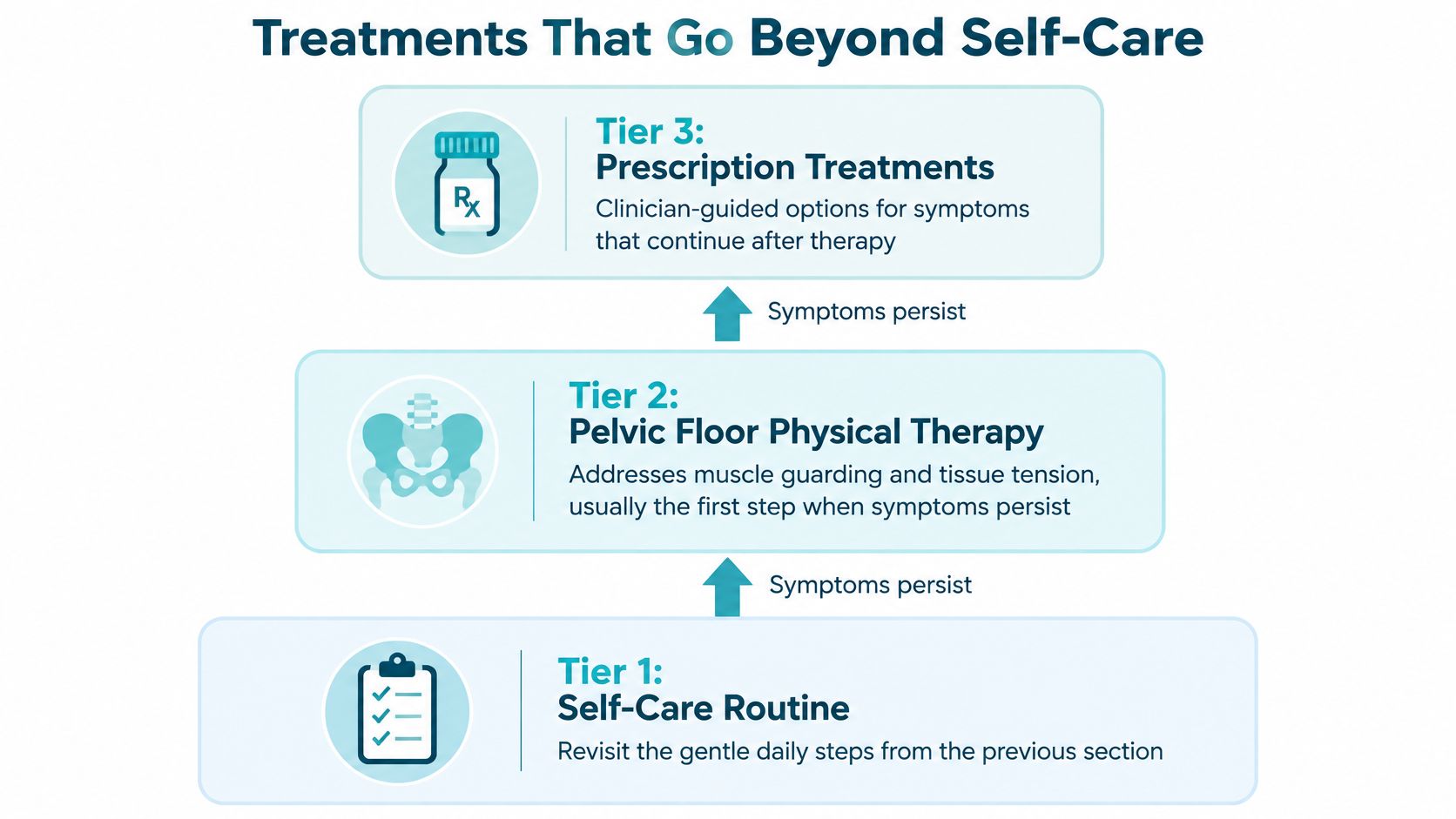
When a gentle routine doesn't provide enough relief, treatment should target the finding that remains. Muscle guarding needs a muscle-focused plan; persistent tissue changes may need a prescribing clinician. Neither treatment automatically replaces the other.
A pelvic health physical therapist can assess relaxation, tenderness, coordination, and scar mobility. With your consent, treatment may include manual techniques, breathing and relaxation practice, graded movement, and education about comfortable contact. An internal examination isn't something you must endure; ask what it would add and what alternatives are available.
Compare the options
Treatment options beyond self-care and who manages them
| Option | What It Addresses | Breastfeeding Considerations | Who Manages It |
|---|---|---|---|
| Pelvic floor physical therapy | Muscle guarding, tissue sensitivity, scar mobility | No medication; can be used during breastfeeding | Pelvic health or women's health physical therapist |
| Low-dose local vaginal estrogen | Refractory dryness or clinically evident atrophy | Limited postpartum evidence; requires a product-specific discussion | Prescribing clinician, with review of cancer and thrombotic risk |
| Vaginal DHEA, or prasterone | Selected refractory symptoms when considered appropriate | Limited postpartum evidence; not an established breastfeeding-safe substitute for estrogen | Prescribing clinician, involving the child's clinician when appropriate |
A 2024 clinical review published in The Journal of Sexual Medicine discusses vaginal estrogen or DHEA for refractory lactational symptoms and summarizes encouraging estrogen findings, including minimal or no milk transfer and no demonstrated reduction in supply, while emphasizing limited postpartum studies. That isn't a guarantee for every formulation, dose, feeding situation, or infant, and it doesn't establish equivalent safety for DHEA.
This treatment diagram is a guide to escalation, not a requirement to complete therapy before discussing medication:
Make the breastfeeding decision together
Ask the prescriber to weigh the expected benefit against uncertainty in your circumstances. Useful questions include:
- Symptoms and prior care. What finding are we treating, and which nonhormonal approaches haven't helped?
- Feeding circumstances. Does the feeding pattern, infant age, or current supply concern change the recommendation?
- Personal risk. How do cancer history, clotting history, and other medicines affect the choice?
- Monitoring. What improvement should I expect, what concerns should I report, and when should treatment be reviewed?
A history of estrogen-sensitive cancer changes this conversation and may require oncology input. Lactation compatibility and cancer-related safety are separate questions; reassurance about one doesn't answer the other.
Shared-decision rule: Ask about the specific prescribed product, not whether vaginal hormones are universally safe or unsafe.
You can seek physical therapy and medical evaluation in parallel when both muscle and tissue symptoms are present. The aim is a coordinated plan, not a rigid sequence that delays appropriate care.
When to Get Checked and Book Your Next Step
Mild friction-related dryness may improve with a consistent, well-tolerated routine. There isn't a supported universal deadline for improvement, though, and you shouldn't have to complete an arbitrary waiting period before asking for help.
Persistent, severe, or bleeding-associated symptoms need evaluation. An OB/GYN or another qualified clinician can examine tissue, consider infection or skin conditions, and decide whether medication is appropriate. A pelvic health physical therapist can assess the muscle and movement components of pain.
Arrange a clinical appointment
Contact your clinician when you notice:
- Bleeding after contact. Repeated spotting or bleeding after sex deserves an explanation, even if you suspect fragile tissue.
- Pain that limits your life. Difficulty with intimacy, sitting, exercise, or everyday movement is enough reason to seek care.
- Symptoms despite sensible self-care. Ongoing discomfort or repeated product irritation calls for reassessment.
- Urinary concerns. Burning, persistent urgency, or difficulty emptying your bladder shouldn't automatically be attributed to dryness.
- Scar changes. Increasing tenderness, swelling, redness, or pain near a healing incision needs review.
- Possible infection or skin disease. Unusual discharge, sores, or persistent itching may require treatment different from lubrication.
- A hormone-sensitive cancer history. Tell the prescriber before discussing hormonal products.
Know when not to wait
Seek same-day medical assessment for fever, severe or rapidly worsening pelvic pain, or heavy bleeding. Heavy bleeding with dizziness, fainting, or marked weakness warrants emergency care. These aren't symptoms to manage with a moisturizer or a routine therapy appointment.
For nonurgent care, say what you need when booking: evaluation of postpartum dryness, painful intercourse, or involuntary tightening. Ask specifically for a pelvic floor assessment when the pain includes guarding, blocking, or difficulty relaxing.
Bring your symptom diary, product names, birth and scar history, current medicines, and feeding pattern. Include your pain map and tell the clinician what examination you feel comfortable having. Before leaving, agree on what to try, how to judge progress, and whom to contact if symptoms worsen.
Lake City Physical Therapy offers postpartum pelvic floor assessment and treatment for painful sex, muscle guarding, and scar-related discomfort, with in-person care in Coeur d'Alene, Hayden, Post Falls, Spokane South Hill, and Boise, plus telehealth options. Visit Lake City Physical Therapy to book an evaluation and bring your symptom diary so your clinician can help identify whether tissue, muscle, scar sensitivity, or a combination needs attention.

