Does Exercise Help Nausea in Pregnancy?
Yes, gentle exercise can often help manage nausea in pregnancy. Up to 80% of pregnancies involve nausea, and the right movement can ease it by improving circulation, helping regulate blood sugar, and releasing endorphins.
If you're reading this while trying to sip water, nibble crackers, and figure out whether standing up is a good idea, you're not alone. Pregnancy nausea is often called "morning sickness," but for many women it shows up at any hour and can make even basic routines feel harder than they should.
As a women's health physical therapist, I don't treat movement as a test of discipline. I treat it as a tool. When exercise helps, it usually isn't because someone pushed through a hard workout. It's because they found a small amount of the right kind of movement, at the right time, in a way their body could tolerate.
Coping with Nausea During Early Pregnancy
Early pregnancy nausea can be strangely isolating. You may look fine from the outside while feeling unsettled, lightheaded, or one step away from vomiting through much of the day. That mismatch often makes women wonder whether they should rest completely or try to move more.
For many women, the answer is somewhere in the middle. Gentle activity can help, but only when it respects your current symptoms. A slow walk, a few mobility drills, or prenatal yoga may calm things down. A hot, intense, or overly long session often does the opposite.
A helpful way to think about this is that nausea changes your movement threshold. What normally feels easy may not feel easy right now. That's not weakness. It's good information.
Gentle exercise should feel like support, not like something you have to survive.
A 2019 study of 129 pregnant women in the first trimester found a significant inverse relationship between leisure-time physical activity and nausea severity. In that sample, 53% met the guideline of at least 150 minutes per week, and women with low nausea were more likely to meet that guideline than women with high nausea. The same paper notes that first-trimester nausea affects up to 80% of pregnancies, most commonly between weeks 6 and 12, and cites a qualitative finding that outdoor activity may feel better than gym-based exercise for some women. You can read the study in the Journal of Physical Activity & Health pregnancy nausea analysis.
That matters because it gives us a more useful answer to the question "does exercise help nausea in pregnancy?" Yes, often it does. But the kind of exercise matters, the dose matters, and your symptoms matter.
If you're already looking for broader support during pregnancy, structured pregnancy care physical therapy services can help you sort through what to keep doing, what to modify, and what to pause.
How Gentle Movement Fights Pregnancy Nausea
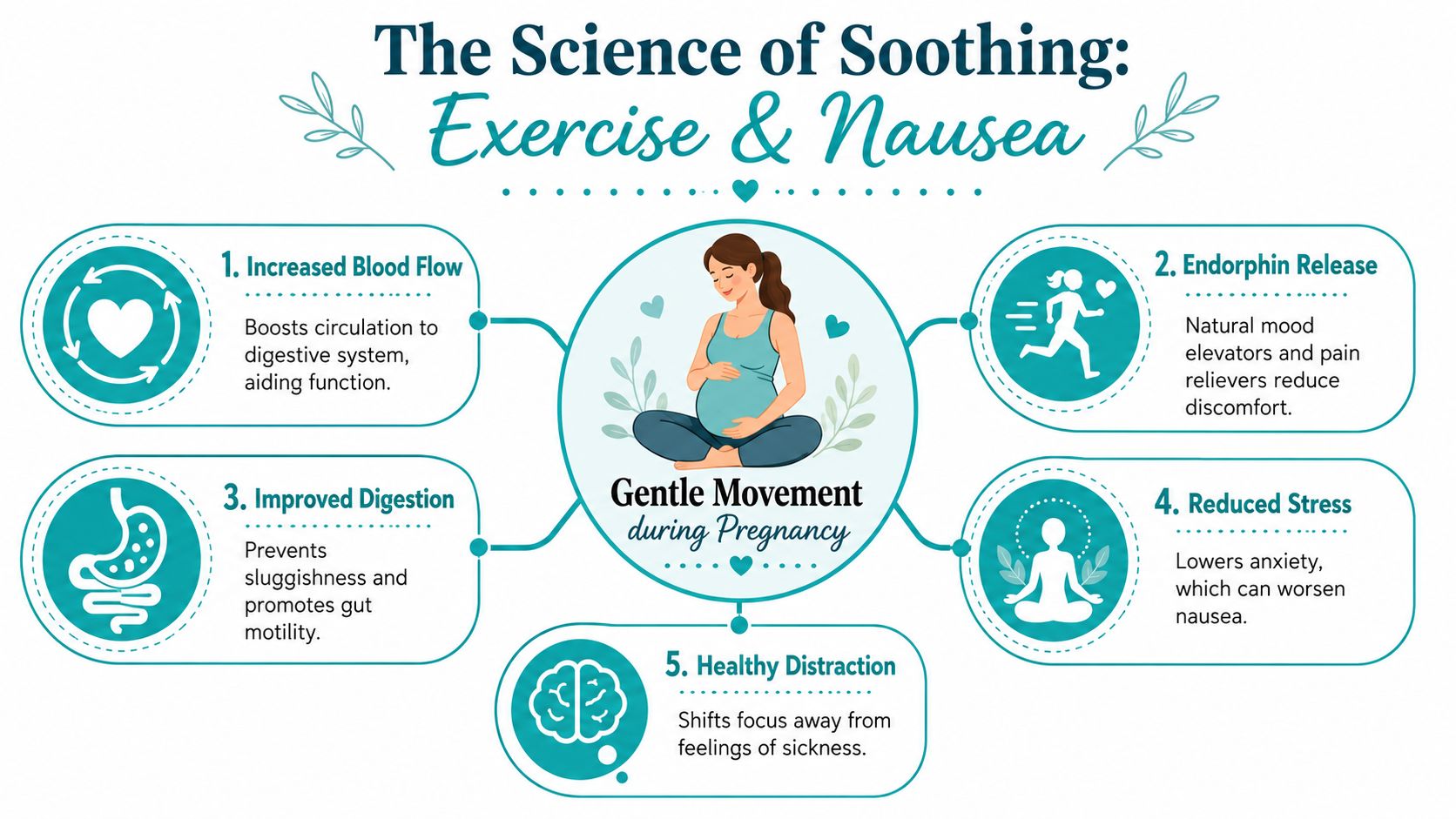
Nausea in pregnancy isn't random, even though it can feel that way. Hormonal shifts, an unsettled digestive system, stress, and blood sugar swings can all feed into the same miserable loop. Gentle movement can interrupt that loop from several directions at once.
Blood sugar gets steadier
One reason nausea can hit hard is that blood sugar doesn't stay steady. It is similar to a rollercoaster with sharp drops. If you haven't eaten in a while, or if your body is reacting strongly to early pregnancy changes, those dips can make you feel worse fast.
Research summarized from the American Journal of Obstetrics & Gynecology reports that low-to-moderate intensity exercise helps regulate blood sugar levels, a key trigger for nausea, thereby reducing symptom severity, and that this effect is complemented by endorphin release, which improves mood and reduces the perception of discomfort. That summary appears in this review of exercise and first-trimester nausea.
In practice, this is why a brief walk after a small snack can feel better than collapsing on the couch for the rest of the afternoon.
Digestion and circulation work better
When you feel sick, your first instinct is often to stay very still. Sometimes that's appropriate. But complete stillness can also leave digestion feeling sluggish and your whole system feeling heavy.
Gentle movement can help by:
- Encouraging circulation so your body doesn't feel as stagnant
- Supporting digestion with light, rhythmic motion
- Reducing that "pooling" feeling many women describe after sitting too long
This doesn't require a workout mindset. It usually works best when the movement is repetitive, calm, and easy to stop.
Practical rule: If movement makes you feel more human within a few minutes, you're probably in the right zone. If it makes you feel hotter, shakier, or more nauseated, back off.
Your nervous system settles down
Nausea isn't only physical. The stress of anticipating nausea can make symptoms louder. That's where breathing, mobility, and low-intensity exercise can be surprisingly useful.
A short walk, supported stretching, or prenatal yoga can shift your body away from that braced, tense state. Endorphins may soften discomfort, and the act of moving can pull your attention away from the constant internal monitoring that often accompanies nausea.
There is also a simple benefit that doesn't get enough attention. Gentle movement can give you a task. When you're counting breaths, walking to the corner, or doing a few supported squats, you're not spending those same minutes waiting to feel worse.
Best Exercises for Nausea Relief
If your goal is symptom relief, choose movement that is easy to start, easy to stop, and unlikely to spike body temperature or effort. The best exercise for nausea in pregnancy is usually the one you can tolerate consistently without dreading it.
Walking often works best
Walking is usually my first suggestion because it's accessible, self-paced, and adaptable. You can walk for five minutes, turn around early, or slow down without feeling like you've failed.
Outdoor walking may be especially helpful for some women. Fresh air, visual distraction, and a cooler environment can make the whole experience easier to tolerate than a stuffy room or crowded gym.
Prenatal yoga can calm an unsettled system
Prenatal yoga works well when nausea is tied to stress, shallow breathing, or overall body tension. The goal isn't extreme flexibility. It's steadiness.
A few positions and strategies tend to be more helpful than long holds or fast transitions:
- Supported child's pose or side-lying rest when you need the session to feel grounding
- Cat-cow and gentle mobility when your body feels stiff from lying down or sitting
- Breath-focused practice when nausea gets worse with anxiety
If you respond well to slower, breath-led movement, resources on how yoga reduces stress can be especially useful.
Swimming and water exercise can feel easier
Water changes the experience of movement. The buoyancy can reduce pressure, and many women find the cooler environment more comfortable when they're queasy.
This isn't the time for hard lap work. Easy walking in the pool, gentle floating movement, or relaxed swimming is usually the better fit.
Light strength work has a place
Strength training can still be appropriate if it's light and doesn't leave you straining. The goal is to maintain comfort and support, not to chase performance.
Think simple, controlled movements such as:
- Sit-to-stands from a chair
- Wall-supported squats
- Band rows
- Glute bridges if they feel comfortable
- Standing hip work while holding a counter
Short, repeatable sessions usually beat ambitious plans. A few tolerable movements done consistently are more useful than one workout that wipes you out.
Here is a quick reference guide.
| Exercise | Primary Benefit for Nausea | Tip for Getting Started |
|---|---|---|
| Walking | Gentle circulation boost and easier digestion | Start with a short, flat route and keep the pace conversational |
| Prenatal yoga | Calms stress and helps breathing feel more controlled | Choose a slow class or a few supported poses at home |
| Swimming | Cooler full-body movement with less joint strain | Keep the effort easy and take breaks often |
| Light strength training | Maintains support without high fatigue | Use bodyweight or light resistance and stop well before strain |
| Mobility work | Reduces stiffness when you can't tolerate a full workout | Pick two or three movements and repeat them slowly |
The broad pattern matters more than any single workout. In the earlier first-trimester study, women with lower nausea were more likely to meet the exercise guideline than women with higher nausea, which supports the idea that activities such as walking or prenatal yoga can be useful tools, even when symptoms are present.
Practical Tips for Exercising When You Feel Unwell
Most women don't need more motivation when they're nauseated. They need a plan that feels doable on a rough day.

Make the first five minutes easy
Don't start by asking whether you can complete a full workout. Ask whether you can tolerate five minutes. That mindset change helps a lot.
Try this sequence:
- Eat or sip something first if an empty stomach tends to make you worse.
- Choose a cool setting rather than a warm room.
- Start with the gentlest option such as walking indoors, marching in place, or a few stretches.
- Reassess at five minutes and decide whether to continue.
Many women do best when movement happens before they become severely nauseated, not after symptoms have built for hours.
Keep intensity lower than you think you need
This is one of the biggest mistakes I see. If your normal brain says, "A real workout should feel productive," your pregnant, nauseated body may disagree.
Useful movement during this phase often feels almost too easy. That's fine. Relief is the target.
A few practical adjustments can make a big difference:
- Use shorter sessions instead of trying to make up for lost time
- Pick low-odor environments if smells trigger symptoms
- Avoid quick position changes if you feel head rushes or queasiness
- Stop before overheating because heat can amplify nausea for many women
If all you can manage is a slow loop around the house or driveway, that still counts.
Some women also like having a guided routine so they don't have to think while they feel miserable. A simple mobility or prenatal exercise video can lower the barrier to starting.
Know what doesn't work well
A few patterns tend to backfire:
- High-intensity intervals when you're already nauseated
- Exercising on an empty stomach if low blood sugar is part of your symptom pattern
- Long sessions in hot spaces
- Forcing yourself through worsening symptoms because you think movement is always supposed to help
The right approach is flexible. Some days you may walk. Other days your best option may be breathing, stretching, and getting outside for fresh air.
Safety Precautions and Red Flags
Exercise should never become a loyalty test. If your body is sending warning signs, the safest choice is to stop and reassess.

Stop exercising and call your provider if needed
Pause activity if you develop symptoms such as:
- Dizziness or feeling faint
- A significant headache
- Vaginal bleeding
- Shortness of breath before you even get going
- Abdominal, pelvic, or unusual pain
Those symptoms move you out of the self-management category.
Mild nausea is different from severe vomiting
Typical pregnancy nausea and severe nausea are not the same thing. This distinction matters.
Guidance summarized in Expecting and Empowered's discussion of exercise with morning sickness notes that while gentle exercise may be reasonable for mild symptoms, it is not appropriate for the 1% to 3% of pregnancies affected by hyperemesis gravidarum without explicit doctor approval, because it can worsen dehydration and strain. In those cases, medical management comes first.
Severe nausea changes the priority list. Hydration, nutrition, and medical care matter more than staying active.
If you're vomiting frequently, unable to keep fluids down, or getting weaker instead of steadier, don't try to fix that with exercise.
When to See a Prenatal Physical Therapist
Sometimes nausea is only part of the problem. You may also be dealing with pelvic girdle pain, low back pain, hip pain, sciatica, pressure symptoms, or a history of injury that makes movement harder to choose safely. That's where a prenatal physical therapist can be useful.
A tailored plan beats guesswork
A prenatal PT doesn't just hand you a generic exercise sheet. We look at how you move, what positions trigger symptoms, how your breathing pattern changes when you're nauseated, and whether your pelvic floor and abdominal wall need a different strategy than the one you've been trying.
That matters when:
- Walking helps nausea but flares pelvic pain
- Yoga sounds good but certain positions feel awful
- You want to stay active but don't know what's safe for your body
- You already had bladder, prolapse, or core concerns before pregnancy
For women also considering hands-on care, this guide on how to choose a qualified RMT is a practical resource for understanding what credentials and prenatal experience to look for.
Professional help is useful before things get severe
You don't need to wait until you're miserable enough to need a full reset. A prenatal PT can help you find positions that settle symptoms, adjust exercise dosage, teach breathing and pressure management, and build a plan that changes as pregnancy changes.
If you want more individualized support, prenatal and postpartum physical therapy is designed for exactly this kind of problem solving. The goal isn't to push through pregnancy. It's to move through it with more comfort, more confidence, and fewer setbacks.
If nausea is making movement feel confusing, Lake City Physical Therapy can help you sort out what's safe, what's likely to help, and how to adapt exercise to your body. Explore care options or schedule a visit with Lake City Physical Therapy.

