Dry Needling Pelvic Floor for Pain Relief
Pelvic floor dry needling is a highly specific physical therapy treatment that uses incredibly thin needles to target and release painful 'knots' in your pelvic muscles. These knots, known as trigger points, are often the hidden culprits behind chronic pelvic pain, bladder problems, and even sexual dysfunction.
What Is Pelvic Floor Dry Needling?
Think of your pelvic floor as a muscular hammock that supports your internal organs. When this hammock develops tiny, hyper-irritable knots, the whole system gets thrown out of whack. You can stretch and strengthen all you want, but until you release those specific knots, the tension and pain often remain.
Pelvic floor dry needling is an advanced application of the broader practice of dry needling for pain management. While the general technique can be used on muscles all over the body, applying it to the intricate muscles of the pelvic floor requires specialized training and a deep understanding of pelvic anatomy.
To put it simply, we use this technique to go straight to the source of the problem.
For a quick overview, here's a breakdown of the core concepts.
Quick Guide to Pelvic Floor Dry Needling
| Key Aspect | Explanation |
|---|---|
| The Problem | Tiny, painful knots (trigger points) form in the pelvic floor muscles, causing pain, tightness, and dysfunction. |
| The Mechanism | A physical therapist inserts a sterile, ultra-thin needle directly into the trigger point to elicit a "twitch response." |
| The Result | The twitch response acts like a reset button, forcing the muscle to release its tension, breaking the pain cycle and restoring normal function. |
| Primary Benefits | Reduces chronic pain, improves bladder and bowel control, and helps restore healthy sexual function. |
This targeted approach allows us to address issues that other treatments can't always reach.
A Common Problem Hiding in Plain Sight
If you're dealing with these issues, you are far from alone. Pelvic floor dysfunction (PFD) is surprisingly common, affecting an estimated 20-25% of women and men in the United States. Many of these cases are linked to chronic pelvic pain, making the search for effective solutions more urgent than ever.
A Targeted Approach to Muscle Release
This isn't a general, one-size-fits-all treatment. Pelvic floor dry needling is a precision tool used by a highly trained physical therapist to address the muscular root of your symptoms.
When the needle stimulates the trigger point, it causes a "local twitch response"—an involuntary reflex that makes the muscle fiber contract and then, crucially, let go.
Think of it like hitting CTRL+ALT+DEL on a frozen muscle. The needle triggers a spinal cord reflex that forces a hard reset, breaking the stubborn pain-tension cycle and allowing the muscle to return to a relaxed, healthy state.
This release accomplishes several amazing things almost immediately:
- Eases Chronic Pain: By deactivating trigger points, we can relieve both local pain and referred pain—that confusing ache you might feel in your low back, hips, or during intercourse.
- Improves Bladder Control: Overly tight pelvic muscles can be a major cause of urinary urgency and frequency. Releasing that tension can calm things down significantly.
- Restores Normal Function: A balanced and responsive pelvic floor is essential for comfortable sexual function, regular bowel movements, and proper core stability.
Once the muscles are released, they are finally receptive to other physical therapy exercises. This unlocks your ability to effectively strengthen and coordinate your pelvic floor, paving the way for lasting relief and helping you get back to the life you love.
How Dry Needling Helps Heal Your Pelvic Floor
It seems almost too simple, doesn't it? The idea that a tiny, solid needle can relieve deep-seated pelvic pain is a bit hard to grasp at first. But what’s happening is a powerful chain reaction that helps break the cycle of muscle tension and pain.
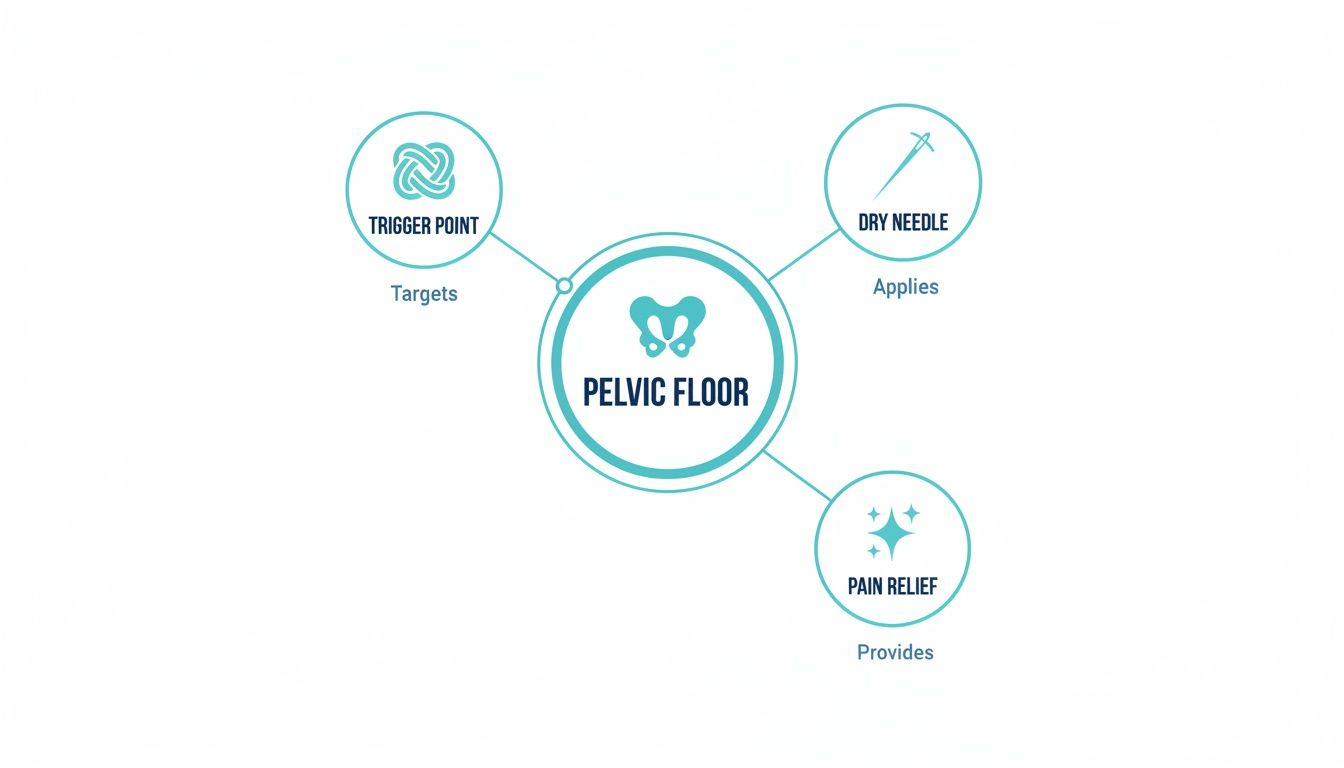
When a skilled physical therapist identifies a trigger point in your pelvic floor, the needle sets off a cascade of healing. It’s not just one thing, but a combination of three key responses that work together to bring you relief.
The Local Twitch Response: A Muscle Reset
The first thing that happens is a fascinating and visible phenomenon: the local twitch response. As the needle makes contact with the tight, knotted-up fibers of the trigger point, the muscle gives a quick, involuntary twitch. It’s a clear sign we’ve hit the right spot.
Think of it like rebooting a frozen computer. This twitch is a reflex arc that happens at the spinal cord level, essentially forcing the muscle to release a contraction it's been holding onto for far too long. This immediate release is what starts to break that stubborn cycle of tightness and pain.
This isn't a temporary sensation; it's a physiological reset. By forcing the muscle out of its chronically tense state, we’re changing its fundamental behavior and teaching it how to relax again.
Turning Down the Volume on Pain Signals
Chronic pain doesn't just live in the muscle; it rewires your nervous system. Over time, nerves can become hypersensitive, blasting the brain with pain signals even when there’s no new injury. Dry needling directly addresses this.
The insertion of the needle stimulates specific nerve fibers that act as gatekeepers for pain. They can actually interrupt the pain messages traveling up the spinal cord to your brain.
This process is called neuromodulation. In simpler terms, the needle helps turn down the 'volume' on your pain perception. It changes how your brain interprets signals from the pelvic area, effectively dialing down the sensation of pain.
This is why you might feel relief not just at the site of the needle, but also in areas of referred pain, like your lower back, hips, or abdomen. This broader impact on the nervous system is a core part of its value, similar to other holistic strategies for managing cancer pain that focus on the whole body's response.
Boosting Blood Flow and Promoting Tissue Healing
Finally, with the muscle knot released and the pain signals quieted, your body's natural healing crew can finally get to work. A tight trigger point is like a traffic jam—it chokes off blood flow, trapping waste products and preventing oxygen and nutrients from getting in.
The needle creates a tiny, controlled injury that signals the body to respond. This triggers a healthy, localized inflammatory response that brings a rush of fresh, oxygenated blood to the trigger point.
This renewed circulation is critical. It does two things at once:
- It flushes out the accumulated waste products and pain-causing chemicals that were stuck in the tight muscle.
- It delivers the oxygen and nutrients your tissues desperately need to repair themselves and heal for good.
So, by restoring healthy blood flow, dry needling doesn't just put a band-aid on the pain. It creates the perfect environment for the muscle tissue to heal itself from the inside out. This triple-action approach is what makes it such a powerful tool within a comprehensive pelvic physical therapy plan.
Who Can Benefit From Pelvic Floor Dry Needling?
Knowing the science behind pelvic floor dry needling is one thing, but what really matters is seeing how it helps real people get their lives back. This isn't some niche treatment for a select few. It’s a powerful tool for a surprisingly wide range of people whose lives have been turned upside down by pelvic floor problems.

The common denominator for almost everyone who finds relief is the presence of myofascial trigger points—those tight, stubborn, and painful knots hiding in the pelvic floor muscles. When these knots are the true source of the problem, dry needling can offer incredibly targeted and effective relief.
Individuals Struggling With Chronic Pelvic Pain
Chronic pelvic pain is a frustrating and often misunderstood condition. It can be linked to things like endometriosis, interstitial cystitis (painful bladder syndrome), or general pelvic myalgia. When pain hangs around for months or years, the pelvic floor muscles often clench up in a protective spasm. This creates trigger points, which then start their own vicious cycle of pain.
Imagine trying to get through your day with a deep, persistent ache that makes sitting at your desk, driving, or even just relaxing feel impossible. For people living this reality, dry needling pelvic floor muscles can feel like finally finding the right key to a lock you thought was permanently rusted shut. By precisely releasing the muscle knots that are perpetuating the pain, we can help the entire nervous system calm down.
The research backs this up. A 2026 randomized controlled trial on women with chronic pelvic pain showed that just five sessions of dry needling brought significant, lasting relief from both pain and nervous system sensitivity. To go a bit deeper on this, you might find our guide on understanding pelvic myalgia helpful.
People Experiencing Painful Intercourse (Dyspareunia)
Intimacy is supposed to be about connection, not pain and anxiety. For so many women and men, dyspareunia (painful sex) creates a wall of fear around what should be a positive experience. More often than not, the culprit is hypertonic—or overly tight—pelvic floor muscles that simply won't allow for comfortable penetration.
A Real-World Example: Think of a woman who has started avoiding intimacy because the pain has become unbearable. It’s causing stress in her relationship and a deep sense of loss. A pelvic health therapist finds several key trigger points in her pelvic floor. After a few dry needling sessions, those muscles finally get the message to let go. The pain diminishes, and she's able to reconnect with her partner without that constant fear.
This is a story we see play out time and time again in the clinic, and the data supports it. In one study of 79 women, 92% of whom had dyspareunia, dry needling led to meaningful pain reductions of 30-50%, demonstrating that this treatment can create real, lasting change.
Athletes and Active Individuals with Urinary Incontinence
It's one of the most frustrating problems for active people: urinary leakage during a run, a jump, or a heavy lift. We’re often told this is from a "weak" pelvic floor, but the issue can just as easily be muscles that are too tight and exhausted to function correctly.
Here’s how it happens:
- The Runner's Story: A dedicated runner starts leaking with every few strides. She's been doing Kegels for months, but nothing helps. A pelvic PT quickly discovers her pelvic floor isn't weak—it's overactive and fatigued. Dry needling helps hit the reset button on that chronic tension. Suddenly, her muscles can do their job properly, contracting and relaxing as needed. The leaks stop, and she’s back on the road.
Dry needling helps restore the essential coordination these muscles need to support you during intense activity, without the unwanted side effects.
Women Navigating Postpartum Recovery
Pregnancy and childbirth put the pelvic floor through an incredible amount of stress. It’s completely normal for new moms to deal with anything from pain and pressure to bladder issues or discomfort when returning to intercourse.
Scar tissue from perineal tearing or an episiotomy can create adhesions that tug on surrounding tissue and create painful trigger points. Dry needling is a fantastic tool for working on that scar tissue, helping to improve its mobility and release the tight muscles around it.
For a new mom who is struggling with pain that makes it hard to lift her baby or even just feel like herself, dry needling can be a game-changer in her recovery. It helps bring the pelvic floor back into balance so she can heal fully and get back to enjoying life with confidence.
What to Expect During Your Pelvic Floor Dry Needling Session
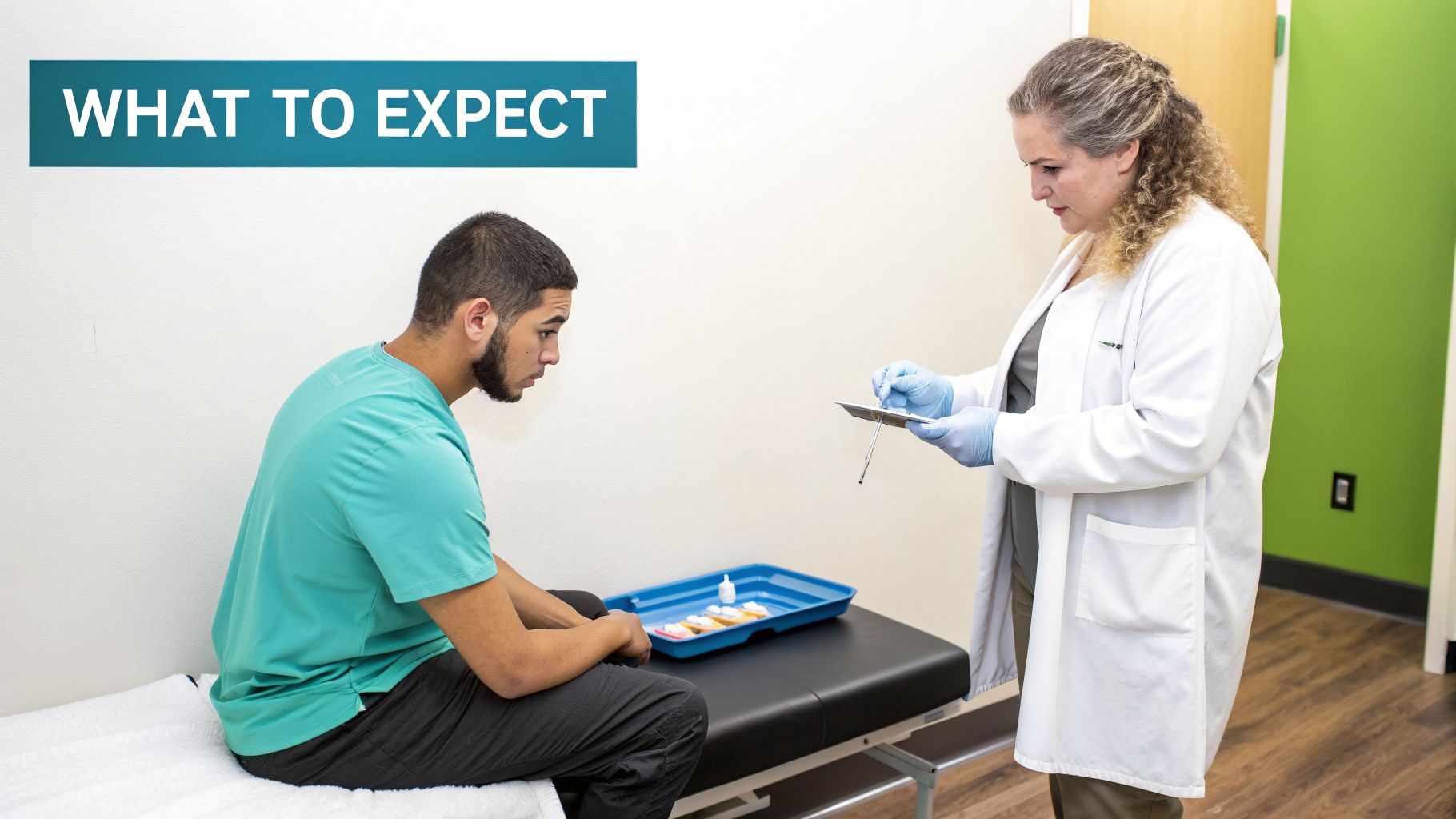
The thought of needles anywhere near the pelvic region can sound intimidating—that's a completely normal reaction. My goal is to walk you through the process step-by-step, so you can trade that apprehension for confidence. A dry needling pelvic floor session is a highly controlled, professional treatment that we can break down into three simple phases: before, during, and after your appointment.
Phase 1: The Consultation and Prep Work
Your session always starts with a conversation, not a needle. We’ll begin with a thorough evaluation to discuss your symptoms, medical history, and what you hope to achieve. This is the perfect time to ask every question on your mind. It’s also how I confirm that dry needling is genuinely the best fit for your specific situation.
I'll explain the whole procedure, making sure you feel completely informed and comfortable before we move forward. We’ll talk about which muscles we plan to address and what you're likely to feel. Only after you give your informed consent will we get started. You'll be positioned comfortably on a treatment table in a private room, usually with pillows or bolsters for extra support.
From there, I’ll prepare the treatment area by cleaning the skin to create a sterile field. I will be wearing gloves and using single-use, sterile needles for every insertion—no exceptions. Your privacy, comfort, and safety are the absolute priorities.
Phase 2: The Dry Needling Procedure Itself
Once you’re settled and comfortable, the treatment begins. I'll use an incredibly thin, solid-filament needle to precisely locate a trigger point within a pelvic floor muscle. As the needle passes through your skin, you might feel a tiny prick, but many people hardly notice it at all.
As the needle tip reaches the tense muscle knot, or trigger point, you'll likely feel a different kind of sensation. It's often described as a deep, dull ache or a momentary feeling of pressure.
But the key sensation we're looking for is the local twitch response. This is a quick, involuntary muscle spasm—it feels like a little flutter or a brief cramp. While it might catch you by surprise, it's actually the main therapeutic goal. That twitch is the signal that the trigger point has been successfully released and the muscle is starting to reset.
I’ll be communicating with you the entire time, checking in to make sure you’re doing okay. A single session might involve treating a few different trigger points, and each needle might only stay in place for a few seconds or up to a minute. The actual needling portion of the appointment is usually quite quick.
Phase 3: Aftercare and Recovery
Once the needles are removed, the session is over. It's very common to feel some muscle soreness afterward, much like you would after a deep tissue massage or a tough workout. Think of this soreness as a positive sign—it means the muscles were engaged and are now beginning their healing process. This feeling typically fades within 24 to 48 hours.
To help you feel better faster and get the most out of the treatment, I’ll give you some specific aftercare instructions. Following these tips is crucial for helping your muscles recover properly.
Here’s what I usually recommend:
- Apply Gentle Heat: A heating pad applied to the area for 15-20 minutes can soothe soreness and boost blood flow, which speeds up healing.
- Stay Hydrated: Drinking plenty of water is a must. It helps your body flush out the metabolic byproducts released from the trigger points and keeps your muscle tissue healthy and happy.
- Perform Gentle Stretches: I'll show you specific, gentle stretches to do at home. This is key to encouraging the newly released muscles to maintain their new length and flexibility.
- Avoid Strenuous Activity: It’s best to take it easy for the rest of the day. Postpone any intense exercise or heavy lifting to give your body a chance to fully rest and integrate the changes.
Following these simple steps will help you recover smoothly and set the stage for lasting relief from your symptoms.
Comparing Pelvic Pain Treatment Approaches
When you’re dealing with pelvic pain, figuring out which treatment is right for you can feel overwhelming. It’s important to understand that dry needling pelvic floor therapy isn't a silver bullet. Instead, it’s a highly specific tool that, when used as part of a complete physical therapy plan, can be incredibly effective.
To really get a feel for what it does, it helps to see how it stacks up against other common treatments you might have heard of.
Dry Needling vs. Acupuncture
This is the most common point of confusion, and for good reason—both use thin, sterile needles. But that’s where the similarities end. The philosophy behind each practice is fundamentally different.
Acupuncture is an ancient practice rooted in Traditional Chinese Medicine. Its goal is to restore the body’s flow of energy, or "qi," by placing needles along specific pathways called meridians. It’s a holistic approach aimed at rebalancing the entire system.
Dry needling, on the other hand, is a modern technique based on Western anatomy and neurophysiology. We’re not targeting energy lines; we’re targeting knotted muscle fibers. The primary goal is to find and release myofascial trigger points to restore proper muscle function.
I often explain it to my patients like this: Acupuncture is like a master electrician rebalancing your home’s entire electrical grid. Dry needling is like sending a specialist to fix one faulty outlet that keeps shorting out a specific appliance.
How Dry Needling Complements Manual Therapy
Manual therapy—using our hands for techniques like soft tissue massage and myofascial release—is the bedrock of pelvic health physical therapy. So, where does dry needling fit in?
Think of the needle as a precise extension of your therapist’s hands. While hands-on work is fantastic for warming up tissues and releasing broader restrictions, some trigger points are just too deep or too stubborn to let go with manual pressure alone. The needle allows us to reach those deep, persistent knots with a level of accuracy that fingers simply can’t match.
The two therapies work in perfect harmony. We use manual techniques to prepare the area and address surrounding tissues, then use dry needling for a targeted strike against the most resistant trigger points.
Dry Needling vs. Injections
Medical injections, like corticosteroids or even Botox, also target specific spots to relieve pain. The key difference is that they work chemically, whereas dry needling works mechanically.
A Botox injection, for example, temporarily paralyzes the muscle by blocking nerve signals, forcing it into a relaxed state. This can certainly reduce pain, but it doesn't retrain the muscle to function correctly on its own.
Dry needling aims to reset the muscle. That characteristic "twitch response" is the muscle rapidly contracting and then releasing, breaking the pain-spasm cycle. This allows the muscle to return to its normal state, capable of both contracting and relaxing when it’s supposed to. For some, exploring non-invasive innovations first can be a great step; you might be interested in our Emsella chair reviews for another perspective on strengthening the pelvic floor.
The proof is in the results. One powerful case study followed a young man with severe pelvic floor tightness. After 38 physical therapy sessions that included dry needling, his pain plummeted from a debilitating 10/10 to a 2/10. Even better, his functional ability score jumped by 50 points, marking a dramatic return to his daily life. You can read the full research about these findings to dig into the data yourself.
Finding a Qualified Pelvic Floor Therapist
When it comes to something as sensitive as dry needling for the pelvic floor, the therapist you choose makes all the difference. This isn’t a job for a general physical therapist. You need a professional who has deep, specific training in both pelvic health and dry needling.
Think of it this way: you wouldn't see a general doctor for complex heart surgery. The same principle applies here. An expert understands how to navigate the complex and delicate structures of the pelvic floor, using dry needling as just one tool in a comprehensive treatment plan. The wrong provider could mean ineffective treatment or, even worse, a potential injury.

Questions to Ask Your Potential Therapist
So, how do you find the right person? You become an active participant in your own care. Don’t be afraid to interview a potential therapist before committing. Their answers will tell you everything you need to know about their expertise and whether they're the right fit for you.
Here are the key questions you should be asking:
- What specific training do you have in pelvic health physical therapy? You're listening for mentions of certifications or advanced courses focused exclusively on the pelvic floor.
- What's your experience with dry needling, especially for the pelvic region? Ask what certification level they hold and how many patients with conditions like yours they've successfully treated.
- How do you fit dry needling into a bigger treatment plan? A great answer will always include other components like hands-on manual therapy, specific exercises, and education. Dry needling should never be the only thing they do.
- What does a typical treatment plan look like? This gives you a realistic idea of the time commitment and what to expect from your sessions.
A great therapist will be happy you're asking these questions. They'll give you clear, confident answers because they want you to feel comfortable and in control. If you feel rushed, or like your questions are an inconvenience, that’s a major red flag.
Finding an expert is the most important step you'll take. A skilled therapist acts as a partner in your recovery, helping you understand your body, regain function, and get back to your life. If you're ready to find that kind of specialized care, you can learn more about how our expert team approaches pelvic floor physical therapy and creates truly personal treatment plans.
Your Questions About Pelvic Floor Dry Needling, Answered
It's completely normal to have questions when you're looking into a new kind of treatment, especially for something as personal as pelvic health. We get it. Below, we've answered the most common questions our patients ask us every day, based on years of hands-on experience.
Does Pelvic Floor Dry Needling Hurt?
This is always the first question, and the answer usually comes as a relief. The needles we use are incredibly fine—much, much thinner than the kind you’d get for a flu shot. Most people barely feel the needle go in.
What you will likely feel is a unique sensation when the needle reaches the targeted trigger point. Patients often call it a deep, dull ache or a brief, involuntary muscle "jump" or "flutter." That little twitch, which we call a local twitch response, is actually a great sign. It means the tight, knotted-up muscle has just been encouraged to release. It’s a strange feeling for a second, but it’s therapeutic, not sharp or painful.
How Many Sessions Will I Need?
There’s no magic number here. How many sessions you'll need really depends on your specific condition, how long you've been dealing with the symptoms, and your body's individual response to treatment. Think of it as a process, not a one-and-done fix.
That said, most people start feeling a noticeable difference within the first 2-4 sessions. Dry needling works cumulatively, with each appointment building on the last. Your physical therapist will work with you after your initial evaluation to map out a realistic timeline that aligns with your personal goals.
A Note From Our Therapists: True healing takes time. The goal isn't just a quick fix but to fundamentally change how your muscles function for lasting relief. We achieve this by combining a consistent series of treatments with your other physical therapy work.
Is It Safe During Pregnancy Or Postpartum?
Your safety is always our number one priority. During pregnancy, we approach dry needling with extreme care and expertise. While many practitioners avoid needling the pelvic floor itself during pregnancy, it can be safely used on nearby areas like the low back, hips, or glutes to relieve common pregnancy-related pain.
After childbirth, dry needling can be a game-changer for recovery. It's fantastic for helping improve scar tissue mobility from C-sections or perineal tears and releasing deep muscle tension that contributes to postpartum pain and dysfunction. For both pregnancy and postpartum care, it is essential to work with a physical therapist who specializes in both pelvic health and perinatal treatment.
Will My Insurance Cover It?
This is where things can get a bit tricky. Insurance coverage for dry needling is inconsistent and really varies from one plan to another. Some insurers see it as a standard, covered part of physical therapy, while others might consider it "investigational."
Your best bet is to talk to the administrative team at your physical therapy clinic. They deal with this every day and can help you verify your benefits, so you have a clear picture of any out-of-pocket costs before you start.
At Lake City Physical Therapy, we believe that feeling confident in your care starts with getting clear, honest answers. We're here to answer every question you have and empower you on your path to recovery. If you’re ready to find a personalized solution for your pelvic health, contact us today to schedule your consultation.