Glycerin as a Lubricant: A Pelvic Health Guide
You bought a lubricant because you wanted less friction, less pain, and less stress. Then it burned. Or it felt slippery at first but left you feeling dry and irritated later. Or you noticed a familiar cycle after using it: tenderness, stinging, maybe even the sense that your tissues just didn't tolerate it well.
That experience is common, and it's also confusing. Many people assume a lubricant is either “safe” or “unsafe” based on one ingredient on the label. Glycerin is usually at the center of that debate.
The problem is that the simple answers miss what matters in the clinic. Glycerin as a lubricant isn't automatically good for everyone, and it isn't automatically harmful for everyone either. The essential question is why some products feel soothing while others trigger dryness, burning, or irritation, especially in people with pelvic pain, postpartum healing tissue, or changes related to cancer treatment.
The science becomes useful, not intimidating. Once you understand pH, osmolarity, and tissue sensitivity, lubricant labels start making more sense. You can stop guessing and start choosing products that support comfort, microbiome balance, and tissue healing.
Navigating the World of Personal Lubricants
Rather than reading ingredient lists, the focus is typically on solving a problem. Vaginal dryness. Painful sex. Friction with a dilator. Discomfort during pelvic floor therapy home work. A product that promised “silky glide” seemed like a reasonable fix, yet the tissues reacted badly.
That's why the glycerin conversation matters. Glycerin shows up in many personal care products because it feels smooth and helps hold moisture. For some people, that works well enough. For others, especially those with sensitive tissue, that same ingredient can be part of a formula that feels fine for a few minutes and irritating after.
A better approach is to stop asking, “Is glycerin always bad?” and start asking better clinical questions.
- How does this lubricant interact with delicate mucosal tissue
- Does it support hydration, or does it pull water away from cells
- Is it a reasonable fit for someone with dyspareunia, postpartum healing, or recurrent irritation
- Does the label suggest a formula designed for sensitive tissue
If you're trying to narrow your options, a focused guide to sensitive personal lubricants can help you compare products with tissue comfort in mind.
A lubricant should reduce friction without creating a second problem.
That standard sounds obvious, but many people have never been taught how to evaluate a lubricant the same way they'd evaluate a skin product or wound-care product. In pelvic health, that matters. The best lubricant choice depends on the tissue in front of you, the symptoms you're managing, and whether the formula works with your body instead of against it.
What Is a Glycerin-Based Lubricant
Glycerin, also called glycerol, is a common ingredient in personal care and pharmaceutical products because it's slippery, water-soluble, and non-toxic. It has been used in medical and personal care preparations for over 150 years, and its lubricating behavior is tied to a viscosity of 1,412 cP at 20°C, which is roughly 1,000 times the viscosity of water, according to Alliance Chemical's glycerin guide.
Why manufacturers use it
Glycerin is popular for a reason. In a lubricant, it can create that familiar silky, cushioned glide many people notice right away. It also acts like a moisture magnet. That's useful in many formulations because it helps attract and hold water.
Think of glycerin like a sponge with a strong pull for moisture. In the right setting, that can improve feel and spreadability. It can also help a lubricant last longer on the skin's surface than a thinner formula.
Why that appeal can be misleading
What feels smooth at first doesn't always mean the product is ideal for vaginal or rectal tissue. Surface feel and tissue compatibility are not the same thing.
That distinction matters because people often shop by texture alone:
| What people notice first | What matters clinically |
|---|---|
| Slickness | Tissue tolerance |
| Lasting glide | Hydration balance |
| No immediate sting | What tissues feel like later |
| Easy availability | Ingredient profile and formulation |
A glycerin-based lubricant can feel pleasant in the moment, especially if someone compares it to no lubricant at all. But the ingredient's moisture-attracting behavior is also the start of the larger conversation about osmolarity, tissue dehydration, and irritation risk.
Clinical lens: “Slippery” and “gentle” are not interchangeable.
That's why glycerin as a lubricant needs a more careful discussion than most labels provide. The feel makes sense. The popularity makes sense. The trade-offs do too.
The Science of Lubricants pH and Osmolarity
When a lubricant causes burning or post-use dryness, the problem often isn't that your tissue is “too sensitive.” The problem may be that the formula doesn't match what healthy mucosal tissue needs.
Two concepts help explain this best: pH and osmolarity.
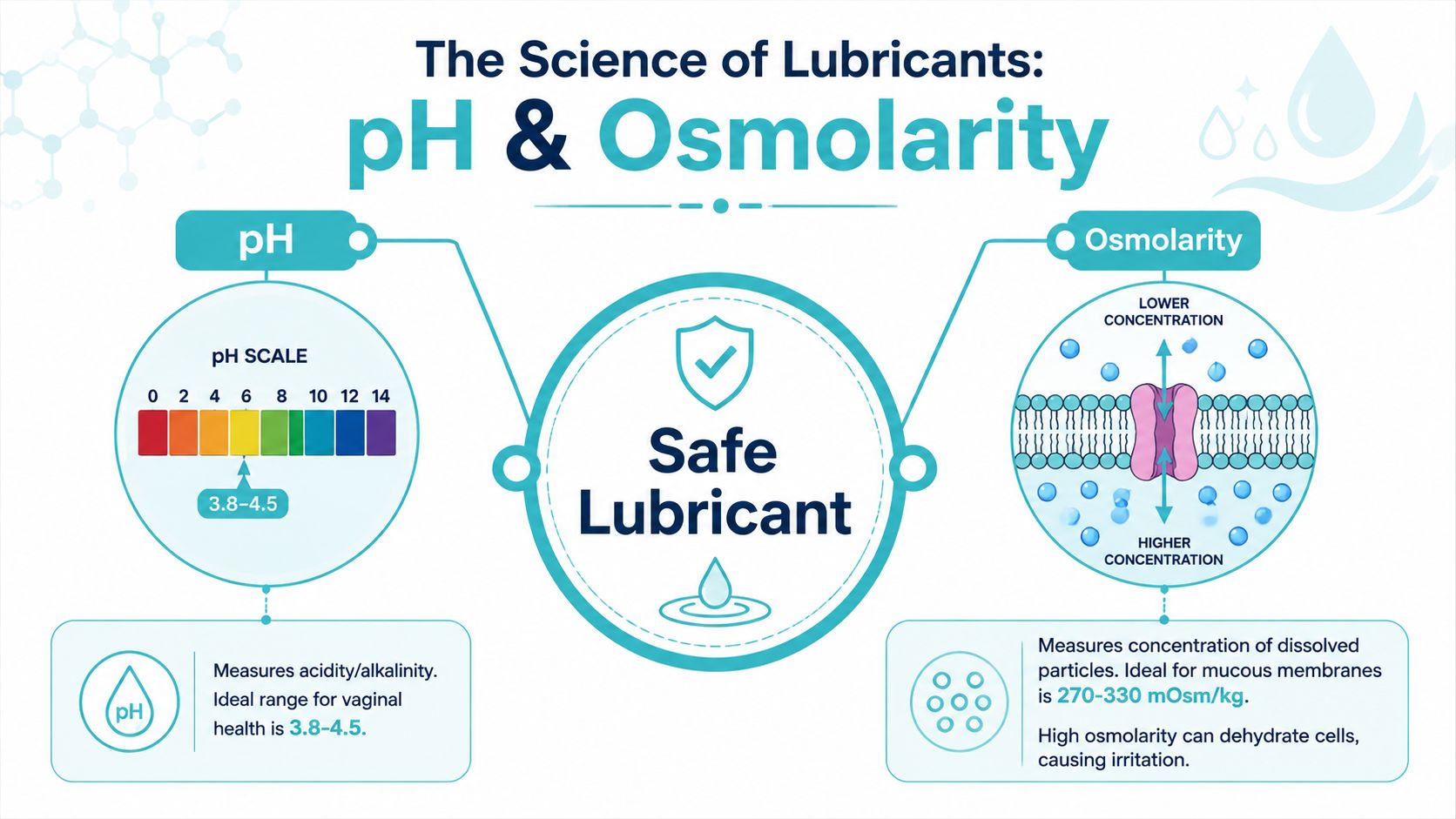
Why pH matters
Vaginal tissue functions best in a naturally acidic environment. The normal vaginal pH range is 3.5 to 4.5, as noted in this discussion of glycerin safety and lubricant osmolality.
That acidic environment supports the vaginal microbiome. When a product disrupts that balance, tissues may become more vulnerable to irritation. Some people notice this quickly as burning, stinging, or redness. Others notice it later as a pattern of discomfort after sex, pelvic floor exercise, or dilator use.
What osmolarity means in plain language
Osmolarity sounds technical, but the idea is simple. It describes how concentrated a solution is.
A helpful analogy is this: if a lubricant is extremely “thirsty” for water, it may pull water toward itself. On mucosal tissue, that can mean the product pulls moisture out of cells instead of sitting alongside natural moisture.
That's where terms like these matter:
- Hyperosmolar means the product is more concentrated than body tissues. It tends to pull water out of cells.
- Iso-osmolar means the product is closer to body fluids. It's more neutral to tissue hydration.
- Hypo-osmolar means the product is less concentrated. In some settings, that may be gentler than a highly concentrated formula.
Why this changes how glycerin is judged
Clinical studies have shown that hyperosmolar lubricants, often containing glycerin, can dry out vaginal and rectal tissues, disrupt normal pH, and increase microscopic tissue damage, with symptoms such as burning, stinging, redness, and swelling, according to the same glycerin safety and lubricant osmolality guide. Because that source URL can only be cited once here, keep that principle in mind as you evaluate products later in the article.
In practice, this explains a pattern many patients describe:
- The lubricant feels smooth at first.
- Friction seems improved briefly.
- Tissue starts to sting, feel raw, or become dry afterward.
That sequence makes sense if the formula gave slip on the surface while also dehydrating tissue at the cellular level.
Lubricants work best when they cooperate with the body's own moisture. They work poorly when they borrow water from the tissue to create glide.
A simple decision frame
If you're comparing products, ask:
- Does this formula support the vaginal environment
- Is it likely to maintain comfort after use, not just during
- Is the lubrication coming from balanced formulation, or from a highly concentrated ingredient mix
For pelvic health, that distinction is not academic. It affects comfort with sex, pelvic exams, dilators, speculums, and day-to-day tissue tolerance.
Glycerin Yeast Infections and Irritation
A lot of people have heard the same warning: glycerin causes yeast infections. That statement is too blunt to be clinically useful.
The more accurate version is narrower and more helpful. The claim that glycerin directly causes yeast infections lacks conclusive evidence, but glycerin's properties may still create problems for certain people, especially when the formula is irritating or highly concentrated.
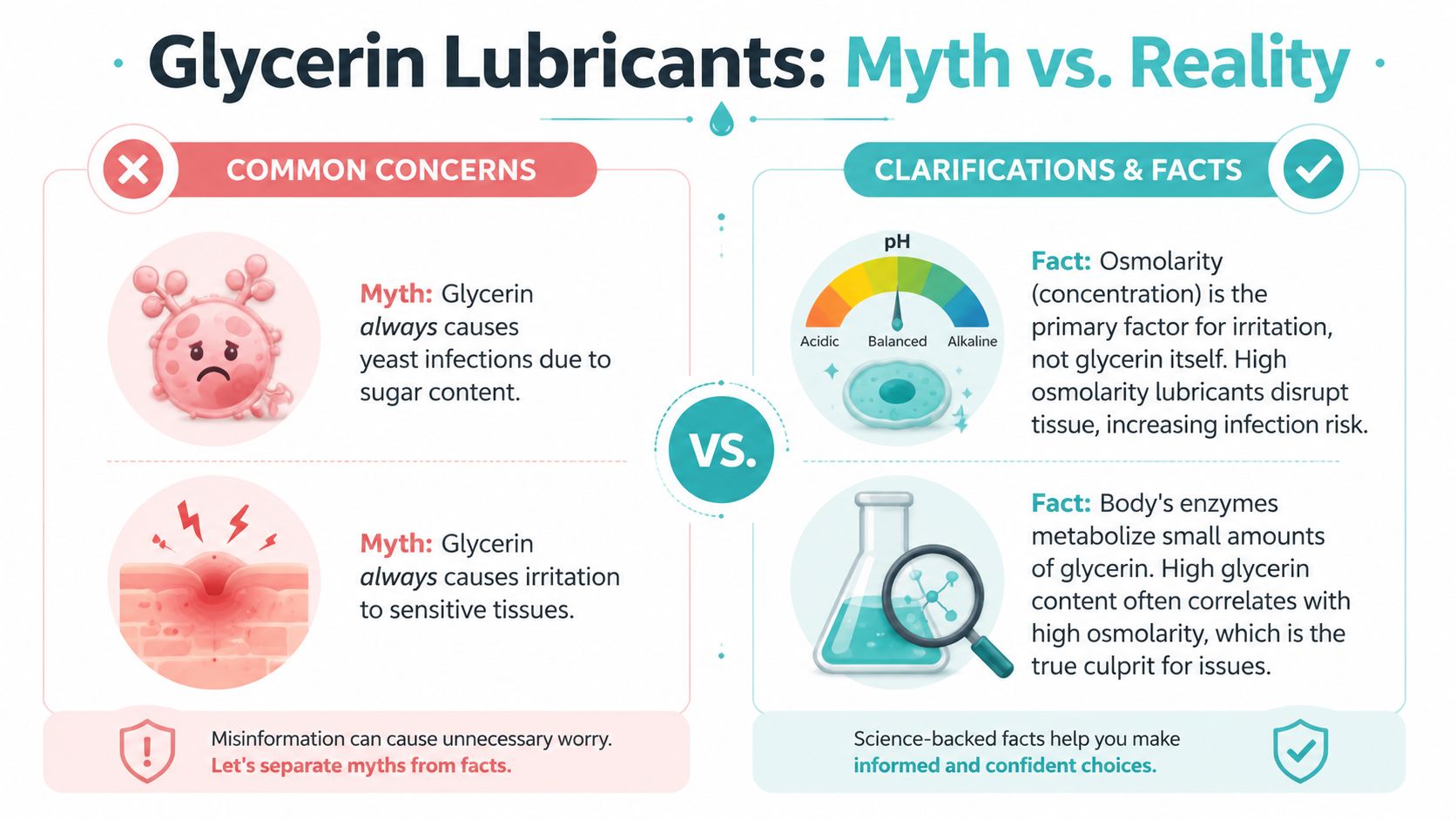
The myth versus the clinical reality
The key issue isn't “glycerin equals infection.” The key issue is that sensitive tissues and disrupted microbiome conditions can make a glycerin-heavy lubricant a poor match.
According to this review on what women should know about glycerin in lubricant, the persistent myth that glycerin directly causes yeast infections lacks conclusive evidence. The same source explains the more nuanced concern: glycerin's hyperosmolar behavior can disrupt pH and feed yeast in people with recurring sensitivity, and content often fails to discuss the concentration threshold, such as more than 40%, where glycerin can break down mucous membranes.
That last point matters. It shifts the conversation away from fear of a single ingredient and toward formulation risk.
Who tends to react more
In pelvic health, the people I worry about most are not necessarily everyone using glycerin. I worry about people whose tissues are already easier to irritate.
That includes people who:
- Get recurrent yeast symptoms and notice flare patterns after certain products
- Have vulvar or vaginal sensitivity and react to many topical products
- Live with pelvic pain and can't afford another source of tissue irritation
- Are healing after birth, procedures, radiation, or prolonged dryness
For someone in that group, the “maybe it's fine” approach usually isn't worth it.
Irritation often comes first
For many patients, the first sign isn't a proven infection. It's irritation. Burning after sex. Stinging with insertion. A raw feeling the next day. Those symptoms matter because irritated tissue is less resilient.
If you've been stuck in a pattern of persistent discomfort after infections or suspected infections, this discussion of pelvic pain after a yeast infection can help connect tissue irritation with ongoing pain.
A useful reframe: the question isn't “Can my friend use this?” The question is “How does my tissue respond to this formula?”
That's the practical difference between internet advice and patient-centered care. Blanket avoidance doesn't help everyone. Blanket reassurance doesn't help either. What helps is matching the product to the tissue.
Lubricant Guidance for Pelvic Health Patients
Some tissues can tolerate a broader range of lubricants. Others can't. In pelvic health, that distinction changes recommendations quickly.
When tissue is healing, hormonally affected, inflamed, scarred, or pain-sensitive, a hyperosmolar product becomes much harder to justify. Consequently, cautious lubricant selection stops being a preference and starts becoming part of treatment.
Postpartum and menopausal tissue
Postpartum tissue often has small areas of healing, tenderness, or hormonal dryness. Menopausal tissue can also become thinner, drier, and less forgiving. In both situations, patients often say they need “more glide,” but what is usually needed is gentler support for tissue hydration.
A lubricant that draws moisture away from epithelial cells can make these tissues feel worse, even if the initial slide seems good. That's one reason many clinicians steer sensitive patients toward glycerin-free options that are designed to be more tissue-friendly.
For patients who are also using local hormone support, practical instruction matters. This guide on how to apply vaginal estrogen cream is often useful alongside lubricant counseling, because tissue resilience and lubricant tolerance are closely linked.
Dyspareunia and pelvic floor overactivity
Painful sex rarely comes from one cause alone. Friction, fear, guarding, dryness, anticipatory tension, and previous irritation can all stack on top of each other.
In someone with dyspareunia, a poorly matched lubricant can keep that cycle going:
| If the lubricant irritates | What may happen next |
|---|---|
| Burning during insertion | Muscles guard more |
| Post-use soreness | Anticipatory fear rises |
| Tissue dryness afterward | Friction increases at the next attempt |
| Repeated negative experiences | Avoidance and pain become more entrenched |
That's why “any lube is better than none” is too simplistic in pain care. Some products reduce friction yet maintain the conditions that keep pain active.
For a patient with pain, a lubricant should lower threat. If it adds sting, dryness, or uncertainty, it isn't doing its job.
Oncology and medically fragile tissue
Oncology patients often deal with tissue changes from chemotherapy, endocrine therapy, surgery, or radiation. These tissues may be dry, fragile, and reactive. A formula that might be tolerable for someone else can feel harsh here.
In this population, I strongly favor products chosen with a conservative mindset:
- Look for pH-balanced options
- Prefer glycerin-free formulas when tissue is highly reactive
- Avoid products with extra “sensations”, such as warming or heavily fragranced ingredients
- Choose simplicity over novelty
The same mindset applies to pelvic floor therapy tools, vaginal dilators, and speculum exams. Comfort depends on friction reduction, yes, but also on preserving tissue integrity.
The practical bottom line
If a patient is postpartum, menopausal, dealing with pelvic pain, or in oncology recovery, lubricant choice isn't a side detail. It can either support healing or repeatedly interrupt it.
How to Choose a Safer Lubricant
When people stand in the store aisle, they usually don't need more fear. They need a filter. A short list of what to look for and what to skip.
A microbiome-focused approach to lubricants has received growing attention in recent years, with discussion from 2024 to 2026 emphasizing the need for hypo-osmolar, pH-balanced, glycerin-free products and noting a broader clinical concern that hyperosmolar lubricants raise irritation and infection risk, as described by Acme-Hardesty's overview of glycerine trends in lubricant products.
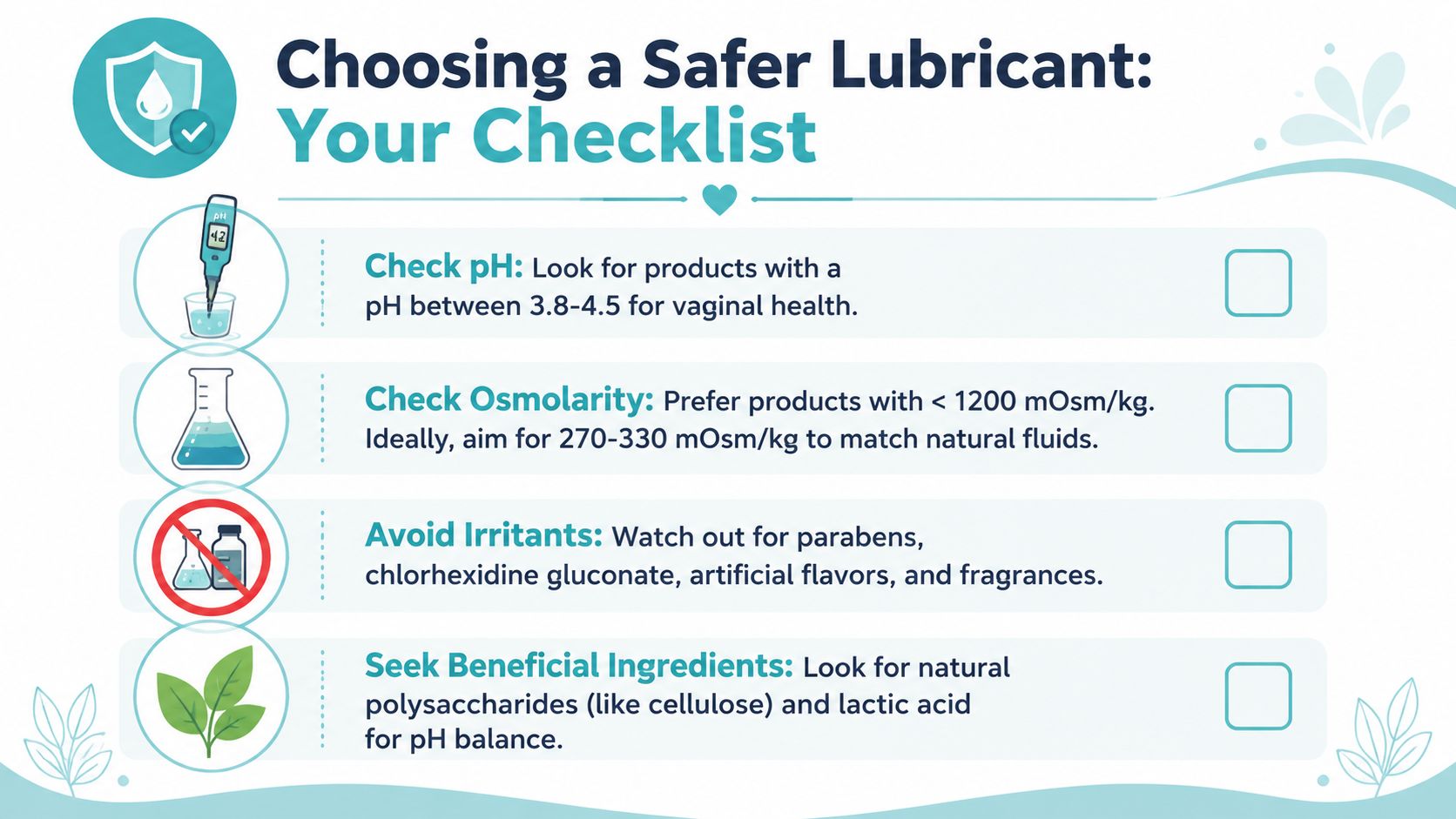
What to scan for on the label
Start with a few practical questions.
- pH-balanced means the product was designed with vaginal tissue in mind.
- Glycerin-free is often a smart first filter if you're irritation-prone.
- Fewer extra additives is usually better when tissues are reactive.
- No fragrance or warming claims is a safer bet for sensitive users.
This short video can help you think through the selection process in a more practical way.
Comparing main lubricant categories
Different base types have different trade-offs.
Glycerin-free water-based options
These are often the easiest place to start for vaginal use, pelvic floor therapy, and dilator work. They tend to rinse off easily and are commonly chosen when someone wants compatibility with a wide range of uses.
Best fit: people who want a simple, sensitive-tissue option.
Silicone-based lubricants
These usually last longer and don't evaporate the way some water-based products do. They can be especially helpful for significant dryness or when repeated reapplication gets frustrating.
Trade-off: they may stain fabrics, and compatibility with some silicone devices needs checking.
Oil-based lubricants
These can feel rich and protective, but they are not the default choice for everyone.
Important caution: oil-based lubricants are not compatible with latex condoms.
A practical shopping checklist
- If you burn easily, start with glycerin-free.
- If tissue feels dry afterward, suspect the formula, not just your body.
- If you need frequent reapplication, consider whether silicone might serve you better.
- If you have a history of recurrent irritation, avoid “fun” features and choose the plainest effective formula.
Your best lubricant is the one your tissue tolerates consistently, not the one with the best marketing language.
Clinical Takeaways for Patients and Providers
For patients
- Switch sooner if symptoms repeat. If a lubricant regularly causes burning, dryness, redness, or next-day soreness, it's not a good match.
- Read past the front label. “Smooth,” “natural,” and “gentle” don't tell you enough.
- Prioritize tissue comfort over trend claims. For sensitive users, glycerin-free and pH-conscious formulas are often easier to tolerate.
- Watch your own pattern. If irritation shows up after sex, dilator use, or exams, the lubricant may be part of the picture.
- Get help when pain lingers. Ongoing pain with penetration isn't something you need to just push through.
For providers
- Ask what lubricant the patient is using. This question belongs in visits for dyspareunia, recurrent vaginitis symptoms, vulvovaginal irritation, postpartum pain, and oncology follow-up.
- Consider formulation, not just ingredient fear. A more nuanced discussion of osmolarity and tissue tolerance is often more useful than telling every patient to avoid one ingredient forever.
- Match product guidance to tissue status. Healing, atrophic, radiated, hormonally depleted, or pain-sensitive tissues need a more conservative recommendation.
- Treat lubricant counseling as part of pelvic care. It influences symptoms, exam tolerance, home program adherence, and sexual function.
A good lubricant should protect comfort, support tissue health, and reduce friction without creating new irritation. That's the standard worth using.
If you're dealing with painful sex, postpartum dryness, pelvic pain, or tissue sensitivity after cancer treatment, Lake City Physical Therapy offers specialized pelvic health care that looks at the full picture, including the small details that often get missed. The right treatment plan can address muscle tension, scar mobility, vulvovaginal irritation patterns, and the product choices that affect day-to-day comfort.

