How to Stop Leaking Urine: A PT’s Practical Guide
A laugh comes out before you can stop it. Or a sneeze. Or that first jumping jack in a workout class. Then you feel it. Just a little leak, maybe enough that you start thinking about your clothes, where the bathroom is, or whether you should stop doing things you enjoy.
If that's where you are right now, you're not overreacting, and you're not alone. Urine leakage can show up after pregnancy, around menopause, during sports, or with no obvious life change at all. It can be annoying, embarrassing, and surprisingly limiting.
It also isn't something you have to accept.
As a pelvic floor physical therapist, I want women to hear this clearly. Bladder leakage is common, but “common” and “normal to live with forever” are not the same thing. In most cases, there are practical steps that can improve control. The key is matching the plan to the kind of leakage you have, then doing the right things consistently instead of trying every tip you've ever heard.
Regaining Control Starts Now
Many women try to solve leakage. They cross their legs before a sneeze, wear liners every day, stop running, skip longer outings, and hope it doesn't get worse. Some even cut way back on drinking water because it seems logical. Others do random Kegels in the car and wonder why nothing changes.
That frustration makes sense. A lot of advice about how to stop leaking urine is either too vague or too simplistic.
Leakage can affect postpartum moms, women in perimenopause and menopause, and athletes who seem strong everywhere else. It can also affect men, and if someone in your household is looking for practical containment options while they work on treatment, male incontinence products can help with day-to-day management.
You do not need to choose between “just live with it” and “jump straight to surgery.”
The better path usually starts with figuring out what type of leakage is happening, then building a plan around that pattern. Some women need pelvic floor strengthening. Some need bladder retraining. Some need to change pressure habits during lifting or running. Many need a combination.
A good plan feels specific. It should tell you what to do, how often to do it, what mistakes to avoid, and when to ask for help. That's how real progress happens.
First Identify Your Leak Type
Before you can fix the problem, you need to know what's driving it. I see women waste a lot of time doing the wrong strategy for the wrong symptom. Someone with urgency tries endless strengthening. Someone with stress leakage starts “holding it longer” and only gets more uncomfortable.
The three big categories are stress incontinence, urge incontinence, and mixed incontinence.
Stress leakage
Stress incontinence means urine leaks when pressure increases in your abdomen and pushes down on the bladder and pelvic floor. This is the classic leak with a cough, sneeze, laugh, jump, run, or lift.
It usually feels mechanical. You don't necessarily have a strong urge to pee first. The leak happens because your support system doesn't respond well enough, fast enough, or strongly enough for the load.
Urge leakage
Urge incontinence is different. The main feature is a sudden, hard-to-ignore need to urinate that can turn into leakage before you reach the bathroom.
Women describe it as, “I'm fine until I'm not.” You might be okay until you put the key in the door, hear running water, or stand up after sitting. The issue is less about impact and more about a bladder that's become overly reactive.
Mixed leakage
Mixed incontinence includes features of both. You may leak when you cough and also have “got to go right now” moments.
That combination matters because treatment usually needs to address both muscle function and bladder habits. If you've never thought about the difference before, this is often the first moment things start making sense.
Here's a simple way to sort it out. If you want a deeper overview of causes, this guide on what causes urinary incontinence in women is a helpful next read.
Identifying Your Incontinence Type
| Leak Type | What It Feels Like | Common Triggers |
|---|---|---|
| Stress | A small or moderate leak with effort or impact, often without warning urge | Coughing, sneezing, laughing, running, jumping, lifting |
| Urge | A sudden intense need to urinate, then leaking on the way to the toilet | Key in the door, hearing water, standing up, waiting too long, anxiety around bathrooms |
| Mixed | Both of the above patterns show up | Impact plus urgency triggers |
If your main trigger is movement or pressure, start by thinking “support problem.” If your main trigger is a powerful urge, think “bladder timing problem.”
A few women don't fit neatly into one box, especially early on. That's okay. You're looking for your dominant pattern, not a perfect label.
Foundational Lifestyle Habits for Bladder Control
You can do excellent exercises and still make bladder symptoms worse with daily habits that irritate the system. The basics matter more than is often realized.
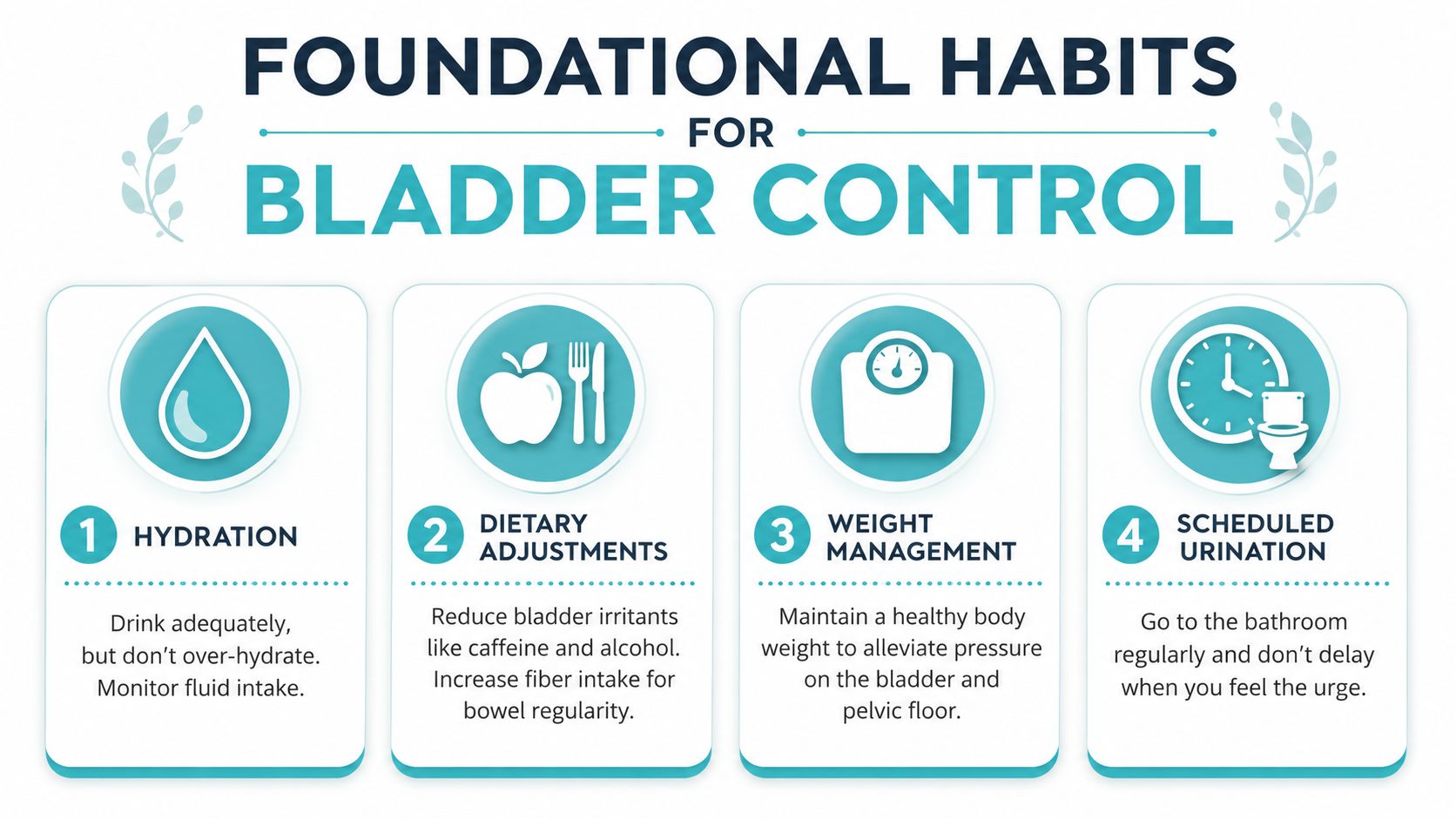
Stop trying to solve leakage by barely drinking
Cutting fluids too aggressively often backfires. Concentrated urine can irritate the bladder, which can make urgency and frequency worse. Drink consistently through the day instead of swinging between under-drinking and chugging.
A simple rule works well. Sip regularly, notice whether your bladder gets irritated by very large drinks, and avoid “hydration catch-up” late in the evening if nighttime trips are a problem.
Reduce irritants and protect bowel regularity
Some bladders are sensitive to caffeine, alcohol, and acidic or highly irritating foods and drinks. You don't need to assume every item is a problem. Pay attention to your own pattern.
At the same time, work on preventing constipation. Straining to have a bowel movement adds repeated downward pressure through the pelvic floor. That pressure can worsen both support issues and urgency patterns.
Useful habits include:
- Choose steady fiber intake: Food-based fiber and regular meals support easier bowel movements.
- Use better toilet posture: A small stool under your feet can make it easier to empty bowels without bearing down hard.
- Don't hover or rush: Relaxing enough to empty fully matters. Pushing harder is not the goal.
Weight matters because pressure matters
For women with a body mass index of 30 or higher, a 10% reduction in body weight leads to a 50% to 70% decrease in incontinence episodes, and excess weight can increase abdominal pressure on the bladder and pelvic floor by approximately 20 to 30 pounds, according to Mayo Clinic's stress incontinence treatment guidance.
That doesn't mean everyone with leakage needs a weight-loss plan. It means that if higher body weight is part of the picture, the bladder and pelvic floor are carrying extra load all day. Reducing that load can make every other treatment work better.
Practical rule: Lifestyle changes are not “extra credit.” They reduce the workload on the bladder and pelvic floor so your exercise program has a better chance to succeed.
Bathroom habits that help instead of hurt
A few day-to-day habits can calm things down fast:
- Don't pee “just in case” all day long: Frequent preventive trips can teach the bladder to expect emptying too soon.
- Don't ignore urges for hours either: Long delays can leave you bouncing between urgency and overfilling.
- Aim for calm, complete emptying: Sit, breathe, and let the pelvic floor relax instead of pushing.
These habits aren't flashy, but they create a much better foundation for bladder control.
Mastering Pelvic Floor Exercises The Right Way
Most women get bad advice in this area. “Do Kegels” sounds simple, but technique is everything. I've treated many women who were working hard and still not improving because they were squeezing the wrong muscles, holding their breath, or never fully relaxing.
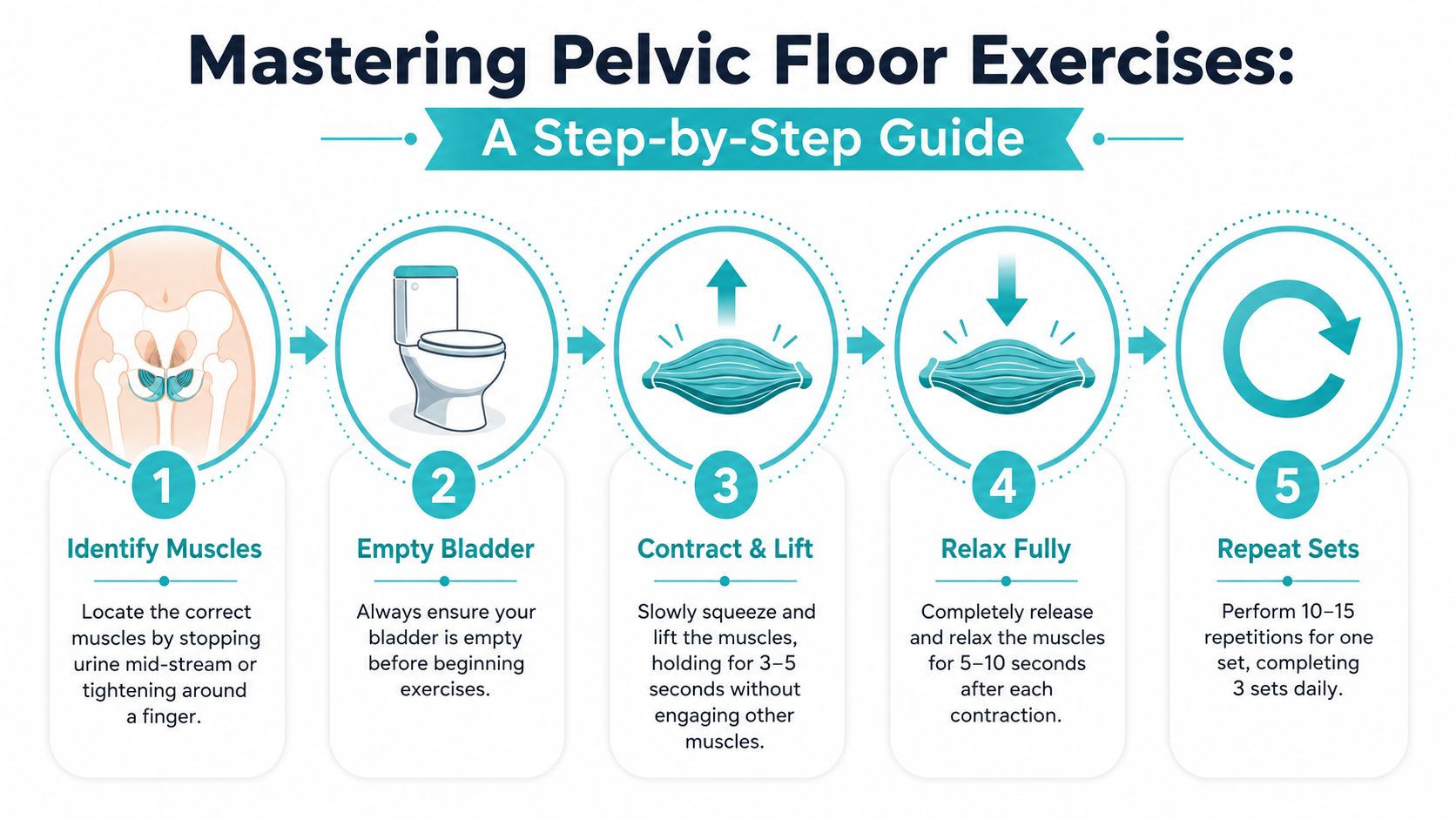
Pelvic floor muscle training is worth doing correctly. Approximately 70% of women with stress incontinence achieve significant symptom relief or complete resolution after consistent practice, and the standard therapeutic protocol is contracting for 5 to 10 seconds, relaxing for an equal duration, repeating 10 times per set for at least three sets daily, according to the NHS guidance on stopping leaks.
A more detailed breakdown of pelvic floor exercises for bladder leakage can be useful if you want extra coaching after reading this section.
Find the right muscles first
The pelvic floor is a sling of muscles at the bottom of the pelvis. A correct contraction should feel like a gentle squeeze and lift around the vaginal and anal openings. Many women describe it as “closing and lifting inward.”
Common mistakes are easy to miss:
- Squeezing your glutes: If your butt clenches hard, you're compensating.
- Tightening your inner thighs: That's not the target.
- Bracing your abs hard: A little lower abdominal co-activation can happen, but bearing down is not the goal.
- Holding your breath: Breath-holding often increases pressure instead of improving support.
Quality beats effort. A small, well-coordinated lift is better than a huge squeeze that recruits everything except the pelvic floor.
Here is the visual guide many patients find helpful:
Build strength progressively
If you're weak, jumping straight to long holds usually leads to compensation. Start where you can do the movement cleanly.
A practical progression looks like this:
-
Start with short holds
Gently contract and lift. Hold for about 2 to 3 seconds if that's all you can do with good form, then fully relax. -
Match the relaxation time
If you hold for 3 seconds, relax for 3 seconds. The relaxation phase matters because tight muscles that never let go can also contribute to symptoms. -
Repeat for a set of 10
Stop if the quality drops off. Sloppy reps teach sloppy patterns. -
Work toward longer holds
Gradually build to the therapeutic goal of 5 to 10 second holds with equal rest. -
Practice three sets daily
Spread them through the day. That's more realistic than trying to cram everything into one session.
This video can help you visualize the rhythm and control involved:
Add quick contractions for real-life moments
Long holds build endurance, but life often demands speed. Sneezes, jumps, and lifts happen fast. Once you can do your basic holds well, add a few quick “squeeze and lift, then release” reps.
This helps train the pelvic floor to respond before or during pressure. For women with stress leakage, timing is often just as important as raw strength.
Try pairing that quick contraction with common triggers:
- Before a cough or sneeze
- Before lifting a child or laundry basket
- Before stepping into a jump or hop
- Before standing up if you tend to leak then
Don't do Kegels all day long
Over-gripping is not the answer. The pelvic floor needs to contract, but it also needs to lengthen and relax. If you constantly clench, symptoms can stay the same or even worsen.
Watch for signs that you're overdoing it:
- Increased pelvic tension
- Pain with the exercise
- Trouble starting your urine stream
- A feeling that you can never relax your core or pelvis
A strong pelvic floor is not a clenched pelvic floor. It's one that can contract when needed and let go when the job is done.
That's the difference between random Kegels and real training.
Implementing a Bladder Training Protocol
If your problem is urgency, the answer usually isn't “go faster to the bathroom.” It's retraining the bladder and nervous system so every urge doesn't feel like an emergency.
Bladder retraining achieves success rates of 50 to 70% in patients with urge incontinence when done with a structured schedule, and the protocol starts at your baseline interval plus 15 minutes, progressing toward 2.5 to 3.5-hour voiding cycles. A major pitfall is moving too quickly. 30% of treatment failures stem from increasing wait times before mastering the current interval, according to Mayo Clinic's bladder training guidance.
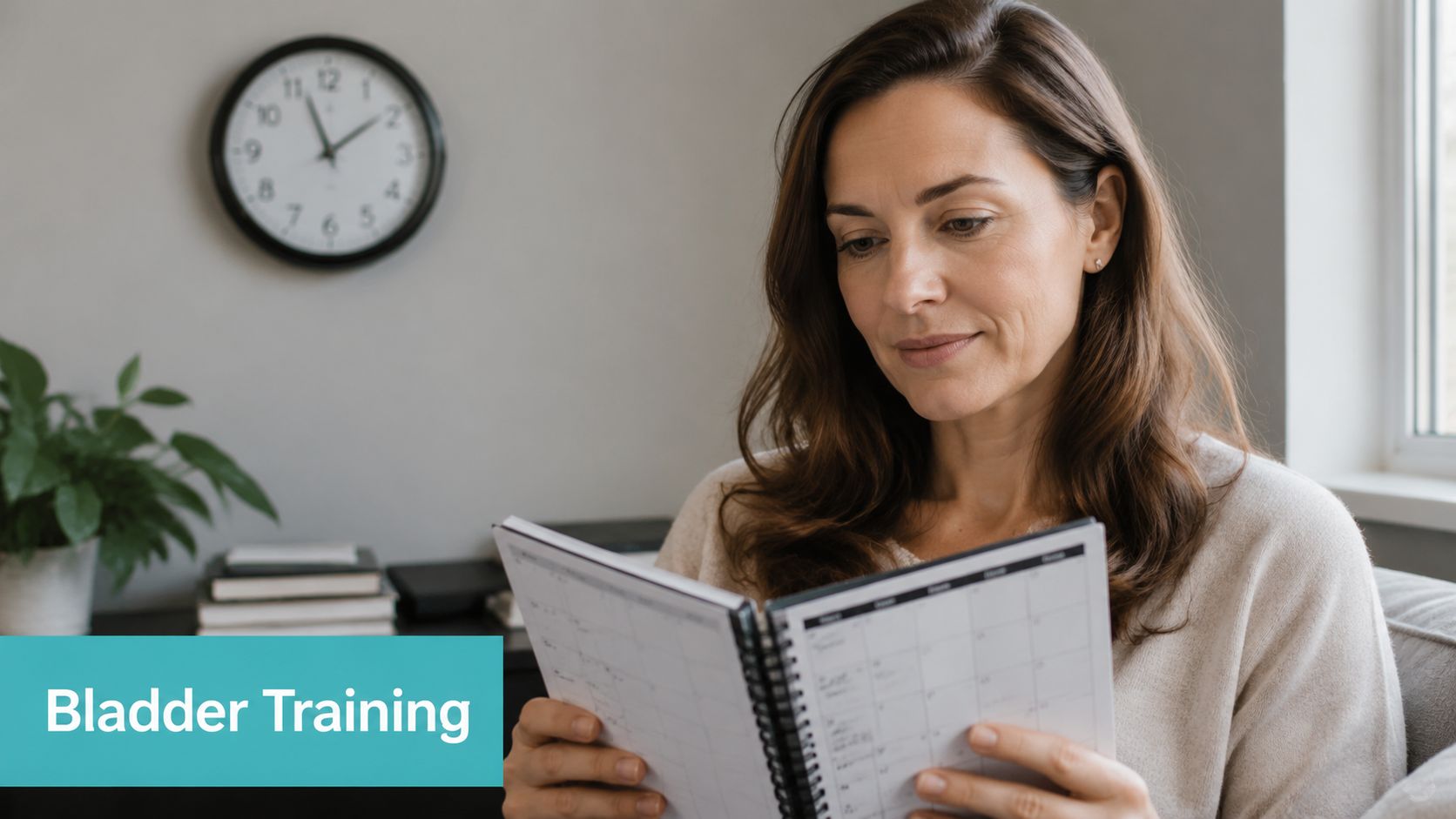
Start with a bladder diary
Before changing anything, keep a 3-day bladder diary. Write down when you urinate, when urgency hits, and when leakage happens. Patterns show up fast.
If you discover you're going every hour, your starting point is not a dramatic jump to three hours. That would feel miserable and usually fails.
Use a schedule, not your fear
Once you know your baseline, set your first target at your usual interval plus 15 minutes. If you normally urinate every hour, aim for 1 hour and 15 minutes.
When urgency shows up early, use a suppression sequence instead of sprinting to the toilet:
- Pause instead of rushing.
- Take a deep breath to reduce panic.
- Distract your brain with a simple task, count backward, name objects in the room.
- Do a pelvic floor contraction to help settle the urge.
- Wait until the wave drops, then walk calmly if it's time.
The slow pace is the right pace
Hold each interval long enough that it feels manageable before increasing again. In clinic, I often remind women that steady progress beats heroic effort.
A few practical notes help:
- Stick to the schedule even on good days: Random extra trips confuse the retraining process.
- Increase only after consistent success: Waiting another week is better than losing momentum.
- Expect the first part to feel awkward: You are changing a habit loop between the bladder, brain, and bathroom behavior.
Bladder training isn't glamorous, but it works well when the plan is specific and the pacing is realistic.
When Self-Care Is Not Enough See a Specialist
Home strategies are a good start. They are not the final answer for everyone.
If you've been consistent and still aren't improving, that's not a sign that you failed. It usually means you need a more precise diagnosis, better technique coaching, or a plan designed for your body and activity demands.
Signs it's time to get help
Consider seeing a pelvic floor physical therapist if any of these apply:
- You're unsure which leak type you have
- Exercises cause pain or increased tension
- You can't tell if you're contracting the right muscles
- Leakage continues after several weeks of solid effort
- Running, lifting, or sport-specific movement still triggers symptoms
- You also have pelvic pain, prolapse symptoms, or pain with sex
A specialist can tell the difference between weakness, poor coordination, overactivity, pressure management issues, scar restrictions, and movement patterns that keep overloading the pelvic floor.
What an evaluation usually includes
A pelvic floor PT appointment is much more than being told to do more Kegels. It often includes a discussion of your bladder habits, bowel habits, childbirth and surgical history, exercise patterns, breathing strategy, core control, posture, and movement mechanics.
If you want a clearer picture of the process, this page on what to expect at pelvic floor therapy makes the first visit feel much less mysterious.

Needing help does not mean your problem is severe. It often means your body needs a more individualized plan than the internet can provide.
A physician may also discuss other options depending on your symptoms, such as medication for urge-related leakage or procedures for more persistent stress incontinence. Physical therapy fits well as a conservative first step because it addresses how the system functions, not just the symptom.
Answering Your Lingering Questions
Why do I still leak when I run even though I'm doing Kegels
Because running leakage isn't always a simple strength problem. It can be a timing, breathing, landing, or pressure-management problem.
Emerging guidance for athletic incontinence highlights intra-abdominal pressure management, breath coordination such as exhaling on exertion, and progressive loading of the pelvic floor as key pieces that generic home advice often misses. A 2024 study noted that 30 to 50% of female runners experience leakage, yet fewer than 10% receive targeted pelvic floor physiotherapy specific to sport mechanics, as summarized in the NIDDK bladder control treatment resource.
That means some women need more than isolated exercises. They need training that matches impact, cadence, lifting style, and breathing under load.
Is leakage after childbirth normal
It's common after pregnancy and birth, but it should still improve. Early postpartum tissues are recovering, sleep is disrupted, and your pressure system has changed. Some leakage in that period doesn't mean you're damaged for life.
If symptoms persist, worsen, or make you avoid activity, get evaluated. Postpartum recovery responds best to a plan that looks at the whole system, not just the pelvic floor in isolation.
Should I wear a pad while I work on this
You can. Pads and liners can reduce stress in daily life and let you stay active while treatment is underway. The key is not to stop there.
Containment can be useful. It just shouldn't become your only strategy if your goal is lasting improvement.
What if I have both stress and urge leakage
That's common. In mixed cases, the best approach usually combines support work, bladder habit changes, and trigger-specific strategies. If one pattern is clearly more bothersome, start there, then layer in the second piece.
If you're tired of guessing and want a plan that fits your body, symptoms, and goals, Lake City Physical Therapy offers specialized pelvic floor care for women dealing with leakage, postpartum recovery, pelvic pain, and return to sport. Their team helps you move past generic advice and build a treatment plan you can follow.

