Hysterectomy and Sexuality: A Compassionate Guide
You may be sitting with a surgery recommendation open on your phone, or replaying a short conversation with your OB/GYN in your head. You heard the medical reason for the hysterectomy. You understood the part about bleeding, pain, fibroids, or another benign condition. Then a different question took over everything else.
What will happen to my sex life?
That question is common, very personal, and often asked discreetly. Many women worry about desire, orgasm, pain, body image, and whether intimacy will ever feel natural again. Those fears make sense. Sexuality is not a side issue. It’s part of comfort, identity, partnership, and quality of life.
The reassuring truth is that hysterectomy and sexuality are not a simple story of loss. For many women, the story is more nuanced, and often more hopeful, than they expected.
Your First Question After "Hysterectomy"
A woman in my clinic once described the moment this way: everyone around her focused on whether surgery would fix the bleeding and pelvic pain, but she was stuck on one thought she felt embarrassed to say out loud. She wanted relief, but she also wanted to know if she would still feel like herself in bed.
That is usually the first real question. Not the technical one. The human one.
If that’s where you are, it helps to know that the outcome isn’t automatically negative. A large prospective study of women who had hysterectomy for benign conditions found that overall sexual satisfaction improved significantly six months after surgery, and the main reason seemed to be relief from symptoms such as chronic pain and heavy bleeding that had been interfering with intimacy in the first place, as summarized by American Family Physician.
That doesn’t mean every woman feels instantly better. Some feel relieved. Some feel uncertain. Some feel both at the same time. Sexuality after surgery can change because the body changes, and because emotions, hormones, expectations, and relationships all matter too.
Sexual recovery after hysterectomy is usually not about “getting back to normal” overnight. It’s about understanding what changed, what didn’t, and what can be improved with the right support.
A helpful way to think about this is to separate the experience into a few parts:
- The surgery itself changes anatomy in specific ways.
- Hormone shifts may matter, especially if the ovaries are removed.
- The pelvic floor can become tense, weak, guarded, or painful.
- The mind and relationship can either support healing or make intimacy feel harder.
Many readers get confused because they’ve heard broad statements like “sex is worse after hysterectomy” or “nothing changes at all.” Neither statement is reliably true for everyone. The details matter. Which surgery you had matters. Whether your ovaries were preserved matters. Whether sex was painful before surgery matters. Whether scar tissue and pelvic floor muscle tension develop afterward matters.
That’s why education helps so much. When you understand the mechanics, fear often softens. When you know what can be treated, you stop feeling trapped.
Understanding Your Specific Hysterectomy Type
Not all hysterectomies are the same, and that’s one reason hysterectomy and sexuality can feel confusing. Two women may both say, “I had a hysterectomy,” while meaning very different surgeries.
A simple analogy can help. Think of your pelvis as a neighborhood. The uterus is one house. The cervix is the front entry area to that house. The ovaries are hormone-producing structures nearby that affect the whole neighborhood’s climate. The surrounding tissues and upper vagina are the streets and support structures around it.
Different operations remove different parts of that neighborhood.
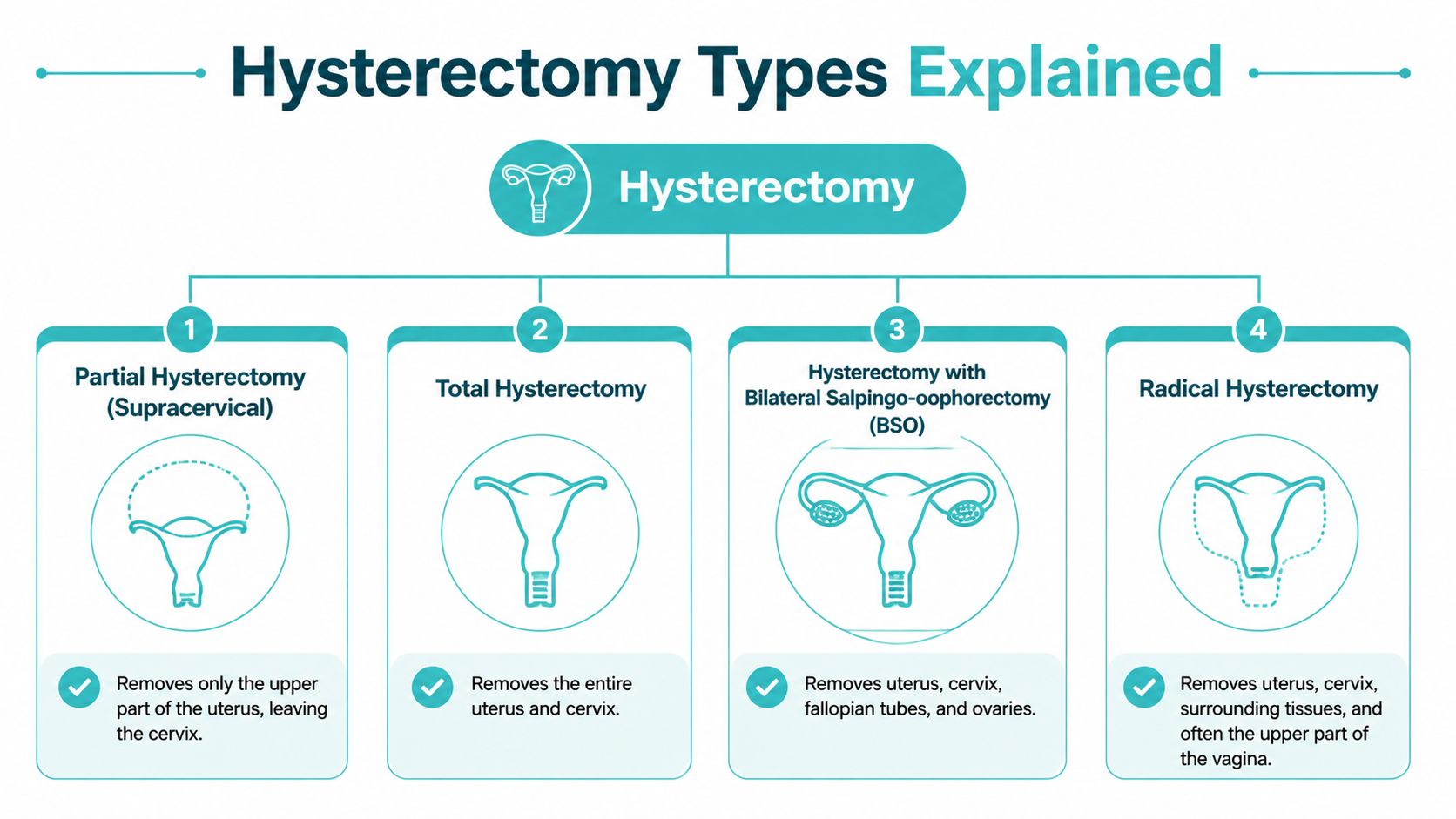
The main surgery names
A supracervical or subtotal hysterectomy removes the upper part of the uterus and leaves the cervix in place.
A total hysterectomy removes the uterus and cervix.
A hysterectomy with bilateral salpingo-oophorectomy, often shortened to BSO, removes the uterus and both ovaries, usually along with the tubes.
A radical hysterectomy removes more tissue around the uterus and cervix, and often affects nearby support structures more extensively. This is a different category of surgery and can have different implications for comfort and sexual function.
Why these differences matter
Many women assume the uterus itself is the center of all sexual sensation. That’s usually not how the body works. Sexual response is influenced by the clitoris, vaginal tissues, pelvic floor muscles, nerves, blood flow, hormones, and the brain.
Research discussed by the Boston University sexual medicine program notes an important distinction. The cervix itself does not appear to be the primary source of orgasm for most women. When sexual changes happen after cervical removal, the issue may relate more to reduced blood supply to remaining pelvic structures than to the cervix being an “orgasm organ.” That’s a meaningful point, because blood flow and neuromuscular function are things rehabilitation can address.
Readers often get mixed messages. Someone says, “If they remove your cervix, orgasm is gone.” Another person says, “The cervix does nothing.” Both statements are too simplistic. A better summary is this: sexual sensation is complex, and changes after surgery may come from vascular changes, scar tissue, muscle guarding, or hormonal shifts, not from one body part disappearing in isolation.
Hysterectomy Types and Their Impact on Sexuality
| Hysterectomy Type | What is Removed | Hormonal Impact | Potential Sexual Function Changes |
|---|---|---|---|
| Supracervical or subtotal | Upper uterus, cervix remains | Usually limited if ovaries remain | Some women feel reassured by preserving the cervix; blood flow and pelvic floor function still matter |
| Total | Uterus and cervix | Usually limited if ovaries remain | Possible changes in deep sensation, scar-related discomfort, or altered orgasmic experience in some women |
| With BSO | Uterus plus both ovaries | Direct hormonal change because ovaries are removed | Greater chance of lubrication and orgasm changes due to hormone loss |
| Radical | Uterus, cervix, and surrounding tissues, often with more extensive dissection | Depends on whether ovaries are preserved | More potential for tissue, nerve, and support-structure changes that can affect comfort and sensation |
Questions worth asking your surgeon
If you haven’t had surgery yet, these questions can give you clearer information:
- Which type am I having? Ask whether it’s supracervical, total, radical, or includes BSO.
- Will my ovaries stay? This is one of the most important questions for sexual recovery.
- Will my cervix stay? If not, ask how healing at the vaginal cuff may affect future comfort.
- What does my incision or internal healing mean for sex later? Ask about expected scar tissue and timing.
Practical rule: Don’t settle for “you’re having a hysterectomy” as the whole explanation. Ask what is being removed, what is being preserved, and what that means for hormones, blood flow, and healing.
Once you know your specific surgery, the next questions become easier to answer. You can stop guessing and start understanding your own body.
The Physical Realities of Sex After Surgery
Sexuality after hysterectomy is easier to understand when you break it into four separate experiences: desire, arousal, orgasm, and pain. People often lump them together, but they’re not the same thing. A woman may want sex but have pain. She may have desire but struggle with lubrication. She may feel emotionally close to her partner but notice orgasm feels different.
That distinction matters because each concern points to a different part of recovery.

Desire is not just hormones
Libido can shift after surgery, but not always for the reason people expect. Some women feel more interested in sex because bleeding, pelvic pressure, or fear of pain are finally gone. Others feel less interested because they’re exhausted, healing, emotionally overwhelmed, or dealing with hormone changes.
One of the clearest findings in the research is about ovary removal. A 2017 systematic review and meta-analysis covering 32 studies and 4,054 women found no statistically significant overall decline in sexual functioning after hysterectomy for benign conditions, but women who had hysterectomy without bilateral salpingo-oophorectomy had better lubrication and orgasm than women who had BSO, according to the summary from the Sexual Medicine Society of North America.
That finding helps answer a common fear. For many women, the uterus alone is not the main problem. Hormonal preservation often plays a larger role.
Arousal depends on circulation, comfort, and safety
Arousal is a body process. Blood flow increases. Tissue swells and becomes more sensitive. Lubrication changes. Pelvic floor muscles coordinate in a rhythmic way rather than clenching protectively.
After surgery, arousal can feel muted for a few reasons:
- Hormonal change if the ovaries were removed
- Scar tissue restriction that makes tissues feel stiff or less responsive
- Protective muscle guarding when the body expects pain
- Fear and hesitation that interrupt the body’s normal arousal sequence
Some women describe this as “my brain wants intimacy, but my body doesn’t catch up.” That description is often accurate. The system is trying to protect you.
If you’re also sorting through broader options for low desire or female sexual dysfunction, XO Medical on FSD treatments gives a patient-friendly overview of how clinicians think about treatment pathways beyond a single pill or quick fix.
Orgasm may feel different, but different does not mean gone
This is one of the most emotionally loaded concerns. Many women fear that hysterectomy means they’ll lose the ability to orgasm.
Orgasm is not one single event produced by one single structure. Some orgasms feel more clitoral. Some involve deep pelvic pulsing. Some include strong pelvic floor contractions. If your uterus is removed, you may notice the internal quality of orgasm changes. That does not mean orgasm disappears.
For some women, orgasm becomes easier because pain and bleeding no longer interrupt arousal. For others, orgasm feels less intense at first because the pelvic floor is guarding, tissue mobility is reduced, or blood flow has changed. Those are important distinctions because they point toward rehabilitation, not resignation.
Pain usually has a mechanical explanation
Pain with sex after hysterectomy can feel mysterious, but it often isn’t random. Common patterns include:
- Deep pain from scar sensitivity, limited mobility at the top of the vaginal canal, or pressure on healing tissues
- Entry pain from pelvic floor muscle tension, dryness, or guarded tissue
- Burning or rawness from irritated tissue or reduced lubrication
- Aching afterward when muscles overwork during penetration or orgasm
A common source of confusion is the phrase “my doctor said I’m healed.” Medical healing and functional comfort are not the same. Tissue can be closed and safe while still being tight, tender, less mobile, or poorly coordinated.
If intercourse still hurts, a focused pelvic floor assessment can help sort out what type of pain you’re dealing with. This guide to pelvic pain after sex after hysterectomy explains common patterns that show up after surgical recovery.
If sex feels different after hysterectomy, ask a more precise question than “What’s wrong with me?” Ask, “Is this a hormone issue, a scar issue, a muscle issue, a pain-memory issue, or a combination?”
That question usually leads to better answers.
Navigating the Emotional and Relationship Journey
Some changes after hysterectomy happen in tissue. Others happen in identity.
A woman may look physically recovered from the outside and still feel unsettled inside. She may grieve the loss of fertility, feel disconnected from her body, or worry that a partner will see her differently. Even women who wanted and needed surgery can have these feelings. Relief and grief can exist together.
That emotional layer affects sexuality more than many people realize.

Why emotional health changes the recovery experience
Research summarized in a review available through PubMed Central found that about 80 to 90% of women have stable or improved sexual outcomes after hysterectomy, while 10 to 20% experience a decline. The strongest predictors of poorer postoperative sexual function were pre-existing depression and unsatisfactory sexual function before surgery.
That doesn’t mean depression causes everything. It means your emotional baseline matters. If your nervous system already feels burdened, intimacy after surgery can be harder to re-enter.
This is especially important for women who are also moving through hormonal transition. If mood symptoms have been creeping in around the same time as pelvic symptoms, this overview of the link between perimenopause and depression may help you identify a broader pattern worth discussing with your medical team.
Talking with a partner without feeling like a problem to solve
Many couples struggle here because both people are trying to avoid making things worse. One partner avoids initiating because they don’t want to pressure. The other avoids bringing it up because they don’t want to disappoint. Silence grows, and both people feel alone.
Clear language often helps more than perfect language.
“I want closeness with you. I’m still learning what my body feels safe with right now.”
That sentence reduces confusion. It tells a partner that distance is not rejection.
You can also be specific about what has changed:
“I may need more time to warm up, more lubrication, less depth, or a full stop if my body tightens.”
That kind of detail is not awkward. It’s useful. Partners usually do better when they know what helps.
A few conversations that lower pressure
Try starting with one of these:
- Name what you do want. “I want touch and connection, even if penetration isn’t comfortable yet.”
- Describe the sensation, not just the verdict. “It’s not that I don’t want you. It’s that deep pressure feels sharp right now.”
- Ask for teamwork. “Can we treat this like recovery, not failure?”
Sometimes couples benefit from broadening intimacy for a while. Kissing, massage, outercourse, mutual touch, and non-goal-oriented closeness can keep connection alive while the body rebuilds trust.
Body image can affect desire more than people expect
Some women feel changed by scars, bloating, menopause symptoms, fatigue, or the meaning of the surgery itself. They don’t feel sexy because they don’t feel at home in their own body.
That deserves compassion, not correction.
You don’t need to force confidence. Start smaller. Comfortable clothing. Gentle self-touch without pressure to perform. Looking at scars with curiosity instead of disgust. Speaking about your body as healing rather than broken. These shifts sound simple, but they can change how the nervous system responds to intimacy.
Sexuality after hysterectomy often improves when the body feels safer, and when the relationship makes room for honesty rather than guessing.
Your Proactive Post-Hysterectomy Recovery Plan
Many women are told one main instruction after surgery: wait until you’re cleared, then resume sex when you’re ready. That advice is incomplete. Clearance matters, but it doesn’t tell you how to reduce pain, improve sensation, or rebuild confidence.
A more useful plan treats sexual recovery as a rehabilitation process.

Research from the Meston Lab at UT Austin highlights that pelvic floor physical therapy is an important but underrepresented part of hysterectomy recovery, with targeted rehabilitation aimed at restoring nerve sensitivity, improving blood flow to genital tissues, and supporting orgasmic response. That’s a big deal, because it moves the conversation from “wait and see” to “here’s what we can work on.”
Step one is understanding what your body is protecting against
If your body tightens during sex, that doesn’t mean it’s failing. It usually means it’s protecting. Pelvic floor muscles often grip in response to pain, fear, scar tension, or dryness. Over time, this guarding can become a habit.
In clinic, we look for patterns such as:
- Overactive muscles that don’t know how to let go
- Weak coordination where muscles can contract but not lengthen
- Tender scar tissue internally or externally
- Reduced tissue mobility that makes deeper penetration feel blocked
- Breathing patterns that keep the whole system braced
This is why a personalized evaluation matters. If the underlying issue is muscle guarding, strengthening alone may make symptoms worse. If the issue is poor support and low endurance, relaxation alone won’t solve it.
For a clearer idea of the process, this page on what to expect from pelvic floor physical therapy gives a practical overview of how assessment and treatment usually work.
Step two is working with scar tissue, not ignoring it
Scar tissue is normal. Restrictive scar tissue is what causes problems.
After hysterectomy, scar-related discomfort may involve abdominal incision sites, laparoscopic port sites, or the vaginal cuff area. When a scar becomes stiff, tissues don’t glide well. During sex, that reduced mobility can feel like pulling, pressure, pinching, or sharp deep pain.
A useful analogy is a stiff leather belt. If it hasn’t been moved much, it doesn’t flex easily. With careful, repeated work, it softens and moves more naturally. Soft tissue and scar mobilization aim to create that same change in the body.
Treatment may include:
- Manual therapy to improve tissue glide around scars and pelvic structures
- Gentle desensitization when touch feels overly intense or irritating
- Breath-coordinated movement so the abdominal wall and pelvic floor stop bracing together
These techniques should be gradual and guided. Aggressive stretching into pain usually backfires.
Step three is retraining the pelvic floor for both strength and release
People often hear “do Kegels” as if every pelvic problem needs more squeezing. After hysterectomy, that advice can miss the mark.
The pelvic floor has to do several jobs well:
- Relax to allow comfortable penetration.
- Lengthen and yield during arousal.
- Contract and coordinate for support and orgasm.
- Recover afterward without staying clenched.
A good rehab plan may include down-training, gentle strengthening, positional work, hip and trunk coordination, and strategies for decreasing guarding before intimacy.
A therapy clinic such as Lake City Physical Therapy may use hands-on treatment, movement training, and home exercises to match the specific pattern a patient presents with, rather than giving every woman the same set of exercises.
Step four is reintroducing penetration gradually when needed
If penetration feels impossible or painful, vaginal dilators can be helpful. They are not a sign that something is terribly wrong. They are a graded exposure tool.
Dilators help with:
- Tissue flexibility
- Nervous system desensitization
- Pelvic floor relaxation
- Confidence rebuilding
The key is how they’re used. Slow progression matters more than forcing size. Some women start with a small device and pair it with breathing, pelvic drop exercises, lubricant, and short sessions. The goal is to teach the body that insertion can happen without threat.
A short visual explanation can make this process less abstract:
Step five is creating a real return-to-intimacy plan
When you restart sex, don’t treat the first attempt like a final exam. Treat it like information gathering.
Consider a progression like this:
- Begin with pressure-free touch and stop before symptoms spike.
- Use generous lubrication if dryness is part of the picture.
- Choose positions that control depth and reduce downward pressure.
- Pause often so your body has time to respond.
- Notice the next day as much as the moment itself.
Recovery goes better when you measure success by comfort, communication, and reduced guarding, not by whether intercourse happened on a certain timeline.
If you’re still having pain, numbness, tightness, or orgasm changes after medical clearance, that is not “all in your head.” It usually means there is more rehab work to do.
How Lake City Physical Therapy Guides Your Healing
A general clearance visit can tell you whether surgical healing is complete. It usually does not tell you why intercourse still hurts, why orgasm feels muted, or why your pelvic floor tightens every time you try to be intimate.
That gap is where individualized rehabilitation matters.
Research available through PubMed notes that presurgical sexual function and cervix preservation are more predictive of postoperative sexuality than the reason for the hysterectomy itself. In plain language, women do better when care is personalized. Broad reassurance helps, but it doesn’t replace an actual plan.
What a more specific plan looks like
A pelvic floor physical therapist starts by asking more detailed questions than most routine follow-ups cover. Is the pain at the entrance or deeper inside? Is it burning, pulling, aching, or sharp? Does it happen during arousal, penetration, orgasm, or afterward? Do scars feel numb or hypersensitive? Does your body clamp down before contact even begins?
Those details matter because different symptoms point to different drivers.
Treatment may include:
- Scar mobility work for abdominal or internal restrictions
- Pelvic floor down-training when muscles stay guarded
- Strength and coordination training when support is poor
- Breathing and pressure management to reduce bracing
- Desensitization and graded return to penetration when the nervous system has become protective
If painful sex is a major concern, this resource on physical therapy for painful intercourse explains how treatment is adjusted to the specific pain pattern rather than reduced to generic advice.
Why one-on-one assessment changes the picture
Two women can use the same phrase, “sex hurts,” and need very different treatment. One may have a scar mobility issue. Another may have dryness and tissue irritation. Another may have overactive pelvic floor muscles with strong anxiety around penetration. Another may be dealing with several of those at once.
That’s why individualized care is not a luxury in this area. It’s practical.
A focused evaluation can help answer questions like:
- Is the tissue mobile enough?
- Are the muscles too tight, too weak, or poorly coordinated?
- Is blood flow and arousal response being limited by guarding?
- Are symptoms more mechanical, hormonal, or nervous-system driven?
When those questions are answered, treatment usually feels less mysterious. Patients stop blaming themselves and start working with clear targets.
Coordinating with the rest of your care team
Hysterectomy recovery often overlaps with gynecology, primary care, menopause management, and mental health support. Physical therapy doesn’t replace those providers. It adds the missing functional piece.
That matters because sexuality after surgery rarely improves from one intervention alone. The best outcomes often come from coordinated care. Hormones may need review. Scar tissue may need treatment. Depression or grief may need support. The pelvic floor may need retraining. When those pieces line up, progress tends to feel more realistic and less frustrating.
If intimacy still feels painful, flat, or uncertain, you don’t need to settle for “give it more time” as the only next step.
Frequently Asked Questions About Hysterectomy and Sexuality
Will I still feel like a woman after hysterectomy
Yes. A hysterectomy changes anatomy. It does not erase identity, worth, femininity, or your capacity for intimacy. Some women do feel grief or disconnection afterward, especially if the surgery touches fertility, body image, or menopause concerns. Those feelings are real, and they deserve support. They are not proof that something is permanently lost.
Can sex actually get better after hysterectomy
Yes, it can. Some women find that sex improves because pain, heavy bleeding, or pelvic pressure are no longer interfering. Others need a period of rehabilitation before sex feels comfortable or enjoyable again. Better is possible, but it may happen through healing plus treatment, not just the passage of time.
My doctor says I’m healed, but sex still hurts. What should I do
Follow up. “Healed” in a surgical sense means tissues have closed appropriately. It doesn’t always mean the scar moves well, the pelvic floor relaxes well, or the nervous system feels safe with penetration. Persistent pain deserves a functional evaluation, especially if the discomfort is sharp, deep, burning, or followed by lingering soreness.
What are red flags that should go back to my surgeon or doctor
Seek medical guidance if you have bleeding that worries you, unusual discharge, fever, strong new pelvic pain, or any symptom that feels acute or clearly different from the expected healing pattern. Physical therapy is helpful for functional recovery, but new or concerning medical symptoms still need medical assessment.
If orgasm feels weaker, does that mean it won’t come back
Not necessarily. Orgasm can change after surgery for several reasons, including hormone shifts, reduced blood flow, scar restriction, muscle guarding, or fear of pain. Those are treatable or manageable issues in many cases. A weaker sensation early on is not the same thing as permanent loss.
Do I need pelvic floor physical therapy even if I’m not having severe pain
Not everyone needs it, but many women benefit from it if they notice tightness, fear around penetration, dryness-related guarding, altered orgasmic response, or uncertainty about how to return to intimacy safely. Early guidance can prevent a short-term problem from becoming a long-term pattern.
What if I’m afraid to try sex again
That fear is common. Start smaller. Focus on comfort, arousal, touch, and communication before penetration. Use positions that let you control depth. Stop treating intimacy like a test. If fear remains high, pelvic floor therapy and counseling can help your body and mind reconnect instead of fighting each other.
If you’re dealing with pain, tightness, scar sensitivity, or sexual changes after surgery, Lake City Physical Therapy offers women’s health-focused care that can help you understand what’s happening and build a personalized recovery plan. A thoughtful evaluation can identify whether the issue is more related to scar tissue, pelvic floor muscle dysfunction, movement patterns, or nervous system guarding, so you can move forward with clearer answers and practical support.