How to Relieve Low Estrogen Joint Pain
You wake up stiff, but not in the way you expect after a hard workout. Your knees feel creaky going down the stairs. Your hands ache when you grip a coffee mug. Your shoulders complain during overhead presses, even though you didn’t injure them.
For a lot of women in their 40s and 50s, that pattern is confusing. The pain moves around. It doesn’t match one clear injury. Rest doesn’t fully fix it, but neither does pushing harder.
That’s often when women start wondering if they’re just getting older, if they’re developing arthritis, or if they somehow lost their fitness overnight. In many cases, the missing piece is hormonal. Low estrogen joint pain is real, it’s common, and it deserves more than a shrug and a bottle of ibuprofen.
That Aching Feeling You Can't Quite Pinpoint
A woman starts noticing that her usual recovery isn’t her usual recovery.
She runs a few miles, and her knees stay sore longer than they used to. She does a strength class, and now her wrists and shoulders feel irritated for days. Some mornings her fingers feel stiff. Other weeks it’s her hips. Nothing seems dramatic enough to call an injury, but nothing feels fully normal either.

That pattern is one of the reasons hormonal joint pain gets missed. It often shows up as a vague, migratory ache instead of one sharp, localized pain. Women describe feeling older in their joints almost overnight. They also describe feeling dismissed when standard imaging doesn’t explain how bad they feel.
Why so many women miss the hormone link
Musculoskeletal symptoms are common during menopause transition. Approximately 70% of women worldwide report musculoskeletal symptoms, with joint pain often more common than hot flashes, according to a review in The Lancet Rheumatology (PMC12915535). That same review notes that self-reported joint pain and stiffness were significantly more common in postmenopausal women than premenopausal women, independent of age.
That matters.
It means this isn’t just “wear and tear” or “you’re not recovering like you used to.” Hormonal change can shift how joints, tendons, muscles, and surrounding tissues behave.
Many women don’t connect new joint pain with perimenopause because they expect hot flashes first. Instead, their body starts with stiffness, soreness, and a sense that movement suddenly costs more.
The pattern I want women to recognize
Low estrogen joint pain often has a few features that make women second-guess themselves:
- It moves around: One week it’s your knees, the next it’s your hands or shoulders.
- It flares with inactivity and overload: Sitting too long can hurt. So can jumping back into hard training.
- It doesn’t always come with obvious swelling: You may hurt without seeing much on the outside.
- It can show up before your periods fully stop: Perimenopause is often where this starts.
Women who are active tend to get especially frustrated. They know their bodies. They know what normal soreness feels like. This feels different. Less predictable. Less earned.
That uncertainty can be exhausting, especially if you’re also dealing with sleep disruption, stress, or changes in recovery. The good news is that there’s a physiological explanation, and once you understand it, the path forward gets much clearer.
The Hidden Connection Between Estrogen and Your Joints
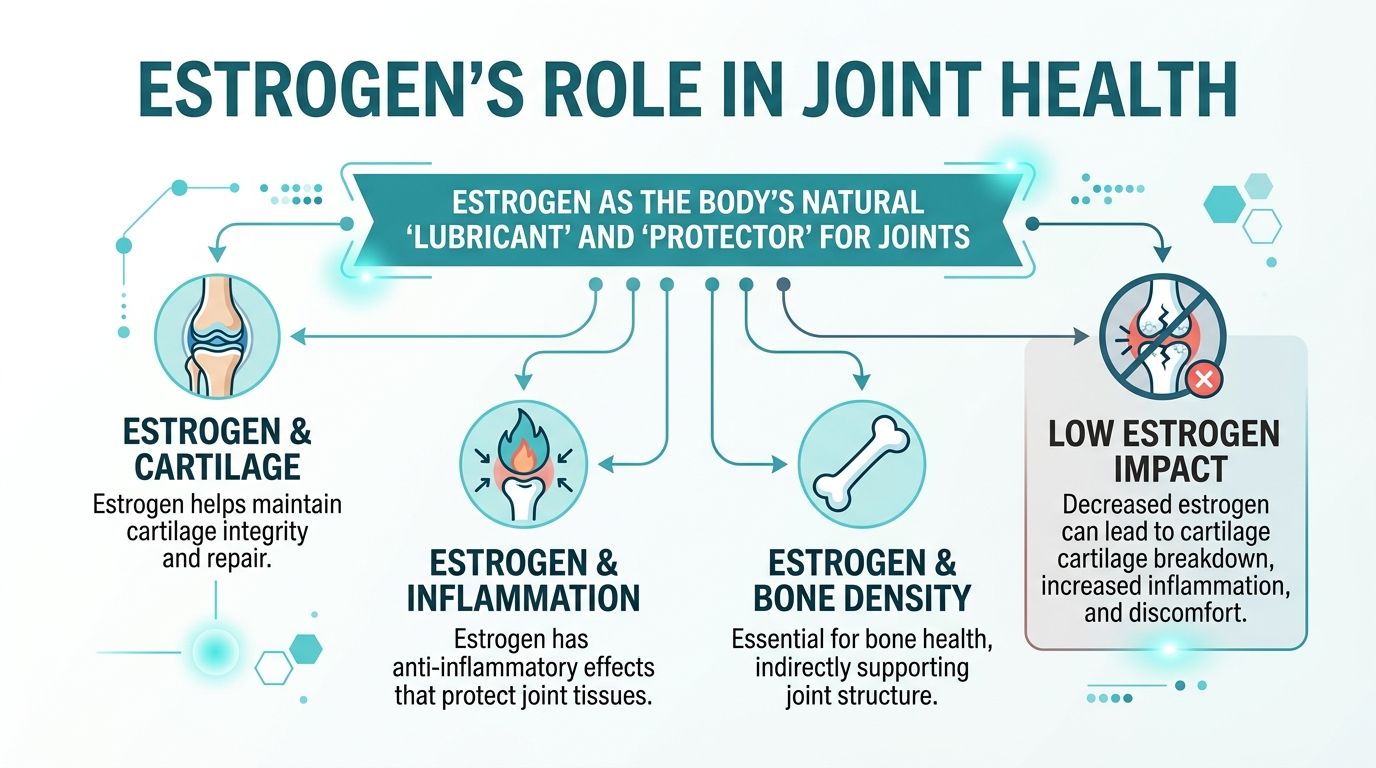
Estrogen doesn’t only affect periods, hot flashes, or vaginal tissue. It also helps support the tissues that make movement feel smooth.
Think of estrogen as part lubricant, part tissue protector, part inflammation regulator. When levels fall, joints don’t necessarily fail, but they often become less forgiving.
What estrogen does in healthy joints
Estrogen receptors are present in joint-related tissues. That helps explain why hormonal shifts can show up as pain, stiffness, or reduced tolerance for impact.
A review on estrogen and osteoarthritis describes three especially important roles (PMC11942494):
- Inflammation control: Estrogen acts as a natural anti-inflammatory by inhibiting factors such as TNF-α and IL-1β.
- Joint lubrication: It supports synovial fluid production, which helps joints glide more smoothly.
- Cartilage support: It helps maintain cartilage elasticity and reduces the conditions that favor degeneration.
When estrogen drops, you lose some of that built-in protection. The result can feel like more friction, more morning stiffness, and more soreness after activity that used to feel routine.
Why low estrogen can feel like “everything hurts”
Hormonal joint pain doesn’t always stay neatly inside one diagnosis box. Some women feel it in weight-bearing joints such as the hips and knees. Others notice it in the hands, feet, shoulders, or low back. Active women often feel it in tendon-heavy areas where loading matters, like the Achilles, patellar tendon, or lateral hip.
This isn’t only about cartilage.
Connective tissue quality, tissue hydration, pain sensitivity, sleep disruption, and inflammation all interact. That’s one reason a woman can feel achy in multiple places while scans and labs remain unrevealing.
Practical rule: If your pain seems to rise and fall with hormonal shifts, recovery changes, or menopause symptoms, hormones belong on the differential. They shouldn’t be the last thing anyone considers.
Where nutrition and lifestyle fit
Food and supplements don’t replace a proper evaluation, but they can support the tissues you’re asking to move and recover. Many women start by cleaning up basics such as protein intake, hydration, and micronutrients that support overall hormonal health. If you want a practical overview, this guide on vitamins that balance female hormones is a useful starting point.
Pelvic health also belongs in this conversation. Hormonal changes don’t isolate themselves to one body part. Women who are noticing joint pain, core changes, pressure symptoms, or bladder issues at the same time often benefit from care that recognizes the whole picture, including menopause and pelvic floor dysfunction: https://lakecitypt.com/menopause-and-pelvic-floor-dysfunction/
One detail that often gets overlooked
In the same review, women with radiographically defined osteoarthritis were more likely to have estradiol concentrations in the lowest tertile, with an odds ratio of 1.88 (95% CI 1.07-3.51) than women without osteoarthritis. That doesn’t mean low estrogen is the only cause of joint pain. It does mean the hormone-joint relationship is biologically meaningful.
When women understand that, they usually feel two things at once. Relief, because the pain makes more sense. Frustration, because no one mentioned it earlier.
Is It Hormonal Pain or Another Joint Condition
Not every ache in midlife is low estrogen joint pain. That distinction matters.
Hormonal pain can overlap with osteoarthritis, rheumatoid arthritis, tendon disorders, bursitis, or pain conditions that affect the whole body. A good evaluation looks at pattern, timing, joint behavior, and red flags.
Symptom checker
| Symptom Feature | Low Estrogen Joint Pain | Osteoarthritis (OA) | Rheumatoid Arthritis (RA) |
|---|---|---|---|
| Pain pattern | Often migratory, can shift between joints | More fixed and localized | Often persistent and inflammatory |
| Common timing | Often worse in the morning or after inactivity, may also flare with recovery changes | Often worse with load and after use of the affected joint | Often marked morning stiffness and ongoing inflammatory symptoms |
| Distribution | Can affect hands, knees, shoulders, hips, feet, or multiple regions | Common in specific joints with degenerative loading history | Often affects multiple joints and may be more symmetrical |
| Visible swelling | May be minimal or absent | Variable, often mild if present | More likely to involve obvious swelling, warmth, or tenderness |
| Response to rest | Rest may help briefly, but too much rest often increases stiffness | Often settles somewhat with pacing | Rest alone usually doesn’t solve it |
| Associated clues | Perimenopause or menopause symptoms, changing cycles, sleep disruption, shifting recovery | Crepitus, joint-specific loss of motion, history of wear and tear | Significant fatigue, persistent swelling, inflammatory presentation |
| Typical feel | Achy, stiff, diffuse, “I can’t quite pin it down” | Mechanical, joint-specific, more predictable | Inflamed, tender, prolonged stiffness |
Clues that point more toward hormones
Hormonal joint pain tends to have a distinct feel in clinic.
I pay attention when a woman says:
- “It moves around.” That’s common with hormonal pain.
- “I feel stiff everywhere in the morning.” Especially when it improves as she gets moving.
- “My training didn’t change, but my body did.” That often matters more than people think.
- “I also have sleep issues, cycle changes, hot flashes, or vaginal dryness.” Joint pain rarely arrives in total isolation.
The term musculoskeletal syndrome of menopause is useful because it captures that whole-body pattern. The symptoms aren’t imaginary, and they aren’t always classic arthritis.
Clues that deserve a medical workup
Some symptoms should push the conversation beyond self-management.
Get assessed sooner if you notice:
- Hot, red, or markedly swollen joints
- Rapid loss of function
- Night pain that feels severe or unrelenting
- Fever or feeling systemically ill
- Persistent numbness, weakness, or major grip loss
- A joint that locks, gives way, or won’t bear weight
If the pain is intense, one-sided, visibly inflamed, or progressively worsening, don’t assume it’s “just hormones.”
What about fibromyalgia
Fibromyalgia can also cause widespread pain, poor sleep, fatigue, and tenderness. It’s part of the differential, especially if pain feels more global than joint-specific.
The key point is this: don’t self-diagnose from a checklist alone. Use the pattern to ask better questions. A clinician should still examine the joint, look at strength and mobility, and decide whether imaging, labs, or referral makes sense.
That’s how you avoid two common mistakes. Missing an inflammatory condition that needs medical care, or being told your pain is random when it follows a recognizable hormonal pattern.
Medical Pathways for Managing Hormonal Joint Pain
Medication isn’t the whole answer, but it does belong in the conversation.
For some women, replacing estrogen helps address a major driver of symptoms. For others, hormone therapy isn’t appropriate, isn’t desired, or only solves part of the problem. Practical care starts with matching the treatment to the woman in front of you.
What the evidence says about estrogen therapy
The strongest trial data we have comes from the Women’s Health Initiative estrogen-alone trial. In a post hoc analysis of women without a uterus, joint pain frequency after one year was 76.3% in the estrogen group versus 79.2% in the placebo group, with benefits persisting through three years (PMC3855295).
That same analysis found fewer hip and knee joint replacements in estrogen users, with 222 cases in 5,076 estrogen users versus 269 in 5,195 placebo users, HR 0.84, 95% CI 0.70-1.00, P=0.05.
Those are modest effects, not magic. But they matter because they show that estrogen can reduce joint pain in a measurable, sustained way.
What works, and what it doesn’t do
Hormone therapy can help when low estrogen is a major contributor. It may reduce pain frequency, calm stiffness, and improve day-to-day comfort.
It won’t:
- rebuild strength on its own
- correct poor loading patterns
- restore tendon capacity without training
- solve every cause of pain in a menopausal body
That trade-off is important. If a woman restarts exercise with deconditioned hips, weak calves, stiff thoracic rotation, and poor sleep, estrogen alone won’t make her joints resilient.
Who needs a more careful decision
Some women can consider hormone therapy with their medical provider. Others need a more cautious route, especially women with a history that makes estrogen use complex or inappropriate.
That includes many oncology patients and women with other medical contraindications. In those situations, a non-hormonal management plan becomes even more important.
The right question isn’t “Should every woman take hormones?” It’s “What is the safest effective mix of medical support, rehab, and lifestyle care for this woman?”
Supportive medical tools
Even when hormone therapy is on the table, many women still use supportive measures.
These may include:
- NSAIDs: Useful for short periods when inflammation and pain spike, but not a long-term substitute for a plan.
- Topical pain relievers: Sometimes helpful for hand, knee, or shoulder flares.
- Vitamin D or magnesium: These may support broader musculoskeletal health when clinically appropriate, though they don’t directly replace estrogen.
- Sleep support: Better sleep often lowers pain sensitivity and improves recovery.
What usually fails is relying on one passive tool for a problem that affects tissue quality, inflammation, movement tolerance, and training capacity all at once.
That’s where rehab becomes more than an add-on. It becomes the part that teaches your body how to handle load again.
How Physical Therapy Builds Joint Resilience
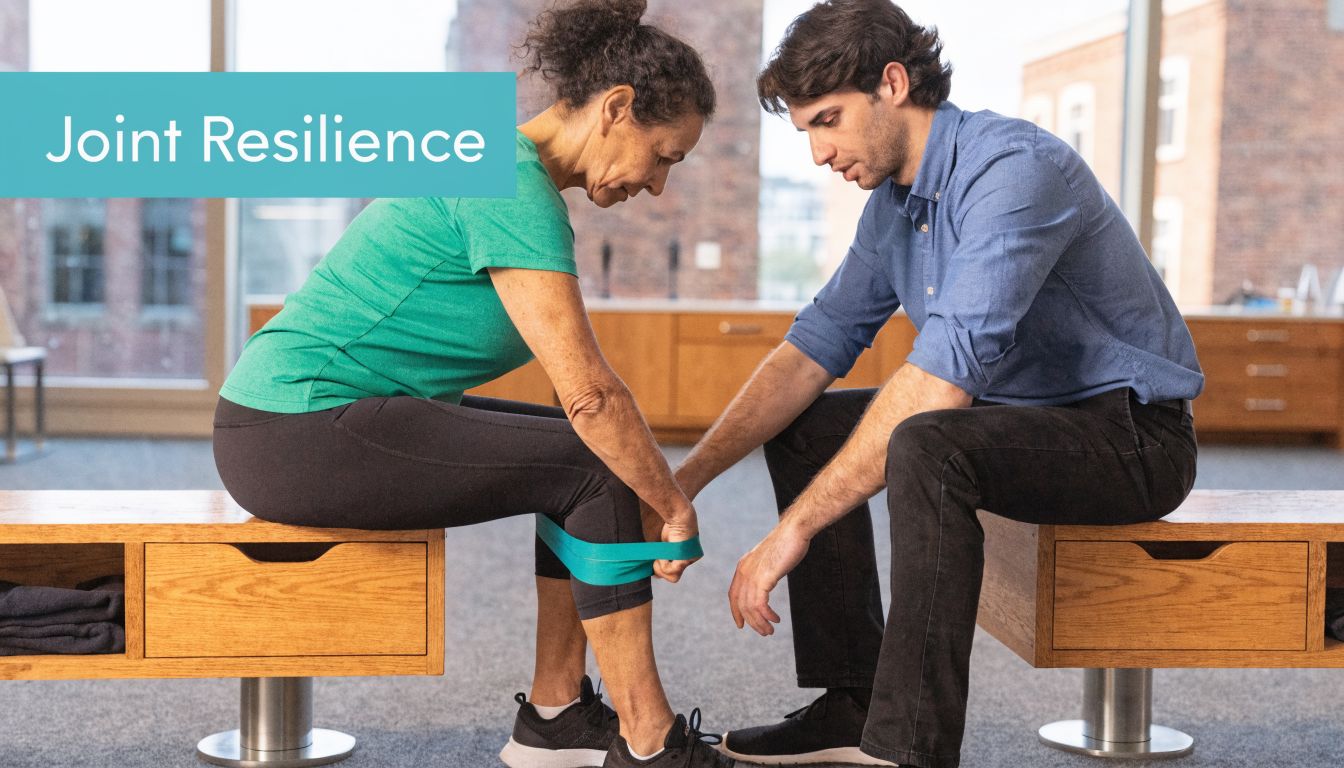
Physical therapy matters because low estrogen joint pain isn’t only a chemistry problem. It’s also a load tolerance problem.
When estrogen declines, many women notice stiffer tendons, less forgiving recovery, and more irritation from training patterns they used to tolerate. That’s why generic advice like “just exercise more” often backfires. The issue isn’t whether movement is good. It’s whether the right tissues are getting the right amount of stress in the right sequence.
Why a tailored plan works better than random workouts
An underserved area in this topic is non-hormonal PT for active women. An orthopedic review highlights that low estrogen affects collagen production and tendon stiffness, and it notes growing use of targeted loading approaches such as progressive eccentric loading to stimulate collagen synthesis and rebuild tendon resilience in low-estrogen states (Orthopedics RI blog).
That’s a big deal for runners, CrossFit athletes, hikers, lifters, and women trying to return to sport after feeling like their joints suddenly became unreliable.
A strong PT plan doesn’t stop at “stretch more.” It asks better questions:
- Which tissues are underprepared for your current activity?
- Which joints are taking load they shouldn’t be taking?
- Are you dealing with stiffness, weakness, poor control, or all three?
- Are you underloading because you hurt, then flaring because you do too much on good days?
What treatment often includes
For knee, hip, or ankle pain, I usually care less about chasing the sore spot and more about rebuilding the system around it.
That can include:
- Glute and hip strength work: Better lateral hip control often reduces knee and low-back stress.
- Quadriceps loading: Helpful when stairs, squats, or descents are aggravating.
- Calf strengthening: Essential for walkers and runners who have lost lower-leg capacity.
- Eccentric tendon loading: Useful for tendons that feel painfully stiff or reactive.
- Balance and proprioception drills: These improve joint awareness and stability.
- Mobility where it counts: Not endless stretching. Specific motion in the joints that are limiting movement.
For some women, pain settles once they stop overprotecting the joint. For others, the breakthrough comes when they stop hammering irritated tissues and build back more gradually.
What active women often get wrong
Active women usually make one of two mistakes.
They either stop moving too much, which makes stiffness worse, or they keep training as if nothing changed, which keeps re-irritating tissues that now need a different loading strategy.
A skilled plan sits in the middle:
- Calm the most irritable tissue.
- Keep enough movement in the system that joints don’t stiffen further.
- Rebuild strength and tendon capacity.
- Return to impact, speed, volume, or overhead work in stages.
That staged approach is one reason orthopedic rehab is useful when hormonal pain starts blending with patellofemoral pain, Achilles trouble, shoulder stiffness, or lateral hip pain. Women dealing with that crossover often benefit from focused orthopedic physical therapy: https://lakecitypt.com/orthopedic-physical-therapy/
Here’s a quick movement demo that fits the idea of loading with purpose, not just moving more for the sake of it.
What good PT should help you do
Physical therapy should make daily life easier, but for many women that isn’t the whole goal. They want to lift, run, hike, dance, or play their sport without guessing which joint will bark next.
A good program helps you:
- tolerate load with less flare-up afterward
- understand the difference between training discomfort and tissue irritation
- modify intensity without losing momentum
- rebuild confidence in movement
The aim isn’t to avoid stress forever. The aim is to make your joints and tendons better at handling it.
Women often feel encouraged when they realize they don’t need to choose between suffering through workouts and giving up the activities they love. There’s a third option. Train with better timing, better progression, and better tissue support.
That’s where rehab provides a sense of control. It gives you a way to influence the problem, not just manage around it.
Your At-Home Toolkit for Easing Aches and Pains
Home care works best when it supports the same principles as rehab. Reduce unnecessary irritation. Keep joints moving. Improve recovery. Build consistency.
You don’t need a perfect routine. You need a repeatable one.
Eat in a way that supports calmer tissues
Food won’t erase hormonal change, but it can help reduce the background noise that makes pain feel louder.
Try building meals around:
- Fatty fish, nuts, and seeds: Helpful for a diet pattern that supports inflammation control.
- Leafy greens and colorful produce: Useful for overall tissue health and recovery.
- Protein at regular meals: Important if you’re trying to maintain muscle while hormone levels shift.
- Berries, beans, and olive oil: Easy staples for an anti-inflammatory eating pattern.
If meal planning feels hard when you’re already tired or busy, a structured anti-inflammatory meal plan can make the basics easier to follow.
Use hydration and movement together
Joints usually feel better when the body is both hydrated and moving regularly. Hydration supports normal tissue function, and movement helps joints feel less stuck after long periods of sitting or sleeping.
A simple rule works well:
- drink consistently through the day
- get up and move before stiffness fully sets in
- avoid the cycle of sitting for hours, then asking your body to perform hard
Build a short morning reset
Morning stiffness is common with low estrogen joint pain. Don’t launch straight into intense activity from cold.
A useful reset might include:
- Five minutes of easy walking
- Gentle spinal rotation or cat-cow
- Ankle pumps and calf raises
- Sit-to-stands or bodyweight squats
- Shoulder circles and wall slides if the upper body is involved
The goal isn’t to stretch aggressively. It’s to tell your joints that movement is coming.
Protect sleep and stress recovery
Pain sensitivity rises when sleep drops. Stress also changes muscle tension, recovery, and how threatening pain feels.
That means your at-home toolkit should include more than exercise.
Focus on:
- A regular sleep window: Even if it’s not perfect, consistency helps.
- Wind-down routines: Lower light, lower stimulation, less late-night scrolling.
- Gentle recovery work: Easy walks, breathing drills, and mobility often work better than forcing a hard session on a bad day.
For more joint-friendly habits that support long-term movement, this guide on keeping joints strong is worth bookmarking: https://lakecitypt.com/how-to-keep-joints-strong/
Small daily inputs usually beat occasional heroic efforts. That’s especially true when your joints are sensitive to both underuse and overload.
Taking Control of Your Joint Health Journey
Low estrogen joint pain can feel slippery because it doesn’t always look dramatic. It often shows up as stiffness, shifting aches, slower recovery, and joints that suddenly feel less tolerant of normal life or normal training.
But it is treatable.
The most effective approach usually combines a few pieces: an informed medical conversation, movement that matches your current tissue capacity, and daily habits that reduce irritation instead of feeding it. Some women benefit from hormone therapy. Some can’t or don’t want to use it. Either way, specialized physical therapy gives you a non-hormonal path to rebuild strength, tendon capacity, and confidence.
Seek professional help if pain is limiting daily activity, waking you at night, not improving with sensible self-care, or coming with red flags like marked swelling, heat, significant weakness, or rapid loss of function.
You do not have to wait until the pain becomes severe to take it seriously. You also don’t have to accept “it’s just aging” as a useful answer.
Your body is changing. That doesn’t mean it’s broken.
If low estrogen joint pain is affecting your workouts, sleep, mobility, or confidence, Lake City Physical Therapy offers women’s health-focused care that looks at the full picture. Their team works with active women, pelvic health patients, prenatal and postpartum mothers, and oncology survivors to build personalized plans that reduce pain, restore resilience, and support a safe return to the activities you love.

