Neck Pain from Breastfeeding: Positions and Fixes
In a Saudi survey published in the Journal of the Pakistan Medical Association, 58% of 281 breastfeeding women reported musculoskeletal pain they attributed to breastfeeding. That doesn't mean breastfeeding causes injury. It means the physical work of feeding deserves attention alongside latch, milk supply, and your baby's comfort.
Neck pain from breastfeeding often involves more than sitting awkwardly. Your seating support, time spent holding the baby, opportunities to change position, and upper-back endurance can all matter. Relief starts with finding which demands you can change, without treating your posture as something you've done wrong.
Feeding Positions Ranked by Neck Strain
In a cross-sectional study of 310 lactating mothers attending postnatal clinics in Enugu, Nigeria, 51.7% reported breastfeeding-related neck pain, and 91.7% of affected participants identified the cradle hold as particularly painful. However, reported positions weren't statistically associated with whether pain occurred, so this isn't proof that cradle feeding causes neck pain.
The clearest comparison concerns supported lying versus unsupported sitting. A Polish survey of 395 breastfeeding women found significantly less intense neck pain among those preferring lying positions than among those feeding in a chair or armchair, with p < 0.05; lying or semi-lying with head support was also associated with lower maximum pain than unsupported sitting.
Feeding positions compared by neck strain and fix
| Position | Neck pain evidence | Setup that lowers strain | Best use |
|---|---|---|---|
| Cradle hold | Most frequently identified as painful among affected mothers in the Nigerian sample | Raise baby to breast height; support baby and elbow with pillows | Close holding when the latch is established |
| Cross-cradle hold | No position-specific pain ranking established in these studies | Support baby with the opposite arm; rest that forearm on a pillow | Guiding an early latch, then changing holds when practical |
| Football hold | No position-specific pain ranking established in these studies | Tuck baby beside you; support baby's back and your forearm | Avoiding pressure across a cesarean incision or trying a different feeding angle |
| Side-lying | Lower neck-pain intensity than seated chair feeding in the Polish survey | Support your head; face baby without twisting your neck | Feeding while awake when sitting is uncomfortable |
| Laid-back, semi-reclined | Lower maximum pain with head support than unsupported seated feeding | Support your back and head; keep baby's face visible and airway clear | Reducing the effort of holding yourself upright |
| Seated in chair or armchair, unsupported | Greatest maximum neck-pain intensity in the Polish comparison | Add back support, foot support, and pillows under baby and elbows | Modify rather than use unsupported sitting as your default |
There isn't a defensible ranking of every hold from best to worst. These surveys relied on self-reported symptoms and preferences, and neither can establish causation. Someone may choose lying down because sitting already hurts.
Choose a hold that brings baby's mouth to the breast while your own head stays comfortably balanced, not level with baby's mouth. Alternate comfortable holds rather than forcing a supposedly ideal position. For lying feeds, stay awake and return your baby to their separate, firm, flat sleep space afterward.
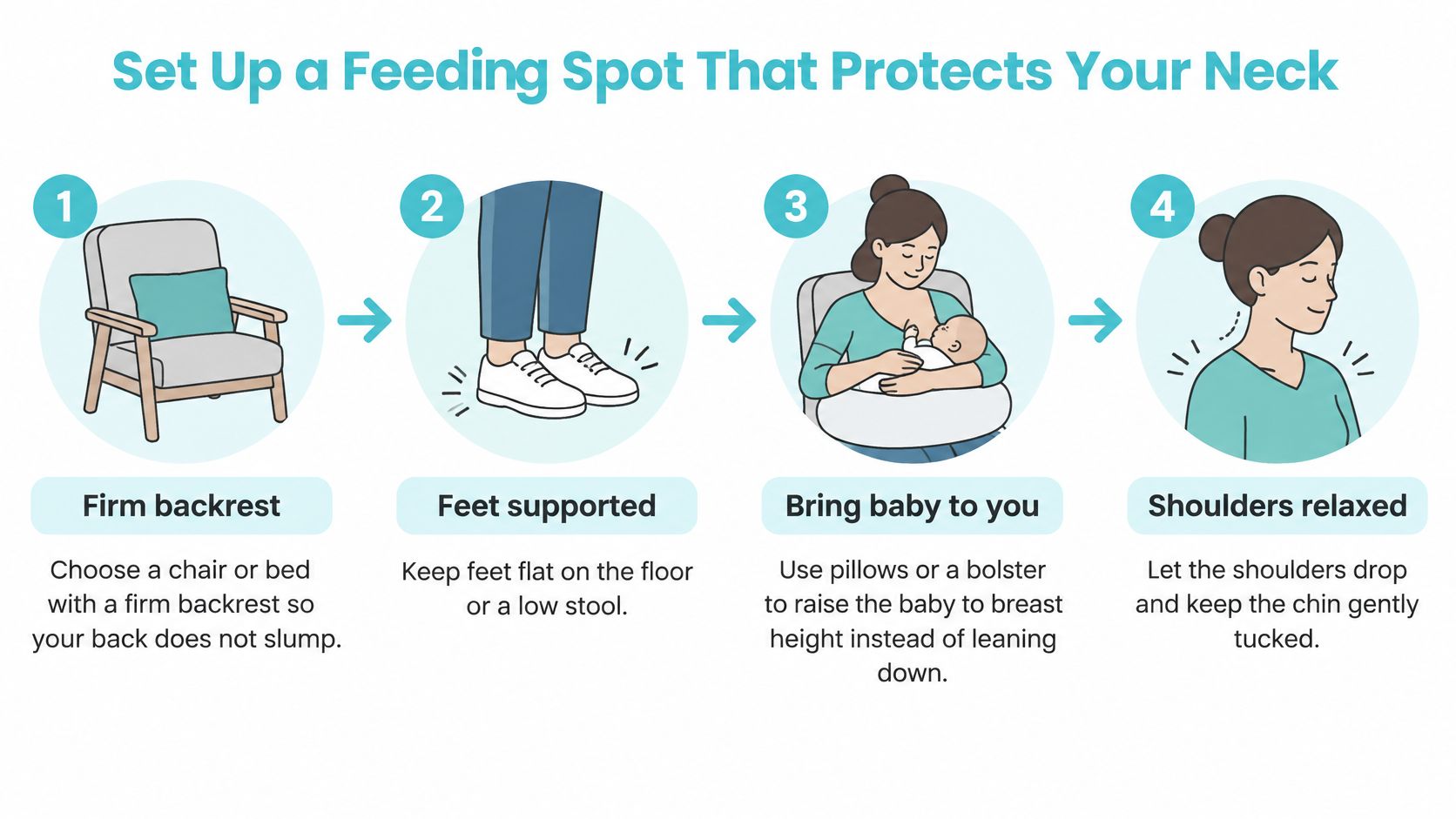
Set Up a Feeding Spot That Protects Your Neck
Arrange your support before you pick up your baby. A survey examining breastfeeding position and spinal pain associated chair or armchair feeding with greater maximum neck-pain intensity than bed, couch, or lying positions. That supports adjusting the whole setup, rather than blaming a particular piece of furniture.
-
Choose a supportive backrest. Sit against a firm backrest rather than perching on the edge. You shouldn't have to keep yourself upright through muscular effort throughout the feed.
-
Support your feet. Place them flat on the floor or a stable footrest. Dangling feet can make it harder to settle your pelvis and back comfortably.
-
Raise your baby. Put a pillow across your lap or beneath your supporting arm so baby's mouth reaches the breast. Keep pillows away from baby's face.
-
Rest your elbow and forearm. Use an armrest or pillow that supports you without lifting your shoulder toward your ear. Your arms shouldn't carry the entire load unsupported.
-
Bring baby toward you. Establish your supported position, then bring baby to the breast. If you need to lean forward to maintain the latch, adjust baby's height or seek latch support.
-
Check without holding your head down. Look at your baby as needed, then return to a comfortable forward gaze. Let your chin settle rather than jutting forward.
-
Change your arrangement when practical. Use different comfortable holds and feeding sides as appropriate for your feeding plan. Don't force a painful side or disrupt feeding advice you've received.
Use this visual as a reminder when arranging your space.
Reset when fatigue changes your position
If you slide forward during a night feed, settle back and reposition the pillow rather than trying harder to sit straight. Meliusly's guide to ergonomic neck relief while reclining offers context for head support, but no cushion should push your chin toward your chest.
Your broader recovery may also include postpartum core strengthening exercises suited to your recovery stage.
Mid-feed check: Relax your shoulders, release unnecessary effort, and adjust if you notice arm tingling or increasing discomfort. A useful position is comfortable, not rigid.
What Forward Head Posture Does to Your Neck
Think of holding a bowling ball close to your body versus farther away. The object hasn't changed, but supporting it becomes harder as it moves away. Your neck muscles face a similar mechanical challenge when your head stays forward of your shoulders.
This feeding scene illustrates why it's easy to spend a session looking downward.

A clinical discussion of breastfeeding-related neck pain describes a proposed mechanism involving sustained cervical flexion, forward-head positioning, and repetitive low-load muscular effort. As you lean toward your baby, your shoulders may round and the muscles behind your neck and upper back work in a lengthened position. Tissues across the front of the neck and shoulders may remain shortened.
Duration matters more than a passing glance
Looking down isn't harmful by itself. The concern is staying there without enough support or movement, especially when you're already tired. Repeatedly turning toward the same side can add rotation and side-bending to that sustained effort.
This doesn't mean your spine is permanently changing shape during each feed. The observational evidence describes associations and plausible mechanisms, not proof that a particular head angle caused an individual's symptoms.
For another seated activity, Tyner Furniture's ergonomic desk setup and chair advice provides context for adjusting furniture to support the person. Feeding needs its own adaptations because you're also positioning a moving baby.
The following video provides an additional visual reference.
You don't need to stop looking at your baby. You need opportunities to stop holding your neck in the same bent position.
Why Posture Alone Often Falls Short
Sit upright and add a pillow is incomplete advice when your neck still aches after you've improved your setup. Support can reduce the work you do during feeding, but it doesn't automatically improve your ability to tolerate repeated holding, lifting, and carrying.
A randomized controlled trial of scapular-stabilization exercises in breastfeeding women with nonspecific neck pain reported greater improvements in cervical pain, function, and mobility than standard treatment. That finding supports addressing shoulder-blade control and muscular capacity, not just how straight someone sits. It doesn't establish that every exercise routine works equally well or that exercise replaces feeding support.
Consider the work around the posture
Say you settle into a well-supported chair but spend the rest of the day carrying your baby on the same arm. Your feeding position may be better while your overall workload remains demanding. Similarly, a comfortable hold may become tiring during a prolonged feed.
Useful questions include:
- Duration: Does discomfort start immediately, or build as the feed continues?
- Support: Are you resting your arms, or holding them just above the pillow?
- Repetition: Do you always turn, carry, or feed toward the same side?
- Recovery: Can someone help with settling, lifting, or household tasks between feeds?
Don't shorten feeds or reduce feeding frequency solely to manage your neck without discussing your baby's feeding needs with a qualified professional. Instead, look for ways to share surrounding tasks and reduce unnecessary unsupported holding.
Posture, feeding load, and endurance work together. A more comfortable setup reduces immediate demand; appropriately chosen exercises help develop the capacity to meet the demands that remain.
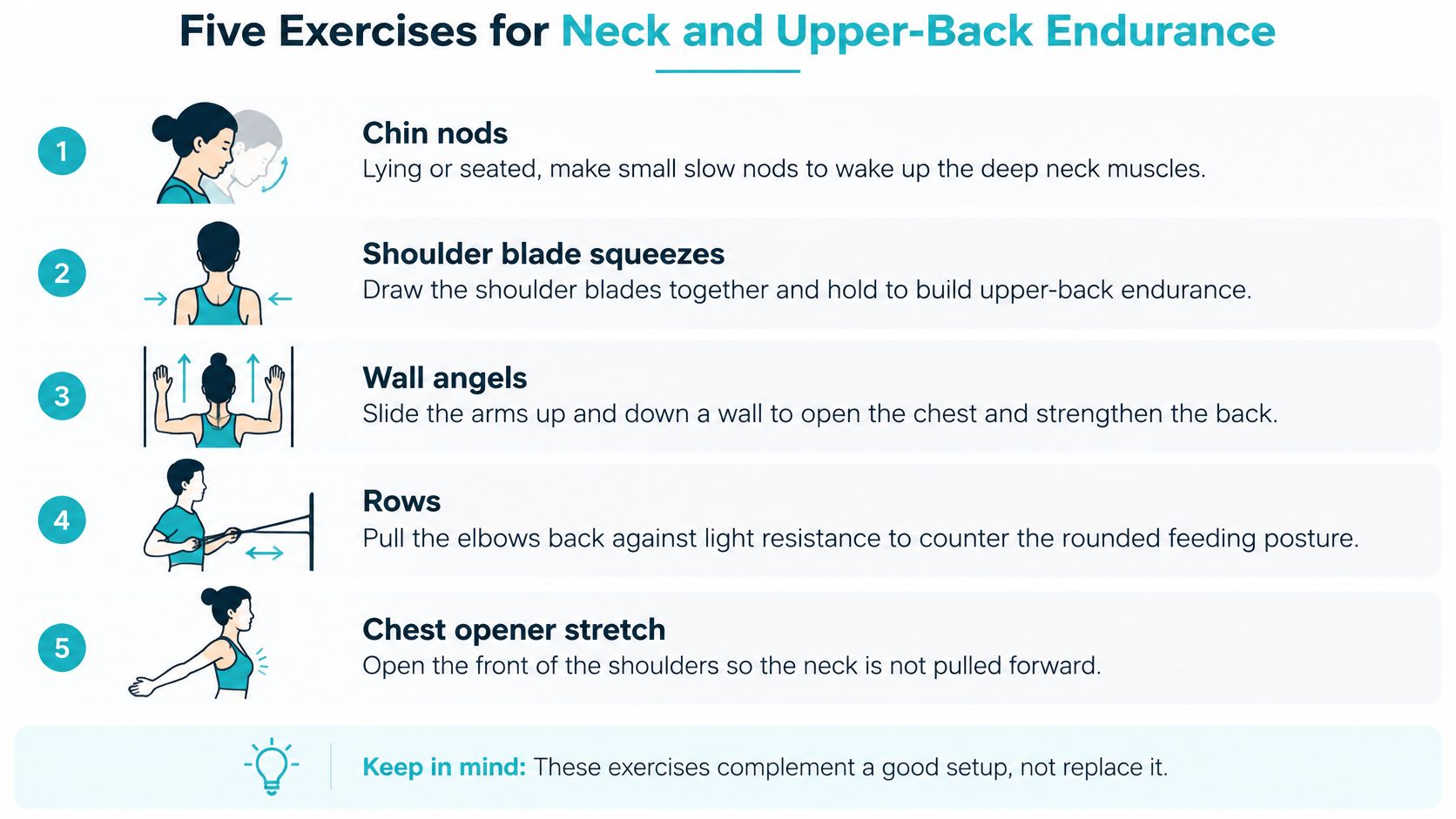
Five Exercises for Neck and Upper-Back Endurance
Gentle movement between feeds can complement support during feeding. These are movement options, not the exact protocol from the clinical trial. Start with a small, comfortable amount, and have a clinician tailor the workload if you're recovering from complications or already have persistent symptoms.
Practice control before adding effort
-
Chin nods. Lie with your head supported and make a small, slow yes movement, keeping the back of your head resting. Use a light effort rather than pressing hard into the pillow. This practices neck control without holding your head against gravity.
-
Shoulder-blade squeezes. Sit comfortably and gently draw your shoulder blades toward each other. Release fully between efforts, avoiding a forceful downward pull or shrug. The aim is controlled shoulder-blade movement, not a permanently braced posture.
-
Wall angels. Stand with your back near a wall and slide your arms upward from a comfortable bent-elbow position. Stop before your shoulders pinch or your lower back arches. Your hands don't have to stay against the wall.
-
Doorway chest stretch. Rest a forearm against a doorframe below shoulder height and gently turn your chest away. You should feel a mild stretch across the chest, not pulling, tingling, or pain down the arm.
-
Chair-back extension. Sit against a stable chair with a rolled towel behind your mid-back. Support your head with your hands and gently lean your upper back over the towel without throwing your neck backward. Keep the movement easy and breathe normally.
The visual below includes related options, including a resistance row that may suit a later, individualized program.
Stop rule: End any exercise that sends pain into your arm or causes tingling, dizziness, or a new headache. Don't push through symptoms to complete a set.
Practice during a break with your baby safely supported elsewhere, not while feeding or holding them. If discomfort lingers or builds afterward, reduce the workload and seek guidance. An assessment focused on shoulder physical therapy can help identify whether shoulder mobility or control needs particular attention.
Signs Your Neck Pain Needs a Clinician
Seek emergency help for chest pressure, shortness of breath, pain spreading to the jaw or arm with sweating, or a sudden severe headache. Don't assume these symptoms come from feeding posture, and don't test whether stretching makes them disappear.
Other symptoms need assessment even when they seem less dramatic. Persistent radiating pain, altered sensation, weakness, fever, and symptoms after trauma shouldn't be managed with pillows and exercises alone.
Warning signs and who to contact
| Sign | Urgency | Who to see |
|---|---|---|
| Chest pressure, shortness of breath, or pain spreading to jaw or arm with sweating | Emergency | Emergency services now |
| Sudden severe headache | Emergency | Emergency services now |
| Neck pain after a fall or car accident | Prompt; emergency if severe or accompanied by neurological symptoms | Emergency or urgent care |
| Fever with neck stiffness | Urgent | Urgent medical assessment |
| Numbness, tingling, or weakness in hand or arm | Prompt; urgent if sudden or progressing | GP or physician |
| Breast or nipple pain, hot red area, or painful latch | Prompt, especially with fever or feeling unwell | GP and lactation consultant as appropriate |
| Neck pain that isn't improving with setup changes | Routine assessment rather than indefinite self-treatment | Physical therapist |
| Pain affecting caregiving or daily tasks | Arrange an assessment | Physical therapist and lactation consultant |
Make the appointment useful
A physician can assess concerning symptoms and medication questions. A physical therapist can examine neck and upper-back mobility, shoulder-blade endurance, lifting mechanics, and your actual feeding arrangement. A lactation consultant can address latch difficulties that make you lean or hold awkwardly.
Bring a short symptom log noting where it hurts, when it starts, which hold you used, and whether symptoms travel into your arm. Before taking a pain reliever, ask your physician or pharmacist which options fit your health history and are compatible with breastfeeding.
Choose Your Next Step for Neck Relief
Choose your next action based on how symptoms behave, not whether you can tolerate more discomfort. You don't need to wait until feeding becomes unbearable to ask for help.
Match the response to the symptoms
- Mild pain that eases with adjustments: Keep the changes that help and introduce comfortable movement between feeds. Note whether you can feed more comfortably and recover more easily afterward.
- Persistent or increasing pain: Book a physical therapy assessment rather than repeatedly buying different pillows or forcing yourself upright. Include lactation support if latch or breast discomfort affects your position.
- Any warning sign: Seek the appropriate medical care promptly. Exercise isn't the next step when symptoms suggest something beyond muscular strain.
At Lake City Physical Therapy, we offer Prenatal & Postpartum Physical Therapy, and our team can also help with orthopedic physical therapy. We're one option alongside your physician and lactation consultant, depending on what your symptoms require.
If you're unsure how to arrange care, our guide to physical therapy without a referral explains considerations to review before booking. Keep notes about what you want help doing, such as finishing a feed comfortably, turning your head, or lifting your baby.
Your practical checklist
- Change a hold: Try a supported alternative that doesn't interfere with a comfortable latch.
- Prepare your space: Put the back support, footrest, and arm pillows in place before feeding.
- Arrange a review: Seek individualized help if symptoms aren't improving or interfere with caring for yourself or your baby.
You can work toward breastfeeding comfort and neck relief at the same time. Your needs belong in the feeding plan too.
We offer prenatal and postpartum rehabilitation and orthopedic physical therapy to help address the physical demands of feeding and caring for your baby. Visit Lake City Physical Therapy to explore care options and ask about an assessment for your neck and upper-back symptoms.

