Painful Sex After Prolapse Surgery: A Practical Guide
Four to six months after prolapse surgery, many women reach the same confusing point. The incision looks healed, the bulge or pressure has improved, and the surgeon cleared intercourse at the postoperative visit. Yet penetration burns, a tender ridge catches under the partner's movement, or deep thrusting creates an ache that lasts long after intimacy ends. Avoiding sex can start to feel easier than explaining why it hurts.
Painful sex after prolapse surgery doesn't automatically mean the repair failed. Surgical healing and sexual comfort are related, but they aren't the same process. Scar mobility, pelvic floor muscle tone, tissue estrogen, surgical material, lubrication, and the nervous system's response to anticipated pain can all influence the experience.
The useful question isn't, “Why am I still hurting?” It's, “Which tissue or response is producing this pain, and what treatment is designed for that driver?” That shift turns a frightening symptom into a clinical pattern that can be assessed and treated.
When Intimacy Still Hurts After Healing
A patient I'll call Maria had an anterior repair and felt encouraged by the changes. She could stand longer without pressure, no longer felt the same vaginal bulge, and had resumed many daily activities. Her surgeon had cleared sexual activity, but her first attempt at intercourse produced sharp burning at the entrance. A later attempt felt less superficial and more like her partner was pressing into one very tender internal spot.
Maria began postponing intimacy. She told her partner she was tired, then worried that each attempt might undo the repair. Nothing about her experience suggested a lack of desire or affection. Her body had learned that penetration could trigger pain, and her pelvic floor responded by preparing to protect her.
That distinction matters. A healed incision can still be stiff, sensitive, or poorly coordinated with the surrounding muscles. The vaginal walls may have healed around a suture line or graft edge, while the levator muscles remain guarded. Hormonal dryness can add friction, and fear can amplify the tightening that makes penetration painful in the first place.
Clinical perspective: Pain is information about a tissue, muscle, or protective response. It isn't a verdict on the quality of your surgery.
Research supports a nuanced conversation rather than a promise that surgery will either fix or ruin sex. In a multicenter analysis of 627 women, dyspareunia or fear of dyspareunia was present in 10.0% at 12 months after prolapse surgery. Among women without preoperative dyspareunia, 3.8% developed new pain, while 74.7% of women who had pain before surgery improved after repair, as reported in the multicenter prolapse surgery analysis.
The practical takeaway is reassuring but specific: persistent pain deserves assessment, not silent endurance. A pelvic floor physical therapist or urogynecologist can determine whether the main problem is at the entrance, within the muscle layer, around a surgical site, or in the cycle of anticipation and guarding.
What Actually Causes Painful Sex After Prolapse Surgery
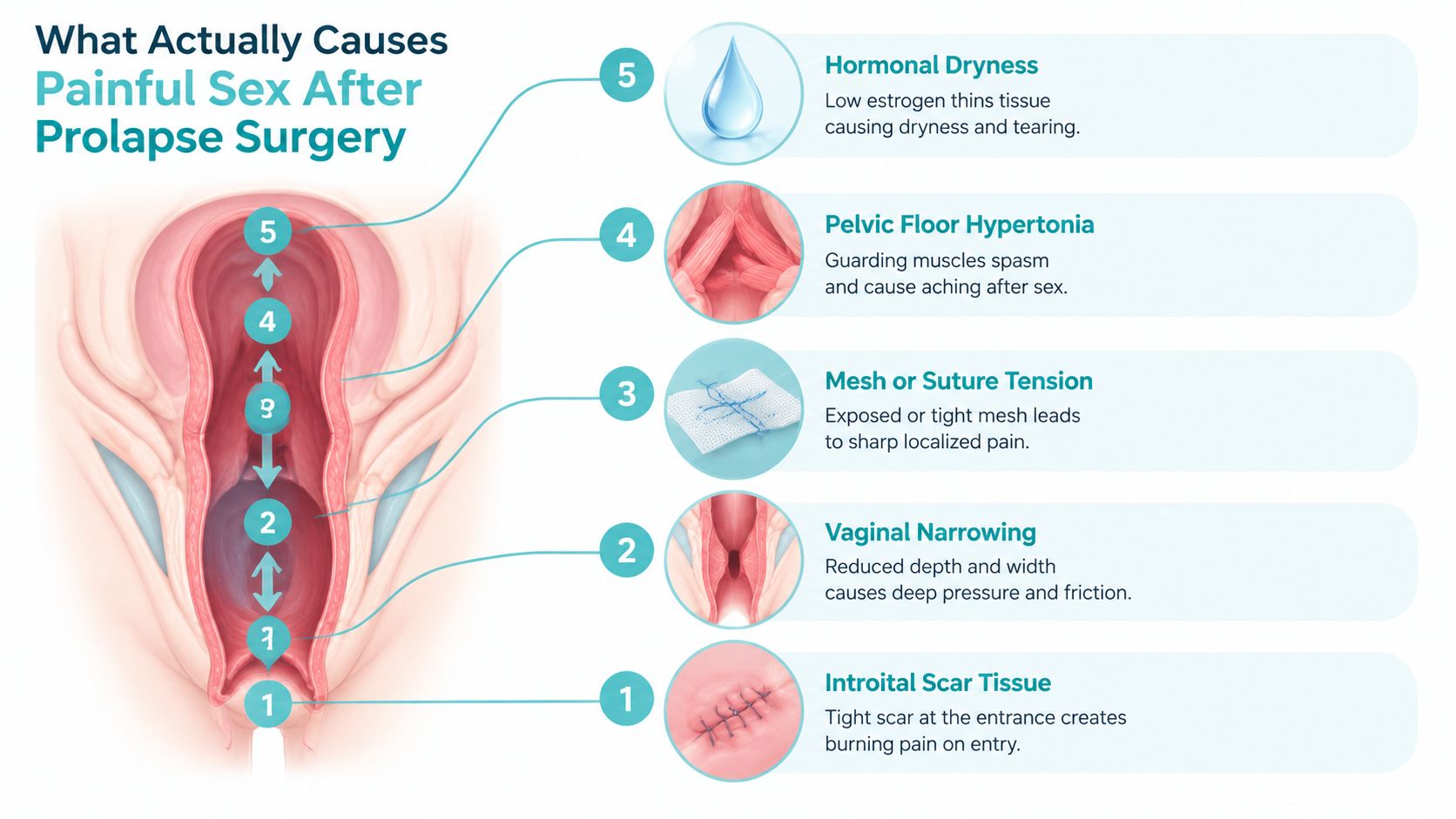
Think of the vagina as a body map that runs from the entrance inward. The location, quality, and timing of pain often point toward the structure needing attention.
At the entrance
Introital or perineal scar tissue can develop where an incision, perineal repair, or prior episiotomy restricts tissue movement. The scar may feel like a tight band or a ridge. Pain is often sharp, burning, or tearing on entry, especially when the tissue is asked to open quickly.
A second entrance-related contributor is hormonal dryness. Lower estrogen can make vaginal tissue thinner, less elastic, and more vulnerable to friction. The sensation may be rawness or stinging during penetration, followed by soreness or small amounts of irritation afterward. Lubricant can reduce friction, but it won't restore scar mobility or calm an overactive muscle.
Around the muscle layer
The levator ani muscles may become hypertonic, meaning they stay partially contracted instead of lengthening for penetration. These muscles can guard after months of prolapse symptoms, surgery, or painful attempts. Entry may feel blocked or excessively tight, while deeper pressure produces an aching sensation. Some women notice muscle throbbing or soreness after sex rather than pain during the first contact.
This is different from weak pelvic floor support. A muscle can be strong enough to contract and still be unable to relax. Repeatedly doing strengthening exercises when the primary problem is guarding may increase tension rather than improve comfort.
At a focal surgical point
A mesh, graft, or suture ridge can create a precise tender spot. The pain may feel sharp and localized, as though penetration repeatedly contacts one area. A clinician needs to examine this pattern rather than assuming that all deep pain comes from muscle tension.
The old literature helps explain why technique-specific counseling matters. A historical review of posterior repair outcomes described increased dyspareunia after some posterior repairs and identified higher risk when certain repairs were combined. These findings don't predict an individual outcome, but they show why a focused examination is more useful than a generic instruction to wait.
In the nervous system
Finally, fear-avoidance can become a physical driver. If you expect penetration to hurt, your breathing may become shallow, the pelvic floor may tighten, and arousal-related lubrication may decrease. Less lubrication creates more friction, which confirms the expectation of pain. Treatment must then address both the tissue and the protective response.
What the Research Shows About Pain Outcomes
The broad research message is not that every repair has the same sexual outcome. It's that most women don't experience a simple decline in sexual function, and baseline pain status often provides more useful counseling information than the operation name alone.
A 2021 systematic review found that postoperative dyspareunia was lower than preoperative dyspareunia across surgery types. De novo dyspareunia generally ranged from 0% to 9%, while an evidence summary reported resolution of baseline pain in 50% to 74% of women. Limited data suggested a somewhat higher de novo rate, about 14%, after posterior repairs, as described in the systematic review of sexual function after prolapse surgery.
| Repair Type | De Novo Dyspareunia Rate | Resolution of Pre-op Pain | Typical Sexual Function Impact |
|---|---|---|---|
| Anterior repair | Generally within the overall 0% to 9% range | Many women with preoperative pain improve | Overall function often improves or remains stable |
| Posterior repair | Generally within the overall range, with limited data suggesting about 14% | Many women improve, but posterior repairs warrant technique-specific counseling | Greater concern for entry or deep pain when tissue or muscle is over-tightened |
| Sacrocolpopexy | Generally within the overall 0% to 9% range | Many women improve | Apical support can preserve or improve function, although individual pain drivers remain possible |
| Colpocleiesis | Outcomes require individualized counseling based on the procedure and goals | Not directly summarized by the available figures | Sexual activity involving vaginal penetration may not remain an intended outcome |
The most clinically important finding comes from the multicenter analysis cited earlier. Preoperative dyspareunia was the only identified predictor of postoperative dyspareunia, with an adjusted odds ratio of 7.8, and a 95% confidence interval of 4.2 to 14.4 in that study's model (study details). This doesn't mean preoperative pain makes persistent pain inevitable. It means the history of pain should shape preoperative and postoperative planning.
A newer review also highlights the counseling gap. Improvement is common, but de novo pain still occurs, and posterior repair may carry a different risk profile in limited evidence (2025 systematic review). The right interpretation is neither “surgery fixes sex pain” nor “surgery causes sex pain.” Repairing support may remove pressure or bulging, while scar, muscle tension, dryness, or fear still needs targeted care.
How to Figure Out Which Driver Is Yours
Start with the moment pain begins. Don't try to diagnose yourself from one symptom, but do record the pattern before your appointment.
First, locate the pain
- Entry pain: Burning, cutting, or tearing as penetration begins points toward scar restriction, dryness, vestibular sensitivity, or protective muscle tightening.
- Deep thrust pain: A deep ache or focal internal tenderness may involve the posterior compartment, apical support, graft or suture contact, or levator muscles.
- Delayed pain: Soreness or aching that appears after intercourse often reflects muscle fatigue, sustained guarding, friction, or irritated tissue rather than one brief contact point.
Position adds useful information. If pain is worse when you can't control depth, try noting whether side-lying or being on top changes the sensation. A position that reduces symptoms doesn't identify the cause by itself, but it can reveal whether depth, speed, angle, or muscle tension is the main trigger.
Then assess gently
With clean hands and short nails, you may lightly check whether the perineal scar moves with the surrounding skin. Don't force the tissue, press through severe pain, or perform an internal examination if your surgeon hasn't cleared it. A sharply tender spot at the entrance suggests a local tissue issue, while tenderness deeper along the pelvic floor may indicate levator guarding.
Clinicians often assess the pelvic floor muscles in areas corresponding roughly to the 5 and 7 o'clock positions on a clock face. You don't need to reproduce that examination at home. Your job is to notice whether light contact causes immediate tightening, breath holding, or a spreading ache.
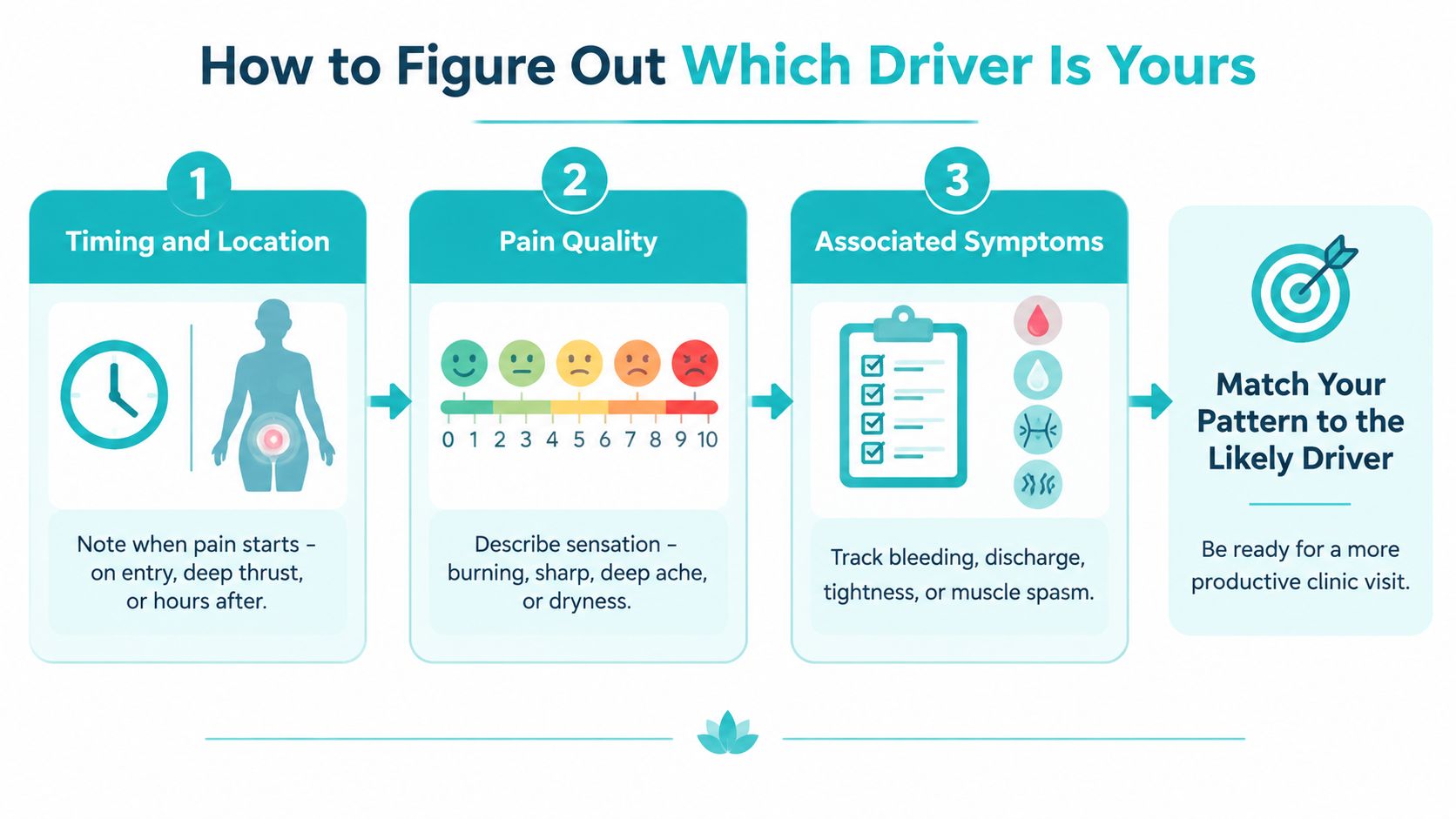
Bring a short symptom cluster to your appointment:
- Superficial burning plus dryness: Ask about scar mobility, vulvar or vestibular tissue, lubrication, and hormonal changes.
- Deep focal pain plus a palpable ridge: Ask for an examination of sutures, graft material, mesh exposure, and the posterior or apical compartments.
- Entry resistance plus aching afterward: Ask whether levator overactivity and pelvic floor down-training could be contributing.
- Pain before contact plus involuntary tightening: Discuss fear-avoidance, breathing, arousal, and graded exposure rather than forcing penetration.
Evidence-Based Treatments That Actually Help
Treatment works best when it matches the driver. Pelvic floor physical therapy is often the most flexible starting point because a clinician can assess scar mobility, muscle tone, breathing, coordination, and movement patterns in one plan. Treatment may include internal trigger-point release, gentle lengthening, down-training of the levator muscles, nervous-system regulation, and education about pain without threatening the repair.
A typical plan may be organized over 6 to 12 sessions, but the appropriate duration depends on examination findings and response. Useful progress markers include less guarding during examination, improved tolerance of touch or a dilator, reduced pain during controlled penetration, and less soreness afterward. Strengthening is added only when weakness is part of the picture. For an overview of care for intercourse-related pain, see pelvic floor physical therapy for painful intercourse.
Match the tool to the tissue
Scar mobilization uses gentle external or internal pressure and movement to improve how the healed tissue glides. It's usually considered only after the incision is fully healed and the surgeon has cleared the area, often around 6 to 8 weeks postoperatively, but healing varies. A home program may involve brief, comfortable contact, breathing, and gradual movement rather than aggressive rubbing. Silicone-based topical products may support scar care for some external scars, but they won't correct a deep suture issue or replace examination.
Graded dilators provide controlled exposure for introital or vaginal tightness. The purpose is desensitization and coordination, not forcing the vagina to stretch. Begin with the smallest comfortable size, use generous lubricant, maintain relaxed breathing, and progress only when the current level feels calm during and after use.
For dryness related to genitourinary syndrome of menopause, ask your gynecologist whether topical estrogen is appropriate. Vaginal moisturizers can support routine comfort, while lubricants provide immediate friction reduction. Neither is a complete treatment for scar restriction or pelvic floor guarding.
| Treatment | Pain Driver Targeted | Typical Timeline | Expected Outcome |
|---|---|---|---|
| Pelvic floor physical therapy | Levator overactivity, guarding, poor coordination, scar sensitivity | Planned around examination findings and progress | Better relaxation, tissue tolerance, and control |
| Scar mobilization | Fixed or sensitive incision tissue | Begins after complete healing and medical clearance | More comfortable tissue glide and less entry restriction |
| Graded dilators | Introital tightness and fear-related guarding | Gradual practice with pauses between progressions | Increased tolerance without forcing penetration |
| Topical estrogen or moisturizers | Hormonal dryness and fragile tissue | Based on medical guidance and regular use | Less dryness and friction-related irritation |
| Lubricants | Friction during sexual activity | Immediate symptom support | Reduced drag, but not correction of the underlying driver |
| Sex-positive counseling or CBT | Fear-avoidance, relationship strain, anticipatory tension | Individualized | Less threat response and better communication |
Counseling can be valuable when pain has changed how you and your partner approach intimacy. The aim isn't to suggest the pain is imaginary. It's to reduce the alarm response while physical treatment addresses the tissue and muscle findings.
A Staged Plan for Returning to Sex
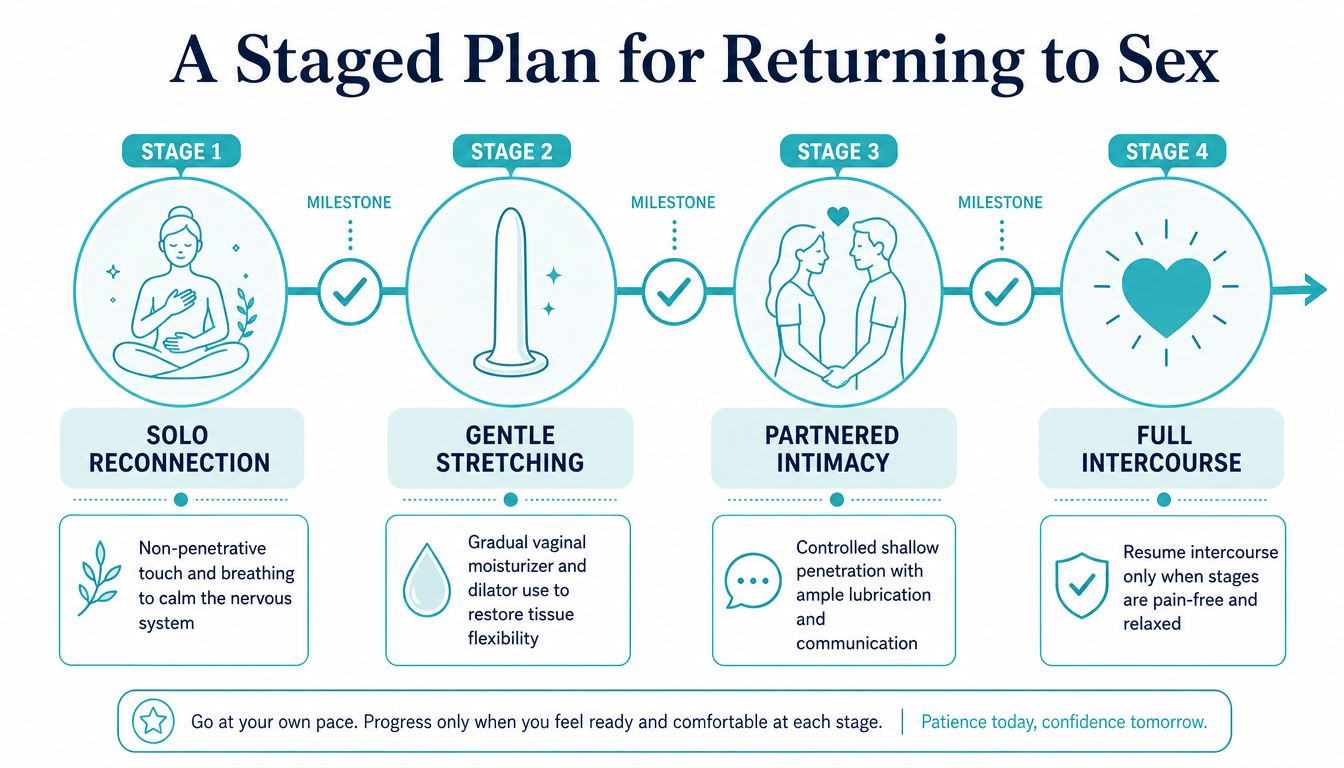
Returning to intercourse shouldn't be a single pass-or-fail event. Use milestones that show your tissues and nervous system are tolerating the next level.
Stage one focuses on safety
Begin with non-penetrative touch, breathing, and solo exploration after medical clearance. Notice which contact feels neutral, pleasurable, or too intense. Practice lubrication without treating penetration as the required endpoint.
Stage two introduces controlled contact
Use a finger or dilator only if your surgeon or therapist has cleared internal work. Start with the smallest comfortable option, move slowly, and stop if pain rises above 3 out of 10. A pain score isn't a challenge to push through. It's a stopping rule that prevents a sensitized system from learning that every attempt is threatening.
Stage three brings in your partner
Tell your partner the plan before touching begins: “We're practicing comfort, not trying to complete intercourse. I'll guide depth and we'll pause if I say stop.” Agree on a pause word. Side-lying and being on top often give the receiving partner more control over depth and pace, but the best position is the one that keeps breathing easy and muscles relaxed.
Keep practice brief, perhaps 10 to 15 minutes, and schedule it two to three times weekly only if your body recovers comfortably. Use generous silicone-based lubricant and allow warm-up to last as long as, or longer than, penetration itself. For product considerations, review this guide to a sensitive personal lubricant.
Progress toward full intercourse when a functional dilator size is comfortable, guarding no longer drives the attempt, soreness isn't escalating, and you have the relevant physician clearance. You can stop at any stage. A satisfying sexual life can include non-penetrative intimacy while treatment continues.
When to Stop Waiting and Call Your Surgeon
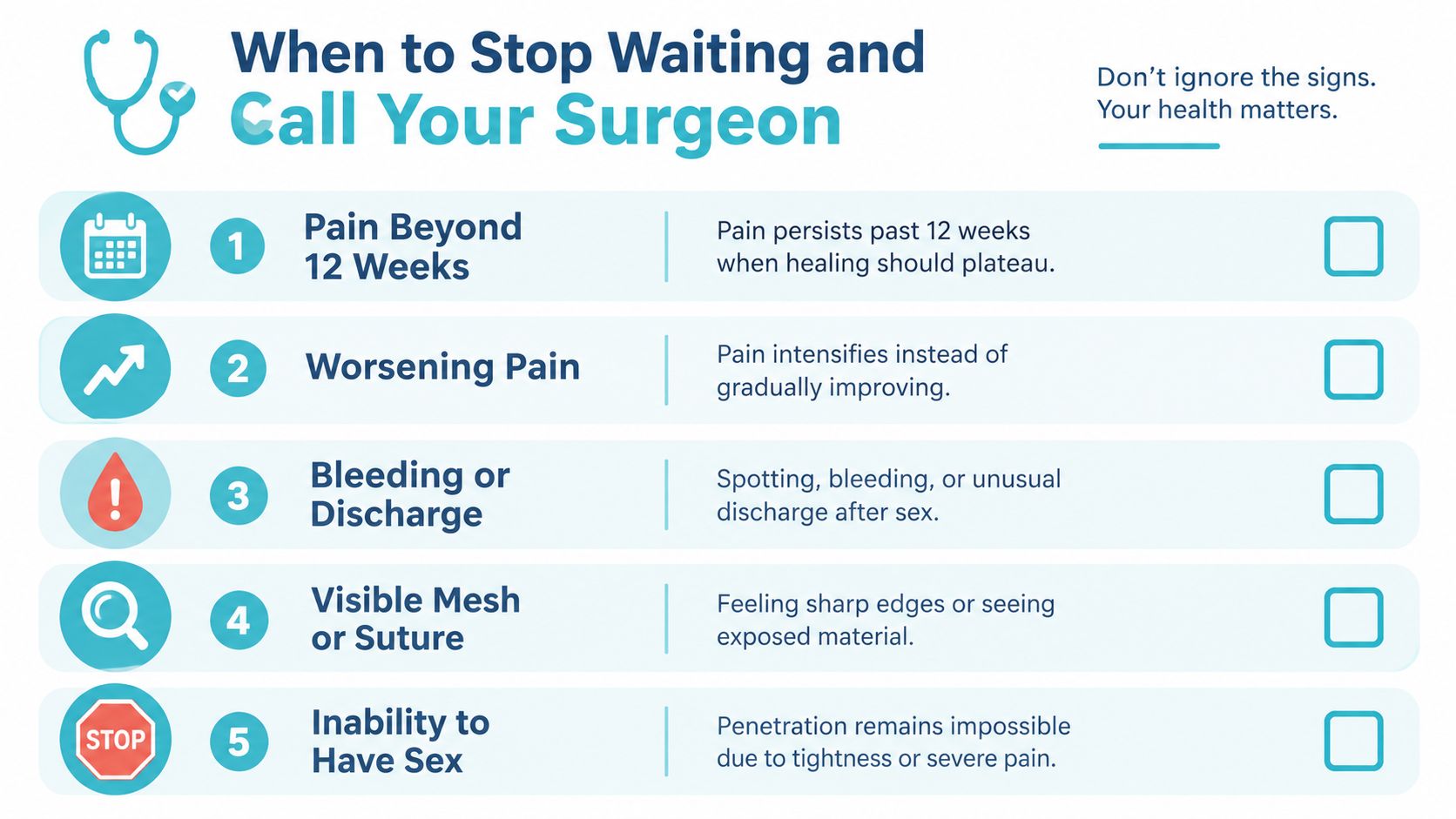
Waiting longer won't correct every cause of painful sex after prolapse surgery. A tight levator muscle, exposed suture, mesh complication, infection, or recurrent prolapse needs assessment rather than passive observation. Recovery may continue, but persistent or worsening symptoms deserve a clinical explanation.
Contact your surgeon or gynecologist promptly if you notice:
- New bleeding: Post-coital spotting or bleeding that wasn't part of your expected recovery needs review.
- Exposed material: A sharp edge, palpable mesh, or suture at the entrance should be examined.
- Worsening pain: Pain that intensifies with each attempt is different from mild discomfort that gradually settles.
- Severe tightness: Penetration remains impossible because the entrance feels closed or intensely painful.
- Bowel changes: Dyschezia or a change in bowel caliber alongside deep pain warrants evaluation.
- Infection signs: Fever, purulent discharge, or rapidly increasing tenderness requires prompt medical contact.
- Possible recurrence: New bulging, pressure, or a sensation that the prolapse has returned should be assessed.
Call with a specific summary rather than “sex still hurts.” State where pain begins, whether it's burning or deep, how long it lasts, and whether there's bleeding, discharge, bowel change, or bulging. Bring your surgical report if you have it, a pain diary, and notes about dilator or penetration tolerance. Guidance on broader recovery is also available in this resource about recovery after bladder prolapse surgery.
If your concerns are dismissed, ask directly for an examination of the scar, pelvic floor muscles, surgical material, and prolapse support. You can also request referral to a urogynecologist or pelvic pain specialist. Returning for evaluation isn't an admission that surgery failed. It's appropriate care for a symptom that has a specific, often treatable mechanism.
Lake City Physical Therapy provides individualized pelvic floor therapy for painful intercourse, prolapse-related symptoms, scar sensitivity, and pelvic floor muscle guarding. Visit Lake City Physical Therapy to explore care options, locations, and scheduling, then bring your symptom pattern and recovery questions to a focused evaluation.