Pelvic Floor After Birth: A Staged Recovery Guide
33% of women experienced some urinary incontinence during the first three months after childbirth, according to a systematic review of postpartum urinary incontinence. That makes leakage common, but it doesn't make it something you have to accept. Recovering your pelvic floor after birth means matching care to your symptoms, tissue healing, and daily demands, not reaching a date and assuming everything should work again.
Your Pelvic Floor Timeline After Birth
Your pelvic floor is a group of muscles and supporting tissues beneath the bladder, bowel, and uterus. It needs to contract, relax, and respond to changes in pressure. After birth, trouble with any of those jobs can feel like weakness, even when more strengthening isn't the right starting point.
A postpartum visit is a useful checkpoint, not a pass-or-fail test for recovery. You might feel comfortable walking but develop heaviness when carrying your baby. You might have no leakage but still have pain when sitting or trying penetration. Those are different recovery needs.
Use stages as a planning aid
The windows below are illustrative planning windows, not validated deadlines or automatic exercise clearance. Your birth provider's restrictions, wound healing, and symptom response take priority. You can stay in an earlier stage while working toward the next.
| Stage | Window | Main practice | Hold here if |
|---|---|---|---|
| Protect and breathe | Days 0–14 | Rest, short walks, inhale to soften and exhale to recoil | Pain, bleeding, or pressure is rising |
| Find the lift and the let-go | Weeks 2–6 | Brief pain-free contractions with full relaxation, supported posture, side rolling | You cannot relax, or a bulge appears when upright |
| Coordinate daily load | Weeks 6–12 | Build endurance and time an exhale to standing, lifting the baby, or moving a car seat | Leakage or heaviness is worse the next day |
| Build before impact | Months 3–6 | Strength work, then clinician-guided short jog-walk or light jump trials | Leakage, heaviness, or pain returns after impact |
| Return to sport | Months 6–12 | Running, lifting, or sport drills graded by next-day response | Symptoms increase, recovery takes longer, or movement requires straining |
The task matters more than the label. Someone recovering from a complicated tear may need protection and comfort work while another person is rebuilding endurance. A cesarean birth doesn't remove the need to assess pelvic-floor function, and a vaginal birth doesn't automatically mean you'll have lasting dysfunction.
Progression rule: Move forward when the current activity is comfortable during the task and doesn't leave you with worse symptoms afterward.
Choose the stage you can tolerate
Start with what happens during an ordinary day. Can you get out of bed comfortably? Does pressure build while preparing food? Do you leak only when lifting something awkward, or also during easy movement?
Keep a brief record of the activity, symptom, and recovery response. That gives a clinician something more useful than saying you feel weak.
For broader context, our guide to how long postpartum recovery can take can help you think beyond a single appointment. Choose your current stage from symptoms and healing, not from whether you've passed the six-week visit.
What to Do in the First Two Weeks
Treat early recovery as protection, not a workout. Your immediate job is to make feeding, toileting, resting, and moving around the home manageable without repeatedly aggravating healing tissues.
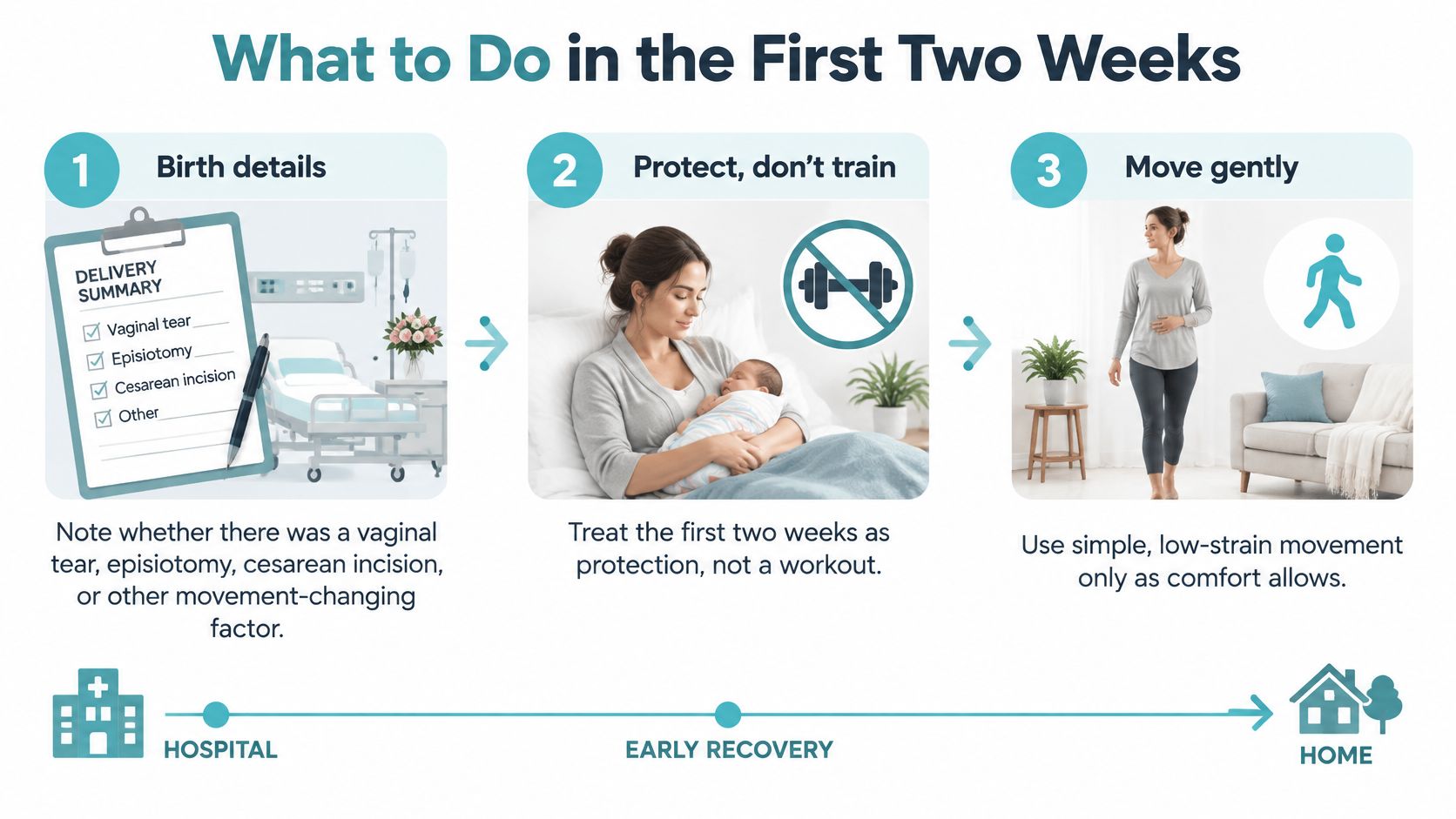
A hospital-to-home sequence
-
Write down the birth details. Note any vaginal tear, episiotomy, cesarean incision, forceps or vacuum delivery, and catheter use. Keep your discharge instructions accessible, especially instructions about wounds, bladder emptying, and activity restrictions.
-
Make comfort supplies easy to reach. A peri bottle can help you cleanse tender external tissues without rubbing. Use pads and wrapped cold packs according to your discharge guidance, never ice directly against skin. Roll onto your side before pushing up from bed rather than pulling straight through a sore abdomen.
-
Practice quiet breathing without forcing a squeeze. In a supported position, let your belly and lower ribs soften as you inhale. Exhale easily and allow a gentle recoil rather than pushing down or gripping hard. Stop if you feel more pain or pressure.
-
Break movement into manageable outings. Walk around the room or along level ground as comfort allows instead of testing how far you can go. When feeding, support your feet and bring the baby toward you with pillows rather than staying hunched or perched on your tailbone.
-
Make toilet visits unhurried. Follow your discharge plan for regular bladder emptying, particularly if bladder sensation feels altered. For bowel movements, support your feet on a footstool and breathe out rather than strain. Difficulty passing urine needs medical attention, not more pushing.
-
Act on warning signs. Contact your birth provider promptly for fever, suddenly increasing bleeding, inability to urinate, or steadily worsening pain. Heavy bleeding, faintness, severe pain, or feeling acutely unwell may require emergency assessment.
Let practical help protect your rest
Help at home is most useful when it removes a specific physical demand. Someone can bring the baby to you, refill water, prepare food, or handle laundry while you concentrate on comfortable transfers and feeding.
If you're arranging support, Superstar Nannies explains how maternity nurses support new parents. Understanding the role can help you ask for practical assistance without confusing household support with medical or rehabilitation care.
An adequate early recovery day might mean moving around your home without holding your breath, finding a comfortable feeding position, and finishing time upright without a new bulge. After a cesarean, use the same gentle approach while protecting the incision from pulling and following surgical restrictions.
How to Rebuild a Contraction You Can Relax
Squeezing a pelvic floor that can't let go can add discomfort without improving control. A useful contraction has a beginning and an end: you can create a small lift, keep breathing, and return fully to rest.
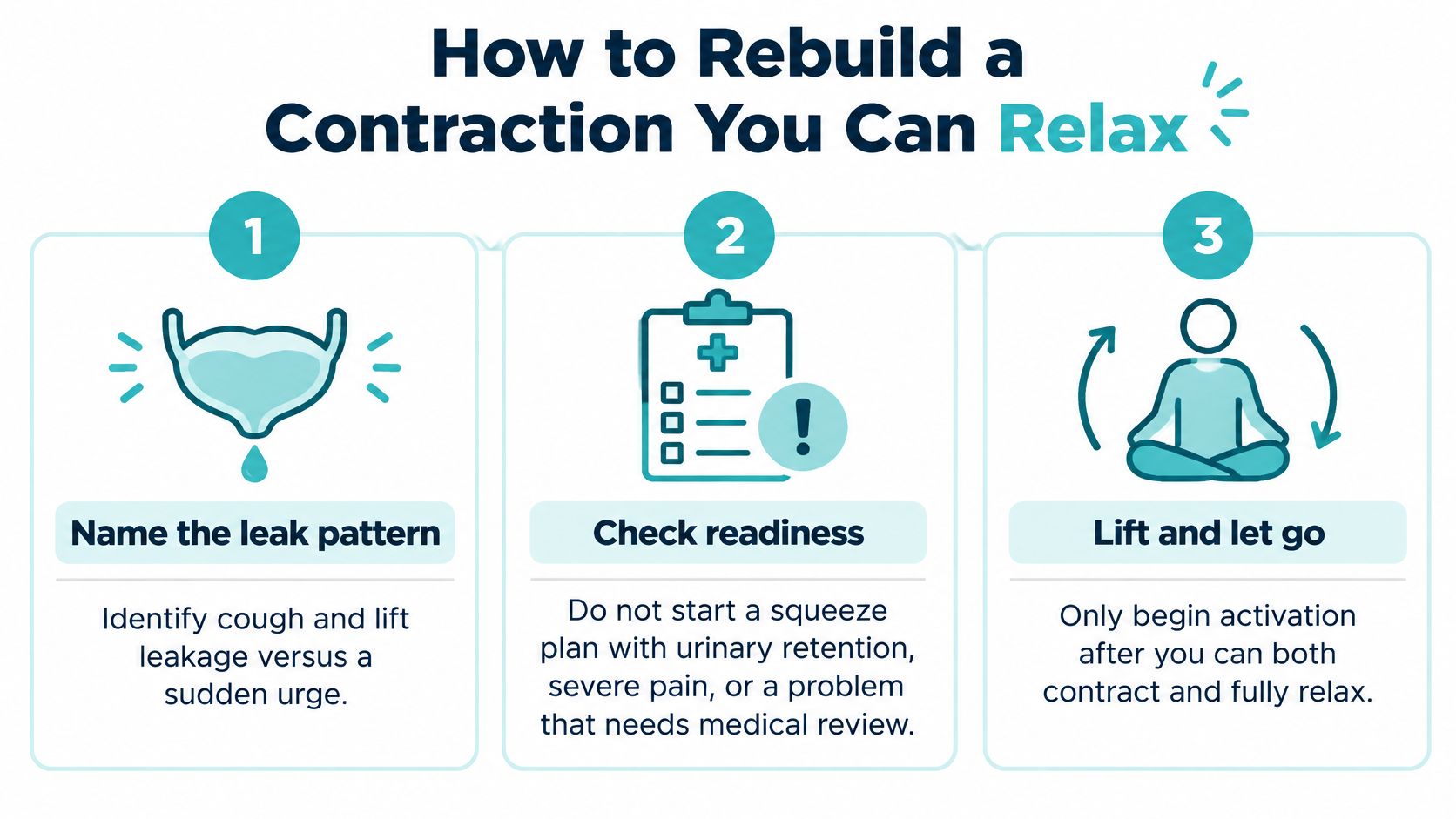
Build control before adding effort
-
Name the leak pattern. Leakage with a cough or lift is different from a sudden urge you can't defer. Don't start a strengthening routine when you have urinary retention, severe pain, or a painful wound that needs examination.
-
Find a small inward lift. Lie on your side with your knees comfortably bent. Gently imagine closing around the vaginal and anal openings and lifting inward. Your buttocks shouldn't clamp together, and you shouldn't need a forceful abdominal brace.
-
Check the release. After the contraction, notice whether the muscles return to their starting point. If you keep gripping or feel uncertain about the release, prioritize supported breathing and arrange an assessment rather than adding longer holds.
-
Use the hold you can perform well. Start with a brief, comfortable contraction and enough rest to release completely. End the set when the lift becomes unclear, you hold your breath, or you begin pushing downward. A clinician can set the duration and repetitions from your actual endurance.
-
Connect it to a useful task. Once you can lift and release reliably, coordinate a gentle contraction with exhalation during a sit-to-stand. The aim is a well-timed response, not keeping your pelvic floor clenched all day.
-
Progress without losing quality. Longer holds, quicker contractions, and more demanding positions belong in the plan only when control remains comfortable and symptoms are stable.
This is motor learning, not muscle effort alone. Our explanation of motor control training describes why learning how and when to recruit a muscle matters alongside strength.
When feedback helps
In a randomized clinical trial published in JAMA Network Open, 452 women with postpartum stress urinary incontinence received treatment, and after three months, self-reported cure was 20.2% with pressure-mediated biofeedback plus pelvic-floor muscle training, compared with 8.7% in the control group. That supports biofeedback as a possible addition to individualized treatment, not a guarantee or a reason everyone needs a device.
Biofeedback gives you information about a contraction that can otherwise be difficult to sense. A clinician still needs to interpret the result alongside relaxation, pain, and everyday function.
A clinical review summarizing WHO guidance distinguishes treatment from prevention: routine postpartum pelvic-floor training isn't recommended as a universal preventive intervention for urinary or fecal incontinence, while women with stress urinary incontinence may benefit from exercises as treatment.
A harder squeeze isn't the only sign of progress. Fewer leaks, easier lifting, and a complete release matter too.
Leakage and Prolapse Need Different Plans
| Symptom | Often means | First action |
|---|---|---|
| Leak with cough, sneeze, lift, or exercise | Stress urinary incontinence | Individualized training coordinated with exhalation and planned reassessment |
| Sudden urge and not reaching the toilet | Urgency, sometimes associated with infection or bladder irritation | Review bladder timing and seek a medical check, not endless holds |
| Bulge, pressure, or heaviness worse by evening | Possible pelvic-organ prolapse symptoms | Adjust lifting and toileting strategies and arrange an examination |
| Cannot start urine or the bladder doesn't feel empty | Possible retention | Same-day medical care |
| Gas or stool leakage | Possible sphincter or bowel-control injury | Early pelvic-floor and obstetric review |
| Heavy bleeding, fever, severe pain, or a rapidly larger bulge | Possible complication | Urgent obstetric or emergency care |
These patterns can overlap. A person can have stress leakage and a painful, overactive pelvic floor, or urgency alongside difficulty emptying the bladder. The symptom table helps you choose a next step; it doesn't replace an examination.
Map pressure before prescribing holds
For a bulge or heaviness, record when it appears and what changes it. Does it develop after standing, settle when lying down, or worsen with constipation? Tell the clinician about the delivery, bowel symptoms, bladder emptying, and the activities you need to resume.
An examination can assess support and whether you can both lift and lengthen the pelvic floor. That distinction matters because a contraction performed as a downward push isn't useful strengthening. Repeatedly gripping already painful muscles can also make daily movement less comfortable.
Start with practical pressure-management skills:
- Bring the load close. Position the car seat near your body before lifting rather than reaching and twisting with it.
- Breathe through the effort. Let air out as you stand or lift instead of using a forceful, prolonged breath hold.
- Avoid bowel straining. Use supported feet and an unhurried position rather than repeatedly bearing down.
- Adjust the dose of standing. Alternate demanding upright tasks with supported rest when heaviness accumulates.
Be realistic about what training can change
A postpartum prolapse study published in the International Urogynecology Journal found that prolapse symptoms and bother generally decreased during the first postpartum year, but physiotherapist-led pelvic-floor training didn't change the measured outcomes. That's a reason to avoid promising that exercise will reverse anatomy.
It isn't a reason to abandon rehabilitation. Treatment can still address how you lift, tolerate activity, manage bowel demands, and respond when symptoms increase. Those are meaningful goals even when an anatomical measurement doesn't change.
Prolapse stage alone shouldn't decide whether running is safe or forbidden. The decision also needs symptom behavior, movement control, tissue healing, and the demands of the activity. Increasing heaviness is a reason to adjust the plan, while urinary retention, severe pain, heavy bleeding, or a rapidly worsening bulge requires prompt medical care.
Checks Before You Run Lift or Jump
A postpartum clearance visit doesn't test every demand of running, lifting, or jumping. Your body also needs to tolerate repeated loading and recover afterward.
A systematic review of postpartum physical-activity guidance found that recommendations differed: some advised immediate pelvic-floor exercises, while others recommended gradually resuming moderate activity after four to eight weeks. That variation is a reason to use a personalized progression rather than interpret a calendar date as universal readiness.
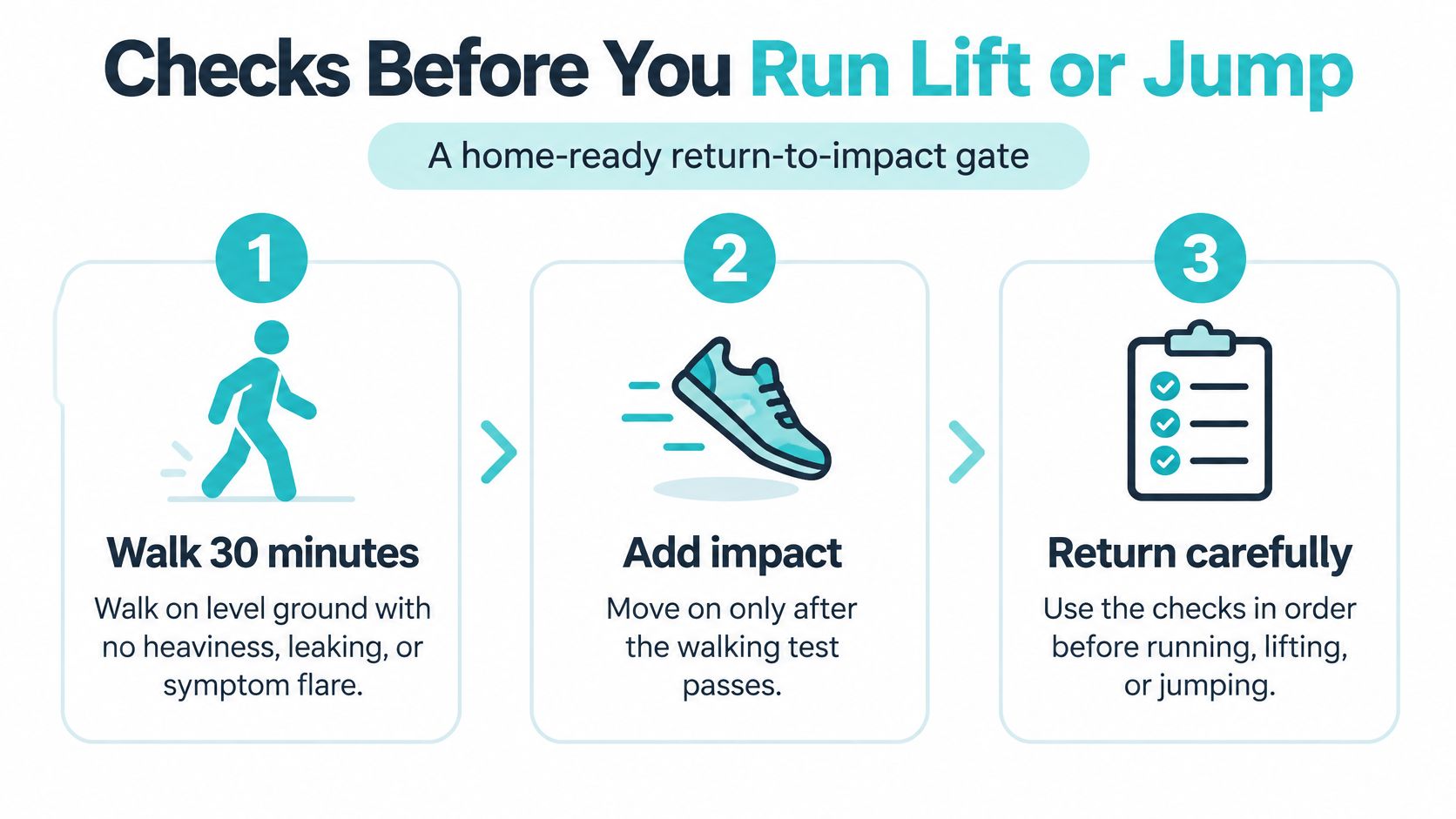
Use a symptom-based readiness gate
These checks are discussion tools for progression, not a validated home clearance test. Begin with comfortable level walking and ordinary daily tasks. Don't attempt impact while wounds, surgical restrictions, or symptoms make it inappropriate.
| Readiness check | Pass when | If it fails |
|---|---|---|
| Comfortable level walking | No leakage, heaviness, pain, or later symptom flare | Shorten the outing and rebuild tolerance |
| Cough, sneeze, or lift the carrier | No leak or bulge | Continue individualized strength and pressure-management work |
| Single-leg stand and slow sit-to-stand | Coordinated with an exhale, without breath-holding or symptoms | Add coordination drills |
| A few low jumps or a brief easy jog, when appropriate | No leakage, pressure, pain, bleeding, or worsening symptoms afterward or the next day | Return to the previous symptom-free stage and reassess |
Don't push through a failed check to prove you're ready. New bleeding needs medical guidance, and repeated leakage or pressure deserves assessment rather than repeated impact testing.
Know when not to self-progress
Get individualized guidance if you had an obstetric anal sphincter injury, your cesarean scar still limits getting up or turning, heaviness worsens through the day, or leakage occurs during ordinary activities. These situations require more information than a home movement check can provide.
Our guide to running after pregnancy can help you consider the demands of returning to that specific activity. A running plan should account for the pelvic floor as well as leg strength, stamina, and recovery.
For example, a runner may walk comfortably but leak during a small hop. Walking tolerance hasn't established impact tolerance. That runner should keep comfortable walking and appropriate strength work while addressing the failed check, rather than starting a race-training schedule or adding jog intervals that reproduce leakage.
When Sex Hurts After Delivery
Pain during sex is common after birth, but common doesn't mean you must endure it. A systematic review of women with obstetric anal sphincter injury found that 27–35% experienced dyspareunia, or painful intercourse, during the first postpartum year. That finding applies to that injury group, not to every woman after delivery.

Two symptoms can need two different treatments
Say you leak a little when sneezing and also can't tolerate penetration. It's tempting to treat both as weakness and add more Kegels. But a sensitive scar, difficulty relaxing, or protective tightening may contribute to pain even when you also need better continence control.
Early tenderness around healing tissue can occur. Pain that persists, worsens, prevents desired touch, or comes with constipation and pelvic tightness deserves evaluation. You don't need to wait for a deadline or repeatedly attempt painful penetration before asking for help.
A useful assessment separates possible contributors:
- Healing and scars. A medical examination can check the wound, while a pelvic-health assessment can explore scar sensitivity once the tissue is appropriately healed.
- Muscle relaxation. Treatment may start with comfortable breathing and learning to release protective tension rather than strengthening.
- Dryness and hormonal changes. Lubrication may help comfort. Discuss persistent dryness and possible hormonal treatment with the clinician who knows your medical history and feeding plan.
- Fear and sensitivity. A graded return to touch should stay within a comfortable range, with your consent at every step. Penetration isn't a required milestone.
Let comfort set the pace
Venus Health Co.'s postpartum intimacy guidance for new mothers offers additional context for conversations about intimacy after delivery. Educational guidance can support those conversations, but persistent pain still needs individualized care.
Permission to resume sex isn't an instruction to tolerate pain.
Choose intimacy that feels comfortable and stop when discomfort begins rather than trying to push through it. Pain accompanied by fever, heavy bleeding, or a wound that opens needs obstetric care before scar work, exercises, or further attempts at penetration.
See a Pelvic Floor Therapist If Progress Stalls
Book an assessment when symptoms keep limiting ordinary life, even if you're unsure whether they count as serious. Daily leakage, heaviness that limits standing or lifting, painful sex, gas or stool leakage, and repeatedly unsuccessful returns to exercise are all reasonable reasons to seek care.
You don't have to complete a generic home program first. An assessment is particularly useful when you can't tell whether you're lifting or bearing down, can't release a contraction, or feel worse after exercises.
What an assessment should clarify
A pelvic-health clinician can review your birth history, symptoms, and goals, then assess movement, breathing, contraction, relaxation, and relevant scars. Any internal examination should be explained and performed only with your informed consent; you can decline or stop it.
Bring practical information:
- Your main limitation. Name the task you want back, such as carrying your baby comfortably or returning to running.
- Your symptom pattern. Note triggers, what helps, and whether symptoms worsen later.
- Your recovery details. Bring information about tears, surgery, wound concerns, and current medical restrictions.
At Lake City Physical Therapy, we offer Prenatal & Postpartum Physical Therapy, including pelvic-floor care for prolapse, incontinence, and painful sex. The purpose is to replace guesswork with a plan matched to what you can currently do and what needs attention.
This week, choose the stage that matches your symptoms, keep warning signs accessible, and book an assessment if you're stalled or uncertain. Don't delay medical care for a red flag while waiting for a therapy appointment.
We offer prenatal and postpartum rehabilitation to help you address leakage, pelvic pressure, painful sex, and difficulties returning to activity. Visit Lake City Physical Therapy to arrange an assessment and build a recovery plan around your symptoms, healing, and goals.

