Pelvic Floor Pain: Causes, Symptoms and Treatment
About 1 in 7 women of childbearing age in the United States, approximately 14%, experience pelvic pain lasting more than 6 months, the duration threshold used by the U.S. National Institutes of Health for chronic pelvic pain affecting quality of life, according to its chronic pelvic pain clinical summary. That estimate describes chronic pelvic pain broadly, not pain proven to come only from pelvic floor muscles.
The distinction matters. Pelvic pain isn't automatically a sign of weak muscles, and a normal scan doesn't mean you're imagining it.
What Pelvic Floor Pain Is and Why It Is Common
Pelvic floor pain can feel like an ache, pressure, burning or sharp pain around the pelvis, perineum, genitals, bladder or rectum. Pelvic floor muscles and nerves may contribute directly, or the muscles may become protective and tense in response to pain from nearby organs.
Think of the pelvic floor as a hammock slung beneath the pelvic organs. It supports those organs while helping you control urine and stool, participate in sexual activity and manage pressure during movement. The muscles need to tighten when appropriate and release when appropriate.
Why symptoms can feel disconnected
Say you notice burning with penetration, difficulty emptying your bowels and an ache after sitting at work. You might assume these are separate problems requiring separate appointments. They can be connected through muscle guarding, sensitive nerves or an overlapping bladder, bowel or gynecologic condition.
The same person may therefore move between clinics without getting a complete explanation. A urinary symptom doesn't exclude a muscular contribution, and muscle tenderness doesn't rule out endometriosis.
A consultation should make room for that whole picture.
Your pain deserves attention even when its cause isn't obvious on the first examination.
A useful starting point is to identify what provokes pain, where you feel it and how it changes your daily life. Those details help a clinician choose an assessment and treatment plan rather than defaulting to strengthening exercises. Many contributors are treatable, although improvement may require coordinated care rather than a single intervention.
Match Your Symptoms to a Likely Pattern
| Symptom or trigger | Pattern it often suggests | First question to ask |
|---|---|---|
| Pain with penetration or tampon use | High muscle tone or vulvodynia-type pattern | Does the pain start at the entrance or feel deep inside? |
| Pain while sitting for long periods | Muscle overactivity or myofascial pain | Does it ease when you stand and shift your weight? |
| Pain or urgency with urination | Bladder pain syndrome or high-tone dysfunction | Does pain increase as the bladder fills? |
| Pain with bowel movements or straining | Constipation-linked or high-tone dysfunction | Do you strain, or feel you cannot fully empty? |
| Pain that worsens with running or lifting | Muscle guarding or pelvic overload | Does pain return after activity? |
| Cyclical pain with periods or deep pain with sex | Possible endometriosis overlap | Does the pain follow your menstrual cycle? |
| Constant pain with no clear trigger that persists for months | Persistent pelvic pain with possible sensitization | Has pain persisted despite normal test results? |
This is a starting map, not a diagnosis. Each row suggests questions worth asking, not proof of a particular condition.
Entrance pain during penetration can involve vulvar sensitivity, skin irritation or protective muscle tightening. Sitting-related pain may involve muscles, the tailbone or nerves, especially if changing position alters it. Urinary pain requires medical assessment for causes such as infection before assuming bladder pain syndrome.
Read the pattern, not just the location
Pain during bowel movements makes stool consistency, straining and muscle relaxation relevant. Exercise-related pain raises questions about loading, breathing and recovery, but it doesn't prove that your pelvic floor is weak.
Cycle-linked pain or deep pain during sex warrants discussion of gynecologic contributors. Persistent pain without an obvious trigger may involve increased pain sensitivity, but normal tests alone don't establish central sensitization.
Track the triggers you notice most, using a phone note or paper diary. Describe entrance pain separately from deeper pain, without trying to assign either one a diagnosis.
Bring useful details: Note whether pain begins during an activity, immediately afterward or later, and what helps it settle.
Matching several rows is common because the bladder, bowel, reproductive organs and pelvic muscles share close anatomical and nervous-system connections. Bring your matched rows and observations to a clinician who can interpret them together.
What Drives Pelvic Floor Pain and Its Overlapping Conditions
Muscles, nerves and organs can contribute together
The same pelvic ache can arise from muscle that will not release, a nerve that fires too easily, or a nearby organ condition that keeps the whole region on guard. Because these drivers overlap, the useful first step is matching the pattern rather than assuming the muscles are weak.
High-tone dysfunction means the pelvic floor has difficulty releasing its resting tension. It works like a fist kept clenched all day: the muscles grow tired and tender even though they are working hard. Tight muscles can also be weak or poorly coordinated, so a clinician who finds tension still has to test strength and control before recommending any exercise.
Myofascial pain involves the muscles and their surrounding connective tissue, often felt as tender points that reproduce familiar pain when pressed. In a 2024 U.S. population-based cohort, roughly 10% of adult women had moderate-to-severe pelvic floor myofascial pain on examination, a finding reported in an International Continence Society abstract.
Nerve-related pain feels different from muscle tenderness, although the two often coexist. An irritated nerve may produce burning, shooting pain or sensitivity to pressure. With sensitization, the nervous system behaves like an overly sensitive smoke detector, and normal touch or movement can hurt more than expected.
Endometriosis involves tissue similar to the uterine lining growing outside the uterus. It can irritate nearby structures while surrounding muscles tighten protectively, which is one reason muscular and gynecologic drivers so often travel together.
None of these drivers rules out the others.
The illustration below separates them without treating them as isolated problems.
Overlap changes the care plan
| Overlapping condition | Documented overlap | What it means for care |
|---|---|---|
| Endometriosis | Can occur alongside chronic pelvic pain and protective muscle guarding | Gynecologic evaluation may be needed alongside physical therapy |
| Irritable bowel syndrome | Can coexist with chronic pelvic pain | Bowel habits and muscle tension need joint attention |
| Bladder pain syndrome | Bladder symptoms and chronic pelvic pain frequently coexist | Urology input and bladder-focused treatment may be needed |
| High-tone pelvic floor dysfunction | Elevated resting tone can accompany chronic pelvic pain | Relaxation and coordination may matter more than strengthening alone |
| Pelvic floor myofascial pain | Muscle tenderness can accompany persistent pelvic pain and interstitial cystitis | Carefully selected manual therapy may be included |
For a closer look at increased muscle tone, this guide to a hypertonic pelvic floor describes the muscular pattern in more detail.
Routine imaging and laboratory tests do not measure every aspect of muscle function or pain processing. Muscles and nerves can stay sensitive after an initial trigger settles, so pain can persist without a visible structural abnormality. New or changing symptoms still deserve investigation.
Stress and poor sleep can raise guarding and pain sensitivity without being the sole cause. If you regularly feel keyed up, this piece on what causes that constant uneasy feeling explains the mental health side of that pattern while your pelvic symptoms are assessed in their own right.
How Clinicians Assess Pelvic Floor Pain
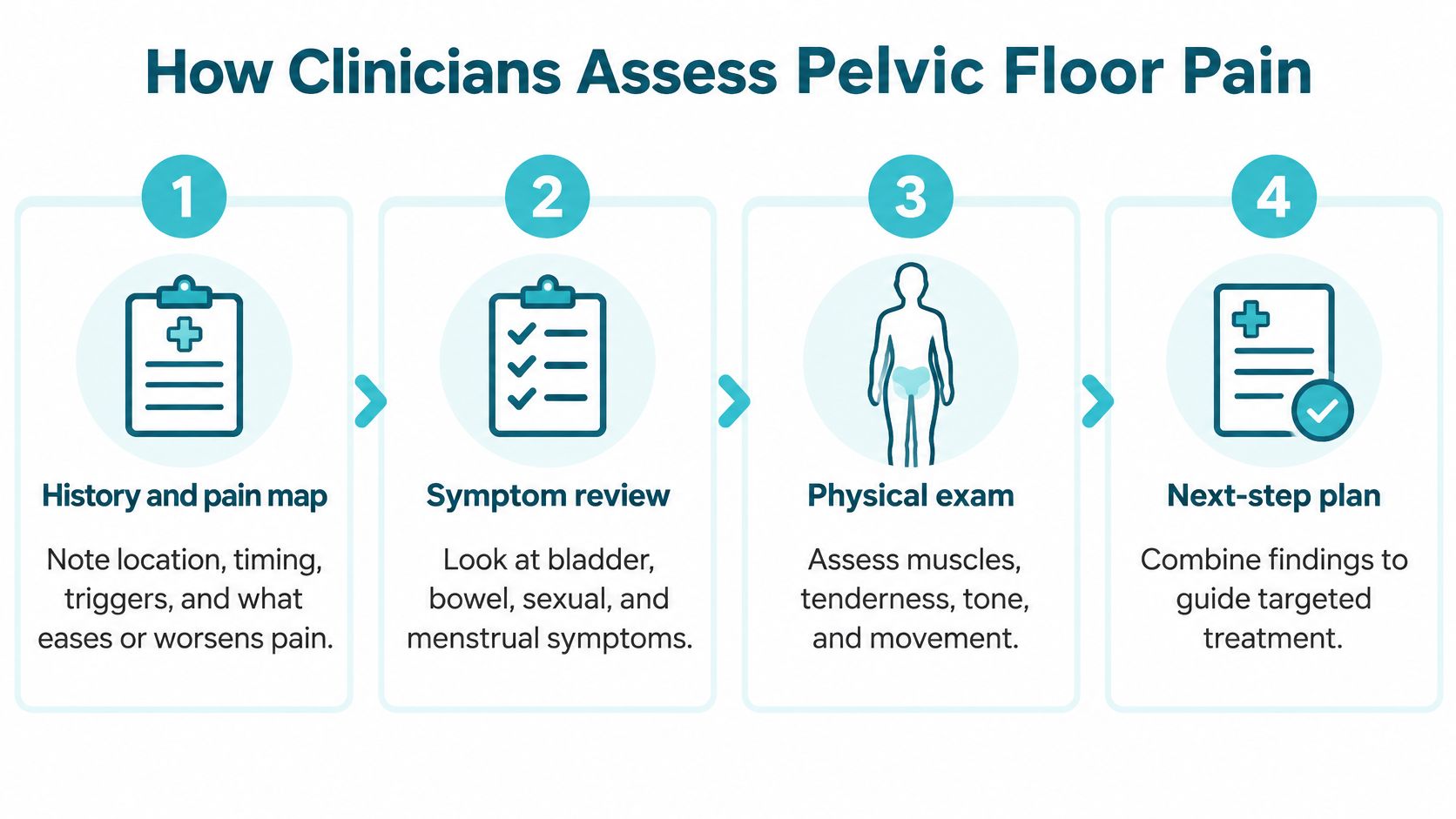
Assessment is a sequence of conversations and examinations, not a single test. The clinician should explain what each part can establish and what remains uncertain.
- Take a history and create a pain map. Identify location, timing, triggers and relieving factors. Include menstrual patterns, childbirth, surgery and the activities you've stopped because of pain.
- Review symptoms systematically. A questionnaire can organize bladder, bowel, sexual and activity-related symptoms. It helps identify concerns that might otherwise go unmentioned.
- Examine movement and breathing. The therapist checks the hips, lower back, abdomen and relevant movement tasks. This helps identify contributors outside the pelvic floor.
- Offer an internal examination with consent. A trained clinician may assess muscle tenderness, resting tone and sensitive areas through a vaginal or rectal examination when appropriate. You can decline, postpone or stop it.
- Check contraction and release. The clinician assesses whether the muscles can tighten, then soften and lengthen. Strength alone doesn't describe their function.
- Choose further testing or referral. Findings may warrant medical assessment, urine testing, imaging or specialist input for gynecologic, bladder or bowel concerns.
What screening can and can't establish
A systematic review described in this clinical review of chronic pelvic pain found that a central-sensitization screening score had 34.8% sensitivity and 84.9% specificity for pelvic floor myofascial pain compared with the reference examination. In practical terms, that screening score missed many people whose examination identified muscle pain.
A questionnaire therefore can't settle the diagnosis by itself. The clinician needs to combine symptoms, muscle findings and possible overlapping conditions.
This visual summarizes the broader assessment process.
Bring your diary, medication list and previous test results. Reviewing what happens during a pelvic floor exam can help you prepare questions and discuss your preferences before any hands-on assessment.
Evidence-Based Treatments and Who Benefits From Each
| Treatment option | Best suited for | What the evidence shows |
|---|---|---|
| Pelvic floor physical therapy | High-tone dysfunction, vulvodynia, bladder pain syndrome and selected mixed patterns | First-line for the named high-tone and pain conditions; outcomes are discussed below |
| Internal and external manual therapy | Myofascial tenderness and sensitive muscle areas | Usually part of a combined plan; isolated effects are difficult to separate |
| Pain education and graded exposure | Persistent pain with sensitivity and activity avoidance | Supports understanding and gradual activity; pooled effect size isn't established here |
| Breathing and relaxation coordination | Guarding during sex, urination or bowel movements | Commonly included in therapy; standalone effect size isn't established here |
| Medical or procedural referral | Endometriosis, bladder or bowel contributors, severe or refractory pain | Treatment and expected benefit must be matched to the diagnosis |
| Multidisciplinary pain care | Pain accompanied by sleep, mood or sexual distress | Combines relevant disciplines; no numerical outcome comparison is established here |
Treatment planning should be a conversation about the likely contributors, your comfort and your goals.

A review of multidimensional pelvic pain care describes pelvic floor therapy as first-line for high-tone dysfunction, vulvodynia and bladder pain syndrome, with reported studies associating treatment with approximately 38%–70% reductions in noncyclic pelvic pain and meaningful relief for about 60%–80% of patients after a full course. The studies are generally small and outcomes differ, so these ranges aren't a personal forecast.
Match the technique to the finding
For an overactive pelvic floor, therapy often begins with release, breathing and coordination. Repeated Kegels may worsen symptoms when they add contraction to muscles that aren't releasing well; strengthening is introduced when the assessment supports it.
Manual therapy involves carefully paced hands-on work around tender muscles, sometimes internally and sometimes externally. It should be consent-based and paired with movement or functional practice, not performed aggressively to force a release.
Pain education explains why pain intensity isn't always a direct measure of tissue damage. Graded exposure then helps you rebuild tolerance through manageable activities, such as shorter walks or modified lifting, without repeatedly provoking a major flare.
This video can support a discussion with your therapist about pelvic floor treatment.
Know when another discipline is needed
An OB/GYN can evaluate suspected endometriosis; a urologist can assess bladder contributors; a gastroenterologist can address bowel disease. A multidisciplinary pain team may help when pain remains disabling despite targeted care.
Treatment principle: No single exercise, manual technique or procedure fits every pelvic pain pattern.
Self-Management Steps to Start This Week
Choose gentle changes that reduce aggravation without turning recovery into another demanding task. Stop an activity that causes sharp pain, new symptoms or a sustained worsening.
- Record a usable diary. Write down the trigger, location, mild or severe intensity, bladder and bowel symptoms, and what helped. Include practical effects such as leaving work early or avoiding intimacy.
- Practice unforced breathing. Lie supported on your back or side and let your belly and lower ribs expand as you inhale. Allow the pelvic floor to soften rather than pushing downward.
- Exhale during effort. Breathe out while lifting groceries or getting up from a chair. This can reduce unnecessary breath-holding and bracing.
- Try comfortable warmth. Use a warm bath or a wrapped warm pack to ease guarding. Keep the temperature gentle, check your skin and don't sleep with a heating pad.
- Change your sitting position. Stand, walk briefly or adjust your support before discomfort builds. Avoid relying on a rigid posture all day.
- Make bowel emptying easier. Support your feet on a small stool, lean forward and breathe instead of forcing. Discuss persistent constipation with a clinician, particularly if fiber worsens bloating.
- Pause provocative exercises. Set aside repeated Kegels, forceful stretching or heavy strengthening that increases pain until your muscle pattern has been assessed.
- Modify rather than abandon movement. Shorten a run, reduce lifting load or choose comfortable walking during a flare. Build back according to symptoms and recovery.
Be cautious with products marketed for relief
Supplements aren't a substitute for identifying the cause of pelvic floor pain. Eve's Eden offers a resource on checking supplement doses and medication interactions; confirm safety with a pharmacist or prescribing clinician, especially during pregnancy or cancer treatment.
Self-care can support treatment, but persistent or recurrent pain still deserves an assessment. You don't need to exhaust every home remedy before asking for help.
Book a Pelvic Floor Assessment When Symptoms Persist
Sudden severe pelvic pain needs urgent medical evaluation, especially with fainting, vomiting, possible pregnancy or heavy bleeding. Fever, blood in urine or stool, and unexplained weight loss also need prompt medical assessment rather than a routine therapy appointment.
Reasons to arrange an assessment
- Daily disruption: Pain affects sitting, sleep, work, exercise or relationships.
- Sexual pain: Penetration or tampon use hurts, even if you've been told to tolerate it.
- Bladder or bowel changes: Pain accompanies urgency, difficult emptying or altered bowel habits.
- Worsening cycle-linked pain: Period-related symptoms are increasing or limiting activity.
- Unresolved symptoms: Pain continues despite reassuring tests or previous treatment.
A global review of chronic pelvic pain reports that only about 40% of women with chronic pelvic pain seek medical help, while endometriosis-related diagnostic delays commonly span 4–11 years. You don't need to wait until pain meets a chronic-pain definition before seeking care.
Bring your diary and ask what supports the proposed diagnosis, which contributors remain unexplored and when referral is appropriate. Useful questions include whether endometriosis, bladder or bowel conditions, and pelvic muscle tone have each been considered.
You shouldn't have to demonstrate exceptional persistence to receive respectful listening and an appropriate referral.
Dismissal and bias can interfere with care, including for Black women. If concerns aren't addressed, request a clear follow-up plan or another opinion.
One local option is Lake City Physical Therapy, which offers pelvic floor assessment, telehealth and online scheduling through its appointment website, with clinics in Coeur d'Alene, Hayden, Post Falls, Rathdrum, Liberty Lake, Spokane South Hill, Eagle and Boise.
Pelvic Floor Pain in Men, Postpartum and Other Groups
Pelvic floor pain isn't limited to adult women, even though much of the available evidence focuses on them. Men can experience pain involving the pelvic muscles, bladder, rectum or prostate region, including pain after ejaculation, urinary urgency or discomfort while sitting.
These symptoms need medical assessment rather than an automatic assumption of infection or a muscular cause. Sudden severe testicular pain requires emergency evaluation.
Pregnancy and postpartum recovery need context
During pregnancy, pelvic girdle strain can contribute to pain around the pelvis, hips or pubic area. After childbirth, perineal injury, scar sensitivity, abdominal recovery and protective muscle guarding may each influence symptoms.
Tell your clinician whether pain started during pregnancy or after delivery, and whether tears, an episiotomy or a caesarean birth have been reviewed. A guide to postpartum pelvic floor physical therapy can help you understand how rehabilitation is adapted to your recovery.
- Share surgical history: Pelvic or abdominal operations can affect scar mobility and movement tolerance.
- Mention cancer treatment: Radiation, surgery and hormonal treatments can alter tissue sensitivity and the rehabilitation plan.
- Describe hormonal symptoms: Dryness or irritation may require medical treatment alongside therapy.
- Prioritize warning signs: Heavy bleeding, fever or sudden severe pain should be evaluated before starting rehabilitation.
Care should also respect your anatomy, gender identity, examination preferences and treatment history. The right plan considers your circumstances rather than applying results from another population without qualification.
Lake City Physical Therapy offers individualized pelvic floor rehabilitation, including guided exercise, hands-on treatment and education for pelvic pain. Visit Lake City Physical Therapy to schedule an assessment and discuss an in-person or telehealth plan suited to your symptoms.

