Pelvic Floor Therapy Benefits: Reclaim Your Health in 2026
You cough, laugh, or pick up your child and feel a leak. Or you notice a heavy, dragging pressure by the end of the day. Maybe intimacy has become uncomfortable, and you've started wondering if this is just something you have to live with.
It isn't.
Many women wait a long time before talking about pelvic symptoms because the topic feels private, embarrassing, or hard to explain. Some assume it's normal after childbirth. Others think they should just do more Kegels and hope for the best. Many stay quiet.
You Are Not Alone in Your Pelvic Health Journey
If any of this sounds familiar, you're in very good company. Pelvic floor dysfunction affects approximately one in three U.S. women, and awareness is growing, with searches for "pelvic floor therapy" increasing by 56% over the past five years according to this overview of pelvic floor therapy trends and prevalence.
That matters for one simple reason. What you're feeling is common, and common problems deserve real care.
A woman might notice leaking when she jumps at a workout class. Another may feel pelvic pressure after standing all day at work. Someone else may be months or years postpartum and still not feel "back to normal." These experiences can look different on the surface, but they often share the same root area: the pelvic floor.
Pelvic floor physical therapy gives that area focused, evidence-based treatment. It isn't a last resort. For many women, it's a first step that helps them understand what their body is doing and what it needs.
You don't have to wait until symptoms become severe to get help.
For some people, one barrier is access to good health information. If medical websites feel hard to read, explore, or use, that can delay care. That's one reason broader conversations about digital accessibility in healthcare matter. Clear, usable information helps patients recognize symptoms earlier and feel more confident seeking treatment.
The good news is that pelvic health problems are often treatable. The even better news is that treatment is customized. Your therapy shouldn't look exactly like anyone else's because your symptoms, daily life, and goals are your own.
Understanding Your Pelvic Floor Muscles
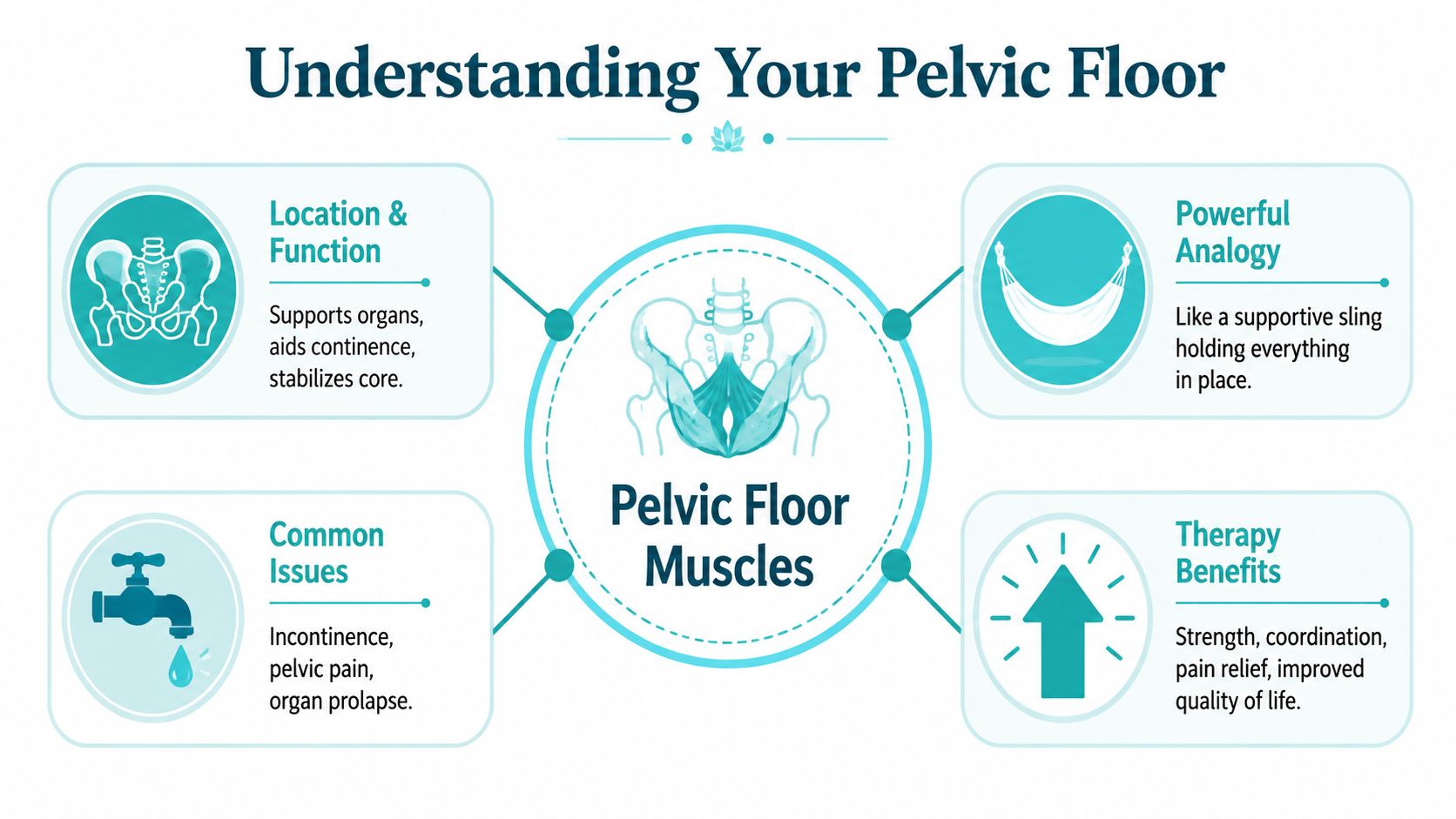
The pelvic floor is easier to understand when you stop thinking of it as a mysterious hidden area and start thinking of it as a supportive hammock at the bottom of your pelvis.
That hammock is made of muscles and connective tissue. It stretches from the pubic bone in the front to the tailbone in the back. It supports the bladder, bowel, and reproductive organs while helping them do their jobs well.
What these muscles do every day
The pelvic floor is often only considered important when there's leaking. It does much more than that.
Here are its three main jobs:
- Support: It helps hold up the bladder, uterus, and bowel.
- Continence: It helps you control when you urinate or have a bowel movement.
- Stability: It works with your deep abdominal and back muscles to support the core and spine.
If you want a deeper look at exercise basics, this guide on how to strengthen pelvic floor muscles can help explain common starting points.
Dysfunction doesn't always mean weakness
Many readers get stuck when they hear "pelvic floor problem" and assume the muscles must be weak.
Sometimes they are. Sometimes they aren't.
A hypotonic pelvic floor is underactive or weak. That can contribute to leaking, a feeling of heaviness, or reduced support.
A hypertonic pelvic floor is too tense and doesn't relax well. That can contribute to pelvic pain, constipation, trouble emptying the bladder, and pain with intimacy.
Practical rule: A muscle that can't relax isn't functioning well, even if it's strong.
That's why Kegels aren't a universal fix. If your muscles already hold too much tension, repeated squeezing may make symptoms worse instead of better. Good pelvic floor therapy benefits come from matching the treatment to the actual problem. Some patients need strengthening. Others need down-training, breathing work, manual therapy, or coordination training.
Coordination matters more than force alone
Think of the pelvic floor like part of a team. It needs to lift when support is needed, relax when elimination is needed, and coordinate with breathing, abdominal pressure, and movement.
If timing is off, symptoms show up. You may leak during a sneeze, feel pressure during a lift, or clench without realizing it during stress. Therapy helps retrain that timing, not just muscle power.
Proven Benefits of Pelvic Floor Therapy
Pelvic floor therapy benefits are often most noticeable in ordinary moments. You get through a workout without leaking. You sit through a meeting without pelvic pain. You stop planning your day around bathroom access. You feel more comfortable in your body again.
Research supports this approach. Pelvic floor physical therapy is a well-established, evidence-based first-line treatment. A meta-analysis found better outcomes for women receiving PFPT for pelvic organ prolapse, and studies also confirm statistically significant quality-of-life improvements in social activities, general health, and sexual function in this Stanford review of pelvic floor physical therapy in women.
Better bladder and bowel control
Many women first seek care because of urinary urgency or leakage. Others feel they can't fully empty their bladder or strain with bowel movements. Therapy can help by improving strength, relaxation, and coordination based on the specific pattern behind the symptom.
When the pelvic floor does its job at the right time, it supports continence without staying tense all day. That balance matters.
Less pain and more comfort
Pain isn't always discussed as openly as leakage, but it's a major reason people seek care. Tight pelvic floor muscles can contribute to pelvic pain, tailbone pain, discomfort with exams, and pain during sex.
For these patients, treatment often focuses less on "squeezing stronger" and more on reducing guarding, restoring tissue mobility, and teaching the nervous system that movement can feel safe again.
Pelvic floor therapy often helps by changing how muscles coordinate, not just by making them stronger.
Stronger core function in real life
The pelvic floor is part of the deep core system. It works with the diaphragm, abdominal wall, and back muscles during lifting, walking, running, and transitional movements like standing up from a chair.
This is why some women notice pelvic symptoms during exercise, carrying groceries, or returning to sport. Therapy can improve how pressure is managed through the trunk and pelvis so daily movement feels steadier and less threatening.
Sexual function and confidence
Pelvic health affects intimacy in ways many patients don't expect. If muscles are overactive, penetration may feel painful or guarded. If support and coordination are reduced, comfort and confidence may decline for different reasons.
Research showing quality-of-life gains in sexual function matters because it reflects something patients feel directly in their relationships, not just on a chart.
Pelvic Floor Therapy Benefits by Condition
| Condition | Primary Benefit of Therapy |
|---|---|
| Stress urinary incontinence | Improves support and timing during coughing, sneezing, lifting, and exercise |
| Urgency urinary symptoms | Helps retrain coordination, bladder habits, and muscle relaxation |
| Pelvic organ prolapse | Improves support strategies and symptom management |
| Pelvic pain | Reduces tension, guarding, and sensitivity |
| Pain with intimacy | Improves relaxation, tissue mobility, and muscle control |
| Postpartum pelvic dysfunction | Restores core and pelvic coordination for daily activity and exercise |
| Hypertonic pelvic floor dysfunction | Teaches lengthening and relaxation instead of constant gripping |
| Fecal incontinence | Improves control and awareness of pelvic floor function |
Not every benefit appears all at once. Progress usually builds step by step. That matters because sustainable change tends to come from repetition, skill, and a treatment plan that fits your body.
How Therapy Helps Women in Every Life Stage
The same symptom can mean different things in different seasons of life. A postpartum mother leaking on a walk doesn't need the same plan as a runner leaking on sprints. A woman recovering from cancer treatment may need scar mobility and swelling support, not just strengthening.
That is where pelvic floor therapy becomes personal.

Prenatal and postpartum mothers
A new mother may come in saying, "I know I should be happy, but I don't feel like myself." She leaks when she stands from the floor. Her abdomen feels disconnected. She avoids exercise because everything feels heavy.
Postpartum rehab often starts with simple things that don't look dramatic from the outside. Breathing. Pressure management. Learning how to coordinate the deep core again. Building back up to walking, lifting, and eventually higher-impact movement if that's the goal.
Some women need help preparing for birth. Others need support after a vaginal delivery or C-section. Many benefit from guidance on returning to exercise safely instead of guessing. This postpartum pelvic rehab resource on pelvic floor physical therapy after pregnancy gives a helpful overview of what that care can include.
Female athletes
Athletes often dismiss early symptoms. They think leaking during double-unders, sprint intervals, or heavy lifts is just part of training. It isn't.
For female athletes, pelvic therapy can address interconnected hip-pelvic dysfunction according to Johns Hopkins' overview of pelvic floor therapy. That matters because the pelvic floor doesn't work in isolation. Running, jumping, cutting, and lifting all depend on pressure control, load transfer, and coordinated motion through the trunk and pelvis.
A volleyball player may feel pelvic heaviness after tournaments. A CrossFit athlete may brace so hard that she creates too much downward pressure. A runner may have hip pain and urinary leakage that seem unrelated until movement assessment shows the connection.
Treatment often includes movement retraining, breathing during exertion, hip and trunk control work, and graded return to impact. The goal isn't only symptom reduction. It's getting back to performance with confidence.
Athletes usually do well when therapy matches the demands of their sport instead of stopping at basic exercises.
Women with prolapse or menopausal changes
Another patient may describe a bulging or dropping sensation by evening. She may feel pressure during chores, walking, or strength training. Often, the fear shows up before the pain. She worries that movement will make things worse.
Therapy can help her learn how to manage pressure, improve support, and move with less strain. That may include pelvic floor coordination, bowel and bladder strategies, lifting mechanics, and exercise modifications that keep her active rather than fearful.
For women in midlife or after menopause, tissues can feel different. Support may change. Recovery may feel slower. A good plan respects those changes without treating them as the end of activity.
Oncology patients
Cancer recovery changes the conversation. A woman may be dealing with fatigue, tenderness, scar tissue, swelling, and uncertainty about what exercise is safe. Her goals may include reaching overhead comfortably, walking without heaviness, or feeling more normal in her own skin.
Pelvic health and oncology rehab overlap more than many people realize. The Johns Hopkins resource notes that care can include scar mobilization post-mastectomy, reducing lymphedema by 25%, and that PFPT can reduce pain scores by 50 to 70% for conditions like endometriosis and dyspareunia. Those outcomes matter because pain, stiffness, and swelling can limit everyday life long after initial treatment ends.
In practice, oncology-focused pelvic therapy may include scar mobility work, breathing and pressure training, graded strengthening, and return-to-activity planning. The pace is individualized. The goal is not to rush recovery. It's to rebuild function safely.
What to Expect During Your Therapy Sessions
Many patients feel nervous before the first visit. That's understandable. Pelvic health is personal, and fear of the unknown keeps a lot of women from getting help.
A first appointment should feel respectful, clear, and collaborative.

The first visit
Your therapist starts by listening. You'll talk about symptoms, medical history, birth history if relevant, exercise habits, bowel and bladder patterns, pain, and goals. A useful visit isn't only about where it hurts. It's about when symptoms happen, what makes them better or worse, and what you want to get back to doing.
You can also review this patient guide to what to expect at pelvic floor therapy if you'd like a preview before your appointment.
The physical assessment may include posture, breathing, abdominal function, hip movement, and core coordination. Depending on your symptoms and your consent, it may also include an external and internal pelvic floor exam. Internal assessment is one tool, not a requirement for every visit, and you are always in control of what happens.
Your therapist should explain each step, ask permission, and adjust the plan if something doesn't feel right.
What treatment can include
Treatment depends on whether your muscles need support, relaxation, retraining, or a mix of all three.
Common parts of care include:
- Manual therapy: Gentle hands-on work to improve tissue mobility and reduce painful tension.
- Neuromuscular re-education: Training your muscles to contract, relax, and coordinate at the right time.
- Biofeedback: Technology that helps you see whether you're relaxing or engaging the right muscles.
- Home exercise practice: A short plan specific to your symptoms and daily routine.
Some treatment protocols include 8 to 12 weeks of training with 3 sets of 10 contractions daily, monitored with tools such as biofeedback or intravaginal dynamometry to help ensure proper technique and target strength gains of over 30%. This approach can reduce the need for surgical referrals by up to 40% according to this systematic review and meta-analysis on pelvic floor muscle training.
This video gives a simple visual introduction to pelvic floor exercise concepts.
What improvement usually feels like
Progress isn't always dramatic in week one. Often it starts with better awareness. You notice you can relax a clenching pattern. You feel less pressure on walks. You get through a workout with fewer symptoms. You feel less afraid of movement.
Those small wins matter because they add up to function. The goal isn't to perform perfect exercises in a clinic. The goal is to help your body work better in real life.
Choosing Your Pelvic Health Partner in Idaho and Washington
Not every physical therapist treats pelvic health, and not every clinic is set up for the level of privacy, specialization, and whole-person care these concerns deserve.
A general PT may be excellent at treating knees, shoulders, or low back pain. A pelvic health specialist has added training in pelvic floor assessment, internal and external treatment approaches, bowel and bladder dysfunction, pregnancy and postpartum recovery, pelvic pain, and related conditions that require more specific clinical reasoning.

Questions worth asking
Before booking, ask a few direct questions:
- Training: Does the therapist have focused pelvic health education and regular experience treating these issues?
- Population fit: Do they work with postpartum patients, athletes, prolapse cases, pelvic pain, or oncology recovery if that's relevant to you?
- Comfort and consent: How do they explain internal assessment and patient choice?
- Plan of care: Will treatment include home guidance, exercise progression, and return-to-activity planning?
If you're trying to compare providers online, it can help to understand how clinics show up in local search and what strong healthcare visibility looks like. While it's written for a different healthcare niche, this piece on local search strategies for chiropractic clinics offers useful context for evaluating whether a practice is easy to find, clearly described, and transparent about services.
What good care feels like
You should feel heard, not rushed. You should understand why you're doing each exercise or technique. You should leave with a plan that fits your life, whether you live near Coeur d'Alene, Spokane, Boise, or another community in the region.
The right pelvic health partner doesn't just treat symptoms. They help you reconnect symptoms to movement, recovery, and daily function so progress makes sense.
Frequently Asked Questions About Pelvic Floor Therapy
Is pelvic floor therapy painful
It shouldn't feel harsh or forced. Some techniques address tender areas, but treatment should be gentle, explained clearly, and adjusted to your comfort level. You can pause or decline any part of care.
How long does it take to see results
That depends on the symptom pattern, how long it's been present, and how consistently you practice your plan. Some people notice early changes in awareness or symptom control within the first few visits, while others improve more gradually over a longer course of care.
Do I need a referral from my doctor
That depends on your insurance plan and local direct access rules. Many patients can start physical therapy without a referral, but it still helps to keep your OB-GYN, primary care clinician, or specialist informed so your care team is coordinated.
Is pelvic floor therapy covered by insurance
Often yes, but coverage varies. The best next step is to ask the clinic what plans they accept and what your expected out-of-pocket costs may be before your first appointment.
If you're ready to stop guessing and start getting answers, Lake City Physical Therapy offers women's health-focused care for pelvic floor dysfunction, postpartum recovery, oncology rehabilitation, and women's sports physical therapy across North Idaho and Eastern Washington. Their team provides personalized, evidence-based treatment with convenient locations, telehealth options, and online scheduling so you can take the next step with clarity and support.