Pelvic Floor Therapy Covered by Insurance Guide
You call your insurer, hear that physical therapy is covered, and schedule an evaluation. Then the explanation of benefits arrives with a denial because the referral lacked the required wording, the clinic was out of network, or the plan treated an adjunct treatment as investigational. That experience is frustrating, but it doesn't mean pelvic floor therapy is never covered.
The practical answer is more useful than a yes or no. Pelvic floor therapy is generally billed as outpatient physical therapy when it's medically necessary, but payment depends on your payer, diagnosis, network status, authorization rules, and the exact service delivered. This guide gives you the questions to ask, the documentation to request, and the steps to take if a claim is denied. If you're arranging care without a referral, review Lake City Physical Therapy's referral information before scheduling.
Clinics also spend substantial time managing calls, referrals, and insurance questions. Practices looking for a better way to handle routine inquiries may find this guide to AI receptionist for spas useful, especially when staff need to protect time for patient care.
Is Pelvic Floor Therapy Covered by Insurance Right Now
You call your insurer before scheduling pelvic floor therapy and hear that physical therapy is covered. That answer still leaves important questions unanswered. Your plan may cover the evaluation and therapeutic exercise while excluding electrical stimulation, biofeedback, or another specific service. Coverage depends on the plan language, billing diagnosis, authorization status, network status, and modality.
Pelvic floor therapy is generally billed as outpatient physical therapy when medically necessary. Medicare Part B helps pay for medically necessary outpatient physical therapy, and the program does not impose an annual dollar cap on covered therapy services. After the Part B deductible, beneficiaries generally pay 20% coinsurance while Medicare pays 80% for covered services, according to Medicare's physical therapy coverage guidance.
Pelvic floor rehabilitation can qualify when it addresses a clinically indicated condition, such as urinary incontinence, prolapse, or postpartum dysfunction. Payment still requires supporting documentation, any required certification, and a billable service the plan recognizes. Lake City Physical Therapy can also explain its referral process if you are arranging care without one. Review the physical therapy without a referral information before booking.
Why the same diagnosis can produce different answers
Commercial plans often cover standard physical therapy but apply different rules for network participation, referrals, prior authorization, visit limits, and exclusions. Medicaid requirements vary by state and managed-care plan. A clinic may accept your insurer while a particular pelvic floor service requires separate approval.
Access is uneven as well. A 2026 secret shopper study of 200 pelvic floor physical therapy offices found that 70% accepted commercial insurance and 47% accepted Medicaid, while 26.6% accepted neither. The study also found that 58.5% reported a cash price for an initial visit, with a median of $190.62 and a range of $70 to $450. Both findings are reported in the study indexed by PubMed.
Before your first visit, ask your insurer to verify benefits for the diagnosis and each planned service. Confirm the therapist's network status and whether authorization is documented. Ask for the representative's name, call reference number, and any required referral or certification language.
Insurance acceptance is not guaranteed payment. Treat every verbal answer as information to verify, not a promise that the claim will be paid. Clinics also manage calls and routine insurance questions, and this guide to AI receptionist for spas may help practices protect staff time for patient care.
How Different Payers Handle Pelvic Floor Therapy Coverage
Your payer determines the starting rules, but the clinic's network status and the treatment plan determine what happens at the point of care. Medicare has a federal outpatient framework. Commercial insurance can offer broad benefits with narrow networks. Medicaid may cover therapy while imposing state or managed-care requirements that patients must confirm directly.

Payer Coverage Snapshot for Pelvic Floor Therapy
| Payer Type | Typical Coverage | Common Hurdles |
|---|---|---|
| Medicare Part B | Medically necessary outpatient physical therapy. After the deductible, Medicare generally pays 80% and the beneficiary pays 20% coinsurance. | Certification, documentation, covered-service rules, and any supplemental-plan details |
| Commercial insurance | Coverage often exists when the diagnosis and treatment meet plan requirements. | Network status, referrals, prior authorization, visit limits, diagnosis exclusions, and modality restrictions |
| Medicaid | Coverage depends on the state and the specific Medicaid plan. | Managed-care rules, referral requirements, authorization, network participation, and service limits |
Medicare's policy history also matters. On October 6, 2000, CMS issued a national coverage decision for biofeedback and pelvic floor electrical stimulation for urinary incontinence. That decision established a federal coverage framework that shaped later reimbursement for pelvic floor-related care, but it doesn't mean every stimulation service is payable under every current plan.
Commercial coverage looks broader on paper than it may feel in practice. A plan can list physical therapy as a benefit, yet the nearest pelvic floor specialist may be out of network. California offers a useful example of how state policy can change access. A state-level benefit review estimated that 99.9% of enrollees subject to AB 1904 already had coverage for pelvic floor physical therapy after pregnancy, showing how postpartum PFPT can become a near-universal covered benefit in a large market. The underlying findings are included in the PubMed-indexed coverage study.
What to confirm before choosing a payer route
Ask whether the provider is in network for your exact plan, not merely for the insurer's brand. Confirm whether pelvic floor therapy is processed under ordinary outpatient physical therapy benefits, whether your diagnosis is included, and whether the plan separates exercise-based treatment from electrical or electromagnetic modalities.
If your plan doesn't provide usable coverage, ask the clinic about its cash policy, superbills, or out-of-network claim process. Don't assume an out-of-network visit is reimbursable until your insurer explains how the deductible, reimbursement rules, and claim submission process work for your plan.
Billing Codes and Documentation That Determine Medical Necessity
Coverage starts with the diagnosis, but payment depends on the entire claim. The referral, evaluation, treatment plan, therapy codes, and progress notes need to tell the same clinical story. If the referral says one thing and the billed diagnosis suggests another, the payer has an easy reason to question medical necessity.
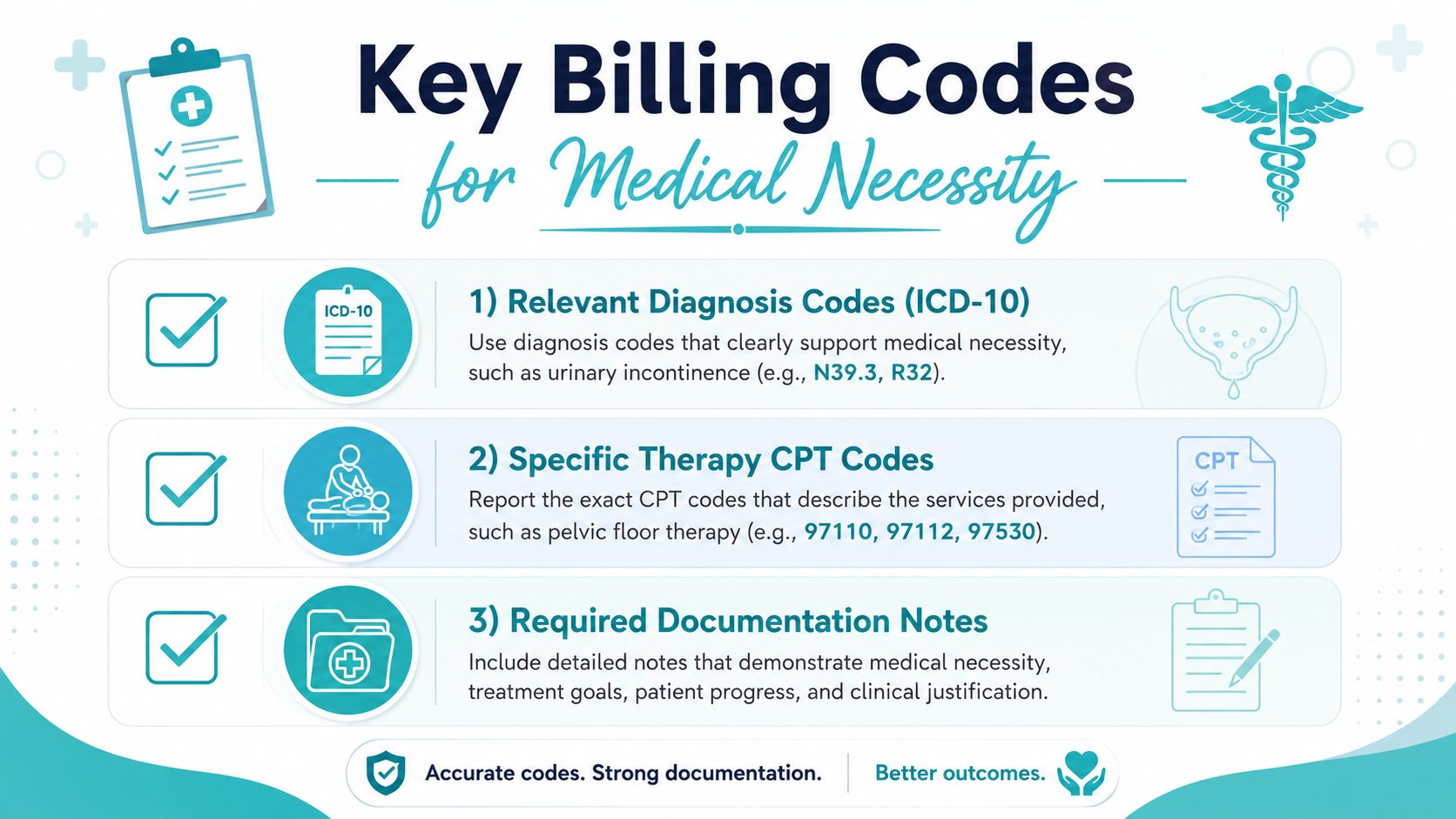
The claim needs a coherent clinical chain
Common medically relevant diagnoses include urinary incontinence, prolapse, dyspareunia, and postpartum dysfunction. A diagnosis alone isn't enough. The therapist's evaluation should connect the condition to functional limitations, identify measurable impairments, and explain why skilled therapy is appropriate.
The referral should use clinically accurate language that matches the reason for treatment. A referral for postpartum dysfunction shouldn't be paired with notes that only describe an unrelated musculoskeletal complaint. Ask your provider to review the diagnosis wording before the first visit, especially when the payer requires a referral or prior authorization.
A claim usually draws on three documentation layers:
- Relevant diagnosis information: The diagnosis should identify the condition being treated, such as urinary leakage or pelvic pain.
- Specific therapy services: The billed treatment should reflect what the therapist provided, including evaluation, therapeutic exercise, education, or other appropriate interventions.
- Required clinical notes: The record should show examination findings, goals, treatment response, and the reason continued skilled care is needed.
For patients, the important question isn't “Which code guarantees payment?” No code guarantees payment. Ask instead, “Does the documented diagnosis accurately describe my problem, and does the treatment plan directly address it?” You can also review Lake City Physical Therapy's insurance guide and patient intake forms before submitting information.
Why adjunct modalities create more denials
Exercise-based pelvic floor therapy, education, and supervised muscle training are more consistently recognized than certain adjunct treatments. APTA Pelvic Health notes that most major payers cover medically necessary pelvic health physical therapy for urinary incontinence, while electrical stimulation and electromagnetic therapy are often classified as not medically necessary or investigational. Some policies require prior authorization and documentation that pelvic muscle exercise was unsuccessful before they'll consider electrical stimulation.
That distinction matters. Your plan may cover the visit and the therapist's education while denying a specific device-based treatment. Review the treatment plan line by line and ask which services are included under your benefits before assuming every intervention carries the same coverage.
How to Verify Benefits and Secure Authorization Before Your First Visit
Benefit verification should happen before the appointment, not after the first denial. The clinic can check benefits, but you should also understand the answer well enough to spot missing details. Insurance representatives may confirm that physical therapy is covered without confirming your diagnosis, network status, authorization requirement, or service exclusions.

Use this exact insurance call script
Have your member ID, group number, provider name, clinic location, and expected diagnosis available. Then say:
“I'm calling to verify outpatient physical therapy benefits for medically necessary pelvic floor rehabilitation. Please confirm whether this service is covered for my plan, whether the provider is in network, and whether my diagnosis requires a referral or prior authorization.”
Follow with specific questions:
- “Is pelvic floor physical therapy processed under my outpatient physical therapy benefit?”
- “Is the clinic and treating therapist in network at the location where I'll receive care?”
- “Do I need a physician, nurse practitioner, physician assistant, or midwife referral?”
- “Is prior authorization required before the evaluation or before subsequent visits?”
- “Are there visit limits, diagnosis-specific exclusions, or separate rules for postpartum care?”
- “Are electrical stimulation or electromagnetic treatments covered, excluded, or considered investigational?”
- “What deductible, copay, or coinsurance applies?”
- “Can you give me the reference number for this benefit verification call?”
Write down the representative's name, the date, the reference number, and the exact department you reached. A verbal estimate isn't a payment guarantee, but a detailed record gives the clinic and your appeal reviewer a clear starting point.
The pre-visit checklist
Before confirming care, make sure these items are complete:
- Referral: The referral identifies the condition being treated and matches the planned therapy.
- Authorization: The plan has approved any required prior authorization, or the clinic has confirmed that authorization isn't required.
- Network status: You know whether the provider and location are in network.
- Cost responsibility: You understand how the deductible, copay, or coinsurance applies.
- Service limits: You know whether the plan limits visits or excludes particular modalities.
- Documentation: You have a copy or reference number for the insurer's response.
Missing pre-authorization is a frequent denial trigger. The patient may then face an unexpected bill even though the underlying diagnosis and therapy would otherwise qualify. Lake City Physical Therapy's insurance verification process is designed to collect payer information and clarify benefits before treatment begins, but patients should still confirm their own plan details.
This short video can help you understand the broader verification process before you call.
Keep your notes. If the insurer later contradicts the original answer, your call reference and authorization record can support a correction request.
Working With Lake City Physical Therapy Billing and Appealing Denials
A denial isn't the final answer. It's a decision tied to a specific claim, code, authorization issue, network rule, or documentation gap. The fastest path forward is to identify that exact reason instead of arguing generally that pelvic floor therapy should be covered.

Lake City Physical Therapy supports patients through locations in Coeur d'Alene, Hayden, Post Falls, Rathdrum, Liberty Lake, Spokane South Hill, Eagle, and Boise, along with telehealth options, online scheduling, and bill pay. Its billing workflow starts with collecting referral and insurance information, checking benefits, identifying authorization requirements, and aligning the documented diagnosis with the treatment plan.
Follow this denial workflow
First, request the complete explanation of benefits. Don't rely on a portal summary that only says “not covered.” Ask for the denial code, the claim number, the service date, the denied service, the reason for denial, and the deadline for appeal.
Next, compare the denial with your records. Check whether the issue was a missing referral, absent authorization, out-of-network processing, incorrect diagnosis, excluded modality, or insufficient progress documentation. The correction depends on the category.
Then, assemble the appeal packet. Include the explanation of benefits, referral, evaluation, relevant progress notes, treatment plan, authorization record, and a short letter explaining why the care is medically necessary for your documented condition. Tie each requested service to a functional problem, such as leakage, pelvic pressure, painful intercourse, or postpartum limitation.
If the payer still refuses the claim, request reconsideration or peer review according to the plan's process. Track every call, submission date, representative, reference number, and promised response. A billing team can help organize the documentation, but you should keep copies of everything you submit.
Appeal language should be specific: “The requested treatment addresses documented functional impairment associated with the patient's diagnosis and is part of a supervised plan of care.”
For clinics building stronger processes, resources focused on how to reduce physical therapy denials can help staff audit authorization, coding, and documentation steps before claims go out.
Keeping Your Coverage Active Through Results and Follow Up
Approval for the first visit doesn't guarantee approval for every later visit. Payers may require evidence that skilled care remains necessary, especially when the therapist requests continued authorization. Your progress notes need to show more than attendance. They should demonstrate what changed, what remains limited, and why the next phase of treatment is appropriate.
Supervised pelvic floor muscle training has a strong clinical rationale for urinary incontinence. A Cochrane review reported cure rates of RR 8.38 for stress urinary incontinence and cure-or-improvement of RR 17.33 compared with no treatment, with women receiving pelvic floor muscle training leaking less often and reporting better symptom scores, as documented in the Cochrane review indexed by PubMed.
Make progress visible
A therapist may use leakage episodes, pad tests, validated symptom scores, strength or coordination findings, functional goals, and home-program performance to document change. These measures help connect treatment to daily life and give an insurer concrete evidence for continued care.
The adherence challenge is operational, not solely clinical. A systematic review found long-term adherence ranging from 10% to 70%, long-term success among responders ranging from 41% to 85%, and loss to follow-up ranging from 0% to 39%. Those findings are reported in the systematic review indexed by PubMed.
Use a manageable home routine, record symptoms consistently, and bring the log to each visit. Tell your therapist when an exercise causes pain, confusion, or difficulty fitting into your day. Adjusting the plan early improves participation and gives the clinician a more accurate record of what you can perform.
Keep this follow-up list
- Attend scheduled visits: Missed care can interrupt both recovery and authorization documentation.
- Track meaningful symptoms: Record leakage, urgency, bowel symptoms, pain, or pressure in a consistent format.
- Complete the home program: Note what you performed and where you struggled.
- Ask about the next authorization: Don't wait until the last approved visit to find out whether more visits require review.
- Save every payer letter: Keep approvals, denials, explanations of benefits, and appeal decisions together.
Your strongest insurance position combines an accurate diagnosis, an authorized plan, consistent participation, and measurable progress. Start by calling your insurer with the script above, then give your referral and benefit details to the clinic before the first visit.
Lake City Physical Therapy provides women's health pelvic floor evaluations, referral and insurance verification support, billing guidance, and care across North Idaho, Eastern Washington, Eagle, and Boise, with telehealth options available. Visit Lake City Physical Therapy to review services, schedule care, and take the next step toward treatment with fewer billing surprises.