Pelvic Floor Therapy Online: Is Virtual PT Right for You?
You may be reading this because something feels off, but life keeps moving. Maybe you leak when you run or sneeze. Maybe sex has become painful. Maybe you're postpartum, your core feels disconnected, and the idea of finding childcare, driving across town, and sitting in a waiting room for pelvic therapy sounds impossible.
That's exactly why pelvic floor therapy online has become such an important option. For many people, the problem isn't motivation. It's access, timing, privacy, and the simple reality that pelvic health care can be hard to find.
The Private Struggle and the Promise of Virtual Care
Pelvic floor symptoms are common, but that doesn't make them easy to talk about. Many people wait months or years before getting help because they're busy, embarrassed, unsure where to start, or convinced they should just live with it. In practice, those delays matter. Symptoms often become more frustrating when people keep guessing, overdoing Kegels, or avoiding movement altogether.
The access problem is real, not imagined. One pelvic health industry report states that about 40 million women need pelvic floor physical therapy, one in three U.S. women experiences pelvic floor disorders each year, and there are fewer than 10,000 providers available to meet that need, which helps explain why telehealth has become such an important bridge for care in that report on pelvic health demand and access.
Why virtual care matters
Online pelvic floor therapy isn't just a backup plan for people who can't get into a clinic. It solves specific problems that regularly keep patients from starting care at all:
- Distance gets removed. If the nearest pelvic health specialist is far away, virtual visits make expert care possible without the commute.
- Privacy improves. Some patients feel more comfortable learning about bladder, bowel, or sexual pain symptoms from home.
- Follow-through gets easier. Consistency matters in rehab. It's often easier to keep appointments when you don't have to arrange travel, childcare, or time off work.
- Real life becomes visible. Therapists can see your home setup, how you lift your baby, where you sit for work, or how you brace during daily tasks.
Many patients don't need more willpower. They need a care model that fits real life.
Pelvic health care is also growing as a telehealth field because more clinicians are choosing to build remote services into their practice. If you're curious how that side of care delivery is evolving, you can explore virtual PT job openings, which gives a useful look at how telehealth physical therapy is being staffed.
What this means for you
Virtual care works best when it's treated as real physical therapy, not a quick advice call. You still need an evaluation. You still need a plan. You still need progression, troubleshooting, and accountability.
For the right patient, though, online care can remove the biggest barrier of all. Getting started.
How Effective Is Online Pelvic Floor Therapy
The biggest question most patients ask is simple. Does it work?
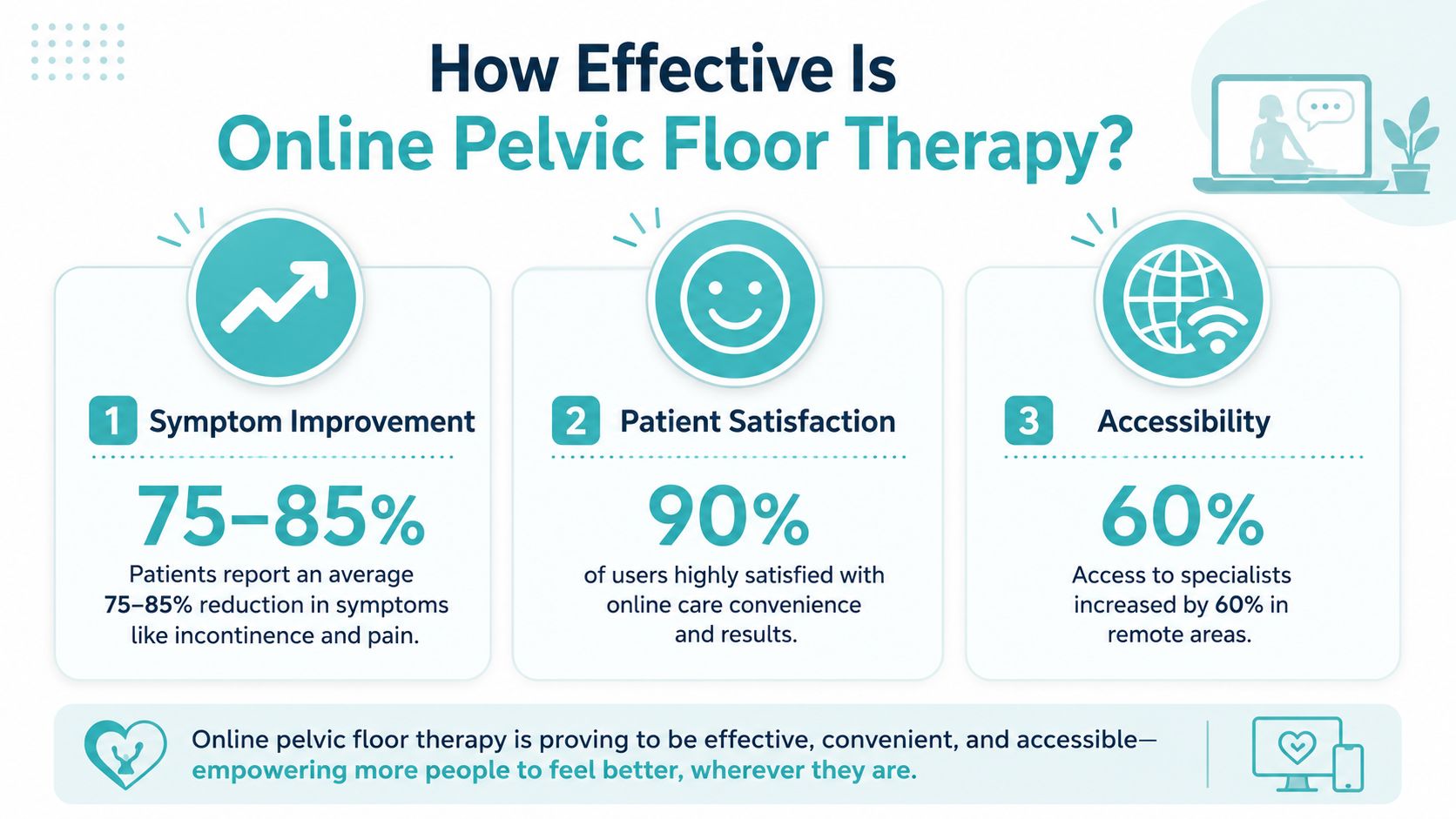
The best answer is yes, for many conditions and many patients, it can. A retrospective cohort study found that pelvic floor physical therapy delivered through telehealth was non-inferior to office-based care. In that study, the mostly telehealth group reached discharge goals at a 35.4% rate compared with 24.4% in the mostly in-office group, with no significant differences in cancellations or no-shows, according to the telehealth versus office-based pelvic floor PT study.
Why online treatment can work so well
A lot of pelvic rehab is not passive treatment. It's skilled coaching.
That includes identifying whether you're gripping instead of relaxing, holding your breath when you lift, pushing down during exertion, clenching through your glutes and abdominals, or rushing through exercises without control. A trained pelvic PT can catch those patterns on video and correct them in real time.
It's similar to working with an excellent personal trainer, except the focus is bladder control, bowel function, pelvic pain, prolapse symptoms, pressure management, and return to daily activity. The value isn't just being in the same room. The value is expert eyes, good cues, and a plan that changes as your body changes.
What tends to translate best to telehealth
Online pelvic floor therapy is strongest when the treatment plan centers on:
| Care element | Why it works virtually |
|---|---|
| Education | Patients need to understand what the pelvic floor is doing, and what it is not doing |
| Exercise prescription | Strength, relaxation, coordination, and breathing drills can all be taught and progressed remotely |
| Habit retraining | Bladder habits, bowel mechanics, pressure strategies, and pacing can be coached over time |
| Form correction | Camera-based movement review often reveals the habits driving symptoms |
If you want a broader overview of outcomes and expectations, this page on whether pelvic floor therapy works is a helpful companion read.
Practical rule: If your treatment depends mostly on education, exercise, movement retraining, and consistent follow-up, virtual care has a strong chance of being effective.
What telehealth doesn't do well is pretend that every condition can be solved without touch, hands-on examination, or in-person decision-making. That's where a balanced plan matters.
Who Is a Good Candidate for Virtual Pelvic Health
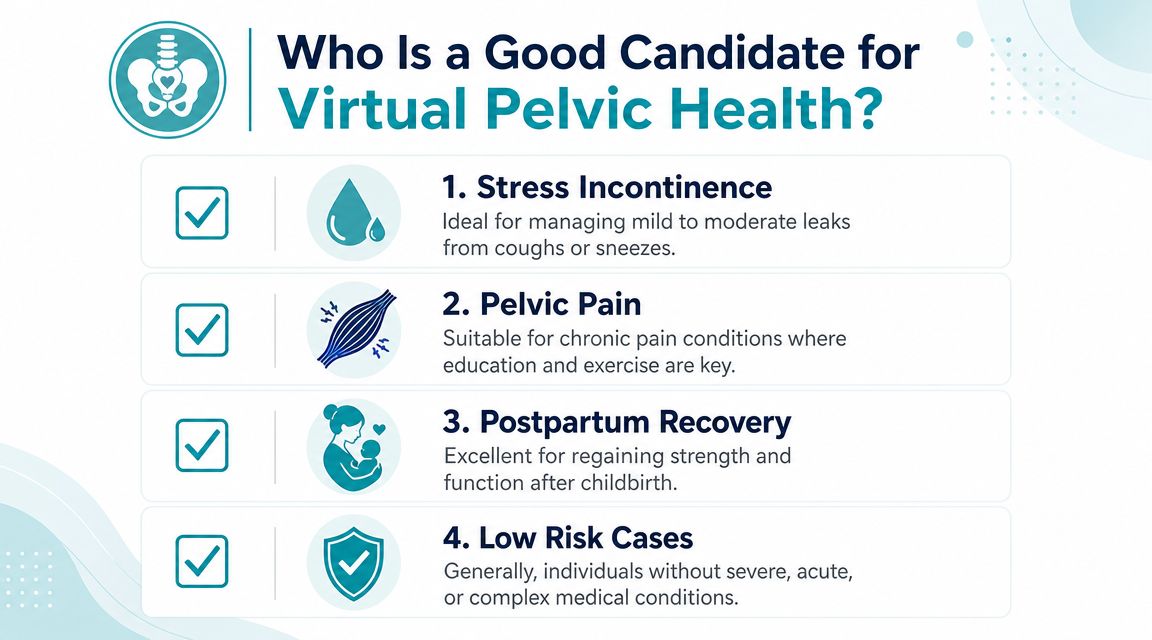
Some patients are excellent candidates for virtual care from day one. Others do better with a hybrid plan or need an in-person evaluation first. The deciding factor isn't whether your symptoms are real enough. It's whether your symptoms can be safely assessed and treated through guided observation, history, coaching, and exercise.
Conditions that often respond well
A common example is urinary incontinence. A systematic review on supervised pelvic floor muscle training reported improved quality of life, and one review cited in that paper found that 58.8% of stress urinary incontinence patients achieved significant improvement after 12 months of supervised training, as summarized in the review of pelvic floor muscle training outcomes. That matters because supervised training is a core part of many virtual treatment plans.
Virtual care is often a good fit for people dealing with:
- Stress urinary leakage. Leaks with coughing, sneezing, jumping, or running often respond well to form work, pressure management, and progressive strengthening.
- Postpartum recovery. Many new mothers need help reconnecting with breathing, abdominal support, pelvic floor coordination, and return to lifting or exercise.
- Mild prolapse symptoms. A feeling of pressure or heaviness can sometimes be managed well with load management, breathing strategies, and exercise guidance.
- Constipation and bowel dysfunction. Toilet positioning, defecation mechanics, abdominal coordination, and routine changes can often be taught effectively online.
- Some pelvic pain presentations. This is usually most successful when the main drivers are guarding, fear of movement, tension, poor coordination, or activity modification needs.
This short video gives a useful patient-friendly look at what virtual pelvic health can feel like in practice.
A quick self-check
You may be a strong fit for online pelvic floor therapy if most of these sound true:
- You can move comfortably enough for an assessment. Your therapist may want to see you breathe, squat, hinge, reach, or change positions.
- You're open to guided home practice. Progress usually depends on doing the plan between sessions.
- You have a private space. You don't need a perfect setup, just enough privacy to talk freely and move around.
- Your symptoms seem stable. Ongoing symptoms are fine. Rapidly worsening or medically unexplained symptoms need a different level of evaluation.
Good telehealth patients aren't perfect patients. They're patients whose symptoms can be safely coached, monitored, and progressed from a distance.
What Happens During a Telehealth PT Session
Most first-time patients are surprised by how thorough a virtual pelvic health visit can be. It doesn't feel like a generic video chat. It feels like a guided evaluation.
A typical telehealth model uses a secure, HIPAA-compliant video platform for assessment and personalized exercise guidance. Published summaries describe effective remote management for issues such as urinary incontinence, postpartum dysfunction, and mild prolapse symptoms when therapists can verify breathing mechanics, lumbopelvic coordination, and exercise quality through video, as explained in this overview of telehealth pelvic floor physical therapy.
The first visit
Your initial session usually starts with history-taking. The therapist asks about bladder habits, bowel symptoms, pain triggers, pregnancy and birth history if relevant, exercise background, surgeries, daily routines, and what you want to get back to doing.
Then the movement assessment begins. You may be asked to:
- Change positions. Sitting, standing, getting up from a chair, or lying down can reveal useful patterns.
- Show your breathing. Many pelvic floor problems are closely tied to breath holding, rib flare, abdominal gripping, or poor pressure control.
- Perform simple movements. A squat, hinge, step, reach, or single-leg task can show how your pelvic floor is responding to load.
- Practice coordination drills. Your therapist may cue a contraction, a relaxation, a cough strategy, or a bearing-down simulation depending on your symptoms.
Follow-up visits
Follow-ups are usually more focused. Your therapist checks what changed, what didn't, and what's getting in the way.
One patient may need better cues because she keeps over-squeezing and creating tension. Another may need to stop doing random internet Kegels and learn how to relax first. Another may be ready to progress from basic breathing drills to impact prep for running.
A good telehealth session should feel specific. If the advice could apply to anyone, it probably isn't skilled pelvic rehab.
Practical details matter too. Wear comfortable clothes, prop your device where your therapist can see you move, and keep a pillow, chair, or yoga mat nearby if asked. You won't be asked to expose intimate areas on camera.
When You Absolutely Need an In-Person Visit
This is the part many articles skip, and it's one of the most important parts of safe care. Telehealth is useful. It is not unlimited.
Research on virtual pelvic health education found that people can improve their knowledge after an online session, but that doesn't always translate into behavior change. The same literature also notes that telehealth is not a complete substitute when an internal exam is needed for conditions such as significant prolapse, dyspareunia, or muscle overactivity, as discussed in this study on virtual pelvic health education and its limits.
Red flags that should not stay virtual
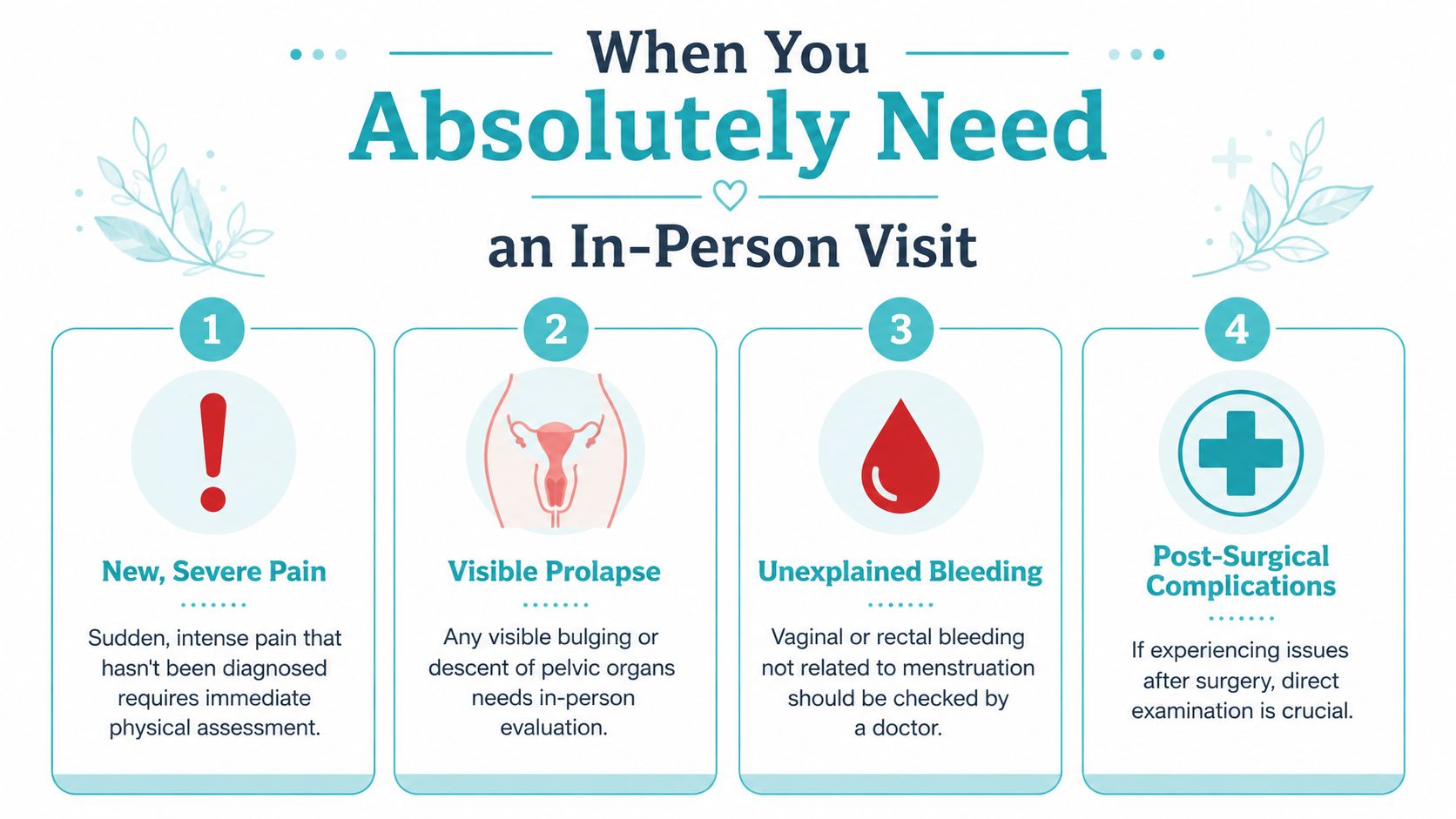
If any of these apply, an in-person exam is the safer next step:
- New severe pain. Sudden, intense pelvic, abdominal, vaginal, rectal, or low back pain needs direct assessment.
- Visible bulging or worsening prolapse symptoms. Pressure alone can sometimes be managed remotely, but visible tissue changes need hands-on evaluation.
- Pain with penetration that seems deep, sharp, or highly irritable. Dyspareunia may involve muscle overactivity, tissue sensitivity, scarring, or factors that require internal assessment.
- Possible muscle overactivity. If the problem seems to be inability to relax, not inability to contract, an internal exam often changes the treatment plan.
- Post-surgical concerns. If healing seems off, pain is escalating, or function drops unexpectedly, don't rely on video alone.
- Unexplained bleeding or other medical symptoms. These require medical assessment, not just rehabilitation advice.
A pelvic floor exam can answer questions that video cannot. If you're unsure what that includes, this overview of what a pelvic floor exam involves can make the process feel less intimidating.
The honest middle ground
Some patients don't fit neatly into “virtual only” or “in-person only.” They need a hybrid model. That might mean starting online for education and symptom management, then coming in for an internal assessment if progress stalls or if the symptom picture stays unclear.
That same decision-making process exists in other therapy fields too. For a broader perspective on balancing convenience with clinical fit, this article on understanding therapy choices in Italy offers a thoughtful comparison that many patients find useful.
If a provider promises that every pelvic floor issue can be handled online, be cautious. Skilled care includes knowing when not to stay virtual.
Choosing a Qualified Online Pelvic Floor Therapist
Not all telehealth is equal. A general fitness coach, a generic rehab app, and a licensed pelvic floor physical therapist are not interchangeable.
You want someone who can tell the difference between weakness, poor timing, overactivity, guarding, pressure mismanagement, mobility restrictions, and behavior patterns that keep symptoms going. That requires training, not just enthusiasm.
What to look for
Use this checklist when you're evaluating an online provider:
- State licensure matters. Your therapist should be licensed to treat patients in your state.
- Pelvic health training should be explicit. Look for a physical therapist with dedicated pelvic health education, not someone who vaguely “also treats core issues.”
- The visit format should be clear. You should know whether you'll get one-on-one care, exercise progression, messaging support, and follow-up planning.
- Privacy standards should be stated. The platform should be secure, and the clinic should explain consent, privacy, and session expectations.
- Scope should be honest. A good therapist will tell you when telehealth isn't enough.

Questions worth asking before you book
A short screening call can save a lot of frustration. Ask:
| Question | Why it helps |
|---|---|
| Have you treated my specific symptom before | Experience shapes the plan |
| How do you decide who needs in-person care | This reveals clinical judgment |
| What will the first session include | You'll know whether the evaluation is thorough |
| Do you offer hybrid care or referrals if needed | Good providers plan for real-world complexity |
| How does billing work for telehealth PT | Coverage varies and should be clarified early |
If you're a clinician or practice owner trying to understand how strong healthcare practices present services clearly online, this essential guide for healthcare providers offers useful perspective on patient communication and digital trust.
The right provider doesn't just give exercises. They help you understand why your symptoms happen, what your body needs, and when your plan should change.
Your Next Steps to Reclaiming Pelvic Health
If you've been putting this off, the most important thing to know is that help doesn't have to look one specific way. Pelvic floor therapy online can be a legitimate, effective option for many concerns, especially when treatment centers on education, movement retraining, symptom tracking, and progressive exercise.
It's also okay if virtual care isn't the whole answer. Some symptoms need an internal exam. Some patients do best with a hybrid model. Some feel more comfortable starting from home and deciding later whether they want in-person support. That's a reasonable path.
Start with an evaluation, not guesswork. A good pelvic health physical therapist can help sort out whether your symptoms are likely to respond to telehealth, whether you should be seen in person first, or whether you'd benefit from both.
The goal isn't to force online care to do everything. The goal is to get you the right care, in the right format, at the right time.
If you're ready to take that next step, Lake City Physical Therapy offers specialized pelvic health care with both telehealth and in-person options across North Idaho and Eastern Washington. That gives you a practical path whether you're a strong fit for virtual treatment or need hands-on assessment. If you're not ready to book yet, their site also includes free educational ebooks and patient resources that can help you get oriented before your first appointment.

