Piriformis Syndrome Pregnancy: A Practical Relief Guide
You're sitting through a prenatal appointment, a car ride, or dinner, and the pain starts deep in one buttock. It may feel like a knot you can't reach, then spread down the back of your thigh. Standing up helps briefly, but walking, rolling in bed, or putting on your shoes can bring it back. If you've searched for “piriformis syndrome pregnancy,” you're probably trying to answer a practical question: is this a tight piriformis, sciatic nerve irritation, sacroiliac pain, pelvic floor tension, or something that needs medical attention?
That distinction matters. Pregnancy changes how your pelvis, hips, spine, pelvic floor, and nerves share load. A stretch aimed at the piriformis may help one person, yet aggravate another whose symptoms are driven by the lumbar spine, sacroiliac joint, or an overactive pelvic floor. The most useful approach is not to chase every painful spot. It's to identify the pattern, reduce the irritating load, and restore comfortable movement without forcing a vulnerable nerve or joint into an end range.
When Deep Buttock Pain Is the Main Problem in Pregnancy
A patient may describe it this way: “It feels like the pain is inside my butt cheek, not on the surface. Sitting makes it worse, especially in the car. Sometimes it travels down my leg, but my back doesn't really hurt.” She may shift from one hip to the other, avoid crossing her legs, and stand during conversations because sitting has become the trigger.
That pattern can fit piriformis-related pain, particularly when direct pressure over the deep buttock reproduces symptoms and hip positions that tension the piriformis are uncomfortable. The piriformis lies close to the sciatic nerve, so irritation in this region can feel neurologic even when the main driver is local muscle overload. The BMJ case report on piriformis syndrome after pregnancy describes how pregnancy can elongate and strain the gluteal muscles, including the piriformis, and identifies the condition as something clinicians should consider when hip or sciatic pain persists.
Why the label can mislead
“Piriformis syndrome” is useful shorthand, but it isn't a complete diagnosis by itself. Deep buttock pain can arise from the lumbar spine, sacroiliac joint, gluteal tendons, pelvic floor, or nearby nerves. Pregnancy also makes several of these tissues more reactive, which means a familiar exercise can become too aggressive even if it's commonly recommended online.
The available pregnancy research is limited and inconsistent. A 2022 clinical study found piriformis tightness in 29% of third-trimester participants, or 27 of 93 women, while a 2024 study reported 51.1%, or 95 of 186 pregnant women, with the highest reported prevalence among women ages 27 to 33 and a higher prevalence among multigravida than primigravida participants. These findings come from the 2022 International Journal of Health Sciences and Research study, and they suggest that symptoms may vary with trimester, age, and parity rather than following one predictable pregnancy pattern.
Practical rule: Deep buttock pain deserves a pattern-based assessment, not an automatic diagnosis of “tight piriformis.”
What the Piriformis Muscle Actually Does
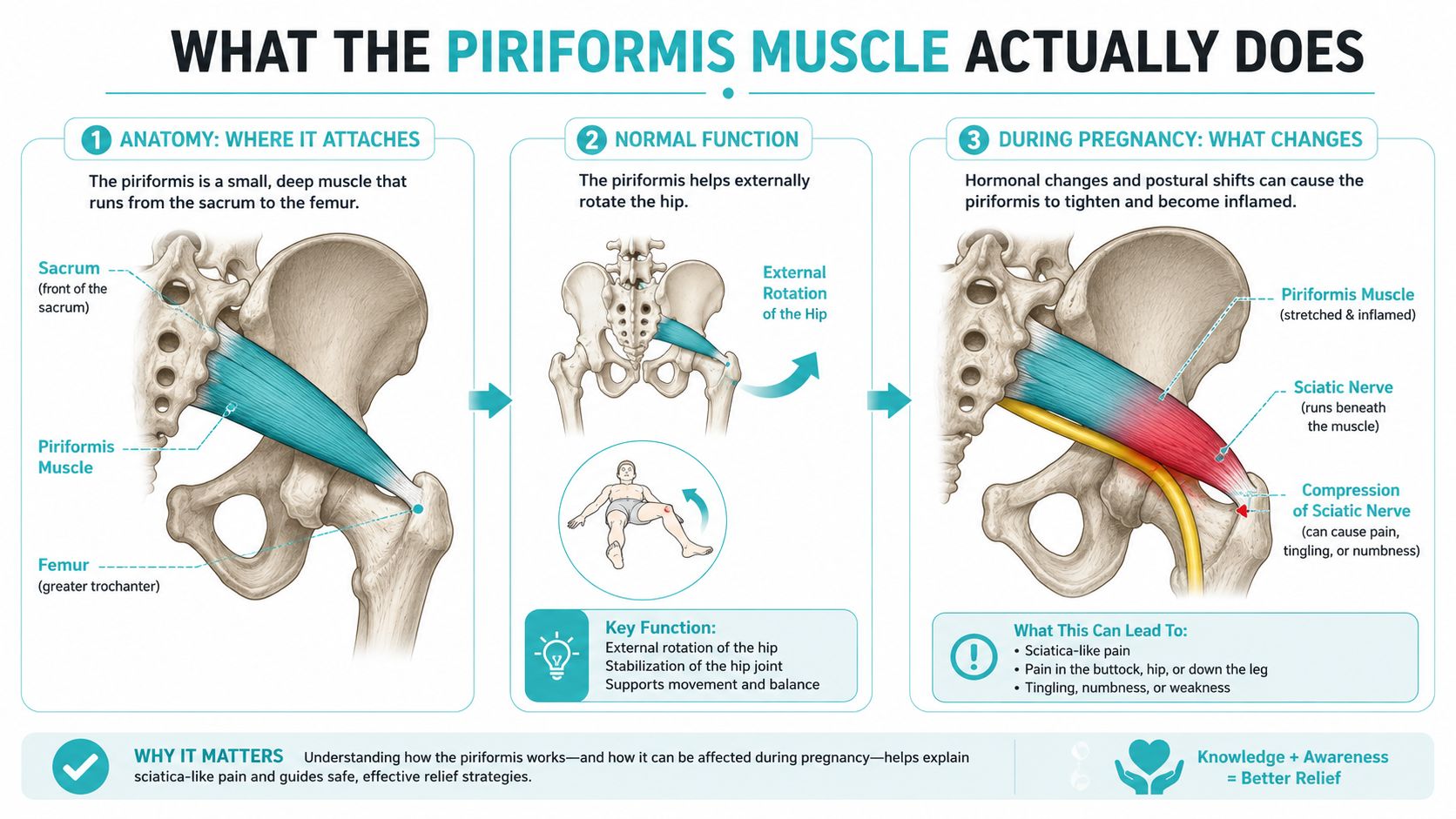
The piriformis is a small, pear-shaped muscle located deep beneath the gluteal muscles. It connects the sacrum, the triangular bone at the base of the spine, to the upper femur near the greater trochanter. You have one on each side, and each one helps control how the thigh rotates and how the pelvis stays steady when your body moves over one leg.
Its normal job
At its simplest, the piriformis helps with external rotation of the hip, turning the thigh outward. It also contributes to hip stability during walking, stair climbing, turning, and single-leg tasks such as dressing. It isn't supposed to hold maximum tension all day. It should adjust its activity as your pelvis and femur move.
The sciatic nerve usually passes beneath the piriformis, although anatomical variations exist. If the muscle becomes irritated, thickened, or persistently overactive, it can increase pressure or friction around the nerve. That may produce deep buttock pain with burning, aching, tingling, or radiating discomfort. The clinical review on piriformis syndrome and sciatic nerve irritation describes buttock tenderness and symptoms provoked by positions that flex, adduct, and internally rotate the hip, commonly called the FAIR position.
What pregnancy changes
As the uterus grows, your center of gravity shifts forward. Your pelvis and trunk then have to manage a different relationship between load, balance, and stability. The piriformis may work harder as a deep hip stabilizer, especially when the gluteus medius and other lateral hip muscles aren't contributing effectively.
The important point is that “tight” doesn't always mean “short.” A muscle can feel tight because it's guarding, working continuously, or responding to instability. Stretching it harder may not solve the reason it's gripping. Sometimes the better intervention is supported positioning, improved hip control, reduced sitting pressure, or pelvic floor relaxation.
Why Pregnancy Overloads the Piriformis
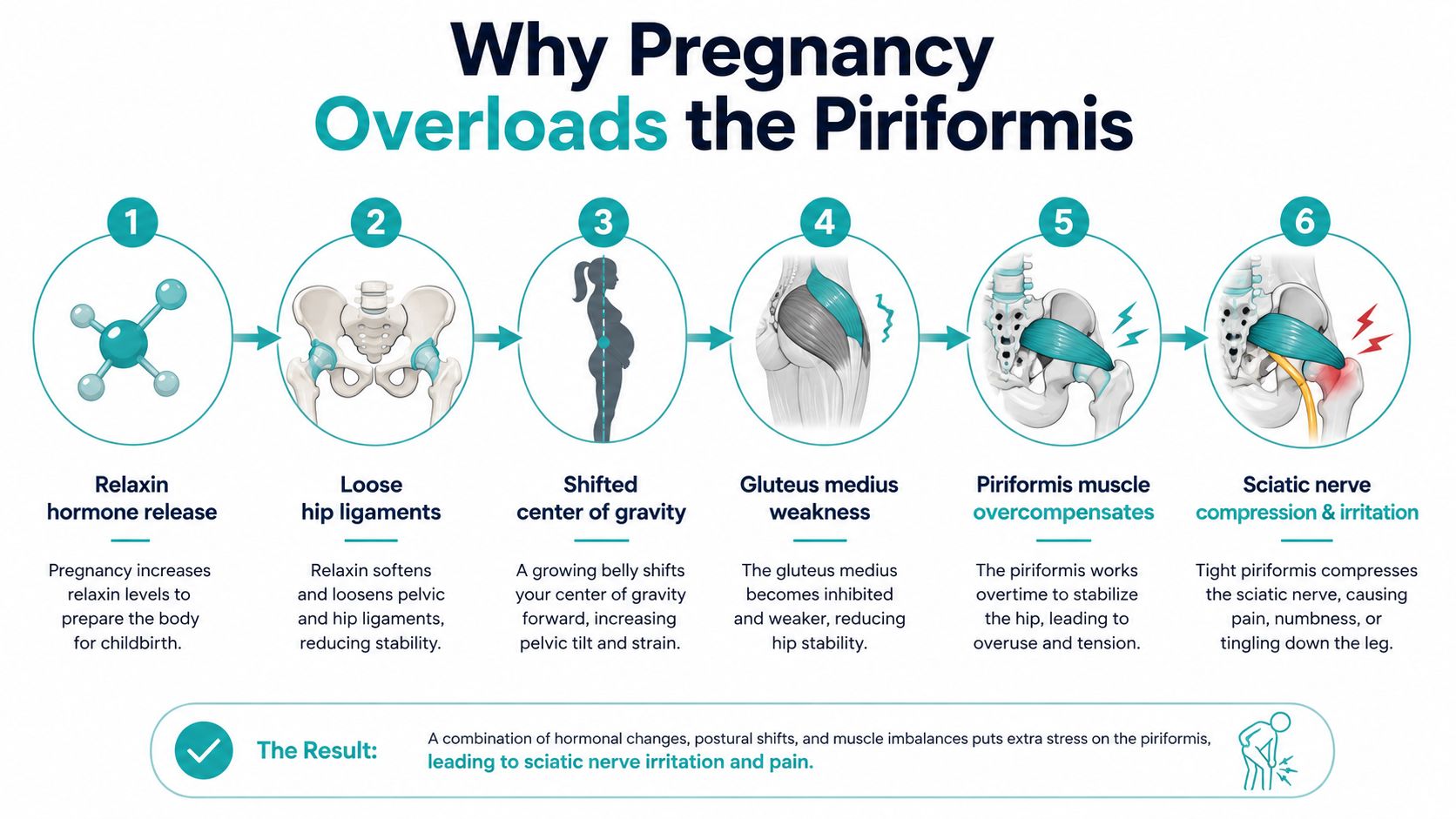
A pregnant patient may develop deep buttock pain after sitting, walking, rolling in bed, or standing on one leg. The trigger is often cumulative rather than a single injury. Ligamentous laxity can make the pelvis feel less secure, while the forward shift in body mass changes how the trunk and hips control movement. The deep rotators may increase their activity to help maintain stability.
The clinical literature on piriformis syndrome describes this pattern as a response to altered pelvic mechanics. The piriformis and other deep external rotators may become hypertonic or hypertrophic when the gluteus medius contributes less effectively or pelvic support changes. Increased tone in this region can irritate the sciatic nerve near the greater sciatic notch, although similar symptoms can also involve the sacroiliac joint, lumbar spine, or pelvic floor.
The load-sharing problem
Relaxin contributes to normal connective-tissue changes, but it does not explain every painful muscle. I assess how the whole system shares load:
- Pelvic support changes: Looser ligaments can alter load transfer through the sacroiliac joints and hips.
- Center of gravity shifts: Standing and walking may require different trunk and hip strategies.
- Lateral hip control drops: If the gluteus medius is not controlling the pelvis well, the piriformis may stabilize more than usual.
- Deep rotator tension rises: The muscle may stay active during sitting, walking, rolling, or single-leg movement.
- Nerve sensitivity increases: Repeated compression or tension can make the sciatic nerve more reactive.
- Pain changes movement: Guarding can increase the workload on the same tissues and may also keep the pelvic floor braced.
Research on piriformis symptoms during pregnancy remains limited. One report described third-trimester piriformis tightness as “very less” and discussed relaxin-related laxity as one possible explanation. That uncertainty argues for gentle, individualized care rather than intense piriformis release for every pregnant patient.
The embedded movement demonstration shows the general region, but a video cannot identify whether symptoms come from the piriformis, spine, sacroiliac joint, or pelvic floor.
Piriformis Syndrome vs Sciatica, SIJ Pain, and Pelvic Floor Dysfunction
Pain location and aggravating positions can offer clues, but they can't replace an examination. Use the comparison below as a way to organize your symptoms, not as a self-diagnosis.
| Feature | Piriformis Syndrome | Lumbar Disc Sciatica | SIJ Pain | Pelvic Floor Dysfunction |
|---|---|---|---|---|
| Main location | Deep buttock, sometimes extending down the back of the thigh | Low back or buttock with symptoms following a nerve-root pattern into the calf or foot | Near the sacroiliac joint, often around the dimples at the back of the pelvis | Deep ache near the sit bones, perineum, tailbone, or pelvic bowl |
| Common aggravators | Prolonged sitting, crossed legs, hip rotation, or positions that tension the piriformis | Forward bending, coughing, sneezing, or spinal loading may increase symptoms | Single-leg stance, stairs, getting out of a car, or asymmetrical loading | Sitting, intimacy, bowel movements, bladder filling, or sustained pelvic muscle guarding |
| Helpful clue | Local tenderness over the deep buttock and reproduction with piriformis-loading maneuvers | Numbness, weakness, reflex changes, or a clearer line of symptoms into the lower leg | Pain with transfers, rolling, stairs, or uneven weight-bearing | Urinary, bowel, sexual, pressure, or perineal symptoms alongside pain |
| Movement response | Changing hip position or reducing sitting pressure may help | Spinal position often affects symptoms more than local hip stretching | Symmetrical loading and external support may reduce strain | Breathing, pelvic floor down-training, and bowel regularity may influence symptoms |
What the pattern can tell you
Piriformis-related symptoms often center in the buttock and may travel down the back of the thigh. They don't have to include significant low back pain. Lumbar disc-related sciatica is more concerning when symptoms follow a consistent nerve distribution into the calf or foot and include sensory or motor changes.
SIJ pain tends to be more localized around the posterior pelvic joint and often reacts to asymmetrical tasks. Pelvic floor dysfunction can feel surprisingly similar to deep hip pain because the pelvic floor, obturator internus, piriformis, and sacral region share close mechanical relationships. If you're also noticing urinary changes, constipation, pain with intimacy, pelvic pressure, or perineal aching, the guide to pain in one leg during pregnancy can provide useful context while you arrange an assessment.
How Clinicians Tell Piriformis Syndrome From Other Causes
A prenatal physical therapist starts with safety, not stretching. Sudden severe pain, saddle numbness, new bladder or bowel changes, fever, marked one-sided leg weakness, or a recent trauma history require prompt medical review. Pregnancy-related musculoskeletal pain is common, but those features can indicate a neurologic, infectious, obstetric, or traumatic problem that shouldn't be managed with home exercises alone.
The interview comes first
A clinician will ask where the pain begins, whether it travels, what happens after sitting, how walking and stairs affect it, and which positions provide relief. Timing matters too. Gestational age, previous deliveries, prior episodes of back or pelvic pain, changes in activity, and abdominal wall concerns such as diastasis can change the interpretation.
The 24-hour pattern often reveals more than a pain score. Pain that appears after sitting but eases with gentle movement points toward a different strategy than pain that worsens with coughing, progressive weakness, or constant night symptoms. A therapist also asks about bowel, bladder, sexual, and pelvic pressure symptoms because a pelvic floor screen may change the treatment plan.
The examination is deliberately comparative
Testing may include the FAIR position, Pace's sign, an active piriformis test, seated palpation, and assessment of the gluteal tendons. The clinician may compare lumbar movement, hip range, sacroiliac loading, gait, single-leg control, and nerve sensitivity instead of treating one positive maneuver as definitive.
Imaging is rarely the first step for a straightforward mechanical pattern. Provocation-based tests, symptom reproduction, strength and sensation screening, and the response to position changes usually guide the initial plan. A pelvic floor assessment may be external or internal, but it should be explained clearly and performed only with informed consent. The purpose is to identify whether the pelvic floor is overactive, poorly coordinated, tender, or contributing to nerve sensitivity.
Pregnancy-Safe Positions, Stretches, and Activity Changes
The most effective home plan is usually gentle and specific. The goal isn't to force the piriformis to lengthen. It's to reduce compression, keep the sciatic nerve moving comfortably, and give the gluteal and pelvic floor systems better support.
Start with sitting mechanics
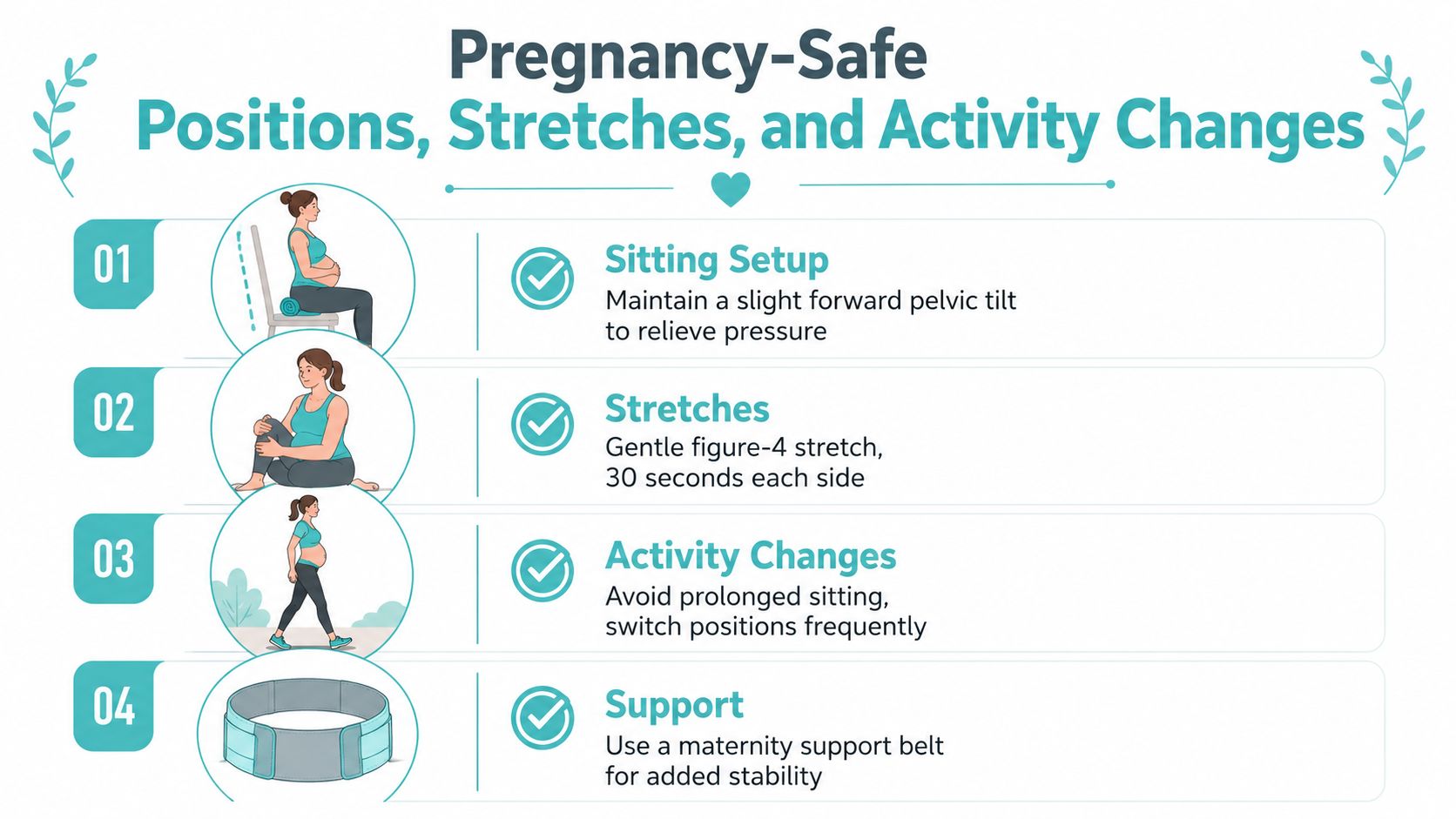
Use a wedge cushion or a rolled towel under the back of the pelvis so your hips sit slightly higher than your knees. Keep both feet supported, avoid crossing your legs, and change position before the ache becomes intense. A perching stool can work well at a counter because it keeps the hips slightly above the knees without requiring prolonged standing.
Take a brief standing or walking break every 20 to 30 minutes as a practical starting point. This interval is a self-management suggestion, not a universal medical threshold. If symptoms flare sooner, move sooner. A wallet or phone in the back pocket can create focal pressure, and a hard chair may make a sensitive deep buttock worse.
Choose supported mobility
A side-lying piriformis lengthening position can be more comfortable than an unsupported seated stretch. Keep the top knee supported on a pillow and stop well before sharp pain, tingling, or a pulling sensation that travels down the leg. A supported figure-four position with your head and shoulders propped up may work for some people, while a standing version using a chair or counter can provide balance and control.
Avoid forcing a deep figure-four stretch, especially if the position compresses the buttock or increases nerve symptoms. Aggressive foam rolling directly over the sacrum or sit bones is another poor choice when the area is irritable. More pressure isn't the same as better release.
Adjust activity without becoming sedentary
Shorten walking bouts and divide long errands into smaller trips. Use side-lying rest or gentle hands-and-knees rocking if those positions reduce symptoms. Calf mobility can help maintain comfortable lower-limb movement, while gentle gluteus medius activation can reduce the tendency for the piriformis to handle every stabilizing task.
For broader prenatal exercise ideas, Venus Health Co. pregnancy workout advice offers a useful starting point for adapting activity. Exercise should leave you feeling more capable, not more compressed or neurologically irritated. If a movement produces spreading numbness, escalating tingling, or pain that lingers after you stop, remove it and seek individualized guidance. You can also review these groin and hip stretches for options, but pregnancy modifications still need to match your symptoms and stage.
Pelvic Floor and Visceral Considerations Readers Often Miss
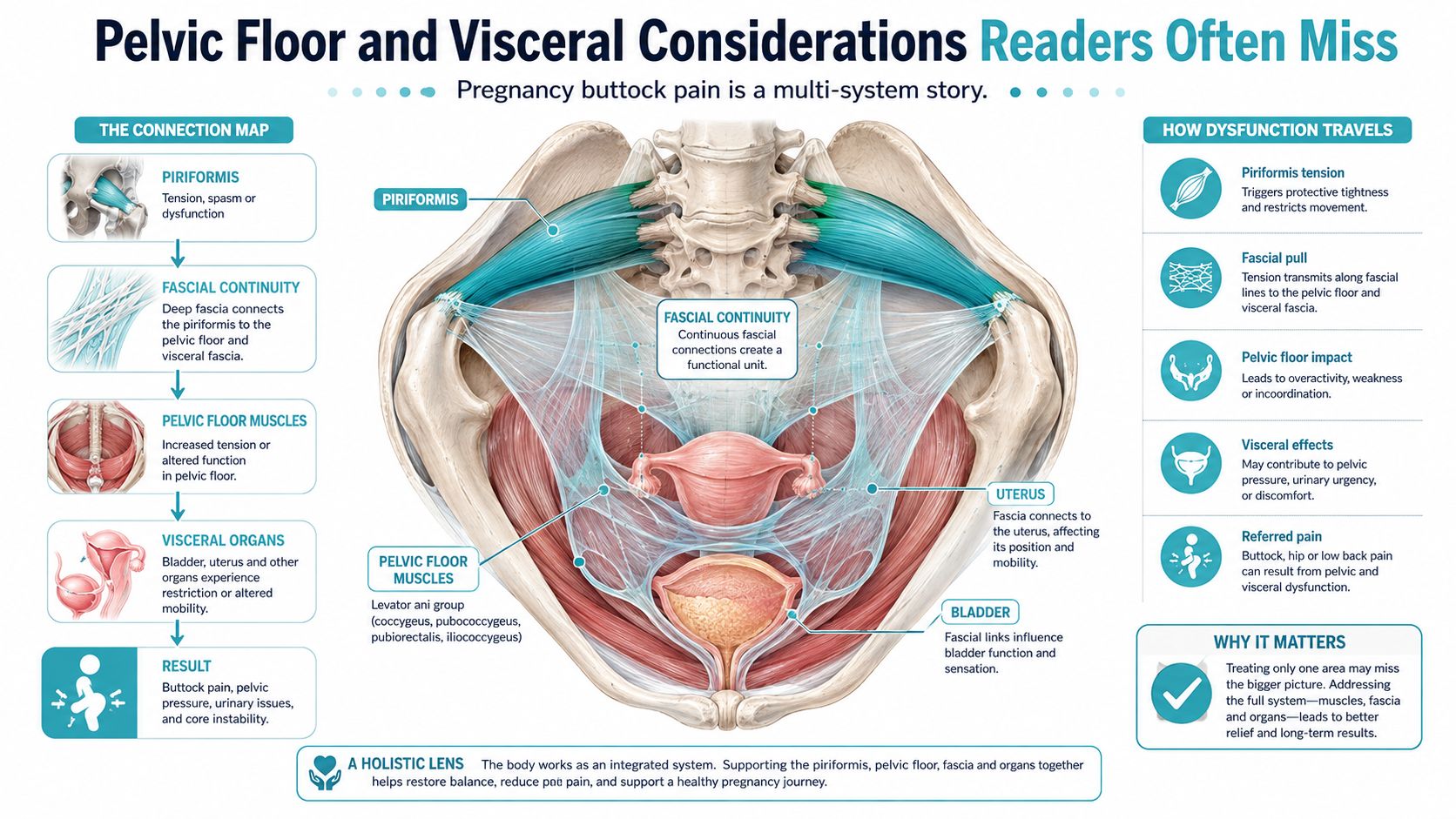
The piriformis doesn't operate in isolation. It sits against the deeper pelvic structures and shares fascial and mechanical relationships with the obturator internus and pelvic floor diaphragm. When these tissues respond to changing load by guarding, a person may feel buttock pain, pelvic pressure, tailbone discomfort, or pain near the sit bones even when the original irritation began at the hip.
Pregnancy adds pressure inside the pelvic bowl as the uterus grows and organs adapt. Constipation can increase bearing down and pelvic floor holding. Bladder symptoms, pelvic organ pressure, and altered bowel habits can also change how a person breathes and braces. Those changes may keep the pelvic floor and deep hip muscles active when they should be able to lengthen.
The breath and bowel connection
A tense pelvic floor often needs coordination training, not more strengthening. Slow breathing that allows the lower ribs and abdomen to expand can help reduce unnecessary gripping. A clinician may pair that breathing with supported hip movement, pelvic mobility, and bowel strategies that reduce straining.
This is why a pelvic floor physical therapy evaluation during pregnancy can be useful even when the complaint sounds like a muscle problem. The evaluation can consider pelvic floor tone, hip control, SIJ loading, lumbar movement, and nerve behavior together.
Pain that changes with bowel movements, urination, pelvic pressure, or intimacy deserves a wider evaluation. Visceral or gynecologic conditions can mimic musculoskeletal symptoms, especially when the pain pattern changes unexpectedly or feels different from ordinary position-related soreness. Treating the piriformis alone may provide temporary relief while leaving the load, breath, pelvic floor, or visceral contributor untouched.
When to Seek Care and a Practical Next-Step Plan
Pregnancy-related buttock pain needs same-day obstetric assessment when it is sudden and severe, or comes with saddle numbness, loss of bladder or bowel control, fever, vaginal bleeding, or headache with visual disturbance. New or worsening weakness in one leg also warrants prompt medical review. Do not stretch through these symptoms or dismiss them as ordinary pregnancy discomfort.
Arrange a pelvic floor physical therapy assessment for slower-burning pain that wakes you, limits walking or sitting, persists after two weeks of consistent self-management, or travels toward the pelvic floor or perineum. These signs do not prove a dangerous condition. They do suggest that piriformis irritation may be interacting with the pelvic floor, SIJ, lumbar spine, or nerve sensitivity.
A simple next step
For one week, note sitting time, walking tolerance, sleep disruption, pain location, nerve symptoms, bowel and bladder changes, and positions that help. Use that record during an evaluation. A gentle routine can include supported sitting, side-lying rest, and hands-and-knees rocking, provided each movement stays below the point where symptoms spread.
Lake City Physical Therapy can assess prenatal buttock and sciatic pain alongside the pelvic floor, SIJ, lumbar spine, and hip. If symptoms persist or recur, schedule an evaluation and bring your log so treatment can reflect your pregnancy and pain pattern.
Lake City Physical Therapy provides women's health and pelvic floor care for prenatal and postpartum concerns, including assessment of piriformis, pelvic floor, SIJ, and lumbar contributors. Visit Lake City Physical Therapy to explore care options and schedule a focused evaluation.

