Postpartum Bladder Control: Recovery Guide for 2026
Postpartum urinary incontinence affects about one in three women during the first year after birth. A 2021 meta-analysis of 24 studies involving 35,064 women found a weighted mean prevalence of 31.0% from 6 weeks to 12 months postpartum, with symptoms falling to 21% at 3 months before rising again to 31% by 1 year (PubMed). That pattern matters because a bladder leak at your six-week checkup isn't necessarily a problem that will disappear if you wait.
As a women's health physical therapist, I've seen how quickly a small leak can shape a new mother's choices. She stops lifting the car seat, avoids laughing hard, changes her workout, or plans every outing around the nearest bathroom. Postpartum bladder control problems are common, but they aren't something you have to accept as the permanent cost of having a baby.
Understanding Postpartum Bladder Control Issues
The first step is identifying the pattern. Stress incontinence happens when pressure rises inside your abdomen and the pelvic floor can't respond quickly enough. You may leak when you cough, sneeze, laugh, pick up your baby, climb stairs, or return to running. A few drops during a workout still count as a symptom, even if you consider it minor.
Urge incontinence feels different. You may experience a sudden, intense need to urinate and struggle to reach the bathroom in time. Some women have both patterns, known as mixed incontinence. They leak with movement and also experience urgency, frequent bathroom trips, or accidents after a strong bladder signal.

Why delivery method doesn't tell the whole story
A 2010 systematic review found that any postpartum incontinence affected 33% of women during the first 3 months after delivery, while weekly leakage affected 12% and daily leakage affected 3% (PubMed). Vaginal delivery carried a higher average prevalence, about 31%, compared with 15% after cesarean delivery during that early period.
That difference doesn't make cesarean birth a guarantee of normal bladder function. Pregnancy itself places sustained pressure on the bladder, abdominal wall, and pelvic floor, and surgery can also alter how the abdominal and pelvic muscles coordinate. A cesarean may reduce one source of pelvic-floor stress, but it doesn't remove every contributor to bladder symptoms.
A leak is information, not a personal failure. It tells you that pressure management, muscle timing, bladder signaling, or tissue support may need attention.
New mothers often need practical help while they recover, especially when sleep deprivation makes symptoms harder to manage. Understanding what is a maternity nurse can help families think through the kind of in-home support that protects rest and creates space for rehabilitation. Your leakage pattern still deserves discussion with an obstetric provider or pelvic floor therapist, regardless of how your baby was delivered.
A Realistic Recovery Timeline Most Articles Skip
The six-week postpartum visit is an important medical checkpoint, but it is not a deadline for bladder recovery. Tissue healing, muscle coordination, nerve recovery, feeding demands, and the gradual return to lifting and exercise continue after that appointment.
Early improvement can be misleading. Leakage may decrease while a woman rests at home, then return when she carries the baby more often, walks farther, returns to work, or resumes exercise. A quieter symptom does not always mean the underlying control problem has resolved.
What the evidence shows over time
A 2021 meta-analysis found that prevalence fell to 21% at 3 months, then rose to 31% by 1 year (PubMed). A separate study followed postpartum women across the first 2 years and reported urinary incontinence in 43.5%, with stress urinary incontinence the most common type at 28.7%. It found no significant change in prevalence across that period.
These findings challenge routine “wait and see” advice at the six-week checkup. Observation can make sense when symptoms are mild, steadily improving, and not limiting daily life. It becomes less useful when leakage persists, returns with increased activity, or interferes with caring for a baby, exercise, work, or sleep.
Factors that can extend recovery
Some women face a longer rehabilitation path. Evidence identifies vaginal delivery, obesity, maternal age, previous incontinence, larger birth weight, and pregnancy weight gain as important risk factors. Delivery history also helps a therapist decide how carefully to progress loading and which movements need closer assessment.
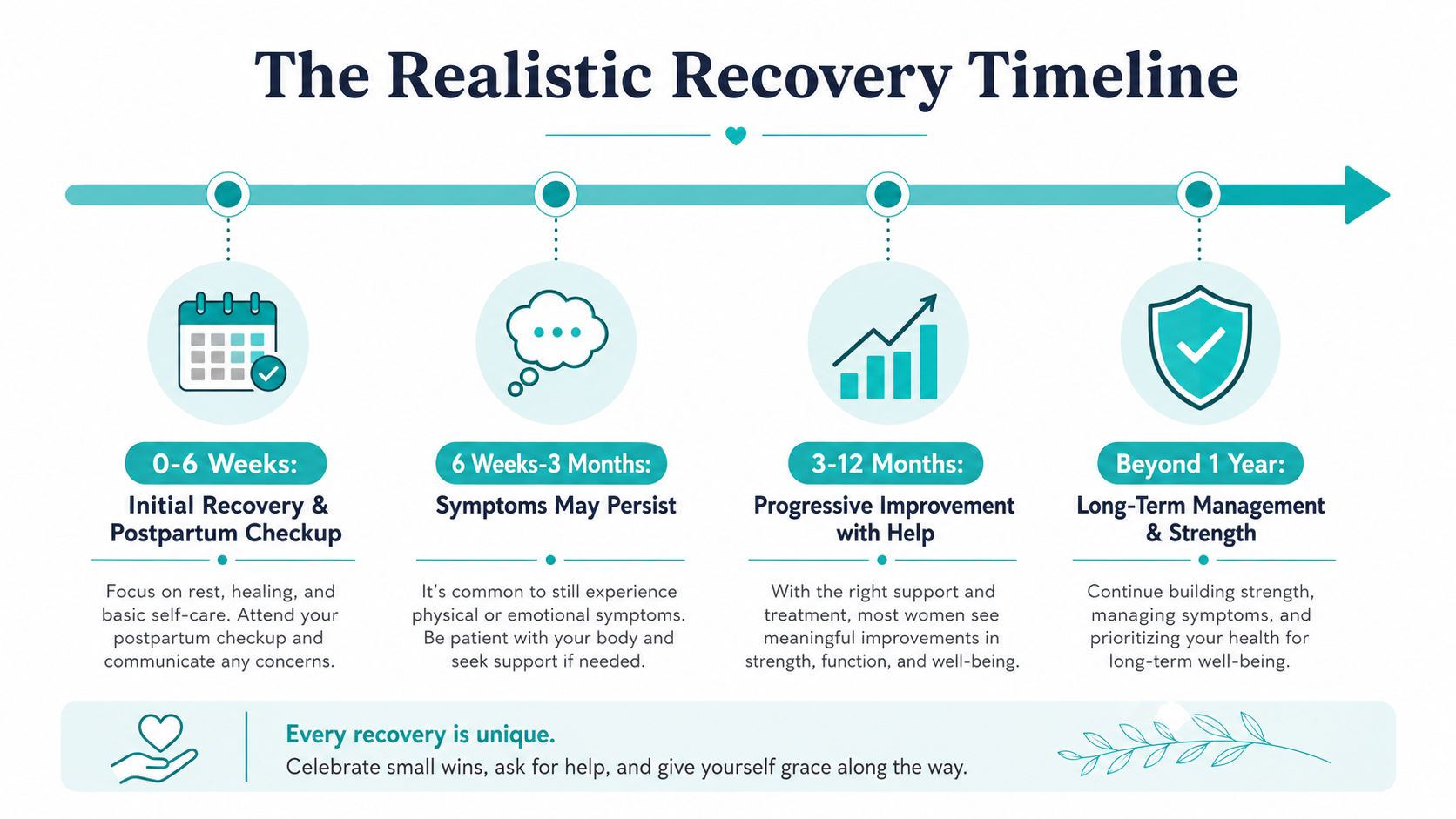
Use phases rather than promises. Early recovery emphasizes healing and awareness. The following months address pelvic floor coordination, strength, endurance, and gradual exposure to real-life pressure. Supervised pelvic floor training can guide that progression, especially when symptoms persist or recur. Beyond the first year, ongoing leakage still deserves treatment, not resignation. A postpartum recovery timeline can help set expectations as physical demands change.
Evidence-Based Self-Care and Pelvic Floor Exercises
Self-care works best when it supports normal bladder function instead of trying to suppress every symptom. Don't restrict fluids to avoid leaking. Concentrated urine can irritate the bladder, and dehydration can make constipation and straining more likely. Drink regularly, then notice whether caffeine or other personal triggers worsen urgency.
Bladder training can help when urgency is part of the picture. When a strong urge arrives, stop, breathe slowly, relax your shoulders, and perform a few gentle pelvic-floor contractions if that strategy has been taught to you. Walk calmly to the bathroom rather than rushing, because panic and hurried movement can increase abdominal pressure.
A safer starter routine
Begin with awareness, not maximum effort. Sit upright or lie comfortably, inhale without gripping, then exhale while gently lifting the pelvic floor as if stopping gas. You should feel an inward lift, not a downward bearing sensation. Keep your buttocks, thighs, and jaw relaxed, and don't hold your breath.
Try a small number of comfortable contractions, alternating shorter lifts with full relaxation. The exact dosage should reflect your delivery, healing status, pain, muscle tone, and ability to release. If you feel heaviness, increased pain, bulging, or worsening leakage, stop and ask for an assessment rather than pushing through.

Make daily movement part of rehabilitation
Your pelvic floor works with your diaphragm, abdominal wall, hips, and back. Exhale during effort when lifting the baby or a car seat, keep the load close, and avoid holding your breath. Start with walking and low-impact movement when cleared, then build toward higher-impact exercise only if you can manage pressure without leaking or pelvic heaviness.
Online instructions can help you understand the basic concept, but they can't tell you whether you're lifting, bearing down, or over-tightening. A practical guide to pelvic floor exercises for bladder leakage can complement care, but persistent symptoms call for individualized examination.
Why Supervised Pelvic Floor Training Outperforms DIY Exercises
Doing pelvic floor exercises on your own shows initiative. It doesn't guarantee that you're using the right muscles or progressing at the right pace. Some women squeeze their glutes, brace their abdomen, hold their breath, or bear down. Others have pelvic floor muscles that are already overactive and need relaxation and coordination more than repeated tightening.
A 2024 systematic review found that supervised pelvic floor muscle training reduced urinary incontinence more than individual PFMT, and supervised training produced better quality-of-life outcomes. The same evidence review reported that vaginal cone use and supervised PFMT performed better than individual PFMT, while an umbrella review found moderate-quality evidence that postpartum PFMT reduces incontinence risk (PubMed).
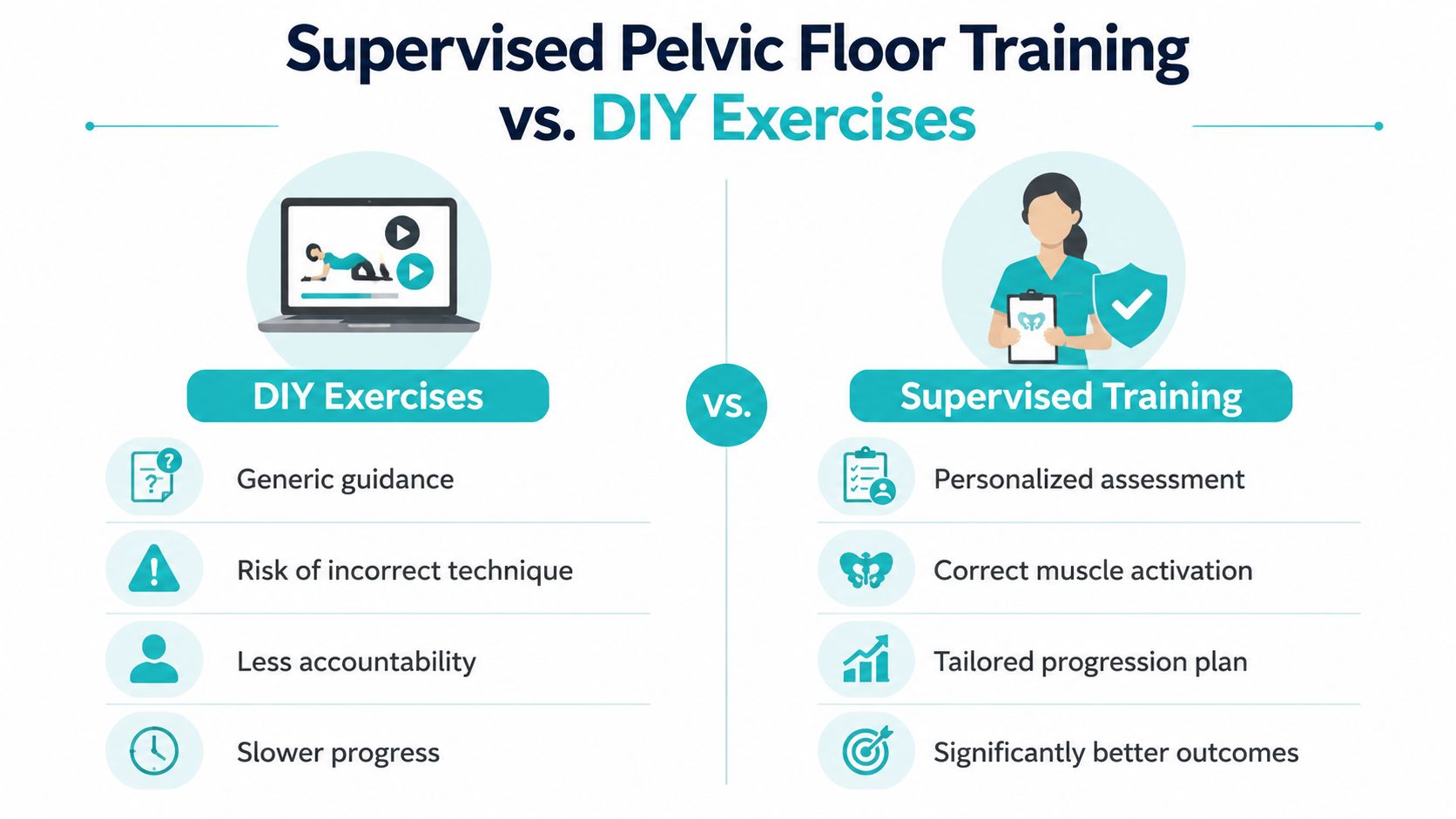
A therapist can assess contraction and release, breathing, abdominal pressure, scar mobility, prolapse symptoms, and movement patterns. That changes the plan from “do more Kegels” to a targeted program that may include strengthening, down-training, bladder strategies, mobility work, and graded return to impact.
Where vaginal cones fit
Vaginal cones can provide feedback and a progressive resistance challenge for selected patients. They aren't a universal solution, and they shouldn't be used when insertion is painful, healing is incomplete, or a clinician has identified a reason to avoid them. A therapist can determine whether cones add value or encourage excessive gripping.
Self-directed exercises remain useful between visits. The trade-off is precision. A supervised program gives you correction, accountability, and progression, while home practice builds the repetition needed to carry new coordination into lifting, coughing, walking, and exercise.
When to Seek Pelvic Floor Physical Therapy
Book a pelvic floor evaluation when leakage interferes with daily activities, worsens with time, returns as activity increases, or keeps you from exercising. Pelvic pain, painful intercourse, pelvic pressure, a vaginal bulge, difficulty emptying your bladder, or bowel and gas-control changes also deserve professional attention. These symptoms can overlap, and treating only the leak may leave the underlying movement problem unchanged.
You don't need to wait until symptoms become severe. A therapist can help clarify whether your primary issue is weakness, poor timing, excessive tension, pressure management, bladder urgency, or a combination.
What happens during an evaluation
The first visit usually starts with a detailed conversation about your pregnancy, delivery, bladder habits, leakage triggers, bowel function, pain, goals, and current activity. The therapist may observe posture, breathing, abdominal movement, lifting mechanics, and the way you coordinate your trunk and pelvis.
With your consent, an internal assessment may evaluate pelvic-floor contraction, relaxation, tenderness, tissue healing, and support. You can ask questions, decline any part of the examination, and request an explanation before each step. A respectful evaluation should leave you with a clear plan, not embarrassment.
You shouldn't have to prove that your symptoms are serious enough to deserve care. If bladder control is changing how you move through the day, that's a reasonable reason to seek help.
Treatment may include education, breathing practice, pelvic-floor strengthening or relaxation, bladder retraining, scar care, hip and trunk strengthening, and gradual return to impact. Learn more about pelvic floor physical therapy after childbirth before your appointment so you know what questions to bring.
Postpartum Bladder Control Treatment at Lake City Physical Therapy
A typical patient journey begins with a conversation rather than a prescription for endless Kegels. Sheree Dibiase, PT, leads Lake City Physical Therapy's women's health program, where clinicians tailor pelvic floor and postpartum rehabilitation to the patient's symptoms, delivery history, healing stage, and goals.
A patient may arrive because she leaks while lifting her infant. During evaluation, the therapist may identify a combination of pelvic-floor weakness, breath-holding, abdominal pressure, and reduced trunk coordination. Her plan can then address those findings together, while also screening for related concerns such as prolapse, diastasis recti, pelvic pain, or painful intercourse.
Care that fits postpartum life
Treatment can include in-person visits at clinics in Coeur d'Alene, Hayden, Post Falls, Rathdrum, Liberty Lake, Spokane South Hill, Eagle, and Boise, along with telehealth options for patients who can't travel easily. Online scheduling and educational resources, including ebooks on pelvic health and postpartum recovery, can support care between appointments.
The practice's approach isn't limited to the first weeks after birth. A patient returning to running may need impact progression, while someone with urgency may need bladder retraining and relaxation strategies. Someone with persistent pressure or abdominal bulging may need a broader pelvic and core assessment.
If you're researching products for urinary comfort, separate those options from rehabilitation. For example, you can find Cystiregul flash powder, but a supplement or urinary product doesn't assess pelvic-floor coordination, prolapse, pain, or movement mechanics. Persistent postpartum leakage still warrants evaluation by an appropriate healthcare professional.
Lake City Physical Therapy is one available care option for women who want individualized postpartum bladder-control rehabilitation, whether they need local treatment or telehealth support.
Common Questions About Postpartum Bladder Recovery
Is postpartum incontinence permanent?
Not necessarily. Symptoms may improve, remain stable, or return as activity increases. Because persistence beyond the early checkup is common, ongoing leakage should be assessed rather than dismissed.
How quickly will therapy help?
Progress depends on the type of incontinence, healing, muscle coordination, pain, activity demands, and consistency. Supervised training gives you feedback and a progression plan, but meaningful recovery still requires regular practice outside appointments.
Is exercise safe if I leak?
Choose activity that doesn't increase leakage, pain, pressure, or bulging. Walking and controlled, low-impact movement may be appropriate when medically cleared, while running, jumping, and heavy lifting should return gradually with symptom monitoring.
Can Kegels make symptoms worse?
Yes, if you bear down, hold your breath, or repeatedly tighten muscles that need to relax. Correct technique includes both a gentle lift and a complete release, which is why an assessment can be valuable.
Could another pregnancy worsen existing symptoms?
It may add another period of pelvic and abdominal demand, but the safest approach is to address current leakage, pain, pressure, or weakness before pregnancy and maintain a personalized strength and coordination plan with your healthcare team.
Lake City Physical Therapy provides individualized pelvic floor and postpartum rehabilitation for bladder leakage, pelvic pressure, abdominal changes, and related pain, with in-person clinics and telehealth options. Visit Lake City Physical Therapy to review postpartum care options and schedule an evaluation that matches your recovery goals.

