Postpartum Rib Pain: Causes, Red Flags and Relief
Nearly 82.5% of 400 postpartum women in a 2025 study reported pain in at least one upper-body location, including the neck, shoulders, arms, or hands, according to the study authors in Clinical and Experimental Obstetrics & Gynecology. Rib and chest-wall soreness belongs in that same recovery picture, and it is easy to misread. A tender spot under the bra line can be muscle strain from a rib cage that spent months wider than usual. It can also be a problem that needs a clinician today, or emergency care right now.
Postpartum rib pain is often mechanical. Feeding, lifting, and carrying keep loading tissues that were already stretched. Isolated rib pain has not been counted on its own, so a whole-body pain figure should not be read as a rib-pain rate.
Before any stretch, sort the symptom. Chest pressure, trouble breathing, fainting, coughing blood, or a swollen painful leg is not a home-care problem. Pain you can reproduce with movement, and without those signs, can be eased while you decide whether it needs an assessment.
Emergency Warning Signs to Act on Now
Sort the symptom before you stretch, ice, or change a feeding position. This table is a triage guide, not a diagnosis. It orders patterns from most urgent to least urgent so you can pick an action in the next few minutes.
| Symptom | What It May Suggest | Action |
|---|---|---|
| Chest pressure, shortness of breath, fainting, or coughing blood | Serious cardiopulmonary condition, including pulmonary embolism | Emergency care now |
| Sudden sharp chest pain that worsens with breathing | Possible lung or pleural cause | Emergency evaluation |
| Pain or swelling in one leg, with chest or breathing symptoms | Possible blood clot | Emergency evaluation |
| Fever with rib-area or back-side pain, or painful urination | Possible kidney or other infection | Same-day medical review |
| Pain that keeps worsening despite rest | Source needs clinician examination | Prompt clinician review |
| Tender, movement-related pain with no breathing, fever, or leg symptoms | Musculoskeletal or chest-wall strain | Self-care, then physical therapy assessment if not settling |
How to read the three tiers
Emergency symptoms are the first three rows. ACOG advises emergency evaluation for postpartum chest pain, breathing difficulty, or leg pain and swelling, because these symptoms can indicate serious complications such as pulmonary embolism. Sudden sharp chest pain that worsens with inhalation, faintness, and swollen legs sit in that same urgent group. Chest pressure, coughing blood, or pain spreading into the arm, jaw, or back does too. Call emergency services. Don't drive yourself if you feel faint or short of breath.
Same-day symptoms are the next two rows. Pain under the back or side of the rib cage, together with fever or painful urination, can point to a kidney infection rather than a rib strain. Pain that keeps building even when you rest also needs someone to examine the source. Arrange medical review the same day. A routine therapy booking is the wrong queue for this tier.
Routine symptoms are the last row. Tender pain you can clearly bring on by pressing, twisting, reaching, or shifting position, with no breathing trouble, fever, or leg symptoms, fits a chest-wall strain. Self-care is reasonable while you watch it. Book a clinician if it does not settle.
A sore spot you can press does not clear you. Costochondritis, tenderness where a rib meets the breastbone, can coexist with another cause of chest pain, so a tender point does not rule out a heart or lung problem, as costochondritis clinical guidance notes. If any emergency feature shows up beside that tender rib, follow the emergency tier.
What to tell the clinician
Write these details before the visit, or ask a partner to note them if you are in pain:
- Onset: when it started, and whether it hit suddenly or built over days.
- Exact location: front, side, or back of the rib cage, one spot or a band.
- Quality: sharp, aching, pressure, or burning.
- Change with demand: whether breathing, exertion, lifting, or feeding alters it.
- Context: any fall, hard cough, fever, or new swelling in one leg.
Practical rule: Call emergency services for the first tier. Arrange same-day review for the second. Book a clinician for routine pain that does not settle.
How Common Postpartum Rib Pain Is and How Long It Lasts
A 2024 study of 432 women, seen six to eight weeks after childbirth, found that 49.8% experienced postpartum pain in at least one body region, according to the study authors in the European Spine Journal. That figure covers the whole body, not the ribs alone. No published rate isolates rib pain after birth. The plausible link is still mechanical. The rib cage widens in pregnancy, the abdominal wall stretches, and feeding, carrying, and lifting load the chest wall over and over.
Pain that is still there at four months
A prospective cohort of 209 women who had low-back or pelvic pain late in pregnancy found that 101 participants, or 48%, still reported pain four months after delivery, in a cohort study of persistent postpartum pain. Low-back pain in that study meant pain between the 12th rib and the gluteal folds, so the lower ribs sit inside the region they tracked. The authors also noted that earlier population-based studies reported postpartum low-back or pelvic pain rates between 30% and 50%.
These figures are not a prevalence for rib pain by itself. They measure broader lumbopelvic pain, which can overlap with lower-rib, thoracolumbar, and abdominal-wall symptoms. The practical point is timing. Pain past the early recovery weeks can last for months, and it deserves a structured look when it limits lifting, feeding, sleep, breathing comfort, or infant care. If you are judging how long postpartum symptoms should linger, treat ongoing rib-area pain as a reason to be assessed, not as something you have to outwait.
A weekly record worth keeping
Each week, write three lines and bring the page to any appointment:
- The pain: where it sits, and whether it is better, worse, or the same.
- The triggers: which positions, reaches, or lifts set it off.
- The tasks: feeding, sleep, carrying, or stairs it gets in the way of.
A week of notes beats trying to reconstruct a bad Tuesday in the waiting room.
Mechanical Causes Behind Postpartum Rib Pain
The rib cage spent months stretched wider, like a barrel pushed outward that has not settled back. During pregnancy it expands sideways so the lungs can keep working. That stretch can overwork the upper-back muscles, shorten the chest muscles, and round the shoulders forward. The enlarging uterus stretches the abdominal wall at the same time, so more load falls on the costovertebral, costosternal, and intercostal tissues. A neuromusculoskeletal review describes those rib-cage and abdominal-wall changes. The same loading often starts before delivery, which is why rib pain during pregnancy and soreness afterward can feel like one continuous ache.
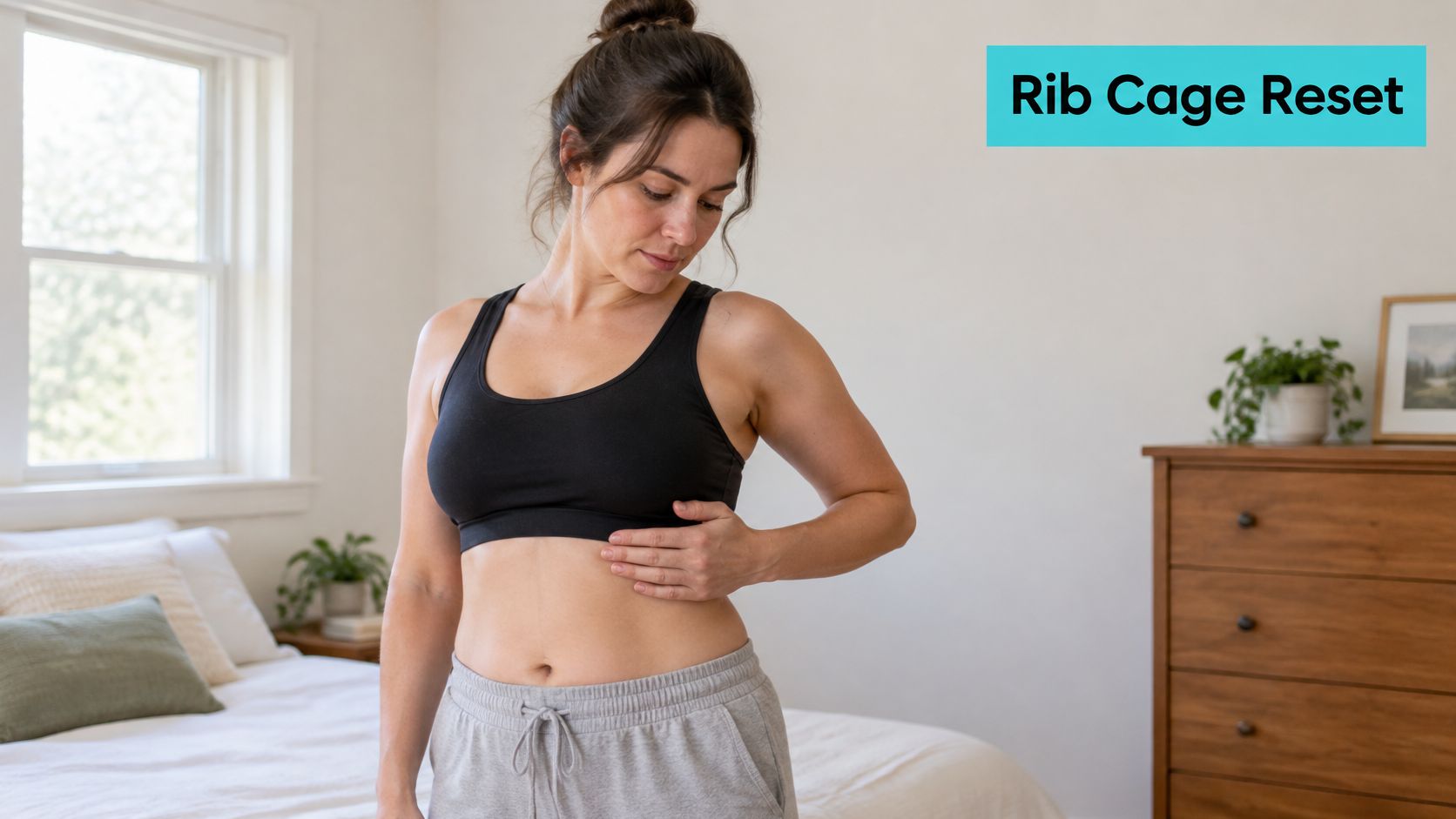
Light self-massage along the sore rib can feel useful once urgent causes are out of the picture. It is not a test that proves the pain is harmless.
Local causes and one clue each
- Costochondritis: tenderness where the ribs meet the breastbone, often sharper with a deep breath or a hug.
- Intercostal strain: pain between the ribs that spikes when you twist or reach for a bottle.
- Myofascial pain: a tender knot in the chest wall or upper back that a fingertip can find.
- Rib stress or a fracture after trauma: focal pain after a fall, a direct blow, or a violent cough. That needs a clinician's decision about imaging, not a home stretch.
Postures that keep reloading the same joints
Slouched feeding, a twist to clip a car seat, and a hunched phone hold the rounded-shoulder shape for long stretches. Say you feed on the couch for forty minutes, lift the baby from a low bassinet, then turn toward the changing pad in one motion. Each piece is small. Together they reload the same joints.
Pain you can reproduce by pressing the rib or moving the arm supports a chest-wall source. It does not exclude heart or lung disease. A screen has to look past the sore spot.
What gets checked in the room
Breathing mechanics, how far the mid-back and shoulders move, posture, abdominal-wall function, and how symptoms respond to a small, graded movement. Hands-on care comes after that screen, and only when the urgent patterns are absent.
If the pain changes when you simply turn your head or lift your arm overhead, the neck or shoulder may be referring pain into the rib region. Mention that pattern so it is not treated as a rib-only problem.
Gentle Movements That Ease Rib and Chest Wall Tension
Use these only for routine, movement-related soreness. Stay under the intensity that provokes pain. If pain sharpens, breathing gets difficult, or symptoms spread, stop and use the urgent path instead of the next rep.
The graphic below shows four of the gentlest options. The steps after it add two progressions once those feel easy.

-
Supported diaphragmatic breathing. Lie or sit with your knees bent and one hand on the lower ribs. Breathe slowly so the ribs widen sideways, for five to ten breaths, twice a day. The point is to let the rib cage move instead of bracing it still. Stop if the breath itself hurts or you get lightheaded.
-
Side-lying rib stretch. Lie on your side and reach the top arm overhead while you breathe into the open side. This eases the tissues between the ribs after long periods of hunching. Stop if you feel a sharp catch.
-
Thoracic extension over a towel. Sit on a firm chair with a rolled towel behind your upper back and lean back gently for a few breaths. It counters the rounded shape without forcing the spine. Stop if pain shoots around the chest.
-
Seated rotation, hips still. Sit tall and turn the upper body slowly to each side, holding about five easy breaths. Rotation restores the twist you use when you reach for wipes or a cup. Stop if discomfort radiates into the arm, jaw, or back.
-
Doorway or wall chest opener. Rest a forearm on a doorframe or wall and step forward slightly so the chest muscles lengthen. Tight pectorals pull the shoulders forward and keep the upper back working overtime. Stop if you feel tingling, chest pressure, or shortness of breath.
-
Scapular setting, then a little load. Draw the shoulder blades gently down and back, hold for a breath, and release. When steps 1 through 5 feel easy, add a small load, such as a light household item held close to your body, rather than jumping into planks. Postpartum core strengthening exercises belong in this later stage, matched to what your exam shows, not to a generic calendar.
Stop the set if pain sharpens, breathing becomes difficult, or symptoms spread. That is an assessment problem, not a cue to push through.
Feeding, Lifting and Holding Baby Without Adding Strain
Positions matter more than willpower. A small change in height or distance takes load off the ribs for the whole feed or the whole carry.

Breastfeeding or bottle feeding. Bring the baby up to you with a nursing pillow or a firm cushion so you are not curling down to the latch. Support the baby's full weight on the pillow, not on your wrist and rib cage. Alternate sides so one costal margin does not take every feed.
Lifting from a cot or the floor. Bend at the hips and knees, keep the baby close to your trunk, and turn your feet instead of twisting while you hold the load. A twist under even a small baby is a common way intercostal pain flares.
Hip carries, car seats, and bags. Switch hips often and keep your shoulders level rather than hiking one side. Carry a car seat or a heavy bag close to your body, or split the load between both arms. Hand the heaviest item to a partner when you can.
Changing and long holds. Set the changing surface near waist height so you are not folded forward for every diaper. During long feeds or rocking, change position about every 20 to 30 minutes. A timer on your phone is enough.
This short clip shows a supported feeding setup you can copy with the pillow you already own.
Scan this once a day until the ache calms:
- Feeding posture: baby raised, shoulders relaxed.
- Lifting: hips and knees bend, baby stays close, no twist.
- Carrying side: switched, shoulders level.
- Change-table height: near your waist.
- Breaks: a position change during long holds.
Confirm Your Next Step With a Clinician
Match the next step to the tier you are in. Emergency symptoms mean you call emergency services now. Fever, urinary pain, a painful or swollen calf, or pain that keeps worsening means same-day medical review. Routine, movement-related pain that has not settled across the weeks you tracked means an assessment, not another month of stretching alone.
What to expect at that visit
- The history covers onset, exact location, quality, how long each episode lasts, changes with breathing, fever, cough, trauma, and any leg symptoms.
- The exam usually includes palpation of the front and back of the chest wall, heart and lung checks, and a screen of the neck and shoulder for referred pain.
- Bring the weekly pain record and the list of tasks it interrupts. That page turns a vague "it hurts when I hold the baby" into a plan.
Lake City Physical Therapy offers Prenatal & Postpartum Physical Therapy for pain that is clearly in the routine tier and still limits feeding, lifting, or sleep. We also offer a free ebook, "Six Postpartum Health Tips for New Moms." Physical therapy does not replace emergency care when red-flag symptoms are present. The correct next step is always the one that matches your tier.
If rib soreness is limiting how you feed, lift, or rest, and emergency symptoms are absent, Lake City Physical Therapy offers prenatal and postpartum physical therapy that looks at breathing, posture, and how you move with your baby. Care is built around an individual assessment rather than a generic stretch list. Visit Lake City Physical Therapy to schedule that visit or see which clinic is closest to you.

