Navigate Recovery after Childbirth Confidently
The most common postpartum advice is also one of the least helpful: “Just get through six weeks.”
If you've recently given birth, you already know recovery after childbirth doesn't feel that neat. Your body may feel sore, swollen, heavy, tired, disconnected, or all of those at once. You may also feel pressure to act like a single checkup will tell you everything is fine.
That model misses what real healing looks like. Postpartum care is still often treated like a one-visit event, even though recovery is most intense earlier and can continue for months. MedBridge describes this as a major gap in care, noting that the first 12 weeks are a critical recovery window and that many parents are left to go through healing without structured guidance in the MedBridge discussion of the six-week gap in postpartum care.
As a women's health physical therapist, I want you to hear this clearly: struggling doesn't mean you're failing, and feeling “not back to normal” at six weeks doesn't mean something is wrong with you. It usually means your body needs a more realistic roadmap.
A practical place to start is with an informed postpartum recovery guide that looks at healing as a process, not a deadline. If you want an even deeper look at how long healing can take, this overview on how long postpartum recovery lasts is also helpful.
Beyond the Six-Week Checkup Your Real Recovery Journey
The six-week visit matters. It just isn't the whole story.
Many new mothers are told to wait, rest, and come back at six weeks. That sounds simple, but real recovery after childbirth rarely follows a clean calendar. Some tissues heal quickly. Others recover slowly. Muscles and fascia may be weak. Scar tissue may feel stiff. Hormonal changes can affect energy, mood, joints, and pelvic support.
Why the old timeline falls short
A single clearance visit can make postpartum healing sound like a sprint. It's closer to rebuilding a house after a storm. First, you protect the structure. Then you repair the visible damage. After that, you restore strength, stability, and function.
That matters because postpartum recovery is both physical and emotional. If care only checks whether bleeding has slowed or an incision looks closed, it can miss the daily issues that affect quality of life, such as leaking, pressure, pain with movement, or fear of doing too much.
Recovery after childbirth isn't about “bouncing back.” It's about regaining function, comfort, and confidence in a changed body.
What a better framework looks like
I prefer to think in phases, not deadlines. In the early days, the goal is protection and basic healing. In the next stretch, the focus shifts to reconnecting with breath, core, and pelvic floor. Later, you rebuild strength and tolerance for daily life, exercise, and impact.
That phased approach helps answer the questions most mothers ask:
- “Is this normal right now?” Some soreness, fatigue, and swelling are common early on.
- “When should I worry?” Symptoms that persist, worsen, or interfere with daily function deserve attention.
- “When should I start PT?” Often earlier than people assume, especially if pain, pressure, leaking, or core weakness are showing up.
The point isn't to make you hypervigilant. It's to replace vague reassurance with useful guidance.
What to Expect Week by Week After Birth
Postpartum recovery after childbirth makes more sense when you break it into stages. I use a simple house-building analogy with patients. In the first phase, you secure the foundation. In the second, you reconnect the support beams. In the third, you start loading the structure again.
This staged view also fits modern postpartum guidance. ACOG, as summarized in Cleveland Clinic's postpartum overview, moved away from a single six-week checkup model and recommended contact within the first 3 weeks after delivery, followed by ongoing care as needed and a thorough visit no later than 12 weeks in the Cleveland Clinic summary of postpartum care.
Postpartum Recovery Timeline at a Glance
| Phase | Key Physical Focus | Emotional & Mental Focus | Gentle Activity Goal |
|---|---|---|---|
| Immediate Healing 0 to 2 weeks | Bleeding, swelling, tissue repair, incision or perineal healing, rest | Overwhelm, sleep disruption, adjusting to constant change | Short walks around the home, position changes, breathing |
| Early Reconnection 2 to 6 weeks | Better pressure management, bowel and bladder habits, gentle core and pelvic floor awareness | Confidence building, frustration with slow healing, asking for help | Walking a bit more, breath-based core work, light mobility |
| Foundational Rebuilding 6 to 12 plus weeks | Strength, endurance, scar mobility, pelvic support, return to exercise planning | Rebuilding trust in the body, navigating identity and routine | Progressive strengthening, low-impact cardio, symptom-guided loading |
Immediate healing feels messy because it is
In the first phase, your body is handling several jobs at once. The uterus is shrinking back down. Bleeding gradually changes. Hormones shift quickly. Tissues stretched by pregnancy and birth begin repairing. If you had a cesarean birth, you're also healing from abdominal surgery.
That's why the first days can feel contradictory. You may be sitting still most of the day while your body is doing enormous internal work.
Early reconnection is not “back to normal”
Between two and six weeks, many mothers expect to feel dramatically better. Some do. Many don't. You may notice that basic tasks feel harder than they look. Rolling in bed, standing up while holding the baby, climbing stairs, and carrying the car seat all test your core and pelvic floor before they're ready for big demands.
This is often the phase where people get confused. The outside may look healed, but the inside still needs support. That's why a symptom-guided approach is more useful than waiting for one universal milestone.
Practical rule: If an activity increases pain, pressure, bleeding, heaviness, or leaking, your body is asking for a smaller step.
Foundational rebuilding starts after basic healing
After six weeks, some people are cleared for exercise. Clearance only means there isn't a major medical reason to avoid activity. It does not automatically mean your pelvic floor, abdominal wall, breathing mechanics, and load tolerance are ready for running, jumping, or intense core work.
A better question is not “Am I six weeks yet?” It's “Can I do this without symptoms during or afterward?”
That shift changes everything. It helps you respect the body you have now, instead of testing it against a deadline.
Navigating the First Two Weeks of Postpartum Recovery
The first two weeks are about healing, not performance. Your main jobs are rest, comfort, hydration, gentle movement, and letting other people help with the nonessential things.

If you had a vaginal birth, the pelvic floor and perineum may feel bruised, swollen, or stingy. If you had a cesarean birth, your lower abdomen may feel sore, tight, numb, or guarded. In both cases, your body benefits from frequent position changes, short easy walks, and plenty of lying down.
The first goal is comfort, not conditioning
Try to think of your body like a phone on low battery. Every diaper change, feeding session, bathroom trip, and visitor conversation drains some charge. You won't rebuild your battery by pushing harder. You recharge by reducing demand where you can.
A few simple strategies help:
- Use support when sitting: A pillow, folded towel, or side-lying position can reduce pressure on sore tissue.
- Log-roll to get out of bed: Roll to your side first, then push up with your arms rather than doing a sit-up.
- Take small walks: A slow lap to the bathroom, kitchen, or mailbox can be enough early on.
- Exhale with effort: Breathe out as you stand up, lift the baby, or change positions to reduce pressure through the abdomen and pelvic floor.
Start with 360-degree breathing
Your first core exercise usually isn't a crunch. It's breathing.
Place one hand on your ribs and one on your lower belly. Inhale and let the ribs widen gently in all directions, like an umbrella opening. Exhale slowly and feel the ribs soften inward. Don't force your stomach flat. Don't clench your pelvic floor.
This kind of breathing does two important things. It calms the nervous system, and it begins to reintroduce coordinated pressure control between the diaphragm, abdominal wall, and pelvic floor.
Gentle walking is still part of healing
Many mothers worry that if they had an epidural, early mobility will be harder or delayed. A 2023 PLOS ONE study found that women who received neuraxial labor analgesia had no significant difference in daily step counts compared with those who did not in the PLOS ONE study on postpartum recovery and epidural use.
That's reassuring. Pain relief during labor doesn't appear to worsen early ambulation-based recovery. So if your care team says it's safe to move, short and gentle walking is usually a helpful part of recovery after childbirth.
Your walk does not need to “count” as exercise. It only needs to support circulation, confidence, and basic function.
How to Safely Reconnect With Your Core and Pelvic Floor
By the time bleeding and soreness begin to settle, many mothers want to “work on their core.” That's a good instinct, but the right starting point is usually coordination, not intensity.
Think of your deep core as a canister. The diaphragm is the lid on top. The pelvic floor is the base. The transverse abdominis wraps around the middle like a gentle corset. The multifidus are small stabilizing muscles along the spine. When these parts coordinate, they manage pressure and support movement.

Build the canister from the inside out
If one part of the canister overworks while another part lags, you may feel doming through the belly, heaviness in the pelvis, breath-holding, or back discomfort. That's why the first layer of rehab is neuromuscular. You're reteaching timing.
A simple progression looks like this:
-
Breath first
Inhale into the ribs and belly without forcing. Exhale slowly and feel the lower abdomen gently gather inward. -
Add pelvic floor awareness
During the exhale, imagine gently lifting a blueberry with the vaginal and anal muscles. The effort should feel subtle, not gripping. -
Add deep abdominal support
Think of zipping up snug jeans halfway, not sucking your stomach in hard. The lower belly should narrow slightly while you keep breathing. -
Practice during real tasks
Use that same exhale-and-support pattern when standing up, lifting the baby, or moving in bed.
For more ideas on steady, low-threat progressions, MEDISTIK's tips for core stability give useful examples of how consistency and control matter more than intensity early on.
How to check for coning or doming
One common question is diastasis recti, or abdominal separation. A self-check can be helpful, but don't turn it into a pass-fail test.
Lie on your back with knees bent. Support your head, then gently lift your head and shoulders a little, as if starting a crunch. Look down your midline. If you see the belly push upward into a ridge or tent shape, that's often called coning or doming. It's a sign the abdominal wall isn't managing pressure well in that moment.
If you notice that, modify the exercise. Exhale sooner. Reduce the effort. Support your body with your hands. Return to easier positions.
The right question is function
A gap in the abdomen is only one piece of the picture. The more useful question is whether your trunk can manage pressure during daily life. Can you cough, carry, roll, stand, and lift without bearing down, bulging, or feeling unstable?
If not, a guided plan helps. This overview of postpartum core strengthening exercises shows what a safer progression can look like.
A strong core after birth doesn't start with hard exercise. It starts with breath, timing, and pressure control.
Your Guide to Returning to Exercise After Childbirth
The best return-to-exercise plan after childbirth is symptom-guided. Not calendar-guided.
That means you use your body's responses as the traffic lights. Green light symptoms tell you a step is going well. Red light symptoms tell you to scale back, modify, or get help.
Here's a practical visual to keep in mind:
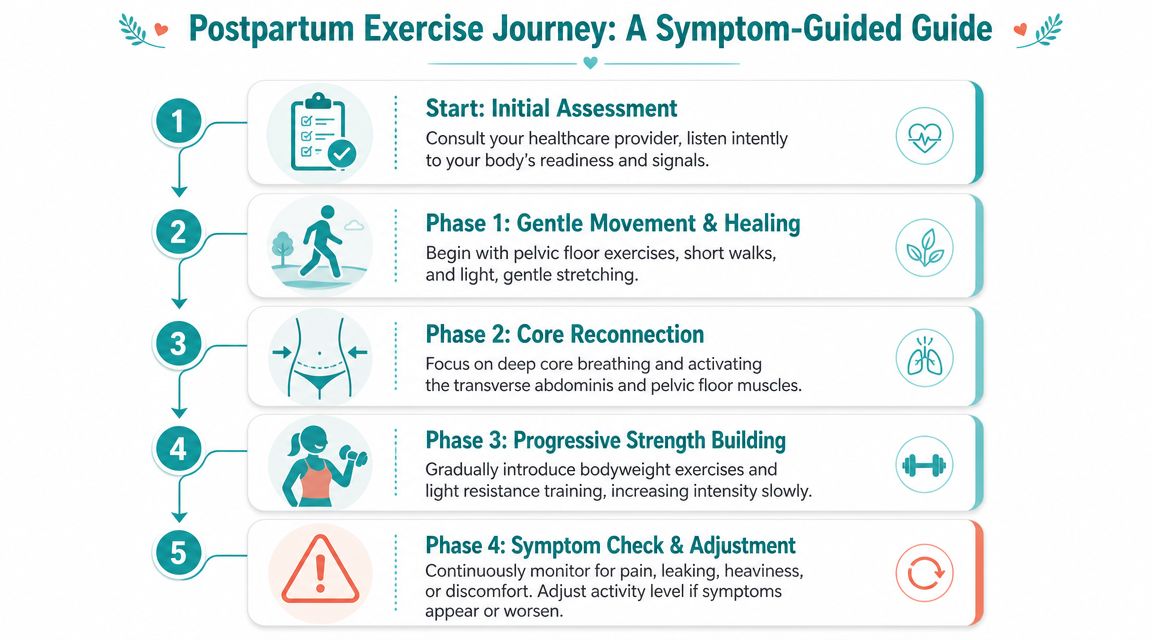
Phase 1 gentle movement and walking
Start with short walks, easy mobility, breathing, and basic posture changes. Your green lights are feeling steady during the activity and not worse later that day.
Red lights include increased bleeding, pelvic heaviness, sharp pain, or a sense that everything feels more irritated afterward.
Phase 2 bodyweight strength and low-impact cardio
This stage may include sit-to-stands, bridges, supported squats, light band work, and longer walks or gentle cycling if tolerated. The key is that your breathing stays natural and you aren't bracing aggressively.
A useful question here is whether you can move without compensation. If every rep makes you hold your breath, grip your glutes, or bulge through the abdomen, the exercise is too demanding right now.
The video below offers a helpful movement reference for this stage.
Phase 3 introducing load and light impact
Once your body tolerates the earlier phases, you can begin adding resistance, speed, and eventually some impact. That might mean carrying groceries more confidently, lifting weights, hiking hills, or reintroducing brief impact drills depending on your goals.
Green lights look like this:
- No leaking: Your bladder stays quiet during and after exercise.
- No pressure: You don't feel vaginal heaviness or a dropping sensation.
- No pain flare: The pelvis, abdomen, back, and scar tissue settle well afterward.
- No doming: Your abdominal wall manages pressure without obvious bulging.
Phase 4 return to higher-impact exercise or sport
Running, jumping, CrossFit-style workouts, court sports, and intense abdominal training ask a lot from the pelvic floor and abdominal wall. They're not bad. They just require a base.
If symptoms appear, don't read that as failure. Read it as information. You may need less load, more recovery, better breathing mechanics, or a more gradual build.
One postpartum rehab option some parents use for this process is an individualized assessment through a women's health provider such as Lake City Physical Therapy, which offers postpartum rehabilitation focused on pelvic floor function, core strength, scar mobility, and return-to-activity planning.
Addressing Pain Incontinence and Prolapse Postpartum
Many postpartum symptoms are common. That does not mean you have to accept them.
The World Health Organization reported in 2023 that at least 40 million women each year are likely to experience long-term health problems caused by childbirth. In that same report, WHO listed postpartum rates including more than one-third for dyspareunia, 32% for low back pain, 19% for anal incontinence, 8% to 31% for urinary incontinence, and 11% for perineal pain in the WHO report on lasting health problems after childbirth.
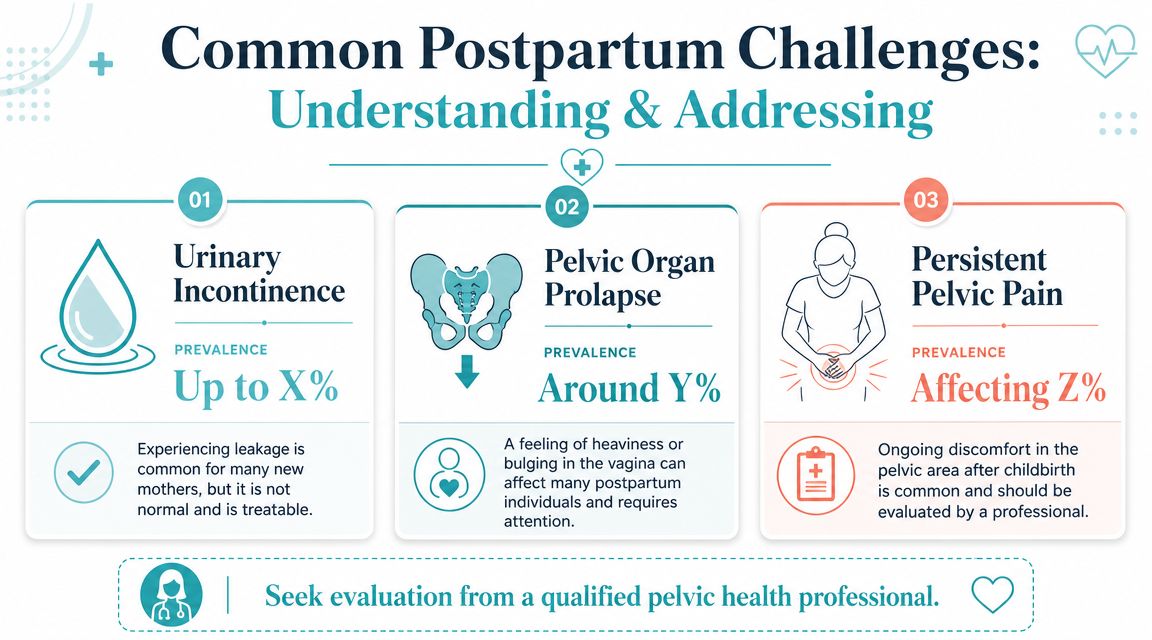
Urinary leakage
Leaking after birth usually reflects a pressure-management problem, a pelvic floor coordination problem, or both. Pregnancy loads the system for months. Birth can stretch or strain it further. Then daily life asks you to cough, carry, squat, and lift before those tissues are ready.
You might leak with sneezing, urgency, jumping, or running. That's common postpartum, but it isn't something you should have to “just live with.” If you want a plain-language overview, this guide on what causes urinary incontinence in women explains the mechanics well.
Pelvic organ prolapse
Prolapse often feels like heaviness, dragging, fullness, or a bulging sensation in the vagina. Patients often describe it as “it feels like something is falling out,” even when nothing is visible.
A simple analogy helps. Think of the pelvic floor like a hammock under the pelvic organs. If that hammock is strained and pressure from above is high, support can feel less secure. Rehab often focuses on improving pressure control, strength, endurance, and symptom management.
Painful sex and persistent pelvic pain
Pain with intercourse can have several layers. Scar sensitivity, dryness, muscle guarding, fear, nerve irritation, and pelvic floor overactivity can all contribute. That's why “just relax” is such unhelpful advice.
Common symptoms deserve attention. You are not overreacting by asking questions about leaking, heaviness, or pain.
Low back pain and perineal pain can also stick around longer than people expect. If pain is limiting movement, intimacy, exercise, or basic comfort, that's a strong sign to get a professional assessment.
When to See a Pelvic Floor Physical Therapist
You don't need to wait until things are severe. A pelvic floor physical therapist can help when symptoms are small, new, confusing, or not improving.
The broad rule is this: if recovery after childbirth feels stalled, painful, or functionally limited, get evaluated. American Pregnancy notes that postpartum recovery is typically defined as the first 6 to 8 weeks, while ACOG guidance summarized there recommends contact within 3 weeks postpartum and a detailed visit by 12 weeks in the American Pregnancy overview of postpartum recovery.
Good reasons to book an evaluation
Consider pelvic floor PT if you notice any of the following:
- Leaking or urgency: Urine leakage with cough, exercise, or sudden urges.
- Pelvic heaviness: Pressure, bulging, or the sense that something is dropping.
- Ongoing pain: Perineal pain, scar pain, back pain, or pain with sex.
- Core concerns: Doming, weakness, trouble getting out of bed, or feeling disconnected from your abdomen.
- Exercise setbacks: Symptoms return every time you try to progress activity.
- Bleeding or discomfort that doesn't settle: Persistent symptoms beyond the early recovery window deserve evaluation.
What an evaluation usually includes
A good postpartum PT assessment looks at more than the pelvic floor. It often includes breathing mechanics, abdominal wall function, movement patterns, scar mobility, posture, strength, and how symptoms show up during real tasks.
If you live in North Idaho or Eastern Washington, working with a local women's health team can make this process easier, especially if you need in-person follow-up or telehealth support.
If you want support that matches what recovery after childbirth looks like, Lake City Physical Therapy provides pelvic floor therapy and postpartum rehabilitation for leaking, heaviness, pain, core weakness, scar restrictions, and return-to-exercise planning. The practice serves patients in Coeur d'Alene, Hayden, Post Falls, Rathdrum, Liberty Lake, Spokane South Hill, Eagle, and Boise, and also offers telehealth options for women who need flexible care.