Women’s Return to Play Guidelines After Injury or Childbirth
You may be sitting on the edge of a return you've wanted for weeks, months, or longer. Your baby is finally napping long enough for a walk. Your incision has healed, but twisting still feels uncertain. Your cancer treatment is behind you, yet your body doesn't feel like the same body that used to run, lift, dance, hike, or compete. You're cleared for activity, but no one has really told you what that means in real life.
That gap matters. Women are often told to “listen to your body,” but not taught how to interpret what the body communicates. Is pelvic heaviness a sign to stop, or a sign to modify? Is leaking during a jog a normal phase, or useful feedback? If fatigue changes day to day, how do you know whether to push, hold steady, or back off?
Good return to play guidelines don't rush you back and they don't keep you stuck. They give you a framework for progressing with purpose. In women's health, that framework has to account for the core, pelvic floor, pressure management, scar mobility, fatigue, hormonal shifts, and the demands of motherhood, work, treatment recovery, and sport. A calendar alone can't do that.
Beyond the Sidelines Your Guide to a Confident Return
You lace up for the first real workout since birth, surgery, or treatment. Warm-up feels fine. Then the questions start. Is that pelvic heaviness a warning sign or simple deconditioning? Does fatigue mean stop today, or scale the session and keep going? A confident return starts when those questions have clear answers.

Why the old advice falls short
Women are often given two options that miss the mark. Rest until you feel normal, or jump back in because you have been cleared. In practice, recovery sits in the middle. Capacity builds in stages, and tissues, breathing mechanics, the abdominal wall, and the pelvic floor do not always recover on the same timeline.
That matters even more for women returning after postpartum recovery, pelvic floor symptoms, or cancer care. Generic return-to-play advice usually centers on orthopedic healing or concussion progression. It rarely addresses pressure management, leaking, heaviness, scar sensitivity, medication-related fatigue, or the stop-and-start reality of caring for children while trying to train again.
A better model uses progression. Start with a level your body can repeat well. Recheck symptoms during the session, later that day, and the next morning. Increase one variable at a time. Volume, intensity, impact, or complexity. Not all at once.
Practical rule: Progress based on response, not pressure.
For many postpartum athletes, that begins with restoring pressure control and trunk support before adding impact. Lake City PT's guide to postpartum core strengthening exercises is a useful starting point for that early rebuild.
What confidence actually looks like
Confidence is not blind trust in a calendar. Confidence is knowing your body's current capacity and having a plan for what to do if symptoms show up.
In the clinic, that can look very different from one woman to the next. A new mom may need to carry her baby, finish a walk, and complete strength work without pelvic pressure later that evening. A lifter may be ready to return to the barbell but still need coaching on breath timing so the pelvic floor is not overloaded at the bottom of a squat. A runner after C-section or oncology treatment may tolerate short bouts of impact, but need longer recovery between sessions while endurance and tissue tolerance catch up.
Those are real trade-offs. Pushing too fast can flare symptoms and cost training time. Waiting for every sensation to disappear can keep women stuck far longer than needed.
Good return-to-play guidelines help you train with more precision. You build repeatable tolerance, test it, then add demand. That is how women return to sport with more clarity, fewer setbacks, and a stronger sense of control in their own bodies.
Build Your Foundation Before You Begin
Before the first interval, class, practice, or lift, start with two decisions. First, make sure the right medical provider has cleared you for activity. Second, get a baseline that goes beyond “you're fine to exercise.”
Clearance is the starting point, not the whole plan
Clearance from your OB/GYN, surgeon, oncologist, sports medicine physician, or primary care provider matters because it answers the tissue-healing and medical-safety question. It does not automatically answer the loading question. Those are different.
The best-supported guidance increasingly treats return to play as a shared decision based on symptom resolution, exertional tolerance, and sport risk, not just time passing, as discussed in this concussion return-to-play white paper. In complex cases, higher-level sports organizations even add another independent clearance layer before contact resumes. That trend matters outside concussion too. Women recovering from childbirth, pelvic symptoms, surgery, or oncology treatment often need more than one perspective.
A provider may say your incision is healed. A physical therapist may identify that your trunk pressure strategy still overloads the pelvic floor during exertion. Both can be true.
What a women's health PT should assess
A useful return to play evaluation doesn't focus on one body part in isolation. It looks at how the system works together.
A thorough starting point often includes:
- Breathing mechanics: Can you expand through the rib cage, manage exhalation, and avoid bearing down with effort?
- Core coordination: Can the abdominal wall contribute to stability without gripping or doming?
- Pelvic floor function: Can the pelvic floor contract, relax, and coordinate with breath and movement?
- Load transfer: Do you control single-leg tasks without collapse, twisting, or symptom provocation?
- Scar and soft tissue mobility: Is scar sensitivity or restriction changing how you move?
- Functional testing: Can you squat, hinge, step down, carry, and transition on and off the floor without compensation?
If you're postpartum and want a practical next step, start with this resource on postpartum core strengthening exercises. It's most helpful when you use it as part of a progression, not as a random list of movements.
The body you're returning with may be different from the one you trained in before. That doesn't make it weaker. It means the strategy has to match the current system.
Questions worth asking before you ramp up
Use these questions to check whether your foundation is ready:
- Can I complete daily tasks without symptom escalation? Think lifting, stairs, walking, and carrying.
- Do I know my key warning signs? Examples include leaking, pelvic heaviness, pain, dizziness, unusual fatigue, or next-day flare.
- Do I have a progression plan? Not just workouts, but criteria for advancing.
- Do I know who to contact if symptoms change? That might be your physician, PT, or both.
Women often assume they need motivation. More often, they need better sequencing.
The Phased Return to Play Protocol
Most women don't need a generic “go easy and see how it feels” plan. They need phases with clear aims, examples, and criteria. That's what makes return to play guidelines useful.
The model below is inspired by modern graduated progression approaches in sports medicine. A foundational change in care is the move away from strict rest and toward a stepwise progression, with the understanding that progression happens only if symptoms stay quiet and each stage should be respected rather than rushed, as reflected in the CDC's graduated return model. For women's health, the same logic applies, but the symptom list is broader.
Four phases that work in real life
Phase 1 reconnect with core and pelvic floor
This phase is about coordination, not intensity. The work is often deceptively simple. Breathing drills, pelvic floor relaxation and activation, deep core engagement, supported bridges, sit-to-stand patterns, and controlled carries build the base.
A woman should stay here if basic loading still creates pressure, leaking, pain, or breath-holding.
Phase 2 build capacity with low-impact activity
Now the goal is tolerance. Walking, incline treadmill work, stationary cycling, low-impact strength circuits, sled pushes, step-ups, and controlled resistance training fit well here. You're teaching the body to handle sustained effort without symptom rebound later in the day.
This is also where recovery habits matter. Some athletes like to review a guide to muscle recovery supplements while dialing in training support, but supplements should sit behind the basics of load management, hydration, sleep, and nutrition.
Phase 3 introduce sport-specific movement patterns
This is the bridge phase. A runner may start run-walk intervals. A CrossFit athlete may reintroduce kettlebell swings, rowing, and lighter barbell cycling. A volleyball player may work on approach mechanics and deceleration. A tennis player may build lateral movement and rotational control.
The focus shifts from general exercise to the specific movement demands that your sport will ask for later.
Phase 4 reintroduce impact and intensity
Impact, acceleration, repeated efforts, heavier lifting, and reactive movement all belong here. This phase works only when the earlier phases were fully earned. If impact exposes pelvic floor symptoms, pain, or poor pressure control, the answer usually isn't more grit. It's a better dosage or a return to the prior phase.
If your goal is jumping, running, or higher-level training after delivery, this guide on returning to high-impact sport activities postpartum is a strong companion to a phased plan.
Phased Return to Play Framework for Women
| Phase | Primary Goal | Example Activities | Progression Criteria (Must be symptom-free) |
|---|---|---|---|
| Phase 1 | Reconnect with core, breath, and pelvic floor | Diaphragmatic breathing, pelvic floor coordination, supported squats, bridges, carries, gentle mobility | Daily tasks and foundational exercises feel controlled, with no pain, leaking, pelvic heaviness, or symptom flare |
| Phase 2 | Build low-impact work capacity | Walking, cycling, elliptical, step-ups, basic strength training, tempo-based resistance work | Tolerates low-impact exercise and recovery remains steady later that day and the next day |
| Phase 3 | Add sport-specific patterns | Run-walk intervals, agility basics, rotational drills, controlled lifting progressions, change-of-direction practice | Handles sport-like movement without symptom return, compensation, or loss of pressure control |
| Phase 4 | Restore impact, intensity, and confidence | Running, jumping, heavier lifting, full practice drills, reactive movement, conditioning | Completes higher-demand work symptom-free and recovers predictably between sessions |
What doesn't work
A few patterns cause setbacks over and over:
- Jumping ahead because one day felt good: A single good session doesn't prove repeatable tolerance.
- Using time alone as proof: Being a certain number of weeks out doesn't guarantee readiness.
- Ignoring low-grade symptoms: Mild heaviness, leaking, or pressure are still useful data.
- Treating symptoms as weakness: Symptoms are information about load, mechanics, or capacity.
A smart return is rarely linear. It is still successful if you pause, adjust, and continue.
Objective Tests to Guide Your Progression
Feeling better matters, but it's not enough. In high-stakes return-to-play settings, technical clearance is stricter than symptom improvement alone. Protocols can require athletes to be symptom-free with normal neurologic and balance testing, often returning to baseline, and some progression criteria even define acceptable symptom response very specifically, including no more than about a 2-point increase on a 0 to 10 scale for less than an hour during low-intensity activity, according to the NFL return-to-participation protocol.
That mindset is helpful in women's rehab. You need objective signs that your system is tolerating demand.
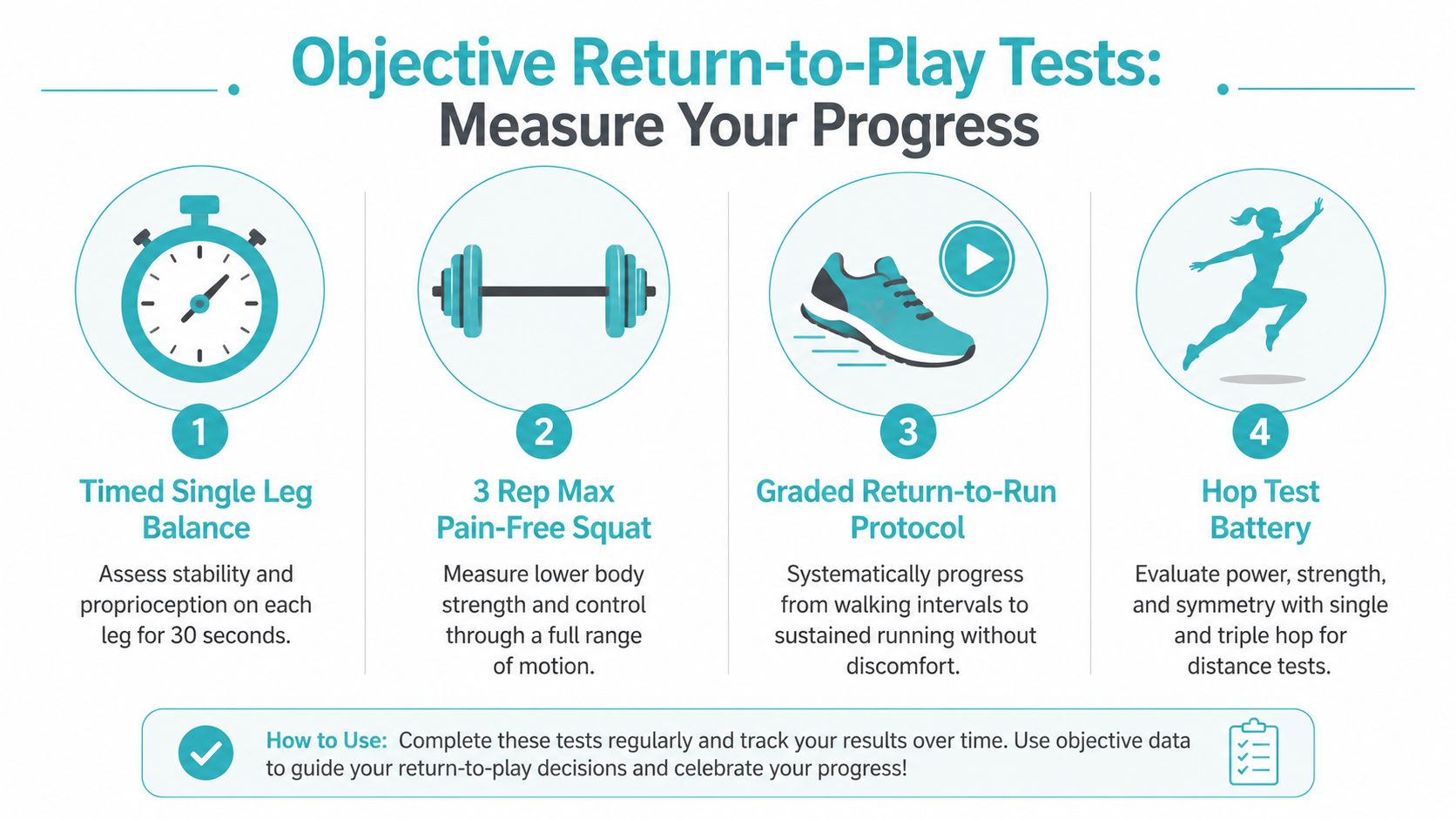
Useful tests you can track
Here are several practical screens I use conceptually when deciding whether someone is ready for the next layer of work:
- Timed single-leg balance: Stand on one leg and look for pelvic control, foot stability, trunk sway, and breath-holding.
- Pain-free squat test: Can you squat through a useful range without shifting, gripping, doming, or symptom onset?
- Step-down control: A slow step-down often exposes deficits before running does.
- Hop tolerance: Small repeated hops or a basic hop battery can reveal impact intolerance quickly.
- Run-walk response: A graded return to run tells you more than a hopeful guess does.
For women after pregnancy, this resource on running post pregnancy can help you think through whether your body is ready for impact.
What counts as a pass
The pass standard is not perfection. It's quality plus symptom stability.
Use this checklist during and after testing:
- No pelvic heaviness: Nothing feels like dropping, bulging, or increased downward pressure.
- No leaking: Even minor leakage is feedback that the current demand may exceed control.
- No pain: Including abdominal, pelvic, low back, breast, incision, or joint pain.
- No breath-holding strategy: You should be able to exhale with effort rather than brace against pressure.
- No delayed flare: The body's response later that day and the next morning matters.
Here's a movement example to watch before increasing load.
A simple symptom rule
If a test causes symptoms, don't label the whole plan a failure. Label the test as too much, too soon, or too poorly matched to the current phase.
Clinical checkpoint: If symptoms rise during a low-intensity task, they should stay mild, settle quickly, and not create a next-day setback. If they don't, reduce the demand.
That's how objective testing builds confidence. It replaces guessing with observation.
Adapting Guidelines for Your Unique Journey
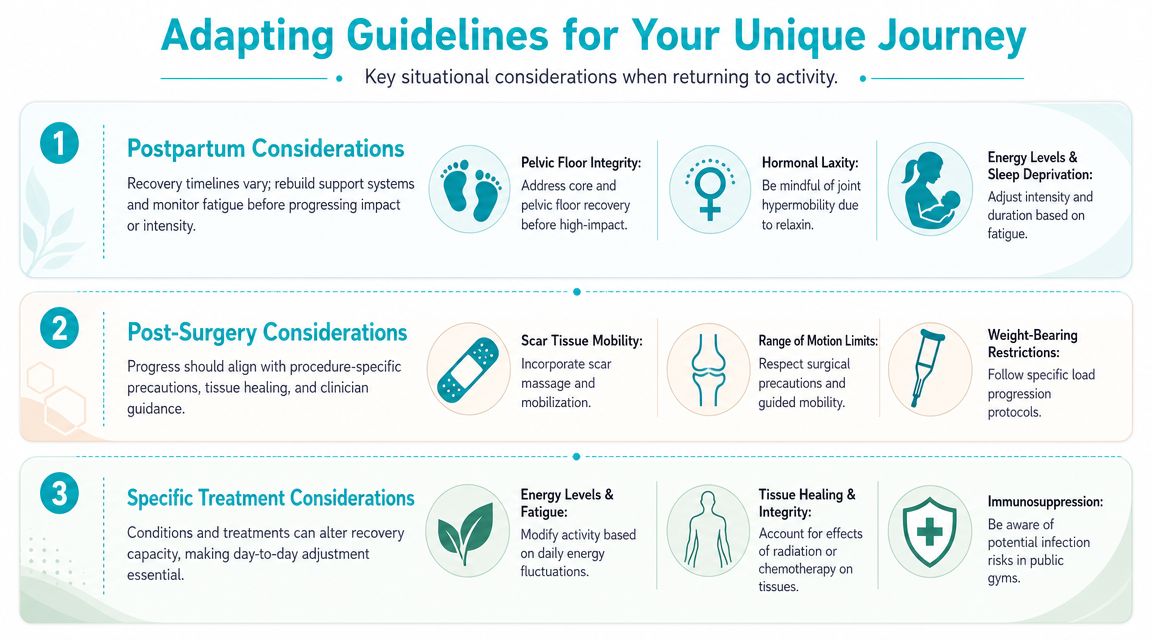
Most return to play guidelines were built for athletes recovering from a straightforward injury. That's useful, but incomplete for women whose symptoms can be subtle, fluctuating, or tied to overlapping systems.
A major gap in public guidance is exactly this problem. Symptoms don't always arrive as a clear yes-or-no signal. For postpartum women especially, fatigue, headaches, pelvic heaviness, and exercise intolerance can overlap with sleep disruption, feeding demands, healing, stress, or preexisting pelvic floor issues. The NFHS discussion of return-to-play nuance highlights why simplistic checklists miss this reality.
Postpartum athletes
A postpartum return shouldn't be built around whether you've been “cleared at six weeks” and left to figure out the rest. It should account for abdominal wall recovery, pelvic floor coordination, sleep debt, feeding demands, scar sensitivity, and how your body handles pressure.
Red flags worth respecting include:
- Pelvic heaviness or bulging sensations
- Leaking with impact or effort
- Abdominal doming or coning
- Incision pulling or deep pelvic pain
- Fatigue that lingers well beyond the session
Joint laxity, disrupted sleep, and feeding demands can also change tolerance from day to day. That doesn't mean you can't train. It means your progression needs room to flex.
Women with pelvic health symptoms
If you have prolapse, incontinence, urgency, pelvic pain, or pain with penetration, the return path should be modified, not abandoned. The common mistake is waiting for all movement to feel easy before starting. The other common mistake is ignoring symptoms and trying to power through.
The middle ground works better:
- Lower impact before higher impact
- Controlled exhalation before maximal bracing
- Repetition quality before external load
- Shorter exposure before longer sessions
For some women, outside structure also helps. Articles on personalized training plans can be useful because they reinforce a principle that matters in rehab too. The plan should match the athlete, not the other way around.
Post-oncology recovery
Women returning after breast or gynecologic cancer treatment often deal with variables standard sports advice ignores. Scar mobility, chest wall tightness, lymphedema risk, fatigue, neuropathy, and tissue sensitivity can all shape how exercise feels.
That usually means:
- Strength and endurance may rebuild at different rates
- Overhead and rotational work may need a slower ramp
- Compression garments or lymphedema precautions may matter
- Recovery windows may be wider, especially after treatment cycles
The right question isn't “Why am I not back yet?” It's “What does my body need to tolerate the next level well?”
An individualized plan respects the medical history without turning it into a permanent limitation.
Your Long-Term Strategy for Health and Performance
A good return doesn't end when you complete a run, finish a class, or get back to full practice. It starts there.
The women who do best long term usually adopt three habits. They track response instead of chasing random intensity. They communicate early when symptoms shift. And they treat maintenance work, including strength, breathing, mobility, and recovery, as part of performance rather than a detour from it.
What helps you stay in the game
A few strategies hold up across seasons and life stages:
- Keep one or two anchor tests: Use the same squat, balance, hop, or run benchmark to spot changes early.
- Expect normal fluctuations: Travel, poor sleep, stress, feeding, treatment after-effects, and cycle changes can all affect training tolerance.
- Adjust fast, not late: A small regression now usually prevents a larger setback later.
- Support the basics: Footwear, skin care, fueling, and sleep still matter. Even something practical like learning how to prevent blisters can make consistency easier when you're rebuilding running or walking volume.
The strongest mindset shift is this. Return to play guidelines are not about earning permission to move. They're about learning how to progress with skill. Once you understand your body's signals and have a framework for load, you're better equipped not just for this recovery, but for the next training block, postpartum season, surgery, flare, or comeback.
If you want expert help building a return that fits your body, your sport, and your stage of recovery, Lake City Physical Therapy offers women's health, pelvic floor, postpartum, oncology, and sports physical therapy with a personalized, evidence-based approach. Whether you're working back to running, lifting, competition, or feeling strong again, their team can help you move forward with a clear plan and real support.