Sacrum Fracture Symptoms: A Guide to This Hidden Pain
You may be reading this because your pain doesn't fit neatly into the label you were given.
Maybe you're postpartum and thought the deep ache in your low back and buttock was just part of recovery. Maybe you're a runner who's been treating a “glute strain” that won't settle down. Maybe you're an older woman who had a minor stumble, a hard sit, or no clear injury at all, and now walking feels sharply different. In women's health practice, that pattern deserves attention, especially when pain is persistent, weight-bearing makes it worse, and the usual explanations don't fully match.
The sacrum sits at the base of the spine and forms the back wall of the pelvis. It functions like a keystone. When it's injured, pain doesn't always stay in one spot. It can show up as low back pain, buttock pain, hip pain, groin pain, or symptoms that feel surprisingly similar to sciatica or SI joint irritation. That's one reason sacrum fracture symptoms are often missed.
That Nagging Pain in Your Backside Could It Be a Sacrum Fracture
If your pain gets worse when you stand, walk, carry your child, climb stairs, or roll in bed, the sacrum belongs on the differential.

A sacrum fracture can follow a major injury, but that's not the only story. Stress and insufficiency fractures can develop more insidiously. That matters for women because hormonal shifts, bone density changes, postpartum load transfer, repetitive impact in sport, and cancer treatment history can all shape how symptoms show up and how long they're dismissed.
Why this injury gets overlooked
The problem is rarely a dramatic, obvious presentation. Sacrum fracture symptoms are often pain-dominant but nonspecific. Independent orthopedic and radiology sources describe the usual pattern as low-back, buttock, pelvic, or hip pain, often worse with standing, walking, weight bearing, or changing positions. Pain can also spread into the legs or groin, symptoms may start gradually or after minor trauma, and in more severe cases patients may become unable to walk. About a quarter of sacral fractures are associated with neurologic injury according to Slocum Center's overview of sacrum fracture symptoms.
That symptom mix overlaps with conditions women hear about all the time: SI joint dysfunction, lumbar disc pain, postpartum pelvic girdle pain, hip irritation, piriformis syndrome.
Practical rule: If the diagnosis keeps changing but weight-bearing still feels distinctly wrong, ask whether the sacrum has been adequately evaluated.
What deserves closer attention
A sacrum fracture becomes more likely when pain is deep, hard to localize, and strongly aggravated by load through the pelvis. People often describe it as pain “in the backside,” “at the dimples,” “deep in the butt,” or “inside the pelvis.”
The reassuring part is this. Once the right diagnosis is made, the recovery plan gets much clearer. The next step is learning the symptom pattern well enough to describe it precisely and to know when you need more than reassurance.
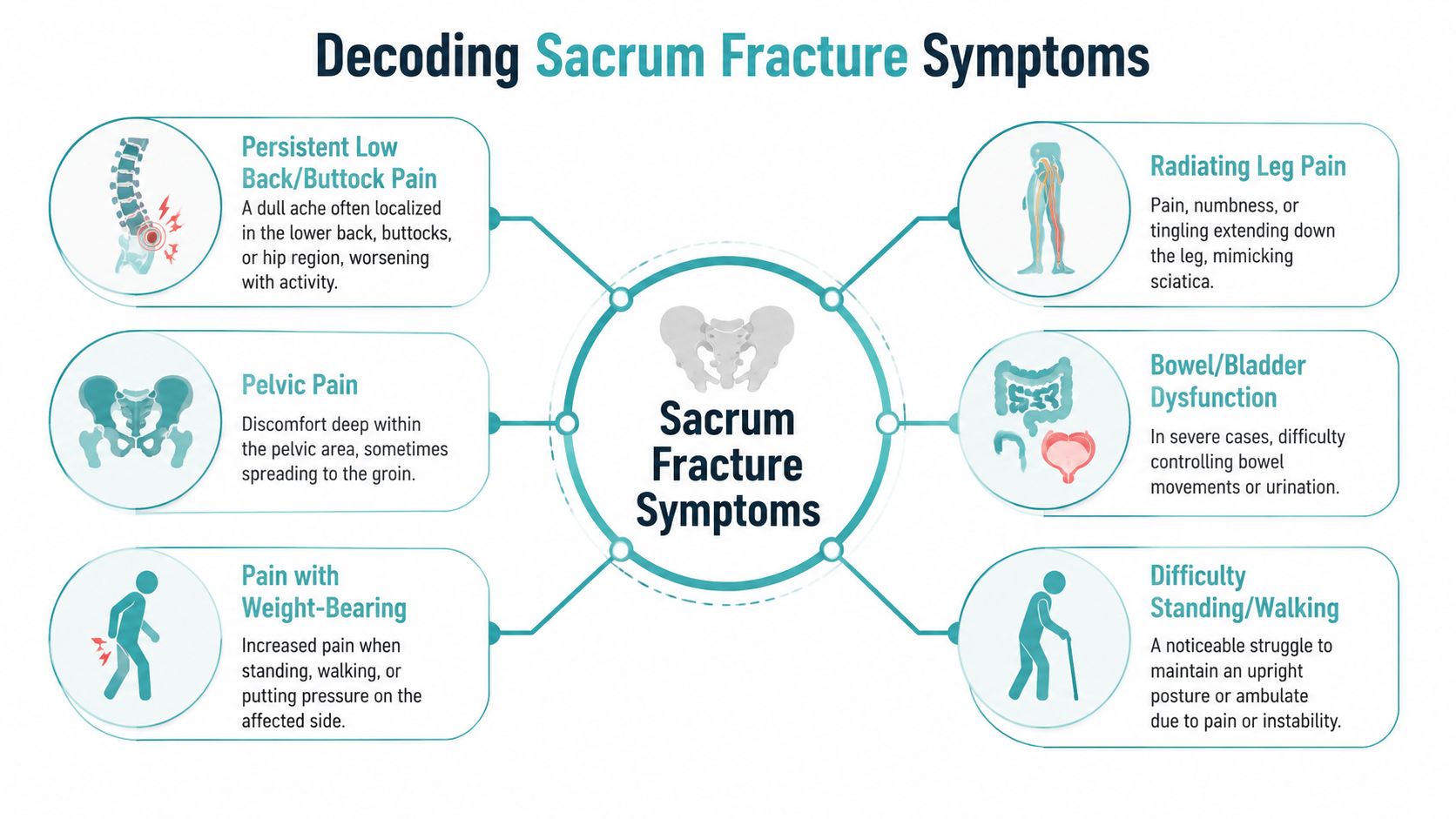
Decoding the Telltale Sacrum Fracture Symptoms
The sacrum connects the spine to the pelvis. When that keystone is irritated or fractured, the body often reports the problem through movement first. Sitting may be tolerable. Walking across the room may not be. Rolling over in bed can be surprisingly sharp. Standing on one leg to get dressed may feel unstable or immediately painful.
The pain pattern most people notice first
The most common complaint is a deep ache or sharp pain in one or more of these areas:
- Low back
- Buttock
- Pelvis
- Hip
- Groin
The pain often increases with loading tasks rather than with isolated stretching. That's why women may notice it during:
- Standing from a chair
- Walking longer distances
- Climbing stairs
- Carrying a baby or laundry basket
- Changing positions in bed
- Single-leg activities, such as stepping into pants or getting into a car
This video gives a useful visual overview of how sacral pain can present clinically.
When it mimics nerve pain
One of the most confusing features is radiating pain. A sacral fracture doesn't have to stay local. Symptoms can travel into the groin or down the leg, which is why many people are initially told they have sciatica, lumbar stenosis, or SI joint pain.
That doesn't mean every radiating symptom is a fracture. It does mean radiating pain should be interpreted in context. If the pain is strongly tied to weight bearing and pelvic loading, and especially if the onset followed repetitive impact, childbirth strain, minor trauma, or sudden increase in activity, the sacrum should be considered.
Pain that behaves like sciatica but doesn't respond like sciatica deserves a second look.
Neurologic symptoms you shouldn't ignore
Neurologic findings are less common than pain, but they matter more. Numbness, tingling, weakness, bowel or bladder changes, or altered sensation around the saddle region raise the urgency. Those symptoms suggest nearby nerve involvement, which changes both medical management and physical therapy planning.
A few symptom descriptions I listen for closely in clinic are:
- “I can't tell if I'm fully emptying.”
- “My leg feels unreliable.”
- “There's numbness where there shouldn't be numbness.”
- “It hurts so much to walk that I'm starting to avoid moving.”
What helps and what usually doesn't
What works diagnostically is precision. Describe where the pain starts, where it spreads, what movements load it, and whether walking is progressively harder.
What doesn't work is reducing everything to “just back pain.” That label is too broad. The more specific your description, the easier it is for the right provider to connect the dots.
How Symptoms Present in Different Female Populations
A woman delivers her baby, starts walking more, and expects the usual postpartum soreness to settle. Instead, standing at the changing table, carrying the car seat, or rolling out of bed triggers a deep pain low in the pelvis or buttock that keeps getting sharper. In clinic, that pattern gets my attention because sacrum fractures are often mistaken for the aches women are told to expect.
Postpartum women
Postpartum symptoms are easy to dismiss. Pelvic girdle pain, tailbone pain, pelvic floor tension, and incision-related discomfort can all overlap with sacral pain, especially in the first weeks after delivery.
What raises concern is the way the pain behaves. A sacrum fracture often shows up as deep, focal pain that gets worse with standing, walking, stair climbing, single-leg loading, or bed mobility. The mother may say, "I thought it was normal after birth, but it keeps getting harder to move, not easier." That change in function matters.
Women's health PT matters here because postpartum recovery is not just about muscles and scar healing. The sacrum has to transfer force between the spine, pelvis, and legs during every lift, step, and feeding setup. If the bone is irritated or fractured, standard postpartum strengthening can be the wrong starting point.
Female athletes
Athletes often describe a slow shift rather than one dramatic injury. Pain starts after training, then shows up during training, then follows them into ordinary life. Running, jumping, cutting, and even brisk walking can become progressively less tolerated.
In women who train hard, especially runners and court athletes, sacral stress injury can hide behind labels like glute strain, SI joint irritation, or "tight hips." I see the problem most often when the athlete has a clear loss of load tolerance. Pace drops. Recovery takes longer. Cross-training starts to hurt too. At that point, pushing through usually prolongs the problem.
Treatment choices are different when bone is the issue. Early rehab may need relative unloading, gait support, and careful return-to-impact planning rather than aggressive strengthening or mobility work.
Older women with osteoporosis
This group gets missed too often.
Older women may develop severe buttock, low back, hip, or groin pain after a minor twist, a low-energy fall, or no memorable event at all. Walking often becomes the clearest problem. Some women can only manage a few steps before the pain spikes. Others can still move, but every transfer and weight shift feels unstable and sharp.
A sacral insufficiency fracture should stay on the list when symptoms seem out of proportion to the event. The PMC review on sacral insufficiency fractures notes that these injuries commonly occur alongside pubic ramus fractures, which can further cloud the picture. For women looking at the bigger bone health picture, this guide on osteoporosis risk in women and bone loss explains why persistent pelvic pain after a seemingly small stress deserves attention.
Women in oncology care
Pelvic pain in oncology care is rarely simple. Prior surgery, radiation history, medication effects, reduced activity, bone health changes, and scar sensitivity can all shape the symptom picture.
That is exactly why new sacral pain needs careful sorting. If a woman with a cancer history develops deep buttock or pelvic pain that worsens with walking, standing, or transfers, clinicians need to consider bone involvement instead of assuming it is only deconditioning or generalized treatment-related pain. In rehab, that distinction changes everything. It affects whether weight bearing needs to be protected, how quickly exercise can progress, and when imaging should happen.
Some women are first told they have SI joint pain because the location seems to fit. SI dysfunction can absolutely coexist with a sacral fracture, but the management is not the same. For readers comparing those patterns, Midwest Pain & Wellness SI joint solutions gives a helpful overview of common SI joint presentations and treatment options.
Across all four groups, the missed diagnosis usually starts the same way. The pain gets folded into a familiar story. Postpartum recovery. Training overload. Aging. Cancer rehab. When symptoms are strongly tied to pelvic loading and function keeps dropping, the sacrum deserves a closer look.
Distinguishing Sacral Pain from Other Common Conditions
The three diagnoses most commonly tangled together are sacrum fracture, sciatica, and SI joint dysfunction. They can overlap. They can even coexist. But they don't behave exactly the same.
Why confusion happens
Sacral insufficiency fractures can radiate into the groin, thigh, knee, or even foot in a pseudo-radiculopathy pattern that resembles L5 radiculopathy. Nearly 25% of cases are missed in clinical practice, and plain radiographs often miss subtle fractures, so MRI or CT is often needed when pain persists despite a normal initial workup, as noted in BackTable's discussion of sacral insufficiency fracture pain patterns and imaging. That's why a normal X-ray doesn't always end the conversation.
Sacrum fracture vs sciatica vs SI joint dysfunction
| Condition | Typical Pain Location | Common Triggers | Key Differentiator |
|---|---|---|---|
| Sacrum fracture | Deep buttock, low back, pelvis, hip, sometimes groin or leg | Standing, walking, stairs, rolling in bed, single-leg loading | Pain is often strongly weight-bearing related and may persist despite treatment aimed at muscle or disc problems |
| Sciatica | Low back or buttock with leg symptoms following a nerve pattern | Sitting, bending, coughing, nerve tension, some spinal movements | Leg symptoms often dominate and spinal testing may reproduce pain more clearly |
| SI joint dysfunction | One-sided low back or buttock near the SI region | Transitional movements, standing asymmetrically, turning in bed | Pain is usually localized around the SI region and may respond to external support or movement correction |
A lot of women are first told they have SI irritation, and sometimes that's a reasonable starting point. If that's the conversation you're having, resources that explain Midwest Pain & Wellness SI joint solutions can help you understand what SI-mediated pain usually looks like. But if your symptoms started after a fall, abrupt load change, or persistent unexplained pelvic pain, this article on pelvic pain after a fall may be the more relevant lens.
What doesn't add up in a missed fracture
Treatments that often fail in a missed sacral fracture include repeated stretching, aggressive manual work to “release” the glute, and progressive loading without confirming the diagnosis. If the bone is the problem, tissue-based treatment alone won't solve it.
If the pain keeps returning every time load goes up, stop asking only how to calm it down. Ask what structure is being loaded.
The Path to a Clear Diagnosis and When to Seek Emergency Care
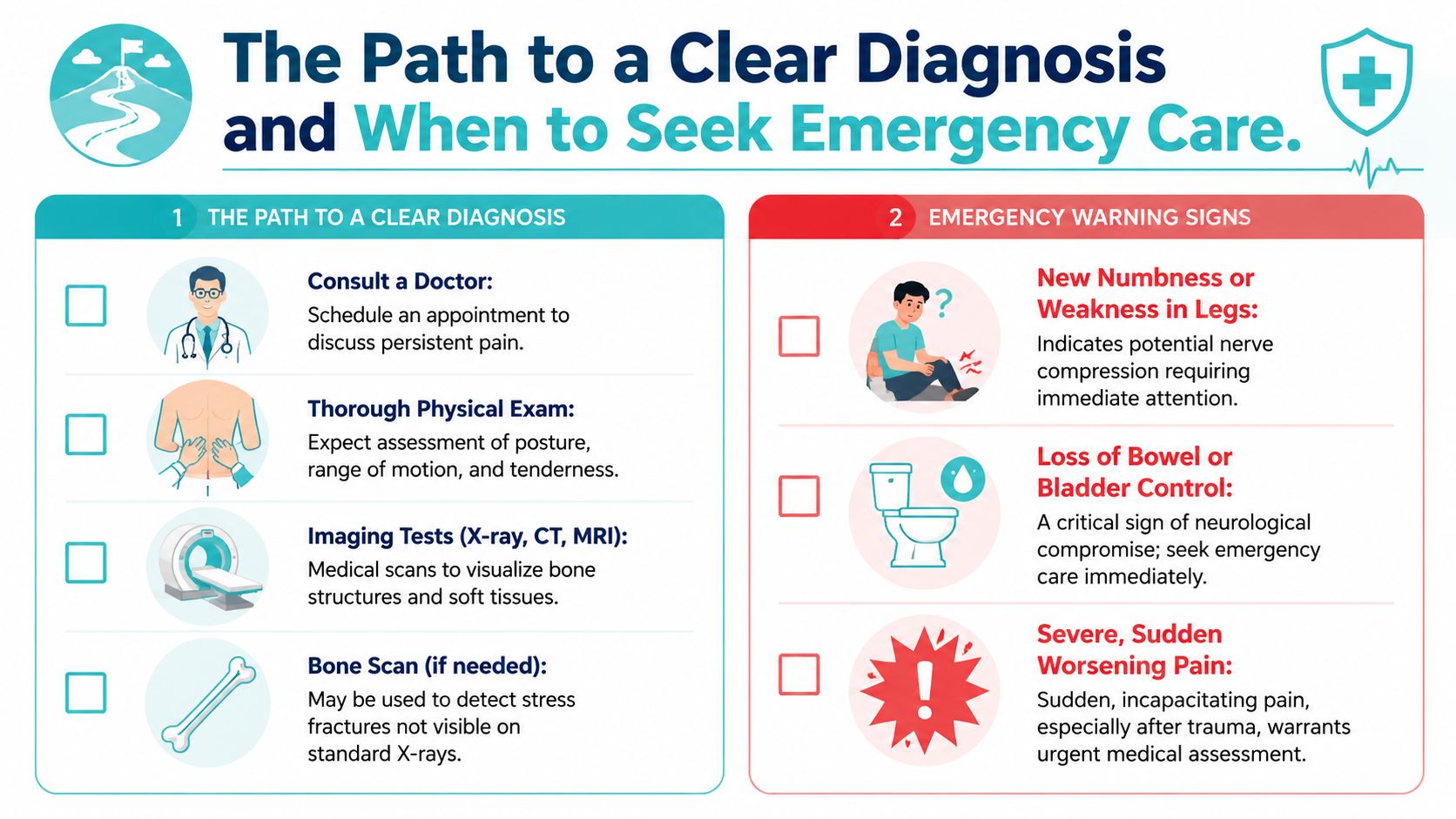
The diagnostic process should start with a detailed history and a physical exam that respects the possibility of bone injury, not just soft tissue irritation. The clinician needs to know whether the pain began after trauma, after a change in training, during the postpartum period, or without an obvious event. They also need to ask directly about walking tolerance, numbness, weakness, and bowel or bladder symptoms.
What evaluation should include
A thorough exam may involve:
- Palpation and load testing to identify where symptoms concentrate
- Walking assessment to see whether gait becomes guarded or asymmetric
- Neurologic screening for sensation, strength, and reflex changes
- Questions about bladder, bowel, and saddle-region sensation
- Imaging beyond plain X-rays if the story suggests fracture and the first workup is inconclusive
For severe traumatic fractures, neurologic screening is critical. Approximately 25% of patients with traumatic sacral fractures exhibit neurological deficits, and Zone III fractures show a 60 to 90% incidence of cauda equina syndrome, including bowel or bladder dysfunction and lower extremity weakness, according to the NCBI Bookshelf review of sacral fractures. That same review notes that perianal sensory loss is a critical sign of severe neurologic compromise.
When normal imaging isn't enough
A normal X-ray can be falsely reassuring. If symptoms still strongly point to the sacrum, MRI or CT is often the next conversation. In practice, self-advocacy matters. “The X-ray was normal” is not the same as “nothing is wrong.”
Emergency warning signs
Go for urgent medical evaluation right away if you have any of the following:
- New bowel or bladder control changes
- New numbness in the saddle or perianal region
- Leg weakness that is worsening
- Severe pain after trauma with inability to bear weight
- Rapid functional decline, especially if walking suddenly becomes very difficult
Those are not symptoms to monitor at home for a week. They need prompt attention.
Your Recovery Pathway from Sacrum Fracture
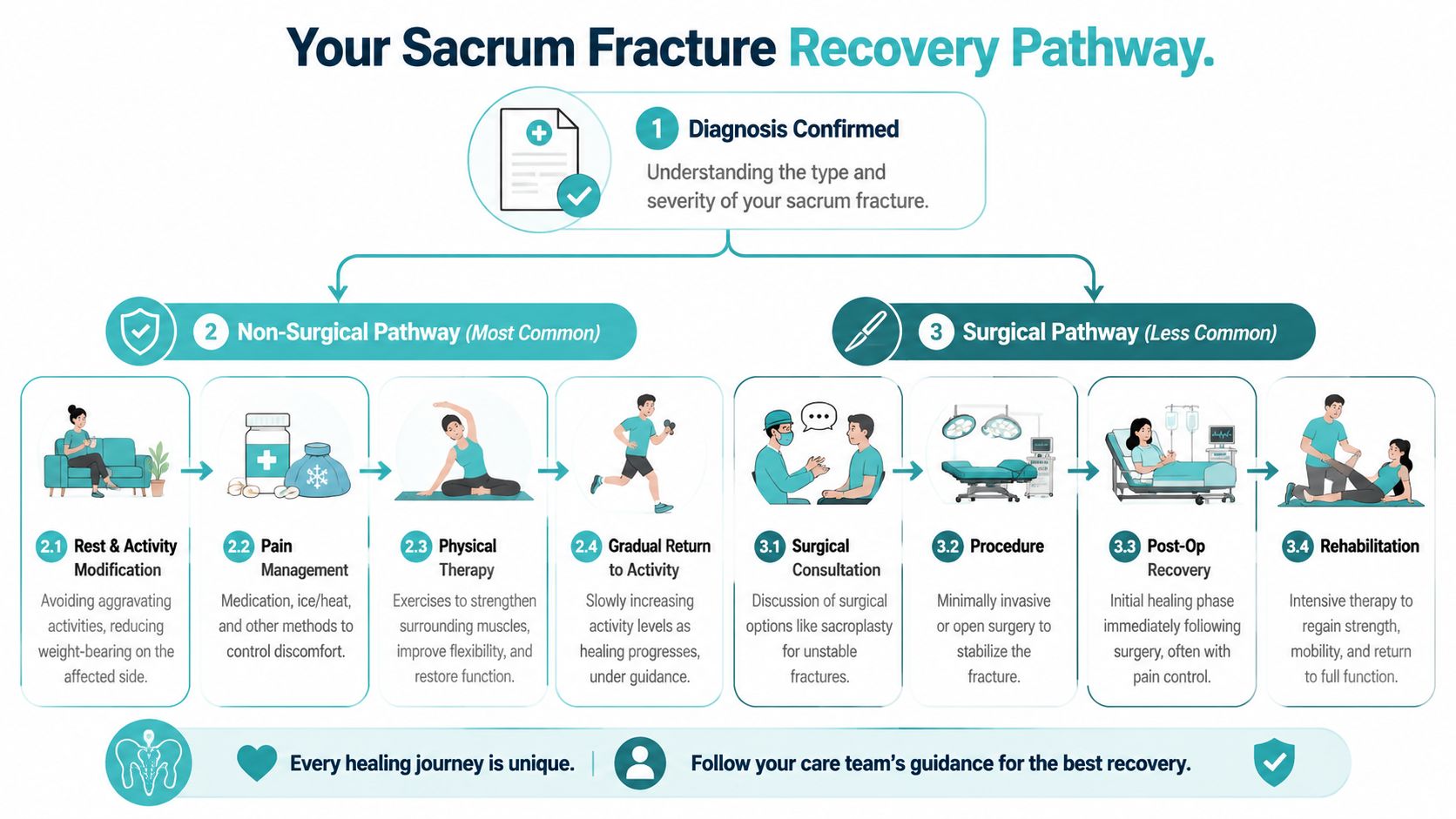
Once the diagnosis is confirmed, the plan usually falls into one of two lanes. A non-operative route is commonly pursued. A smaller group with unstable or more severe injuries may need surgical management.
The non-operative path
This is the path many women follow, especially when the fracture is stable. It usually includes relative rest, activity modification, protected weight bearing as directed by the medical team, symptom management, and a graded return to movement.
The key trade-off is important. Too much rest for too long can leave you weak, fearful, and stiff. Too much loading too early can keep the fracture irritated. Good rehab lives in the middle. It protects healing while preserving function.
When surgery enters the picture
Surgery is less common, but it becomes part of the conversation when fracture stability, nerve involvement, or pain severity changes the risk-benefit balance. If that happens, rehab doesn't stop. It changes pace and sequence.
For some women, sacral pain also collides with work loss, caregiving disruption, and disability questions. In that situation, practical legal information like Melanson Law Group's back pain disability insights can help you understand how functional limits are typically documented.
What recovery usually requires
Most women do best when the plan includes:
- Load protection early
- Clear walking guidance
- Simple movement goals for daily life
- Progressive strengthening later, not immediately
- A return-to-activity plan that matches the person, whether that's infant care, work shifts, or running
Healing the bone is only one part of recovery. The real goal is getting your life back without repeatedly flaring the same pain.
How Women's Health PT Accelerates Your Recovery
A sacrum fracture can look straightforward on imaging and still disrupt nearly every part of a woman's day. Bed mobility can be painful. So can standing long enough to make a meal, lifting a baby, getting out of the car, or trying to walk with a normal stride. I see this often. The bone may be healing, but the person is still limiting movement, bracing through simple tasks, and wondering why recovery feels stuck.
That gap is where specialized women's health physical therapy matters.
The sacrum is not just a low back structure. It is part of how the pelvis manages force, pressure, balance, and movement. If the pelvic floor is overprotective, if breathing becomes guarded, or if hip and trunk support drop off after pain starts, symptoms can persist well beyond the initial injury. General orthopedic rehab does not always screen those factors closely enough, especially in women whose presentation is shaped by postpartum recovery, athletic goals, aging, or cancer treatment history.
A better plan starts with better clinical questions. Is a postpartum patient shifting away from one side during infant care? Is an athlete trying to return to impact before load tolerance is ready? Is an older adult walking less because of pain, fear of falling, or both? In oncology care, does bone fragility or treatment-related fatigue change what is safe right now?
Those answers shape treatment in practical ways. A women's health PT may assess:
- Pelvic floor function, especially with pressure, heaviness, pain, postpartum changes, or guarding
- Breathing mechanics, because pressure management affects pain during transfers and effort
- Daily movement tasks, including rolling, sit-to-stand, lifting, floor transfers, and infant care
- Hip and trunk control, which often need retraining before heavier strengthening makes sense
- Balance and confidence, particularly after a fall or period of prolonged guarding
Nerve-related symptoms need a higher level of caution. Saddle numbness, changes in bowel or bladder control, or unexplained leg weakness should not be brushed off as routine sacral pain. PT should account for those findings and coordinate with the medical team.
Good rehab is also highly individual in dosage. Some women need downtraining before strengthening. Some need shorter walking intervals, better pacing, or a more comfortable strategy for bed mobility. Others are ready to begin graded pelvic and core loading, then improve pelvic floor muscle strength once symptoms are no longer flaring with basic tasks.
This is why standard low back exercise sheets often fall short. A runner may need a staged return to impact. A postpartum mother may need help with feeding positions, carrying, and floor transfers. An older woman after a fall may need balance retraining and confidence-building as much as pain relief.
Lake City Physical Therapy offers women's health, oncology, postpartum, and sports physical therapy. That matters when sacral fracture recovery overlaps with pelvic pain, caregiving demands, return-to-sport goals, or a cancer history.
If your pain story does not fully fit the standard “back pain” label, ask harder questions. If the diagnosis is still unclear, if function is not returning, or if pelvic floor and daily movement issues are being ignored, a more specialized evaluation can change the course of recovery. The goal is not just bone healing. It is getting you back to walking, lifting, caregiving, training, and living with confidence.

