Transverse Abdominis Activation: A PT’s How-To Guide
Maybe you've been trying to “turn on your core” while standing at the sink, lifting a toddler, or starting a workout, and all you feel is a strange mix of bracing, breath-holding, and not much else. That frustration is common, especially after pregnancy or when your back feels unreliable. Transverse abdominis activation is the skill that helps you reconnect with the deep support system that should be working subtly under those moments.
The good news is that this muscle is real, trainable, and measurable. It's not about chasing a six-pack or forcing your stomach flat. It's about restoring the body's inner support so you can move, breathe, and lift with more control, and a practical overview of core training can help frame that bigger picture, like BionicGym's core strength guide.
Reconnecting with Your Body's Natural Corset
A patient once described her core as feeling “hollow,” like nothing was holding her together when she picked up laundry or got out of bed. That's often the first clue that the deep stabilizers aren't coordinating the way they should. The goal isn't to clamp down harder, it's to rediscover the muscle that acts like a built-in support belt.
The transverse abdominis, or TrA, is often described as the body's natural corset because it wraps around the torso and helps create steadiness from the inside. In movement terms, that means less wobble, less overgripping, and a better base for the spine and pelvis. When it's working well, the effort feels subtle, not dramatic.
Practical rule: if your “core work” feels like a max-effort crunch, you're probably not training the TrA.
That matters because the TrA isn't just for workouts. It helps prepare the body for ordinary demands like lifting, reaching, coughing, and carrying, which is why many people notice its absence during daily life before they notice it in the gym. A deeper, more complete view of core training helps explain why isolated abdominal work isn't the whole story, especially when the goal is comfort and confidence in movement.
Understanding Your Deep Core Anatomy
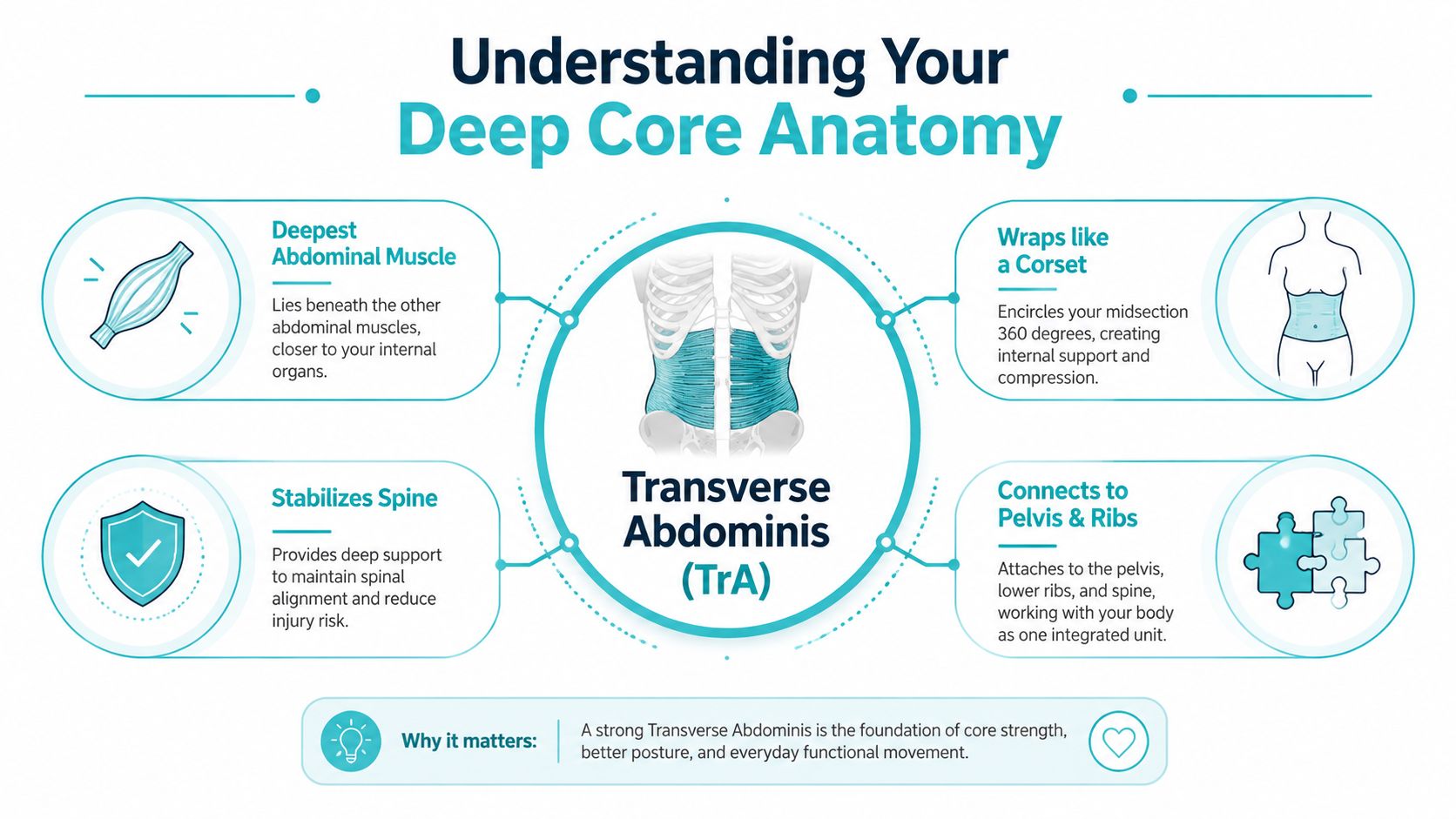
The TrA is the deepest layer of the abdominal wall. It sits under the more visible abdominal muscles and wraps around the trunk like a wide band, which is why people often picture it as an internal corset or weight belt. That shape matters, because a wrapping muscle is built to create tension and support rather than big visible motion.
This isn't just anatomy trivia. In a 2023 ultrasound study of upright functional movement, researchers showed that TrA activation can be quantified as a percentage change in muscle thickness and that the response changes with both task and population, not according to a single fixed pattern. For example, thickness change reached about 2.81% in healthy participants versus 7.50% in chronic low back pain participants during one dual-task condition, and 5.24% versus 5.77% in another condition, with some task conditions differing significantly between groups (journal article). That's a useful reminder that the TrA is sensitive to context, load, and coordination.
The core canister matters more than one muscle
The TrA doesn't work alone. It functions as part of a pressure and stability system with the diaphragm, pelvic floor, and deep back muscles. When those parts coordinate well, the body can manage load without overbracing or pushing pressure in the wrong direction.
A simple way to think about it is this, the TrA helps prepare the trunk before movement starts. That's why it matters for everyday tasks like lifting a child, carrying groceries, or getting up from a chair. The muscle's job is quiet support, not hard gripping.
The best early cue is not “make your stomach disappear.” It's to learn a light inward tension that feels like the lower abdomen is gently tightening from side to side. That subtle response is real, and in controlled settings it's highly reproducible when people are cued well.
How to Find and Gently Activate Your TrA
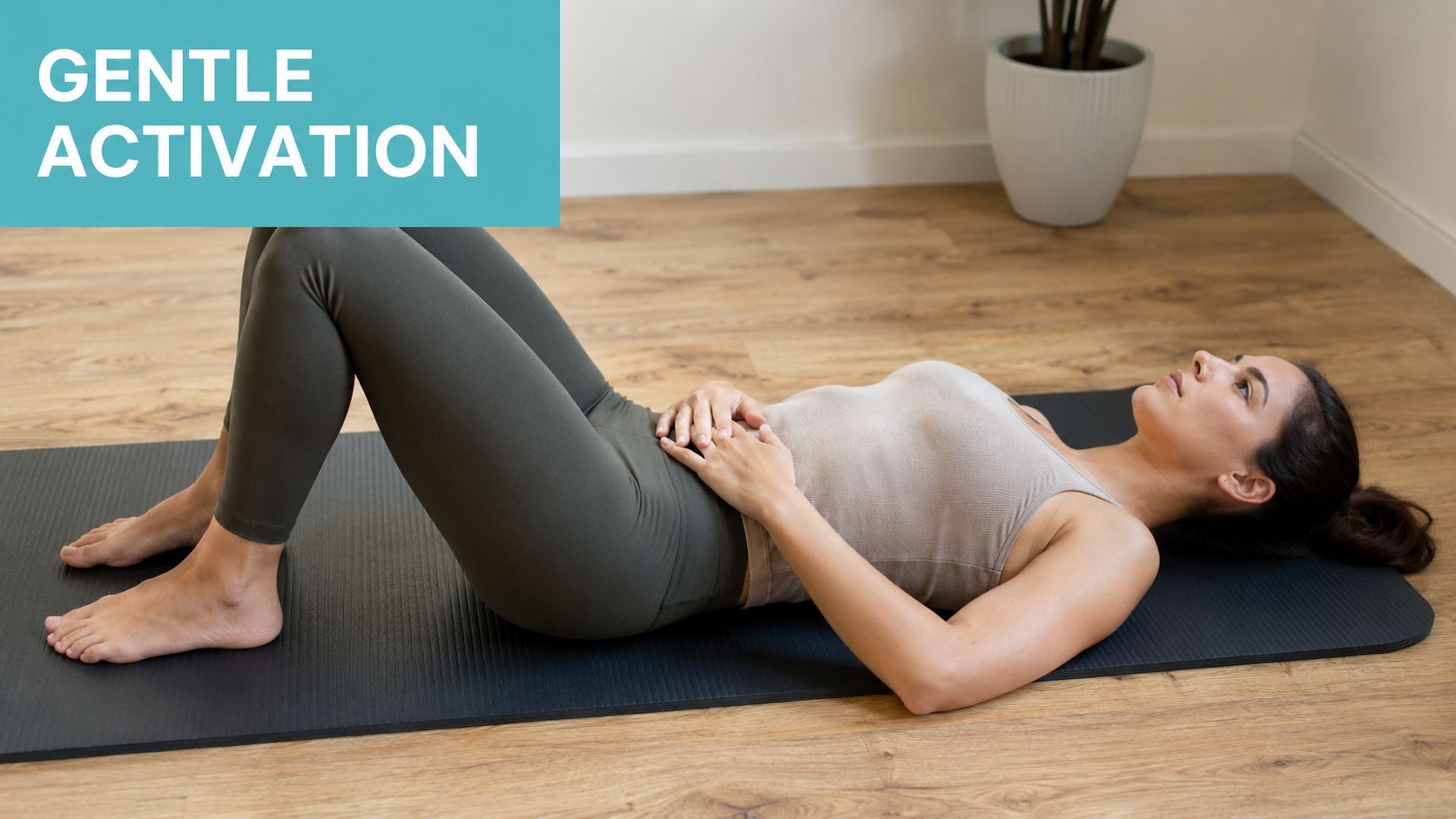
Start in a position that makes success more likely. Lying on your back with your knees bent is usually the easiest place to learn, because your body isn't also managing balance, standing pressure, or big trunk demands. Put two fingertips just inside the front points of your hip bones and take a slow breath in.
As you exhale, think gentle narrowing, not force. You're looking for a light tensioning low in the abdomen, almost like the waistline is subtly drawing inward and upward under your fingers. If you feel a big hard push, an upper-abdominal bulge, or a breath hold, back off and use less effort.
The abdominal drawing-in maneuver is still a strong starting strategy when it's taught well. In one study, 94.7% of participants successfully activated their TrA with that maneuver, which shows that this is a learnable motor pattern, not a rare talent (thesis study). A second ultrasound study reported similarly high success rates across several activation conditions, which supports the idea that cueing and position matter.
A helpful image is to zip up a snug pair of pants one notch, while still letting the ribs soften and the breath continue. Some people find it easier to whisper “shhh” during the exhale because it discourages holding the breath and keeps the effort gentle. If you can't feel the muscle at all, try a smaller exhale, not a stronger squeeze.
Midway through learning, a short video can help you compare the feeling of correct work with overdoing it.
For a more structured progression, a clear set of inner-core drills can be useful, and this inner core exercise guide is a practical companion if you want more movement ideas after the basic activation pattern starts to click.
Keep the contraction quiet enough that your face, neck, and pelvic floor don't join the job.
The key is coordination, not intensity. More recent clinical guidance emphasizes pressure management, meaning the TrA should coordinate with the diaphragm and pelvic floor while you keep breathing and avoid outward bulging or bearing down (clinical overview). That matters especially after pregnancy, when pressure changes can make a strong-looking brace feel wrong.
Common Mistakes and How to Correct Them
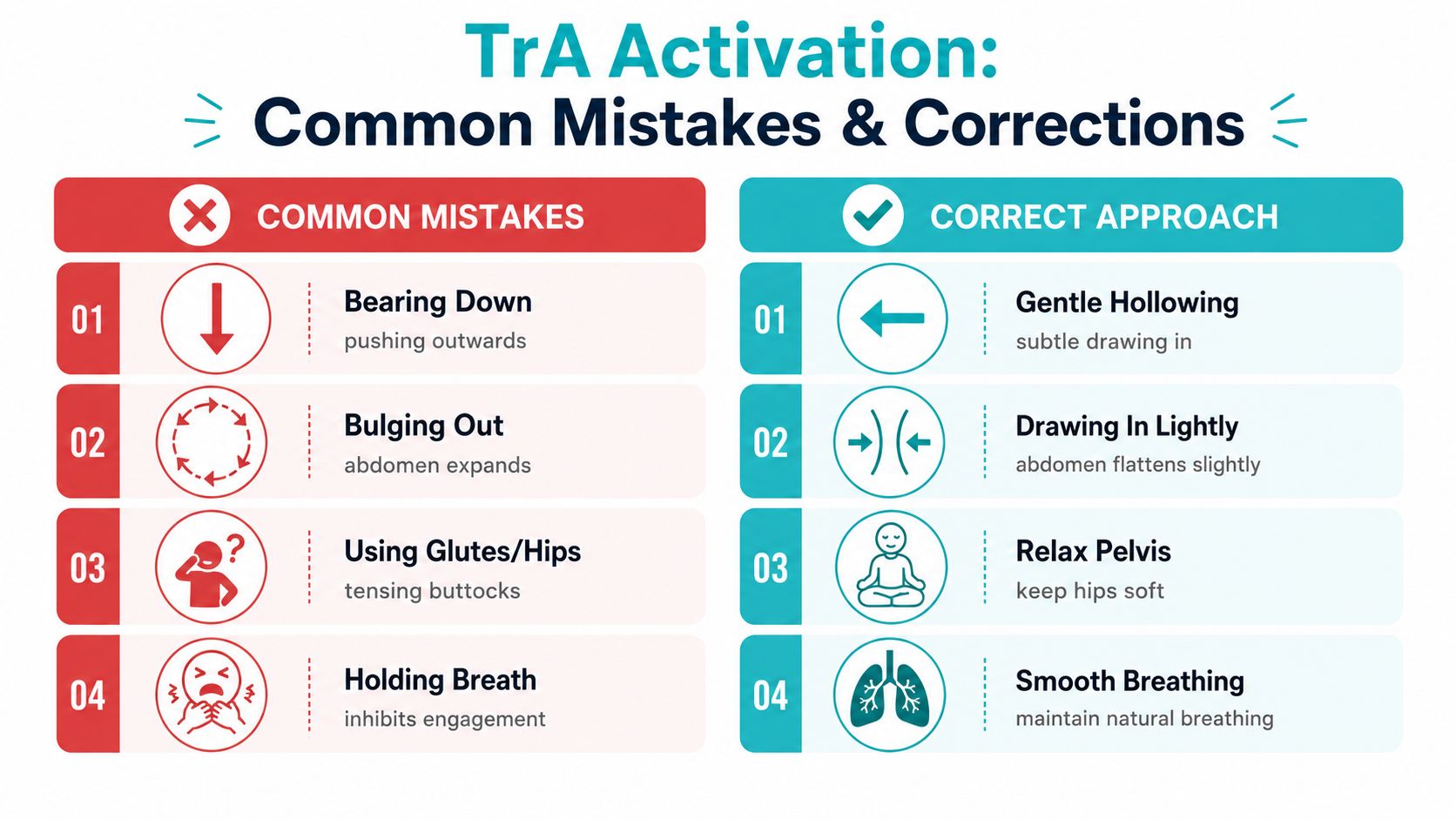
The most common mistake is trying to make the exercise look impressive. People often suck in hard, grip the glutes, or push the ribcage up to create the feeling of effort. That usually recruits the wrong strategy, especially if the goal is control during everyday movement.
What the body often does wrong
If your belly is bulging outward, you're likely increasing pressure instead of organizing support. If your upper abs are hard and your jaw is clenched, the effort has moved away from the deep abdominal wall. If your pelvic floor feels heavy, irritated, or pressured downward, the contraction needs to be scaled back.
The fix is usually smaller than people expect. Return to a gentler exhale, soften the ribs, and think of the lower belly wrapping rather than pushing in. If breath-holding is your habit, pairing the contraction with a steady exhale keeps the diaphragm and abdominal wall working together instead of fighting each other.
Why “sucking in” is not the goal
A lot of mainstream cues still push isolated hollowing as if it were the answer to every core problem. Physical therapy has moved toward more nuanced, task-specific training rather than treating isolated TrA activation as a universal stability solution (clinical overview). That shift makes sense, because a muscle can activate well in a quiet position and still fail to coordinate under real-life loads.
Corrective cue: exhale, soften the ribs, and draw the lower abdomen in lightly while keeping the breath flowing.
That distinction matters. A good TrA contraction should feel like support, not strain. If the exercise leaves you more tense or more pressure-sensitive, reduce the effort and rebuild the pattern from a lower-intensity position.
Progressing Your Activation into Everyday Movement
Short-duration TrA training with feedback can carry over beyond the mat. In one study, participants had increased TrA thickness after brief ultrasound-guided training, and the improvement was maintained at 5 months with transfer to loaded lifting tasks (trial report). That's a strong argument for progression, not endless isolated holds.
Start by keeping the same gentle activation while you breathe. Then add a small movement, like one heel slide or a slow march, while keeping the belly quiet and the ribs soft. The point is not to maintain a rigid brace. The point is to hold enough support that movement stays organized.
A simple progression can look like this.
| Progression Level | Exercise | Sets & Reps / Duration |
|---|---|---|
| Beginner | Supine gentle TrA activation with breathing | 5 slow breaths |
| Intermediate | Supine activation with heel slide | 5 reps each side |
| Advanced | Activation before sit-to-stand or light carry | 5 repetitions |
If you coach yourself, a program builder can make it easier to keep the progression organized from week to week, and workout programming software for coaches can be useful when you want a repeatable structure without guessing.
A good cue before daily tasks is pre-activate, then move. That can mean a small TrA engagement before lifting a grocery bag, pushing a stroller, or getting up from a low chair. For more motor-control ideas, a motor control training resource can help you connect the muscle work to real movement quality.
If you can breathe smoothly while the abdomen stays lightly organized, you're training function, not just a contraction.
The clearest sign of progress is that the effort becomes less conscious over time. In rehab settings, that automaticity is the primary goal.
Pregnancy, Postpartum, and When to See a PT
During pregnancy, the cue should stay gentle. The abdomen is already adapting to load, position, and pressure, so the goal is usually awareness and coordination, not force. A soft exhale with a light TrA engagement can support movement without encouraging breath-holding or extra pressure.
Postpartum, the same skill becomes part of rebuilding the whole system. That includes not just the abdomen, but also the diaphragm and pelvic floor, which need to coordinate again during lifting, standing, coughing, and returning to exercise. A postpartum core strengthening guide can be a useful starting point, but symptoms should guide the pace.
A structured rehabilitation program can improve both the strength and the timing of TrA performance, and one trial found that the muscle activated faster during movement after 4 weeks of rehab (trial report). That timing piece matters because many postpartum bodies don't just need more tension, they need earlier, better-coordinated support.
Signs it's time for a pelvic floor PT visit
- Persistent pain: back, pelvis, hip, or abdominal discomfort that doesn't settle with basic practice.
- Pressure or bulging: heaviness, downward pressure, or a bulging sensation in the pelvic floor.
- Leakage or urgency: incontinence with coughs, lifting, exercise, or daily movement.
- Stuck progress: you can't find the muscle reliably, or every attempt turns into breath-holding and bracing.
If any of those are happening, the answer usually isn't “work harder.” It's getting a personalized assessment of pressure management, breathing, and movement strategy. That's especially true when symptoms show up during postpartum recovery or when returning to higher-impact exercise.
If you're ready to stop guessing and get a plan built around your breathing, pressure management, and core mechanics, schedule a visit with Lake City Physical Therapy. Their pelvic floor and prenatal, postpartum rehab can help you turn transverse abdominis activation into movement that is functional in daily life.

