Vaginal Cuff Prolapse Guide: Causes, Symptoms & Treatment
You notice it first at the end of the day. After standing in the kitchen, carrying groceries, or taking a walk, your pelvis feels heavy. There may be pressure near the vaginal opening, trouble emptying your bladder, or a sensation that something is shifting downward. Because you've had a hysterectomy, you may wonder what could be causing these symptoms now.
Vaginal cuff prolapse, also called vaginal vault prolapse, can feel frightening, but it's a recognized pelvic support problem with several treatment paths. The right plan may include observation, pelvic floor physical therapy, a pessary, surgery, or a combination of these. Understanding what's happening gives you better questions to ask and more control over the next step.
Understanding Your Post-Hysterectomy Pelvic Health
A patient may arrive for an evaluation after quietly adjusting her life around pelvic pressure. She avoids longer walks, sits down while cooking, or presses on the area before emptying her bladder. During a routine gynecologic examination, her clinician identifies a descent at the top of the vagina, the area commonly called the vaginal cuff.
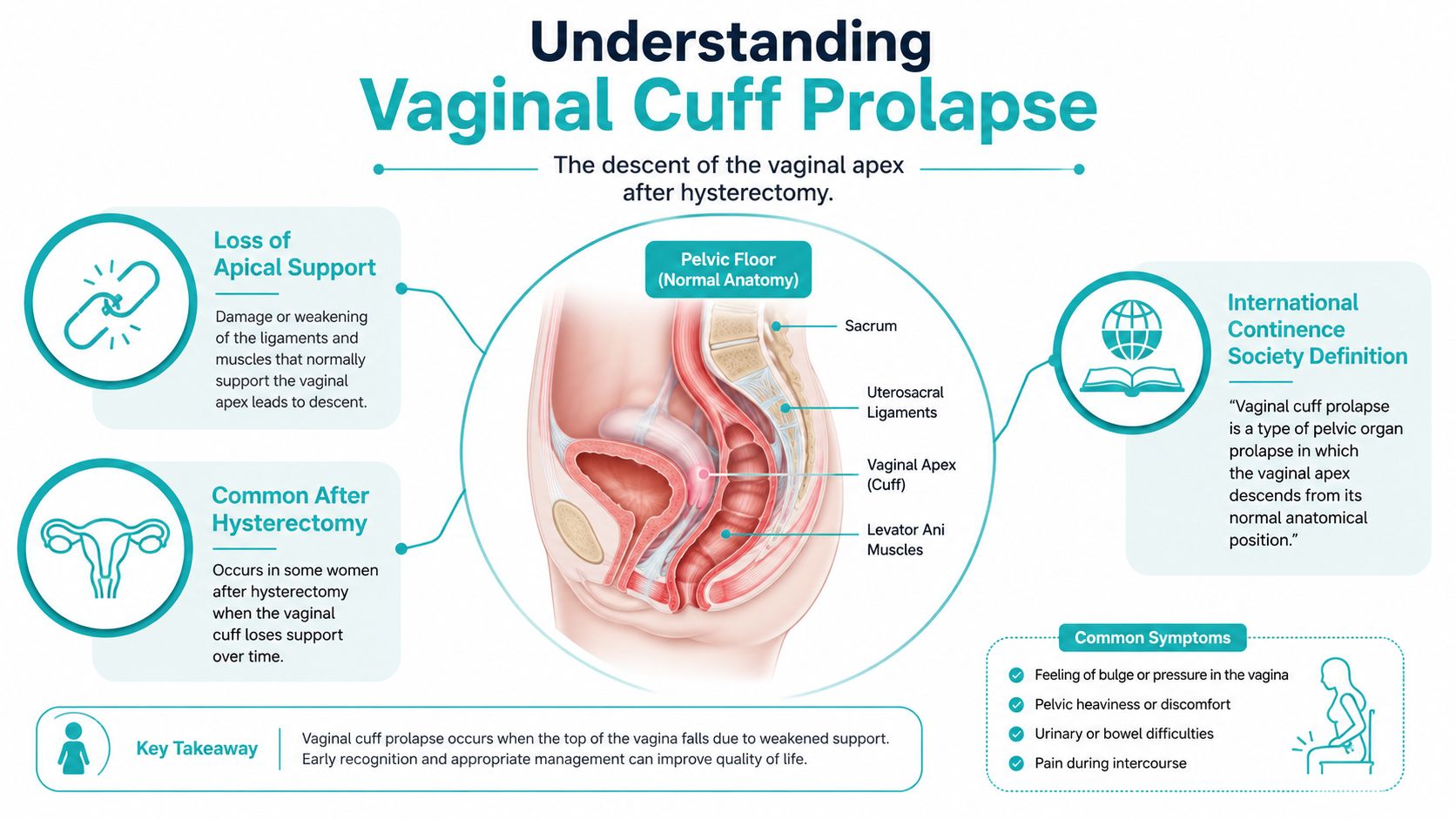
That diagnosis doesn't mean her body has failed or that surgery is automatically necessary. It means the support system at the vaginal apex needs careful assessment. The pelvic floor includes muscles, connective tissue, and ligaments that help support the bladder, bowel, and vaginal walls. After the uterus and cervix have been removed, the top of the vagina still needs strong suspension from the surrounding support structures.

A diagnosis is a starting point
Some women have an anatomical change with little discomfort. Others have bothersome pressure, urinary changes, bowel symptoms, or pain with sexual activity. Symptoms can also reflect other forms of pelvic organ prolapse, pelvic floor muscle tension, bladder conditions, bowel dysfunction, or healing problems. That's why an examination matters more than trying to diagnose yourself from a symptom list.
A pelvic health physical therapist can assess breathing, movement, pressure management, hip and trunk function, and pelvic floor muscle coordination. A gynecologist or urogynecologist can evaluate the vaginal apex and determine whether medical or surgical treatment is appropriate. If you're also dealing with ongoing discomfort after hysterectomy, learning about pelvic pain after total hysterectomy may help you prepare for a more complete conversation with your care team.
You don't have to wait until a bulge is visible outside the vagina. Persistent pressure, a new change in bladder or bowel emptying, or activity-related heaviness deserves an evaluation.
What Is Vaginal Cuff Prolapse and How Common Is It
Vaginal cuff prolapse occurs when the top of the vagina descends after hysterectomy because the apical support system no longer holds it in its intended position. The International Continence Society describes the relevant threshold as the vaginal cuff descending to more than 2 cm above the hymen relative to total vaginal length, a technical definition that clinicians use to describe the position of the vaginal apex. The plain-language meaning is simpler: the upper end of the vagina has lost some of its main suspension.
This problem can exist by itself, but it often occurs with weakness in the front or back vaginal walls. The bladder, rectum, or small bowel may contribute to the overall pattern of pelvic organ prolapse. Your clinician may therefore assess the entire vaginal canal rather than focusing only on the cuff.
Reported prevalence varies widely, from 0.2% to 43%, because studies use different designs, follow-up periods, and definitions of prolapse. A literature-based assessment can identify fewer cases than a direct pelvic examination, especially when researchers count only symptomatic or clinically treated prolapse.
Why the numbers look so different
A classic study published in 1999 found an incidence of 0.4% when researchers used modalities described in the literature, compared with 4.4% when women received direct pelvic examinations, representing 20 of 448 patients. The same study identified a strong relationship with the reason for hysterectomy. Vault prolapse occurred after 11.6% of hysterectomies performed for genital prolapse, or 14 of 120, compared with 1.8% after hysterectomy for other benign disease, or 6 of 328. These findings are detailed in the 1999 clinical study of post-hysterectomy vault prolapse.
More recent data also show that surgery-requiring vault prolapse is uncommon but important. An Austrian study reported a repair incidence of 0.36 per 1,000 women-years and a cumulative incidence of 0.5%, while a broader review cited 6% to 8% for post-hysterectomy vault prolapse requiring surgical repair. The differences reinforce one practical point: your individual risk depends on your original pelvic support, the reason for hysterectomy, how symptoms are measured, and whether the study counts anatomy, symptoms, or surgery.
For a symptom-focused overview, review these signs of pelvic organ prolapse.
Key Risk Factors and What Increases Your Chance
Vaginal cuff prolapse usually develops through a combination of reduced support and repeated downward pressure. Hysterectomy creates the setting in which the vaginal apex must rely on its remaining ligaments and connective tissues. If those structures are already vulnerable, later strain can gradually worsen the descent.
Prior pelvic surgery matters because surgery can alter the normal relationships among the vaginal apex, pelvic ligaments, and surrounding fascia. The indication for hysterectomy matters too. As the historical evidence shows, women who already had genital prolapse when they underwent hysterectomy carried a different support profile from women whose hysterectomy treated another benign condition.
Factors you can't fully control
Vaginal childbirth can stretch or injure pelvic support tissues. Connective-tissue vulnerability can also influence how well fascia and ligaments tolerate strain, and this isn't something you caused or can simply exercise away. These factors help explain why two women with similar surgical histories may experience very different symptoms.
Other contributors increase chronic force through the abdomen and pelvis:
- Elevated body mass index: Greater ongoing load can place additional demand on pelvic support structures.
- Chronic cough: Repeated coughing creates frequent pressure spikes that travel downward toward the pelvic floor.
- Constipation and straining: Bearing down during bowel movements can repeatedly stress the vaginal apex and surrounding walls.
- Repeated heavy lifting: Lifting without coordinated breathing and pressure control can aggravate symptoms, particularly when tissues are already compromised.
- Additional pelvic surgery: Further operations may affect tissue quality, scarring, and the mechanics of support.
Having one risk factor doesn't guarantee prolapse. Several factors together can make symptoms more likely or make an existing prolapse harder to manage.
The clinical review of risk factors and pelvic support describes this condition as an apical-support failure and connects risk to weakened fascial or levator structures and increased chronic downward force. In practice, the useful question isn't whether you can eliminate every risk. It's which modifiable pressures, bowel habits, lifting strategies, and movement patterns you can address now.
Recognizing the Signs and Symptoms Early
The symptoms may be subtle at first. One woman notices pressure after a long shopping trip. Another feels a small bulge while showering or wiping. Someone else doesn't feel a bulge at all but realizes she has to change position to finish urinating.
The most common experience is a sense of heaviness, dragging, or pressure in the pelvis. Some women describe fullness at the vaginal opening or the feeling that a tampon is slipping, even when they no longer use tampons. The sensation often becomes more noticeable later in the day, after prolonged standing, or during lifting and exercise.
Symptoms may involve more than the vagina
Because the vaginal apex sits near the bladder and bowel, support changes can affect several functions:
- Bladder emptying: You may need to urinate more often, start and stop, strain, or remain seated longer because the bladder doesn't feel fully empty.
- Bowel function: Constipation, incomplete emptying, or the need to adjust your position can occur.
- Sexual comfort: Deep pressure, discomfort, or concern about a bulge can affect intimacy.
- Visible or palpable bulging: Some women can feel tissue at the opening, while others notice only pressure.
- Activity tolerance: Walking, lifting, coughing, or prolonged standing may intensify symptoms.

Rest and lying down may reduce the sensation because gravity places less sustained demand on the pelvic support system. That pattern can be useful information for your clinician, but it doesn't confirm the diagnosis. Other pelvic, urinary, bowel, and musculoskeletal conditions can create similar symptoms.
Embarrassment is common, but it shouldn't determine your care. A clinician has heard these symptoms before and needs specific details to match treatment to your goals.
Anatomical stage and symptom severity don't always match. A modest finding can feel very disruptive, while a more pronounced anatomical descent may cause little discomfort. Seek an assessment if symptoms are persistent, new, worsening, or interfering with daily activities, even if you're unsure whether they represent prolapse.
Conservative Management Options and What Research Shows
Conservative care is a legitimate treatment pathway, not simply a way to postpone surgery. NICE identifies weight and lifting changes, pelvic floor muscle training, and vaginal estrogen among the main non-surgical options, with surgery generally considered for more severe or troublesome cases. The best plan depends on the extent of prolapse, tissue health, symptoms, medical history, and what activities you want to preserve.

What conservative care can include
Pelvic floor muscle training should be individualized. Some women need strengthening and endurance work. Others have overactive muscles that remain clenched and need relaxation, coordination, and pressure-management training before strengthening makes sense. A therapist may observe how you breathe, lift, cough, squat, and transition from sitting to standing rather than handing you a generic exercise sheet. Learn more about whether pelvic floor exercises can reverse prolapse.
Movement and lifting changes reduce aggravating pressure without requiring complete inactivity. Your plan may include exhaling through effort, avoiding breath-holding, changing load position, addressing constipation, and gradually rebuilding capacity. Weight management may also reduce ongoing mechanical demand, but it should be approached with support and without blame.
Vaginal estrogen may be discussed after menopause to support vaginal tissue quality. It isn't a mechanical repair for prolapse, and it isn't appropriate for everyone, so your prescribing clinician should review your medical history.
A pessary is a removable support device fitted inside the vagina. It can reduce pressure and bulging for some women and may be useful while you decide about surgery, during recovery, or when surgery isn't your preferred option. Fit, comfort, removal, cleaning, vaginal tissue health, and follow-up determine whether it works well for you.
The mesh question requires precision
The evidence doesn't support a simple “mesh is good” or “mesh is bad” answer. The NICE discussion of current treatments notes that transvaginal permanent mesh can reduce awareness of prolapse and repeat prolapse surgery, but it also increases total repeat surgery, bladder injury, and new stress incontinence. Absorbable and biologic grafts don't show a clear benefit. These trade-offs are summarized in NICE's patient information on prolapse treatments.
Ask whether the proposed material is permanent, where it will be placed, what complications are specific to that approach, and what non-mesh alternatives could meet your goals. Conservative treatment may be enough for symptom control, but a worsening bulge, difficulty emptying the bladder, or major activity limitations deserves specialist reassessment.
Surgical Repair Approaches and Long-Term Outcomes
Surgery for vaginal cuff prolapse must restore support at the vaginal apex. Repairing only the front or back vaginal wall without addressing the top support can leave the central problem in place and carries a higher failure risk. Your surgeon should evaluate the entire support pattern and explain which compartments require treatment.
Sacrocolpopexy is widely treated as a reference-standard apical suspension. In one retrospective cohort, relapse occurred in about 15% after sacrocolpopexy compared with 22% after iliococcygeus fixation, as reported in the comparative surgical outcomes study. Both procedures significantly improved POP-Q anatomy and symptoms related to bulging and voiding in that cohort. These figures describe one study's experience, not a personal forecast.
Comparing the surgical conversation
Sacrocolpopexy suspends the vaginal apex toward the sacrum, commonly using graft material. Iliococcygeus fixation attaches the apex to supportive pelvic structures through a different route. Sacrospinous fixation and transvaginal repairs are other established approaches, and the appropriate choice depends on anatomy, prior surgery, health status, sexual function goals, surgeon experience, and your tolerance for specific risks.
A useful consultation should answer practical questions:
- Apical support: What structure will hold the vaginal apex after repair?
- Whole-pelvis assessment: Are the bladder wall, rectal wall, or small bowel contributing?
- Material choice: Will the operation use permanent mesh, another graft, or native tissue?
- Recovery demands: Which lifting, bowel, sexual, and exercise restrictions apply?
- Failure planning: What symptoms suggest recurrence, and how will follow-up assess it?
Cuff healing deserves particular attention. A prospective cohort found that postoperative vaginal cuff infection increased recurrence risk, with a relative risk of 2.54 and a 95% confidence interval of 1.5 to 4.3, as reported in the same surgical evidence source. Infection prevention, timely attention to abnormal discharge or fever, tissue assessment, and careful postoperative instructions aren't minor details. They can influence the durability of the repair.
Surgery can improve support and function, but no operation guarantees that prolapse will never recur. The best decision weighs symptom burden against recovery, complications, recurrence, and your long-term priorities.
When to Seek Specialist Care and Prevention Strategies
Arrange an evaluation when pelvic pressure persists, a bulge appears, bladder or bowel emptying changes, or symptoms interfere with walking, lifting, exercise, or sexual activity. A urogynecologist can assess the anatomical support, while a pelvic floor physical therapist can examine muscle coordination and pressure management. You may benefit from both perspectives, especially when symptoms and examination findings don't line up.
If you're planning a hysterectomy and already have prolapse, ask how the surgeon will support the vaginal cuff during the original operation. Recent evidence-based recommendations connect the support procedure to the original prolapse stage:
- Non-prolapsed or stage I uterus: Uterosacral or cardinal ligament suturing may be considered.
- Stage II uterus: McCall's culdoplasty may be used.
- Stages III to IV: Sacrospinous fixation or sacrocolpopexy may be considered.
These choices aren't interchangeable shortcuts. They reflect the starting anatomy and the amount of apical support required. A recent randomized-trial update found no significant difference in apical support at one year between laparoscopic and vaginal cuff closure, suggesting that closure route alone may not be the decisive factor. The trial update on cuff closure and apical support supports a broader discussion about suspension, anatomy, and surgical planning.
Prevention is practical, not perfect
You can't change your hysterectomy history, childbirth history, or connective-tissue characteristics. You can work with your care team to reduce straining, manage constipation, improve cough control, use coordinated breathing during effort, and modify lifting while tissues recover or symptoms settle.
Pelvic floor physical therapy can help before surgery, after surgery, or during observation. Treatment may focus on relaxation as much as strengthening, because excessive gripping can interfere with efficient pressure distribution. Recovery should be progressive, with activity decisions based on healing, symptoms, examination findings, and the procedure performed.
Building Your Path Forward with Confidence
Vaginal cuff prolapse sits on a continuum. Prevention begins with recognizing support problems before hysterectomy and discussing an appropriate apical-support plan. After hysterectomy, early symptoms can often be addressed with education, pelvic floor rehabilitation, pressure management, tissue care, and a pessary. Surgery remains an important option when prolapse is advanced, symptoms are severe, or conservative care no longer meets your needs.
The most useful plan is individualized. A pelvic floor muscle program should match your muscle function, not a generic idea that every woman needs more squeezing. Lifting advice should help you return to meaningful activities rather than leave you afraid of movement. A pessary should be assessed for fit and comfort. A surgical consultation should explain the suspension method, material choice, recurrence risk, infection prevention, and recovery expectations in language you understand.
Three actions can move you forward
- Schedule an evaluation: Bring a short record of pressure, bulging, bladder, bowel, sexual, and activity-related symptoms. Note whether rest changes them.
- Ask about prevention: If hysterectomy is planned or has recently occurred, ask how the vaginal apex was or will be supported and what restrictions apply during healing.
- Build a team: Consider coordinated care from a gynecologist or urogynecologist and a pelvic health physical therapist, particularly if you want to explore conservative treatment before surgery.
You don't need to choose between ignoring symptoms and having an operation immediately. You can gather information, try appropriate conservative care when suitable, and revisit the plan if your symptoms change. With the right assessment and support, many women regain confidence in walking, lifting, exercising, using the bathroom, and being intimate.
Lake City Physical Therapy provides individualized pelvic floor evaluations for prolapse, including pelvic floor muscle training, pressure management for lifting and exercise, pessary education, and home programs, with telehealth support available. Visit Lake City Physical Therapy to explore pelvic health services and schedule care for your next step.

