What Causes Stress Incontinence? a Complete Guide for Women
You go for a run, feel good, pick up the pace, and then notice a small leak. Or you laugh hard with friends, cough during a cold, or jump during a workout class and suddenly wonder, “Why is this happening?”
If that's you, you're not broken, and you're not the only one asking. Many women feel caught off guard by bladder leaks because they expected this to happen only after having kids, much later in life, or not at all. In clinic, I hear the same worry over and over. “I thought I was strong. Why would this happen to me?”
The short answer is that stress incontinence is usually a support and pressure problem, not a character flaw, not poor hygiene, and not “just getting older.” Once you understand the mechanics, the symptom becomes much less mysterious and much more treatable.
That Unexpected Leak Is More Common Than You Think
A lot of women have a moment when they first realize something has changed. Maybe it happens during a sneeze at the grocery store. Maybe it shows up in the middle of a volleyball game, on a trampoline with your kids, or during a set of box jumps. You freeze for a second and think, “Wait, did I just leak urine?”
That moment can feel isolating. Many women immediately blame themselves. They think they're out of shape, too old, not doing enough core work, or doing something wrong in the gym. Some discreetly start changing their lives around the symptom. They wear dark leggings, map out bathrooms, skip jumping, or avoid laughing too hard when their bladder is full.
But stress urinary incontinence is common. Mayo Clinic notes that stress urinary incontinence affects 24% to 45% of women older than 30 in its overview of stress incontinence symptoms and causes.
You are not the only woman who leaks when she coughs, runs, lifts, or laughs.
The word stress confuses people. It does not mean emotional stress. It means physical stress on the bladder and pelvic floor. The leak happens when an activity increases pressure through your abdomen and pelvis faster than your body can manage it.
That's why leaks often show up during ordinary movements. A cough. A sneeze. A fast downhill run. A heavy deadlift. A jumping jack in the middle of a warmup. The body is dealing with force, and the support system underneath needs to respond well enough to keep the urethra closed.
If you've been trying to ignore it, minimize it, or tell yourself it's “not bad enough,” that reaction makes sense. But understanding what causes stress incontinence is usually the turning point. Once the mechanics make sense, the next steps get clearer too.
The Core Mechanism Behind Stress Incontinence
Stress incontinence is easiest to understand when you stop thinking of it as a bladder problem alone. It's more like a pressure-management problem involving the pelvic floor, the urethra, and the muscles that help keep urine in until you want it out.
Think of the pelvic floor like a hammock
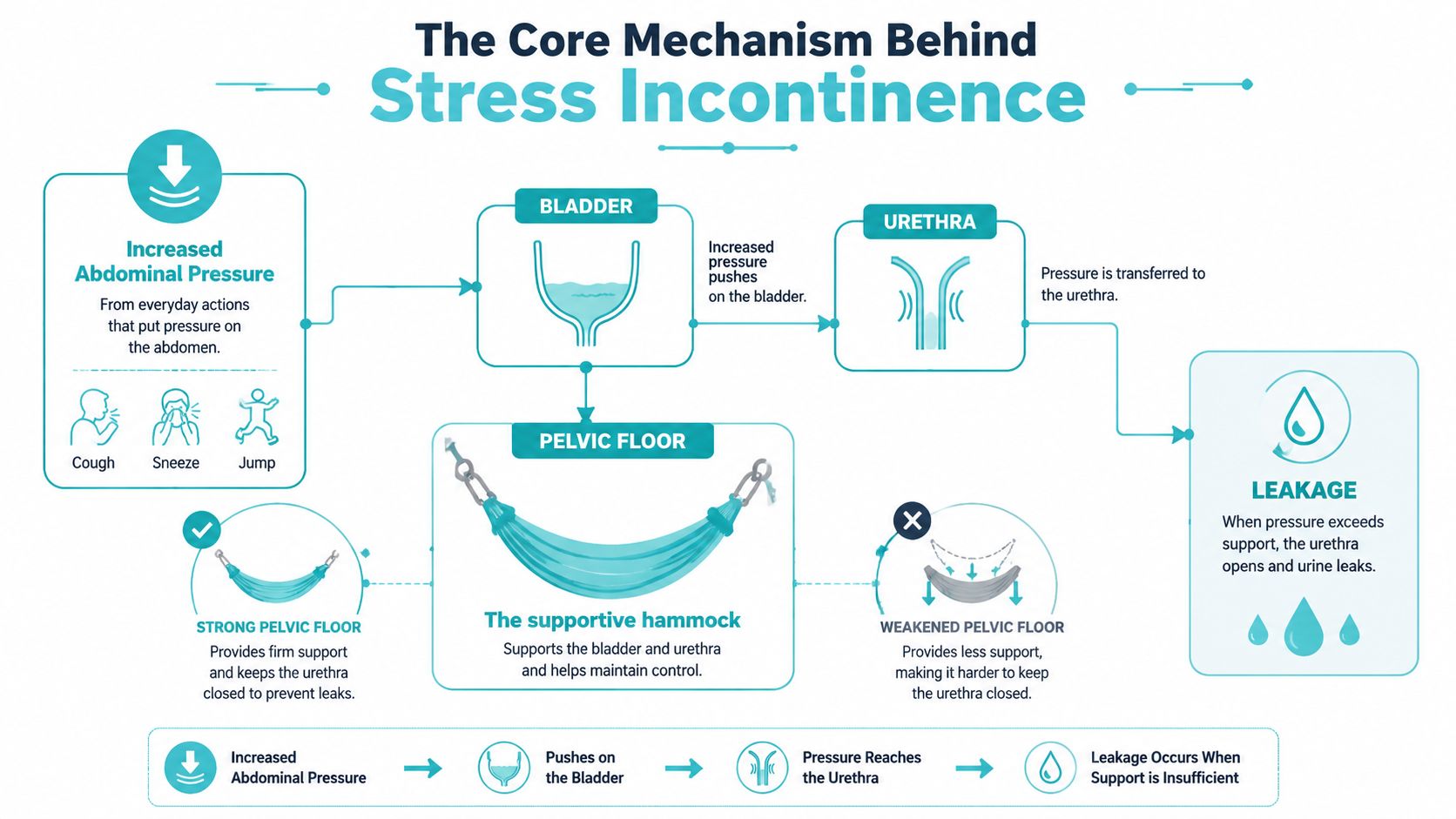
Your pelvic floor sits at the bottom of your pelvis like a supportive hammock. It helps hold up the bladder, bowel, and, in women, the uterus. The urethra, which is the tube that carries urine out, needs that support. It also relies on the urethral sphincter, a valve-like closing mechanism.
When everything is working well, pressure from above and support from below stay balanced. Your abdominal muscles, diaphragm, deep core, pelvic floor, and sphincter coordinate to keep the urethra closed.
When that system loses support, leaks can happen.
What actually happens during a leak
The clearest mechanical explanation is this. The dominant pathway in female stress urinary incontinence is pelvic floor support failure, where weakened muscles and tissues can no longer keep the urethra fully closed when pressure inside the abdomen rises, as described in this StatPearls review on stress urinary incontinence.
A simple way to picture it is to imagine stepping on a water balloon while trying to pinch a straw shut. If the pinch is strong and the support around it is solid, nothing comes out. If the support is delayed, tired, injured, or poorly coordinated, urine can escape through the urethra.
That's why certain triggers are so predictable:
- Coughing or sneezing raises pressure quickly
- Running or jumping repeats that pressure over and over
- Lifting heavy weight can create a strong downward load
- Laughing, bending, or bracing hard can push pressure past what the system can control
For some women, the issue is pure weakness. For others, it's timing. The muscles may be strong enough in a basic squeeze test, but they aren't responding at the right moment during impact or effort. In active women, that timing piece matters a lot.
If you want a broader overview of how this support system changes over time, this article on how pelvic floor muscles get weak is a useful companion.
Practical rule: A leak during effort usually means pressure from above beat support from below.
That's an important mindset shift. Stress incontinence doesn't mean your bladder is lazy or that you lack discipline. It means your body's pressure-management system needs better support, better coordination, or both.
Common Pathways That Weaken Pelvic Support
The same symptom can start from different life experiences. Some women notice leaks after childbirth. Others don't have symptoms until menopause, after surgery, or during a period of chronic coughing or constipation. The common thread is that the tissues supporting the urethra and pelvic organs have been challenged.
Pregnancy, birth, and pelvic support changes
Pregnancy places load on the pelvic floor for months. Then delivery can stretch or injure muscles, connective tissue, and nerves. In women, childbirth is a primary cause of tissue or nerve damage that weakens the pelvic floor, and symptoms may start after delivery or show up years later, as summarized in this Medscape overview of stress urinary incontinence.
That delayed timing confuses a lot of women. They'll say, “But my baby is already in kindergarten,” or “I was fine right after birth.” That can still fit the pattern. Sometimes the system copes for years, then another stressor reveals the weakness.
Hysterectomy can also affect pelvic support. When support structures are altered, the urethra may have a harder time staying closed during everyday increases in pressure.
Hormonal and tissue changes
Hormonal shifts can affect how tissues tolerate force. Menopause is a common example. Lower estrogen states can change tissue elasticity and support, which may make leaks more noticeable during movements that didn't used to be a problem.
This doesn't mean every leak in midlife is “just hormones.” It means tissue quality and support can change, and that change can combine with old childbirth history, exercise habits, or chronic pressure from the abdomen.
Daily pressure that adds up
Some causes are less dramatic but very persistent. Chronic coughing, chronic constipation, smoking, heavy lifting, and higher body weight all increase strain on pelvic support over time. Instead of one big event, the body deals with repeated pressure every day.
Here's a simple way to sort the most common contributors:
| Risk Factor Category | Specific Examples |
|---|---|
| Pregnancy and birth | Pregnancy load, vaginal delivery, tissue injury, nerve injury |
| Surgery and pelvic support changes | Hysterectomy and other pelvic surgeries |
| Hormonal changes | Menopause and other low-estrogen states |
| Repeated pressure from above | Chronic cough, chronic constipation, heavy lifting |
| Body load factors | Obesity, ongoing strain during daily movement |
| Lifestyle factors | Smoking, habits that worsen coughing or constipation |
For women working on body weight because it's adding pressure to the abdomen and pelvic floor, medical support can be helpful. A resource like Pause Medical's approach to weight loss may be worth exploring when weight change is part of the bigger health picture.
When pressure keeps showing up from above, the pelvic floor has to answer every single time. Over months and years, that can expose weak links in support.
Why Athletes and Active Women Can Get SUI
One of the biggest myths about stress incontinence is that it only happens after childbirth or later in life. That idea leaves a lot of active women feeling confused and dismissed. They think, “I'm fit. I haven't had kids. Why am I leaking?”
The answer is mechanical. Athletic bodies create higher demands.
Impact and effort change the load
Yale Medicine lists an “intense exercise regimen” as a risk factor for stress incontinence in its overview of stress incontinence. That matters because many women leak during activity long before anyone talks to them about pelvic floor function.

Running, jumping, sprinting, tumbling, and lifting can all create strong or repeated spikes in abdominal pressure. Even when the pelvic floor is not “weak” in the everyday sense, those forces may be high enough to overload support. Add breath-holding, hard bracing, poor timing, fatigue, or constipation, and the system may start to fail under demand.
That's why an athlete may say:
- “I only leak on double-unders.”
- “It happens when I go heavy on squats.”
- “I'm fine walking, but not during hill sprints.”
- “It started during volleyball, not after pregnancy.”
These patterns are real. They make sense biomechanically.
Strong everywhere else does not guarantee pelvic control
A strong core, strong glutes, and good conditioning don't automatically mean the pelvic floor is coordinating well during impact. Sometimes active women over-grip the abdominals, hold their breath on exertion, or brace in a way that drives pressure downward faster than the pelvic floor can respond.
That doesn't mean exercise is bad. It means the strategy matters.
If you leak only during harder efforts, your body may be showing you a load-management problem, not a lack of fitness.
Athletes often improve when they address breathing, landing mechanics, pressure control, and pelvic floor timing alongside strength. In other words, the goal usually isn't “stop running.” It's “help the system handle running better.”
Practical First Steps for Managing Leaks
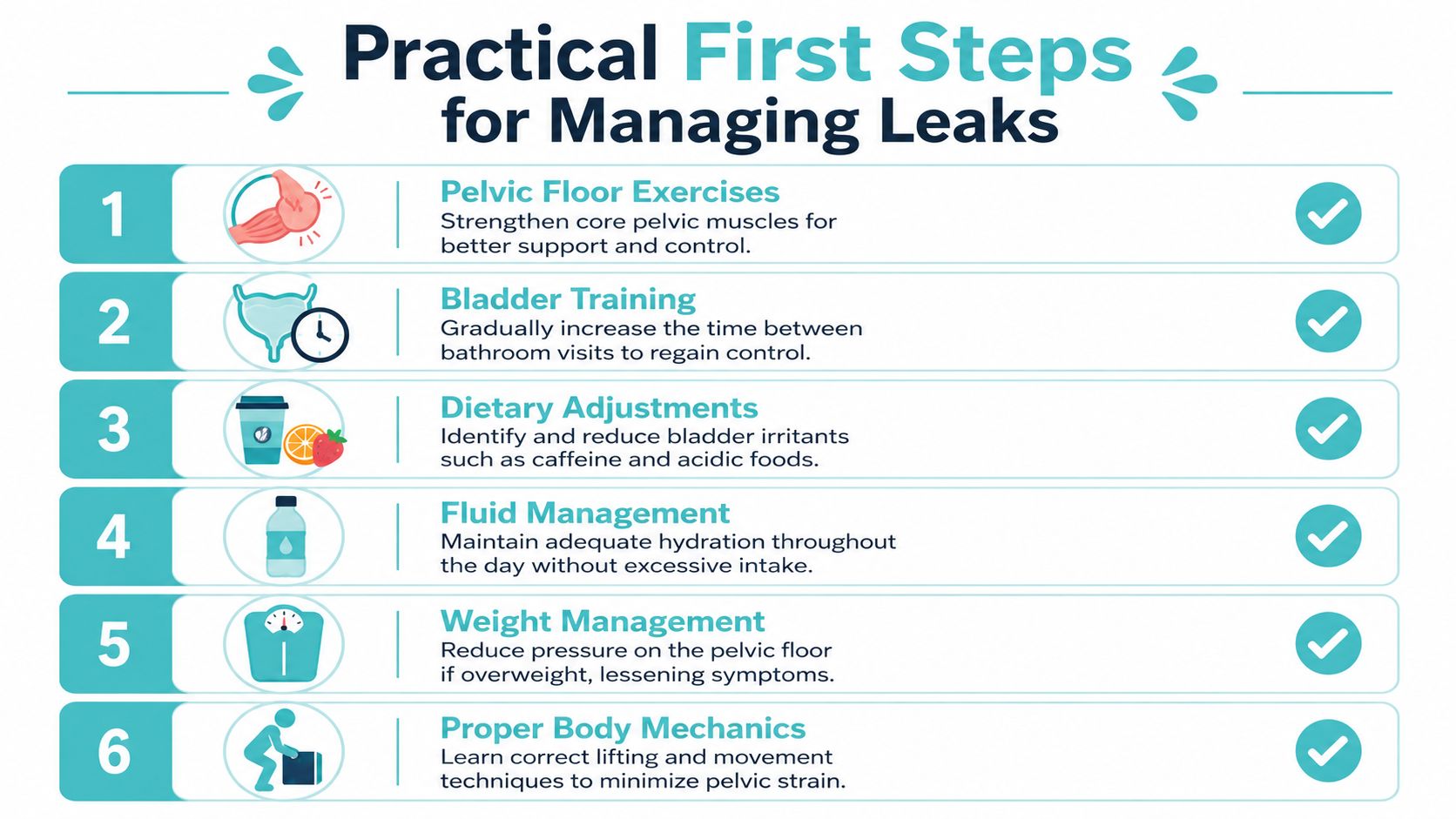
The first goal is not perfection. It's reducing the situations that overload your system while improving how your body handles pressure. Small changes can make leaks less frequent and give you better clues about what's driving them.
Start with habits that lower strain
If constipation is part of the picture, address it. Repeated straining on the toilet puts downward stress on the pelvic floor. If coughing is ongoing, talk with your medical provider about the cause so you're not repeatedly stressing the same tissues every day.
Pay attention to patterns. Do leaks happen when your bladder is very full, only during impact, or mainly during heavy lifting? That information is useful.
Use pressure better, not just force harder
Many women have been told to “just do Kegels.” Sometimes that helps. Sometimes it doesn't. A pelvic floor that's underperforming may need strengthening, but another pelvic floor may already be tense and poorly coordinated. That person may need to learn how to relax, lengthen, and then contract at the right time.
A few practical places to begin:
-
Exhale during effort
Try breathing out as you stand up, lift, push, or exert. This often reduces the pressure spike compared with breath-holding. -
Modify impact temporarily
If jumping triggers leaks every time, lower the load while you work on control. That might mean step-downs instead of jumps for a period, or shorter running intervals. -
Avoid “just in case” bathroom trips all day
Frequent preventive peeing can train the bladder to signal too early for some people. -
Learn proper pelvic floor training
If you want a practical starting point, this guide to pelvic floor exercises for bladder leakage explains common exercise approaches and where people often go wrong.
- Watch your lifting strategy. If you clamp your abs and hold your breath before every rep, you may be creating more downward pressure than needed.
- Support bowel health. Softer, easier bowel movements reduce straining.
- Stay hydrated. Restricting fluids too aggressively can backfire and irritate the bladder.
One important caveat: More squeezing is not always the answer. The right exercise depends on whether your pelvic floor needs strength, coordination, relaxation, or a combination.
When to See a Pelvic Floor Physical Therapist
If leaks are changing how you work out, socialize, travel, or feel in your body, it's worth getting assessed. You do not need to wait until symptoms become severe. A pelvic floor physical therapist can often identify the driver much faster than trial-and-error on your own.

What a pelvic floor PT actually evaluates
A good evaluation goes beyond “do some Kegels.” It looks at how you breathe, brace, move, lift, and transfer force through the trunk and pelvis. It also looks at pelvic floor muscle performance, including both contraction and relaxation.
Depending on the situation, your PT may assess:
- Pelvic floor function including strength, coordination, endurance, and the ability to let go
- Breathing mechanics because the diaphragm and pelvic floor should work together
- Core and hip control since these affect force transfer and pressure strategy
- Movement patterns such as running, jumping, squatting, coughing, or lifting
- Symptom triggers including timing, bladder habits, bowel habits, and activity load
If you aren't sure whether your symptoms justify an appointment, this checklist of signs you need pelvic floor therapy can help you decide.
Some women also like reading how other clinics explain this specialty before booking care. This overview of pelvic floor physical therapy South Shore MA gives a helpful outside perspective on what treatment can involve.
Treatment should match your body and your goals
The right plan depends on why you leak. One person needs graded strengthening. Another needs down-training and better breathing. Another needs return-to-running progressions and impact-specific coordination work.
That's also why generic online advice often falls short. “Do Kegels” is incomplete. “Stop exercising” is rarely the best answer. The primary goal is function. You want a body that can laugh, cough, sprint, lift, or chase kids without fear.
For women in North Idaho and Eastern Washington, Lake City Physical Therapy offers pelvic floor physical therapy for incontinence with evaluation of the likely cause and a customized treatment plan based on symptoms, movement demands, and goals.
A short video can make that process feel more concrete.
You deserve more than pads, guessing, or giving up activities you enjoy. Leakage during exercise or everyday movement is a symptom with a mechanical explanation. In many cases, it also has a clear rehab path.
If you're dealing with leaks when you run, cough, lift, laugh, or jump, Lake City Physical Therapy can help you figure out why it's happening and what to do next. Pelvic floor physical therapy can identify the specific cause in your body, build a personalized treatment plan, and help you get back to daily life and exercise with more confidence.

