How to Strengthen Pelvic floor Muscles: A PT’s Guide
Leaking when you laugh. Feeling pressure when you pick up your toddler. Avoiding jumping jacks, long runs, or a hard workout because you’re not sure what your body will do. Many women start searching how to strengthen pelvic floor muscles when something feels off, but most advice they find is too simple to be useful.
The pelvic floor isn’t just one muscle you squeeze a few times a day. It’s a group of muscles at the base of your pelvis that helps with bladder and bowel control, supports your organs, and works with your diaphragm, abdominals, and hips to manage pressure. When it’s weak, symptoms can show up as leaking, heaviness, or lack of support. When it’s too tight, you might feel pain, tension, or difficulty fully relaxing.
That’s why a better plan goes beyond endless Kegels. Good pelvic floor training includes awareness, proper technique, breathing, strength, relaxation, and progressions that match your life stage. A postpartum mother needs a different approach than a runner returning to impact. Someone with painful sex needs a different starting point than someone with mild stress incontinence.
This guide gives you a practical, evidence-based way to build pelvic floor strength safely. You’ll learn how to find the right muscles, how to train them without overdoing it, how to progress into functional movements, and when it’s time to get one-on-one help.
Introduction
A lot of women arrive at this topic frustrated. They’ve been told to “just do Kegels,” but they’re still leaking on a run, feeling pelvic heaviness by the end of the day, or dealing with pain that gets worse when they try to tighten more.
That frustration makes sense. Pelvic floor problems rarely come from one issue alone. Sometimes the muscles are underactive and need strength. Sometimes they don’t coordinate well with breathing and pressure. Sometimes they’re already holding too much tension and need relaxation before strengthening helps.
Think of the pelvic floor as the base of your body’s core canister. It works with your breathing muscle above, your abdominal wall in front, and your back and hips around it. When this system works well, it helps you stay dry, supported, and stable during daily tasks, exercise, pregnancy, and recovery after birth.
A stronger pelvic floor isn’t built by squeezing harder. It’s built by training the right muscles, at the right time, in the right way.
The good news is that pelvic floor function can improve. The better news is that you don’t need a complicated routine to begin. You need a clear one. Start with awareness, learn what a correct contraction feels like, and build from there into movements that match real life.
Your Pelvic Floor Anatomy and How to Find It
The pelvic floor is often described as a hammock or sling of muscles at the bottom of the pelvis. That’s a useful image because these muscles don’t just pinch shut. They support from below, respond to pressure, and lift gently upward when they contract well.
They help control the openings of the bladder and bowels, support the pelvic organs, and contribute to core stability. They also need to lengthen and relax. That matters just as much as their ability to contract.

What the right contraction should feel like
A good pelvic floor contraction usually feels like a gentle squeeze and lift. For many women, the clearest cues are:
- Around the urethra as if you’re stopping gas or urine, but only as a learning cue, not as a repeated bathroom exercise.
- Inside the vagina as if the tissues are drawing inward and upward.
- In the lower pelvis as a subtle lift, not a forceful clench.
What it should not feel like:
- A hard butt squeeze
- A belly brace so strong you can’t breathe
- Inner thigh gripping
- Breath holding
- Pushing down instead of lifting up
One reason this is confusing is that many people compensate with stronger nearby muscles. Pelvic floor exercises were first described by Dr. Arnold Kegel in the 1950s, and modern research shows effectiveness rates from 29% to 59%, but proper execution is critical because approximately 30% to 40% of people do not perform them correctly on their first attempt without guidance, according to this clinical review on pelvic floor muscle training.
Three ways to identify your pelvic floor
Different bodies respond to different cues. If one cue doesn’t click, try another.
-
The stop-and-lift cue
Think about stopping the flow of urine or holding back gas. Again, this is a cue, not a regular exercise strategy. You’re trying to identify the area, then reproduce that feeling away from the bathroom. -
The mirror or hand cue
Lie down comfortably and place a hand on your lower abdomen and one hand on your glutes. As you contract, those areas should stay relatively quiet. The effort should feel deep and subtle, not big and visible. -
The exhale cue
Breathe in. As you exhale, gently draw the pelvic floor inward and upward. Many women find the muscles more easily when they stop trying to “crush” the movement and instead time it with a calm exhale.
Practical rule: If your jaw tightens, your breath stops, or your butt takes over, back off the effort. A smaller correct contraction beats a bigger wrong one.
A simple self-check for form
Try this in a supported position first, such as lying on your back with knees bent.
- Step 1: Inhale and let your belly soften.
- Step 2: Exhale slowly.
- Step 3: During the exhale, gently contract the pelvic floor.
- Step 4: Hold only as long as you can keep breathing.
- Step 5: Fully relax before the next rep.
If you’re unsure whether you’re doing it right, these signs usually mean the contraction is more accurate:
| Sign | What it usually means |
|---|---|
| You can breathe normally | You’re not over-bracing |
| The effort feels deep, not in the butt | Better isolation |
| You can fully let go afterward | Good control, not just gripping |
| The movement is subtle | You’re using the pelvic floor, not forcing from larger muscles |
Best starting positions
Start where your body can learn the movement with the least amount of strain.
- Lying down: Often easiest for beginners because gravity is reduced.
- Side-lying: Helpful if your back feels uncomfortable or you tend to overuse your abs.
- Seated: Good for building awareness you can use at work, in the car, or during daily tasks.
- Standing: More functional, but harder. Save this for after you can isolate the muscles in easier positions.
Some women find the muscles quickly. Others need practice and feedback. That’s normal. The goal at this stage isn’t intensity. It’s accuracy.
The Core Exercise Program From Beginner to Advanced
Most women don’t need more random exercises. They need a progression. The pelvic floor responds best when you train endurance, quick response, breathing, and whole-body coordination together.
Here’s the visual roadmap.
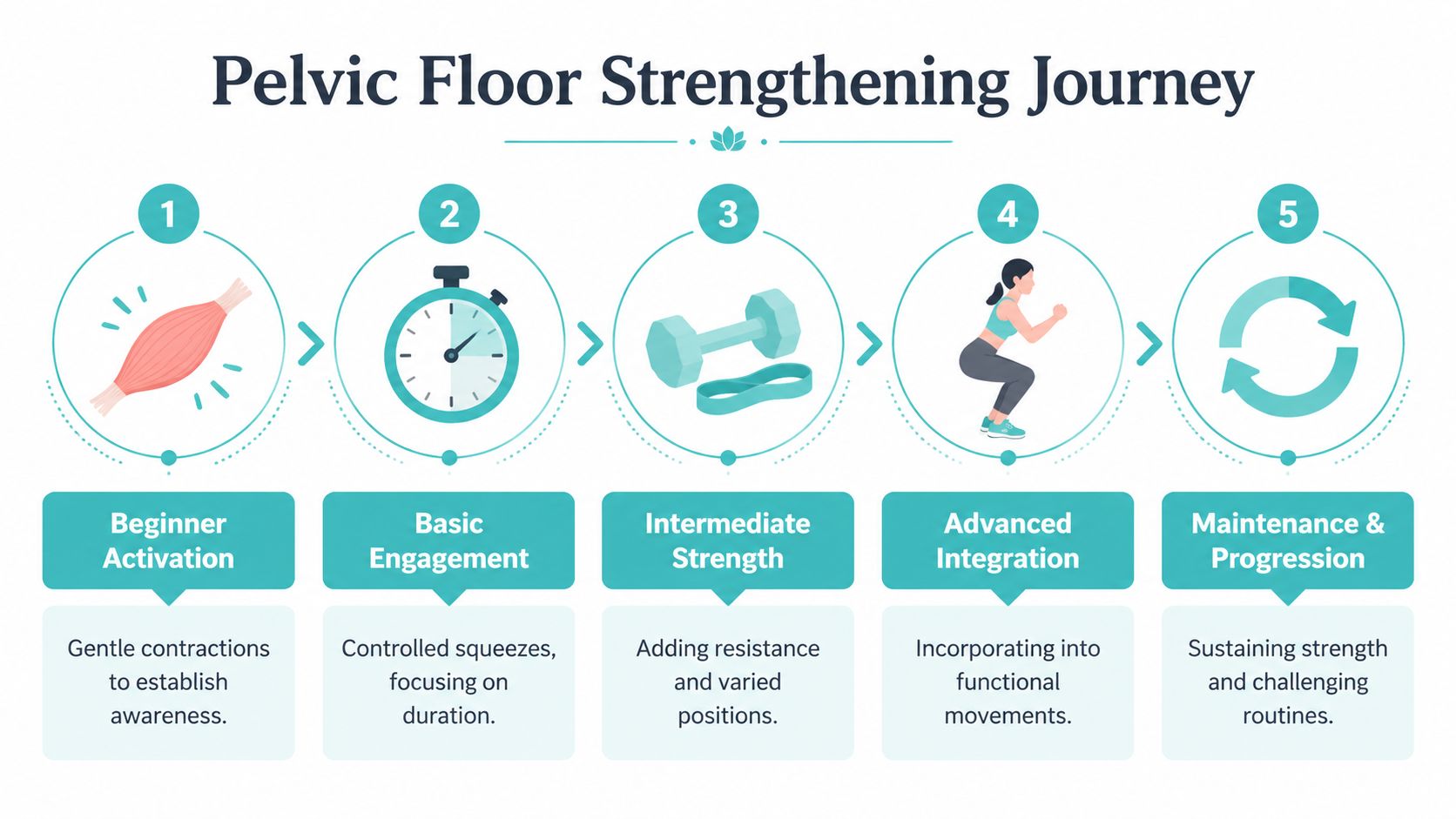
A well-rounded regimen that includes bridges and bird-dog targets the pelvic floor alongside the core and glutes. That matters because coordination and relaxation are part of pelvic floor function, and training protocols work best when they last over 12 weeks and combine slow endurance holds with fast contractions, as described in this pelvic floor exercise guide from Hinge Health.
Stage one with gentle activation
Start in lying or seated. Your job is to learn control.
Endurance holds
- Gently contract the pelvic floor.
- Hold for 10 seconds if you can do that without breath holding or butt gripping.
- Fully relax.
- Repeat 10 times.
Quick contractions
- Gently squeeze and lift, then let go right away.
- Perform 10 quick reps.
Use both types because they train different jobs. Endurance helps you hold support through a walk, workout, or long day. Quick contractions help you respond to a cough, laugh, or jump.
A common schedule is 3 times per day, progressing gradually as your control improves. If symptoms increase, reduce the dose and check your form.
Stage two with breath and pressure control
Many women can contract the pelvic floor when they’re lying down, then lose it when they lift, stand, or strain. The missing piece is often pressure management.
Try this pattern:
- Inhale and let the rib cage expand.
- Start to exhale.
- During the exhale, gently lift the pelvic floor.
- Keep the throat, jaw, and glutes relaxed.
- Finish the movement before the breath runs out.
This is the same principle you’ll use later during squats, lifting a laundry basket, standing up with a baby, or pushing a sled in the gym. Exhale on effort. Don’t bear down unless a clinician has told you to do something different for a specific reason.
Here’s a short demonstration that can help some women connect the movement pattern with breath and body position.
Stage three with integrated strengthening
Once you can contract and relax on purpose, add movements that train the pelvic floor with the rest of your core.
Bridge
Lie on your back with knees bent and feet hip-width apart. Arms rest by your sides.
- Inhale to prepare.
- Exhale and gently engage the pelvic floor as you lift the hips.
- Hold at the top for 10 to 15 seconds while breathing steadily.
- Lower slowly.
- Perform 10 to 15 reps for 3 sets.
Bridge work is useful because it links the pelvic floor with the glutes and trunk. That’s much closer to real function than isolated squeezing alone.
Bird-dog
Start on hands and knees, with wrists under shoulders and knees under hips.
- Engage your core lightly.
- Extend the opposite arm and leg.
- Keep the spine neutral and avoid shifting side to side.
- Hold for 5 to 10 seconds.
- Alternate for 10 reps per side.
Bird-dog challenges stability. The pelvic floor often works best when it coordinates in the background while the rest of the body moves.
Pelvic tilts
Lie on your back with knees bent.
- Rock the pelvis gently forward and back.
- Find the midpoint where your trunk feels supported.
- Perform 10 to 12 reps.
Pelvic tilts help women who struggle to sense the connection between lower abdominals, rib cage, and pelvic floor.
Don’t rush to harder exercises if you still can’t relax between reps. Strength without release usually turns into gripping.
Stage four with functional strength
Therefore, pelvic floor training starts to matter in everyday life.
Add the contraction to:
- Standing up from a chair
- Lifting groceries
- Carrying a child
- Climbing stairs
- Controlled squats
- Light resistance work
In this stage, the goal isn’t to constantly squeeze all day. It’s to turn the pelvic floor on when needed, then let it return to baseline. That’s what healthy support looks like.
For women who want more guided progressions, this library of core and pelvic floor exercises can help bridge basic activation to more functional movement practice.
Stage five with progression and maintenance
Pelvic floor strength isn’t a one-time fix. The strongest programs are the ones women can keep doing consistently. Research on pelvic floor training also points to a practical truth: training should continue for more than three months, and long-term maintenance matters.
Use these progression signs:
- You can hold contractions without breath holding.
- You can relax fully afterward.
- Symptoms improve during normal activities.
- You can use the muscles in standing, lifting, and exercise.
- You recover well instead of feeling more pressure or fatigue later.
If those boxes are checked, progress by changing one variable at a time:
- Move from lying to sitting to standing.
- Increase hold time before increasing volume.
- Add movement before adding impact.
- Add resistance only if symptoms stay stable.
Special Considerations for Pregnancy Postpartum and Athletes
A pregnant patient may tell me she feels heaviness by evening but also worries about preparing for birth. A new mom may want to get back to running but leaks when she jogs to the mailbox. An athlete may feel strong everywhere except during double-unders, box jumps, or heavy lifts.
Those are not the same problems, so they shouldn’t get the same program.
Standard guides often fail postpartum women, 40% to 80% of whom experience incontinence, and female athletes have higher prolapse risk. Progression beyond basic Kegels matters, and integrating Pilates or hypopressure techniques can be more effective for recovery and performance than isolated contractions alone, as noted in this Temple Health article on strengthening the pelvic floor at home.

During pregnancy
Pregnancy changes pressure, posture, breathing mechanics, and load on the pelvic floor. Some women need more support. Others need to learn how to relax tension they’ve been carrying.
In pregnancy, I want women to build three skills:
- Awareness: Can you contract and release the pelvic floor without forcing?
- Pressure control: Can you exhale with effort during sit-to-stand, stairs, and lifting?
- Relaxation: Can the pelvic floor soften when it needs to?
That last point gets missed. Labor and delivery preparation isn’t just about strength. It’s also about letting go. If you can contract but not lengthen, your training is incomplete.
If you’re pregnant and want a more individualized approach, especially if you’re dealing with pressure, leakage, or exercise questions, this guide to pelvic floor physical therapy during pregnancy explains what targeted care can look like.
Postpartum recovery
The early postpartum phase should feel like rebuilding, not testing. Many women are eager to “bounce back,” but symptoms like leaking, heaviness, abdominal doming, or pain are signs to slow down and reassess.
A practical progression often looks like this:
| Phase | Focus | Examples |
|---|---|---|
| Early recovery | Reconnect with breath and gentle pelvic floor control | Exhale with lift, full relaxation, supported walking |
| Rebuilding strength | Add low-load core and hip work | Bridge, pelvic tilt, side-lying work |
| Functional return | Add carrying, squat patterns, stairs | Sit-to-stand, loaded carries, bodyweight squat |
| Return to impact | Add reactive work gradually | Marching, quick contractions, impact drills only if symptoms stay calm |
Pilates-based core control can fit very well here because it emphasizes breathing, alignment, and control before force. If you’re also rebuilding overall fitness, a structured workout plan for women can be useful once your pelvic floor plan is stable and your exercise choices match your recovery stage.
Athletes and high-impact goals
Runners, CrossFit athletes, dancers, volleyball players, and lifters need a pelvic floor that does more than hold a static squeeze. It has to react fast, tolerate load, and recover between efforts.
For athletes, I focus on:
- Quick contractions before impact
- Breathing strategy during lifts
- Hip and trunk strength that supports the pelvic floor
- Gradual return to jumping, sprinting, and heavy loading
One useful skill is the pre-contraction many clinicians teach before a cough, jump, or lift. Done well, it’s brief and timed. It’s not a constant brace. If an athlete grips all workout long, she usually gets tired, loses coordination, and starts compensating elsewhere.
The goal for athletic pelvic floor training is responsiveness. Your body should support impact, then return to normal. It shouldn’t stay clenched through the whole session.
Common Mistakes and When to See a Pelvic Floor PT
The biggest mistake I see is assuming more strengthening is always better. It isn’t.
A hypertonic pelvic floor, meaning an overly tight pelvic floor, is common, and strengthening exercises can make pain worse. Evidence also shows that 1 in 3 women misperform Kegels, often by tensing the abs or glutes, and reverse Kegels or conscious relaxation can be the right first step for many women, according to this pelvic floor exercise resource from UT Health San Antonio.

What too much strengthening looks like
If your routine is built around repeated squeezing with no full release, your body may start showing you that it’s not happy.
Signs include:
- Pain during or after exercises
- Pelvic aching or pressure that lingers
- Pain with penetration
- Difficulty starting urine or fully emptying
- A sense that you’re always gripping
- Symptoms that get worse the more you “work” the area
That doesn’t mean the pelvic floor is weak. It may mean it’s overworking.
How to do a reverse Kegel
A reverse Kegel is not pushing hard downward. It’s a gentle release.
Try this:
- Sit or lie in a comfortable position.
- Inhale and let the rib cage widen.
- Imagine the pelvic floor dropping or softening as you breathe in.
- Keep the jaw, belly, and glutes easy.
- Exhale without clenching.
Some women respond better to images than muscle commands. Think “melt,” “open,” or “let the hammock lengthen.” If your symptoms include pain, urgency, or a constant sense of tension, this may be more useful than another round of contractions.
If every rep feels like effort and none of it feels like release, you’re probably training tension, not control.
When self-guided exercise isn’t enough
You should consider an evaluation if:
- You’re not sure you can find the correct muscles
- Symptoms worsen with Kegels or strengthening
- You have pain with sex, pelvic exams, or tampon use
- You feel heaviness or bulging
- You leak during exercise despite consistent practice
- You’ve tried for several weeks and aren’t seeing progress
In those cases, it helps to get specific answers instead of adding more internet advice. A pelvic floor PT can check whether the problem is weakness, poor coordination, over-tightness, pressure management, or some mix of all four.
If you’re noticing those warning signs, this list of signs you need pelvic floor therapy can help you decide when it’s time for a formal assessment.
Building a Weekly Routine and Daily Habits
A good pelvic floor plan should fit into a real week. If it only works on paper, it won’t last.
The simplest routine includes three ingredients. One, focused muscle practice. Two, integrated strength work. Three, daily pressure habits that protect your progress.
Sample weekly pelvic floor training schedule
| Day | Focus | Example Exercises |
|---|---|---|
| Monday | Activation and endurance | Slow pelvic floor holds, full relaxation, diaphragmatic breathing |
| Tuesday | Integrated strength | Bridge, bird-dog, pelvic tilts |
| Wednesday | Recovery and coordination | Reverse Kegels, breath work, walking with posture awareness |
| Thursday | Activation and quick response | Quick contractions, exhale with sit-to-stand, light squat pattern |
| Friday | Integrated strength | Bridge progression, bird-dog, carrying practice |
| Saturday | Functional movement | Pelvic floor timing during chores, lifting, stairs, or workout warm-up |
| Sunday | Reset | Gentle relaxation, stretching, symptom check-in |
Habit stacking that works
Link pelvic floor work to things you already do.
- After brushing your teeth: Do one short set of slow holds.
- While waiting for coffee or tea: Practice quick contractions with relaxed breathing.
- Before lifting your child or groceries: Exhale and gently engage.
- When you cough or sneeze: Use a brief pre-contraction if that helps symptoms.
- Before bed: Check whether you need strengthening or relaxation more.
Keep the routine small enough that you’ll repeat it. Consistency beats intensity.
A better daily mindset
Don’t aim to hold your pelvic floor tight all day. Aim to be responsive. Turn it on when the task calls for support, then let it go. That pattern is more sustainable, less tiring, and much closer to how healthy pelvic floor function works.
Conclusion Your Path to a Stronger Pelvic Floor
Pelvic floor training works best when it’s accurate, progressive, and specific to your body. That means learning the right muscles first, building endurance and quick response, pairing effort with breath, and progressing into movements that match your life.
It also means respecting the trade-offs. More squeezing isn’t always better. Stronger doesn’t always mean tighter. And if your symptoms include pain, pressure, or a sense of constant gripping, relaxation may be the missing piece.
A strong pelvic floor supports a lot more than continence. It can improve confidence during exercise, help you feel more supported postpartum, and make daily movement feel less stressful. Those changes rarely come from a random list of exercises. They come from a plan that fits your symptoms, goals, and stage of life.
For women in North Idaho and Eastern Washington, personalized pelvic floor care can make the process clearer and far less frustrating. Lake City Physical Therapy offers pelvic floor physical therapy, prenatal and postpartum rehabilitation, oncology support, and women’s sports physical therapy, including telehealth options for women who need guidance on both contraction and relaxation strategies.
If you’re tired of guessing and want a plan that matches your body and goals, Lake City Physical Therapy can help you build one. Whether you’re dealing with leakage, prolapse symptoms, painful sex, postpartum recovery, or return-to-sport questions, a pelvic floor evaluation can show you what to strengthen, what to relax, and how to move forward with confidence.