Discomfort in Pelvic Area During Pregnancy: Causes & Relief
You stand up from the couch, take a few steps, and feel a sharp pull in the front of your pelvis. Or maybe it’s a deep ache in your groin, tailbone, or one side of your low back that shows up when you roll in bed, climb stairs, or get dressed. For many pregnant women, that first episode of discomfort in pelvic area during pregnancy is unsettling because it feels new, specific, and hard to ignore.
The reassuring part is that pelvic pain in pregnancy is common. Around 1 in 5 pregnant women and birthing people experience pelvic girdle pain, and some studies show 60 to 70% of women feel it in late pregnancy according to this review on pregnancy-related pelvic girdle pain. Symptoms often start around the middle of pregnancy and tend to become more noticeable as your body changes and your baby grows.
Common doesn’t mean you have to just push through it. Most pelvic discomfort has a mechanical reason behind it, and that matters because mechanical problems often respond to mechanical solutions. The right movement changes, support strategies, and physical therapy plan can make everyday tasks feel much more manageable.
Important perspective: Pain during pregnancy is common. It is not something you’re required to “just live with.”
Your Guide to Understanding Pregnancy-Related Pelvic Pain
A lot of women describe pelvic pain as confusing because it doesn’t always feel the same from day to day. One morning it may feel like pressure low in the pelvis. That afternoon it may be a sharp jab when stepping into pants. At night it may feel like your hips and pubic bone are arguing about how to turn over in bed.
That pattern often points to a normal pregnancy-related shift in how the pelvis moves and how the muscles around it respond. The challenge is that “pelvic pain” is an umbrella term. Pain in the front of the pelvis can behave differently from pain in the groin or buttock. Brief zingers can mean something different from an ache that builds through the day.
What this pain usually affects first
For most women, the earliest changes show up during ordinary tasks:
- Walking longer distances can start to feel heavy or uneven
- Rolling in bed may trigger sharp pain at the front of the pelvis
- Stairs and lunges often aggravate one-sided pelvic or groin pain
- Single-leg tasks like putting on pants can suddenly feel unstable
- Getting out of the car may become surprisingly difficult
If you’re noticing those patterns, you’re not overreacting. You’re picking up on real changes in joint support, load transfer, and muscle coordination.
What helps most at the start
The women who do best early usually don’t wait until the pain becomes severe. They make practical changes fast. They stop forcing long walks that leave them limping later. They stop assuming stretching everything is the answer. They get more strategic about how they move.
That’s also where modern pelvic physical therapy is useful. Instead of generic advice like “rest more” or “wear supportive shoes,” a therapist looks at the exact movement that’s provoking your symptoms and helps you change the load on the pelvis without telling you to stop living your life.
Why Your Pelvis Changes During Pregnancy
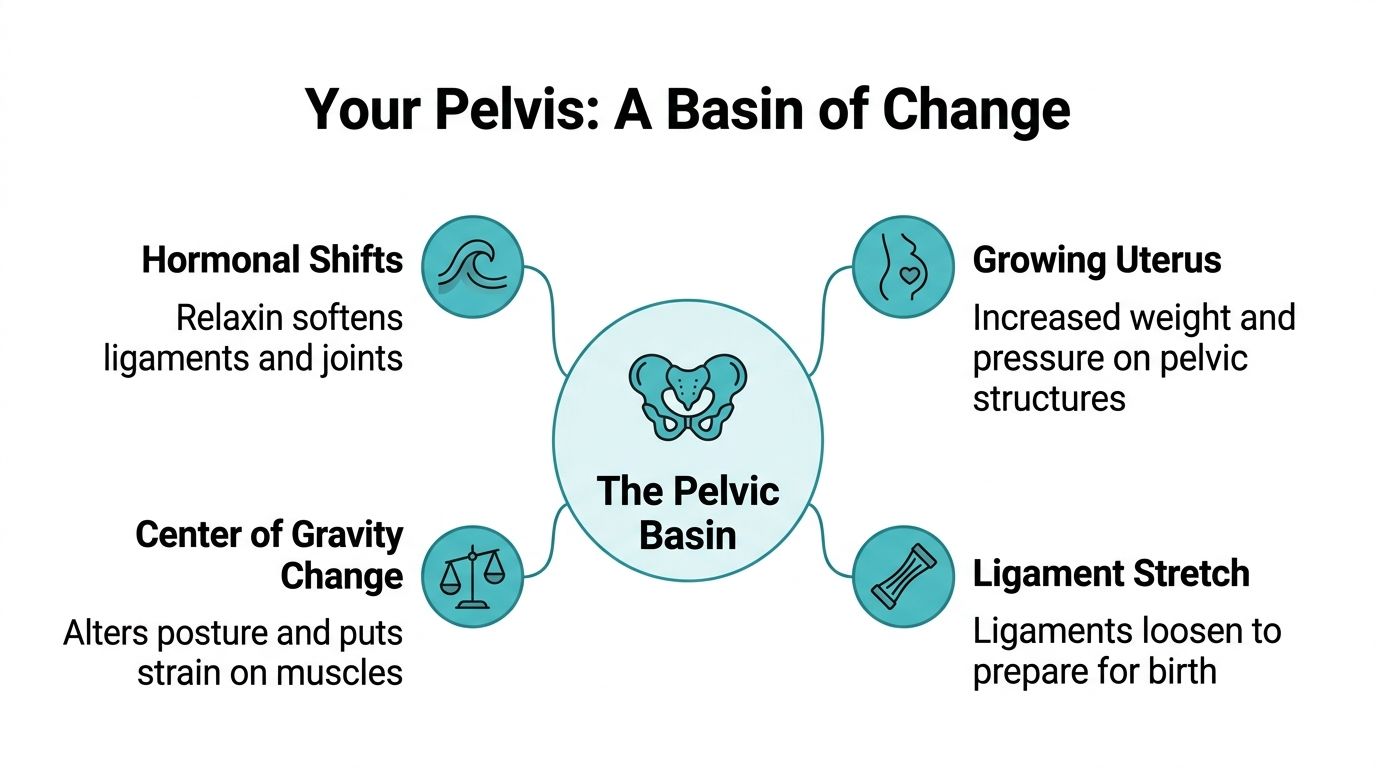
Your pelvis works like a bony basin. Strong joints and ligaments hold that basin together so you can transfer force from your trunk into your legs when you walk, turn, squat, and climb stairs. During pregnancy, those support tissues become more flexible so your body can adapt to growth and prepare for birth.
That flexibility is helpful, but it also comes with trade-offs. Hormones make the ligaments less rigid. Your uterus grows. Your center of gravity shifts. Muscles that used to keep the system steady now have to manage a structure that’s carrying more load and moving with less passive support.
Hormones loosen the support system
A helpful way to think about it is this. Before pregnancy, your pelvic ligaments behave more like firm straps. During pregnancy, they become more like stretchy rubber bands. Hormones including relaxin, estrogen, and progesterone contribute to ligament hyperlaxity, and that can reduce sacroiliac joint force closure. Women with pelvic girdle pain can show 20 to 30% longer double-limb support phases and shorter step lengths during gait, as described in this narrative review on pelvic girdle pain mechanisms.
That gait change makes sense clinically. If stepping onto one leg hurts, your body instinctively spends less time there. You shorten your stride, move more cautiously, and often start using muscles in the hips, back, and pelvic floor in a more guarded way.
Growth changes how force travels
As the uterus expands, pressure through the abdominal wall and pelvic ring changes. Your ribs, low back, hips, and pelvis all adapt to keep you upright. Some women compensate by locking their knees and leaning backward. Others grip through their glutes or inner thighs. Neither strategy works well for long.
This is why pelvic pain often feels worse with asymmetrical tasks. The pelvis generally tolerates load better when both legs share it. It gets irritated more easily when one side has to do the work alone, such as stepping into a bathtub, getting into a car, carrying a toddler on one hip, or standing on one foot while dressing.
The pubic symphysis and SI joints feel the difference
The two areas that complain most often are the pubic symphysis in the front and the sacroiliac joints in the back. When those joints move a little more than your muscles can comfortably control, you may feel pain, catching, grinding, or a sense that the pelvis is unstable.
That doesn’t mean something is damaged. More often, it means the demand on the system is higher than the support available at that moment. Treatment usually focuses on restoring that support with targeted exercise, movement changes, and sometimes external compression.
If your symptoms feel more ligament-driven than muscular, this overview of ligament pain during pregnancy can help you compare patterns.
Your body isn’t failing. It’s adapting fast, and sometimes the support system needs help catching up.
Identifying Common Causes of Pelvic Discomfort
When patients say “my pelvis hurts,” they may be talking about several different problems. The location, timing, and trigger matter. The same pregnancy can include more than one pain pattern, which is why broad advice often falls short.
Pelvic girdle pain and symphysis pubis dysfunction
Pelvic girdle pain, sometimes still called SPD, usually involves the joints of the pelvic ring. Women often describe it as pain in the front at the pubic bone, pain across the low back near the dimples, or pain that wraps into the groin and inner thigh. It may feel sharp, aching, or unstable.
Common triggers include:
- Rolling in bed because the pelvis has to control rotation
- Walking especially after a longer distance
- Stairs because each step asks one leg to accept more load
- Getting dressed standing up during single-leg balance
- Getting in and out of a car because of twisting plus asymmetrical loading
This is the pain pattern that often makes women say, “I feel like I need to hold my pelvis together.” That instinct is useful information. It tells me compression and stability strategies may help more than stretching.
Round ligament pain
Round ligament pain is different. It tends to be sudden, brief, and sharp. It usually shows up in the lower abdomen or groin, often on one side, after a quick movement such as coughing, sneezing, standing up fast, or rolling over.
This pain happens because the ligaments that anchor the uterus are stretching rapidly as the uterus grows. Round ligament pain affects 10 to 30% of pregnancies, and those ligaments can lengthen from 10 to 12 cm to 20 to 25 cm by term. Multiparous women have a 1.5x higher risk based on this overview of pelvic pain causes during pregnancy.
A few features help distinguish it:
- It’s often brief rather than constant
- It follows quick movement
- It’s more of a jab or pull than a grinding pain
- It usually settles once the movement stops and the tissue calms
That doesn’t make it harmless-feeling. It can be intense. But it usually responds best to slowing transitions, improving abdominal support, and reducing sudden strain rather than aggressively mobilizing the pelvis.
Sacroiliac joint pain
Pain from the SI joint often feels deeper and farther back. Women point to one side of the low back, buttock, or back of the pelvis. It can radiate into the hip or upper thigh and may worsen with walking, uneven standing, long periods upright, or getting out of a chair after sitting.
This pain commonly shows up when the trunk, glutes, and deep abdominal system aren’t coordinating well with the changing pelvis. It’s not unusual for SI pain to coexist with front-of-pelvis pain. One side hurts, so you shift away from it. That shift irritates another area. A compensation loop starts.
Risk factors that make symptoms more likely
Some women are more likely to develop stronger symptoms. A prior history of low back pain matters. So does having been pregnant before. Higher pre-pregnancy BMI also increases the odds of more severe pelvic pain, which I’ll address more clearly in the red-flag section because it changes how seriously we should monitor worsening symptoms.
If your pelvic discomfort comes with uterine tightness or cramping and you’re not sure whether you’re feeling musculoskeletal pain or something else, this article on uterus muscle spasm can help you sort out the pattern.
The most useful question isn’t “Where does it hurt?” It’s “What movement reliably brings it on?”
Normal Pregnancy Aches Versus Red Flag Warnings
Most pelvic discomfort in pregnancy is mechanical. It changes with position, activity, and load. It may flare with walking or turning in bed, then improve with rest, support, or better body mechanics. That pattern is uncomfortable, but it usually isn’t dangerous.
What needs quicker medical attention is pain that doesn’t behave mechanically, or pain that arrives with other concerning symptoms. Also, some women carry a higher risk for severe pelvic pain. Compared with women at a normal BMI, the adjusted odds ratio for severe pelvic pain is 1.4 for overweight women, 1.7 for class 1 obesity, and 2.3 for class 2+ obesity in this study on pre-pregnancy BMI and pelvic pain. That doesn’t mean severe pain is expected. It means escalating symptoms deserve a lower threshold for follow-up.
Pelvic discomfort cheat sheet
| Symptom Category | Generally Normal Discomfort | Red Flag Contact Your Provider |
|---|---|---|
| Pain behavior | Pain that changes with movement, improves with rest, or is triggered by rolling, walking, stairs, or standing on one leg | Severe pain that is unrelenting, rapidly worsening, or not affected by position change |
| Location | Pubic bone pain, groin pulling, buttock ache, or low pelvic pressure tied to activity | Pelvic pain with a very different quality than your usual pattern, especially if it feels alarming or sudden |
| Duration | Brief sharp pains that pass, or an ache that eases after load is reduced | Persistent pain that keeps intensifying or prevents normal movement |
| Mobility | Soreness with walking but still able to move around carefully | Inability to walk, bear weight, or function safely |
| Associated symptoms | Muscle fatigue, stiffness, or soreness after a busy day | Pain with bleeding, fever, contractions, visual changes, or other symptoms your OB or midwife has told you to treat urgently |
A practical way to think about it
Typical pregnancy pain usually has a clear mechanical pattern. You can point to the move that irritated it. You can often change it by adjusting position, shortening your stride, using support, or resting.
Red-flag symptoms don’t follow that pattern. They feel outside your normal experience, they don’t settle the way expected musculoskeletal pain should, or they show up with symptoms that need medical screening rather than exercise advice.
When in doubt, call
You never need to earn the right to contact your provider. If the pain feels unusually severe, if you can’t walk well, or if you have pelvic pain plus bleeding, fever, contractions, or visual changes, don’t troubleshoot it alone. Start with your medical team.
Safe At-Home Exercises and Relief Strategies
The best home plan reduces strain without making you afraid to move. That means less random stretching, less pushing through pain, and more deliberate support. Most women do well when they combine better body mechanics, strategic rest, and a few simple stabilization drills.
Smarter body mechanics
The fastest wins often come from changing how you move during pain triggers.
- Keep knees together when rolling in bed: Move your shoulders, trunk, and knees as one unit instead of twisting through the pelvis.
- Sit to get dressed: Pants, underwear, and socks are classic single-leg triggers.
- Use both feet evenly when standing up: Scoot forward, lean your trunk slightly forward, and push through both legs.
- Shorten your stride: Big steps often increase shear through the pelvis.
- Avoid hanging on one hip: That relaxed standing posture can be surprisingly aggravating.
Sleep matters too. Many women feel better with a pillow between the knees and ankles so the pelvis stays more supported at night. If nighttime pain is part of the picture, this guide to sleeping for lower back pain offers practical positioning ideas that often translate well to pregnancy-related pelvic discomfort.
Support that actually helps
A pelvic support belt can be useful when pain feels better with compression. That’s a clue the pelvis wants more external stability. But belts aren’t magic. If you wear one too loosely, too high, or for every waking hour without also improving muscle support, results are usually limited.
Good support gear should do one of two things. It should either make movement feel more stable, or let you tolerate daily tasks with less symptom flare. If it doesn’t change either one, it may not be the right tool for your specific pain pattern.
Practical rule: If a strategy helps only while you’re perfectly still but makes no difference when you walk, turn, or get dressed, it’s probably incomplete.
Foundational exercises for stability
These exercises are often a good starting point when done gently and without forcing symptoms.
Transverse abdominal brace
Lie on your side, sit, or stand in a comfortable position. Exhale softly and imagine zipping the lower abdomen inward without sucking in hard or bearing down. Hold a gentle contraction while breathing normally, then relax.
This works because the deep abdominal wall helps create a steadier base for the pelvis. The effort should feel subtle, not like a max-strength exercise.
Pelvic floor connection
Think of a light lift and release through the pelvic floor coordinated with your breath. Exhale and gently lift. Inhale and let go. If this increases pain, pressure, or gripping, stop. Not every pregnant woman needs more tightening.
A lot of women benefit from a personalized plan rather than guessing, especially since some pelvic floors are weak and others are overworking. This resource on core and pelvic floor exercises is a useful place to start if you want more detail.
Seated or standing pelvic tilts
Gently tip the pelvis forward and backward in a pain-free range while breathing. This can reduce stiffness and help you find a more comfortable neutral position after sitting or standing too long.
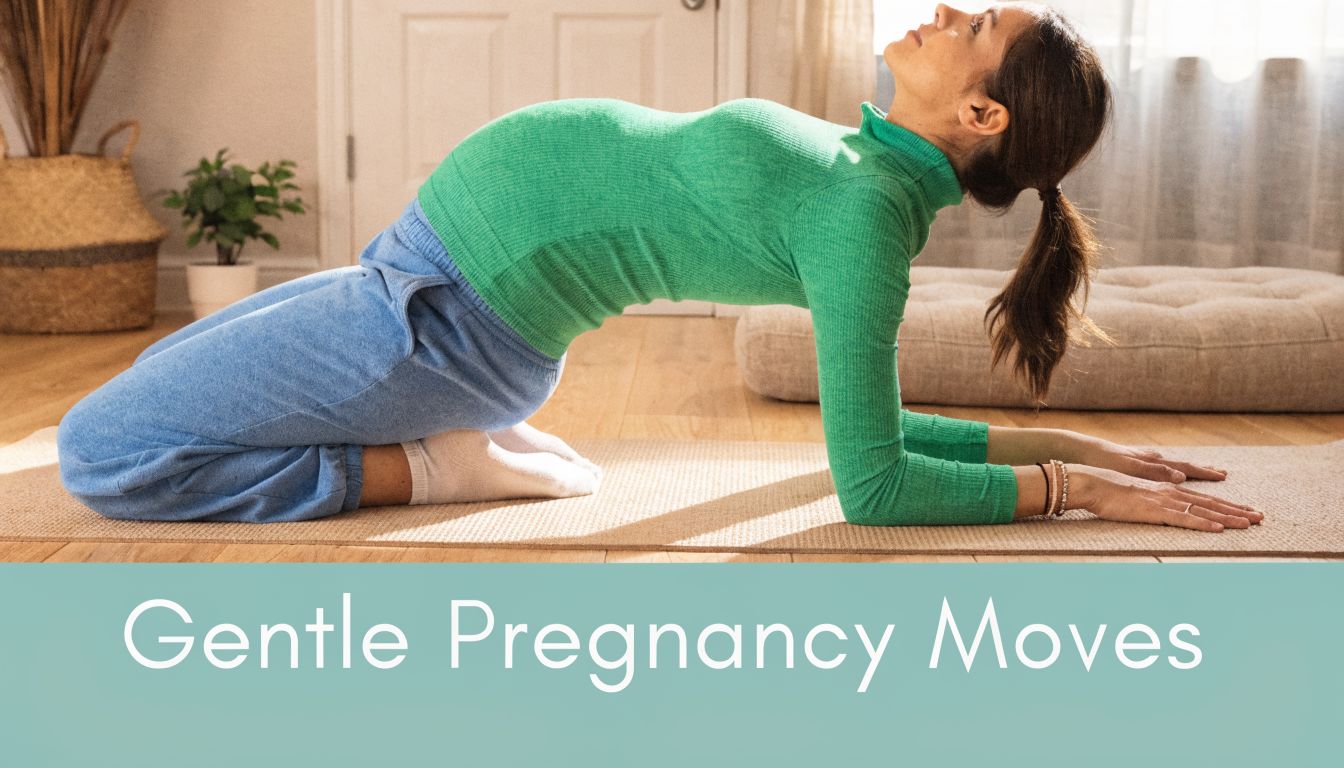
Cat-cow on hands and knees
Move slowly through a small range. Focus on comfort, not depth. This can ease low back tension and reduce the bracing pattern many women develop when they’re protecting the pelvis.
A visual walkthrough can make these movements easier to copy correctly:
What usually doesn’t work well
A few common mistakes keep symptoms going:
- Overstretching the inner thighs or hips: If the issue is instability, more stretch can make you feel worse.
- Pushing through long walks: Endurance isn’t the goal if you pay for it later.
- Doing random online exercises: Good exercises done for the wrong pain pattern can backfire.
- Clenching Kegels all day: More tension is not always more support.
- Ignoring asymmetry: Repeating one-sided movements all day keeps feeding irritation
Use pain as feedback, not a test
If an exercise leaves you feeling more stable afterward, that’s a good sign. If it reliably increases pain during the movement, or you feel more sore and unstable later, back off. Pregnancy rehab should feel supportive, not punishing.
How a Pelvic Physical Therapist Can Help You Thrive
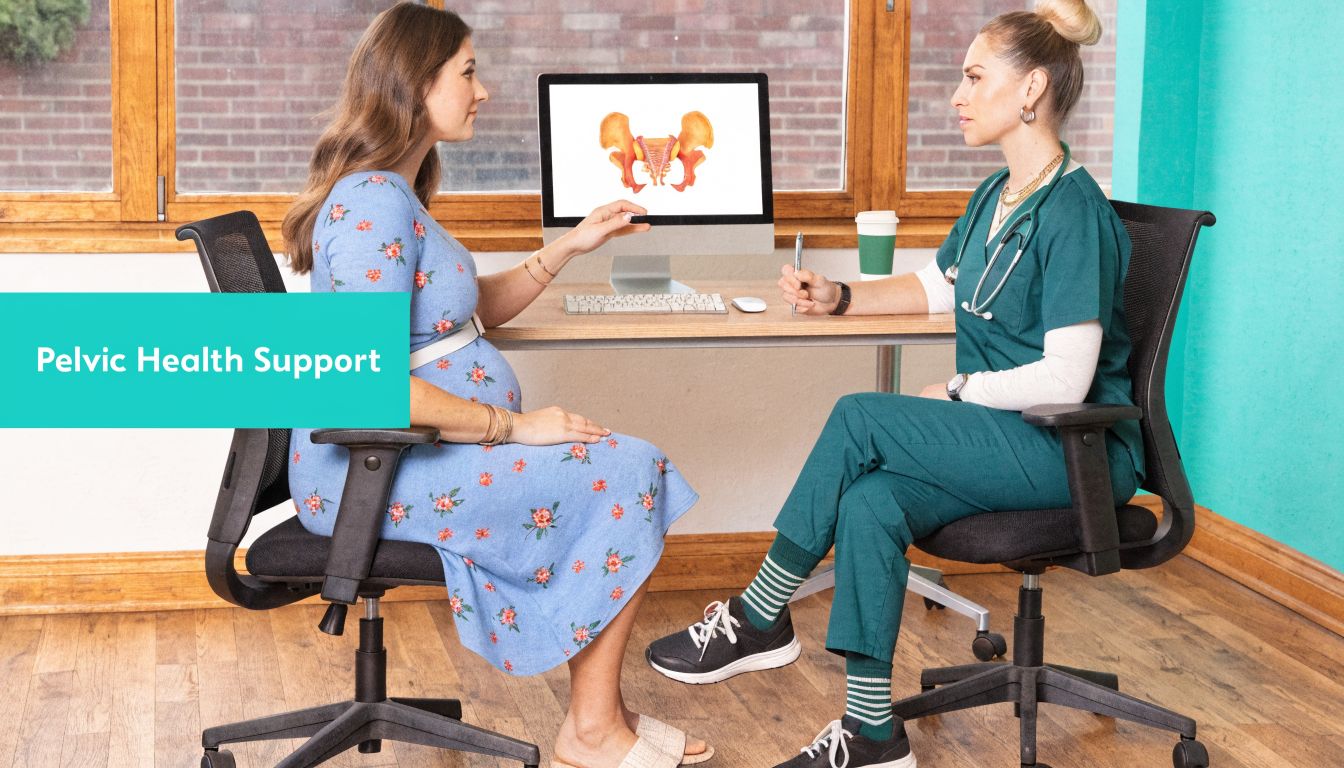
A pelvic physical therapist doesn’t just tell you to rest more. The job is to figure out exactly which structure is irritated, which movement pattern is feeding it, and which support strategy gives you the best return with the least disruption to your day.
That matters because two women can both say, “I have discomfort in pelvic area during pregnancy,” while needing very different plans. One needs compression and glute support. Another needs to stop over-bracing and learn how to move without guarding. Another needs help identifying that brief groin zingers are round ligament pain, not a pelvic floor problem.
What a good evaluation looks for
A thorough pregnancy pelvic PT visit usually looks at:
- Movement triggers: rolling, stairs, car transfers, bed mobility, walking
- Posture and load strategy: how you stand, shift weight, and compensate
- Breathing and abdominal pressure management: especially if pain increases with bracing
- Hip and trunk support: glutes, adductors, deep abdominals, and pelvic floor coordination
- Irritability pattern: what calms symptoms and what predictably flares them
That evaluation is practical. You’re not there for abstract theory. You’re there to figure out why turning in bed hurts, why walking the grocery store wipes you out, or why your groin pain spikes every afternoon.
What treatment often includes
Treatment usually combines several pieces rather than a single fix.
Some women need manual therapy to calm protective muscle tension around the hips, low back, or pelvic floor. Others benefit most from external support, movement retraining, and a short home program with only a few well-chosen exercises. Education is a major part of care because once you understand your trigger pattern, you stop accidentally provoking it all day.
A strong plan often focuses on three questions:
- How do we reduce symptom spikes this week?
- How do we improve support so daily life feels easier?
- How do we prepare for later pregnancy and postpartum recovery?
Telehealth is no longer second-best
For women in North Idaho, Eastern Washington, or any area where travel is difficult, telehealth has become a meaningful option. It works especially well for pregnancy-related pelvic pain because so much of the problem shows up in visible movement patterns: how you stand, walk, roll, transfer, squat, and manage daily tasks at home.
A therapist can watch how you get out of bed, how you step into pants, how you carry your toddler, or how you sit at work. Those details are often more useful than a quick snapshot in a clinic.
There’s also growing evidence that remote care can do more than offer reassurance. A 2026 study reported that telehealth physical therapy reduced pelvic girdle pain scores by 28% in 3 months for 65% of rural participants, with adherence rates 40% higher than self-management, according to this Tommy’s pelvic pain in pregnancy resource. The practical takeaway is clear. When women have guided exercise, feedback, and accountability, they often stick with the plan better than when they’re trying to manage symptoms alone.
Some of the best pregnancy rehab happens in the exact place symptoms occur. Your bed, your stairs, your couch, your car.
What telehealth can realistically do
A virtual pelvic PT visit can often help with:
- Exercise progression: deciding what to do, what to pause, and what to change
- Body mechanics coaching: seeing your real-life setup instead of guessing
- Support belt fitting guidance: identifying whether placement and tension are helping
- Symptom pattern sorting: figuring out whether pain behaves more like PGP, SI pain, or ligament irritation
- Weekly adjustment: modifying the plan as pregnancy changes your tolerance
What telehealth can’t do is replace medical screening when you have red-flag symptoms. It also won’t fully replace hands-on care for every patient. But for many women, especially those managing distance, childcare, weather, or a packed schedule, it lowers the barrier enough that they get help sooner instead of waiting until symptoms become severe.
The trade-off that matters most
Generic self-care is easy to find. Personalized care is what changes outcomes. A warm bath, a pillow, and a support belt may help. But if you keep moving in a way that stresses the pelvis every day, relief is usually temporary.
A targeted PT plan does more. It helps you identify the exact movements that matter, teaches you what support your body responds to, and gives you a realistic path through the rest of pregnancy.
If you want expert help for pregnancy-related pelvic pain, Lake City Physical Therapy offers women’s health physical therapy across North Idaho and Eastern Washington, including telehealth options for moms who need skilled care without a long drive. If your pelvis hurts when you walk, roll in bed, or do ordinary daily tasks, getting assessed early can make the rest of pregnancy far more manageable.