Wrapping Pregnant Belly: A PT’s Guide to Safe Support
By the time many women start searching for help with wrapping a pregnant belly, they're not looking for a trend. They're looking for relief. Their low back aches by midday, rolling in bed has become a project, and standing at the kitchen counter can make the pelvis feel heavy, loose, or irritated.
That's the moment when support can help. Not because a wrap “fixes” pregnancy pain, but because the right support can change how load moves through the body while you stay active. Used well, a wrap, band, belt, or tape can reduce strain, improve comfort, and make walking, errands, or exercise feel more manageable.
As a prenatal physical therapist, I think of belly support as a tool, not a treatment plan by itself. It works best when it matches the problem, fits correctly, and gets used for the right duration.
Is Belly Wrapping Right for Your Pregnancy
A common story sounds like this. You feel mostly fine in the morning. Then as the day goes on, your belly feels heavier, your posture gets harder to maintain, and your back or pelvis starts protesting every time you stand on one leg to get dressed.
That pattern makes sense biomechanically. As pregnancy progresses, the growing uterus changes your center of gravity and increases the demand on the low back, hips, abdominal wall, and pelvic ring. For some people, a well-fitted support garment takes the edge off by improving load distribution and giving a gentle lift from underneath rather than asking already-irritated tissues to do all the work.

Evidence-based summaries connect maternity support garments with relief of common pregnancy pain complaints, especially low back pain and pelvic girdle pain. A review also notes that studies from 2015 and 2017 found maternity support belts were among the most effective non-drug options for those symptoms, according to this peer-reviewed summary on maternity support garments.
When support makes the most sense
Belly wrapping tends to help most when discomfort is tied to movement and upright activity. That includes:
- Walking pain: Your pelvis or low back becomes more uncomfortable the longer you're on your feet.
- End-of-day heaviness: Symptoms build with chores, work, or caring for other children.
- Position-change strain: Rolling, stair climbing, and single-leg tasks trigger discomfort.
- Activity goals: You want to keep moving, but your body needs some temporary assistance.
Clinical perspective: If support helps during activity, that's useful information. It suggests your body may benefit from better force transfer and movement strategy, not just rest.
When a wrap is worth trying, and when to pause
A wrap is reasonable to try if it feels comfortable, improves movement, and doesn't create new symptoms. It's not the right answer if it makes you feel compressed, short of breath, more painful, or worried about whether you're using it safely.
If symptoms are limiting your daily life, it also helps to get guidance on the bigger picture, including posture, mobility, breathing mechanics, and pelvic floor coordination. For a broader look at what that can include, this page on pelvic floor physical therapy during pregnancy gives a helpful overview.
Choosing Your Ideal Support Method
The best support method depends less on marketing language and more on where you hurt, how active you are, and what kind of support you can tolerate. In practice, most pregnant patients do best with one of three options: a flexible belly band, a structured maternity belt, or kinesiology tape.
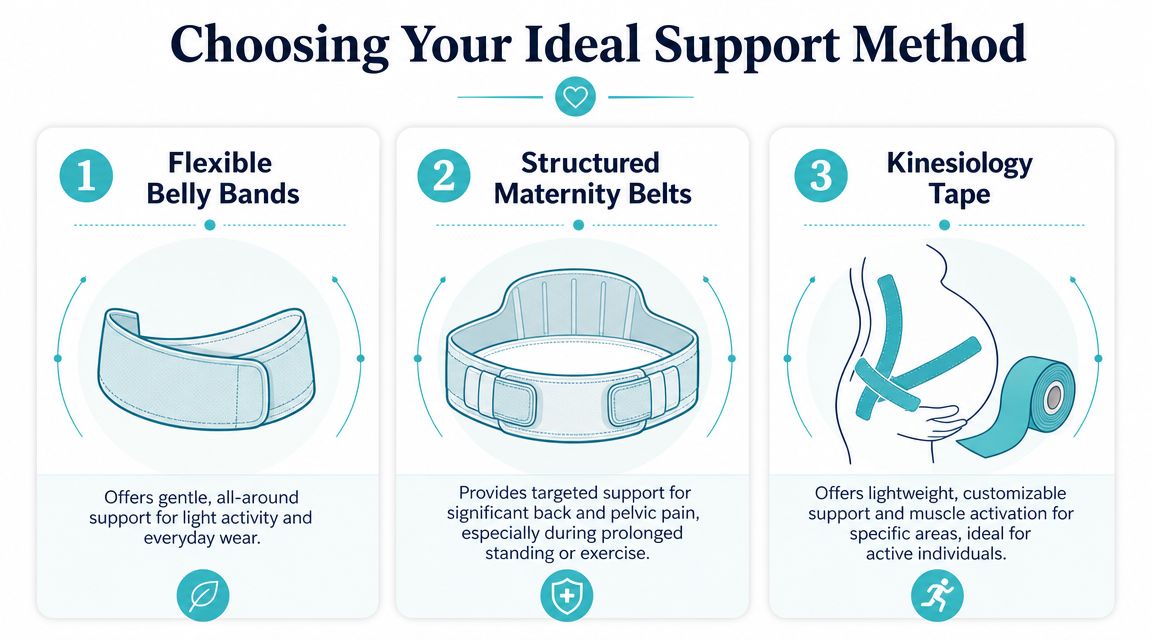
Flexible belly bands
These are the softest option. Think of a stretchy sleeve or wide fabric band that sits around the lower abdomen and hips.
They're often best for women who want light, all-around support without much bulk. If your symptoms are mild, or if you mainly want a little lift during errands or housework, this is often the easiest place to start. They also layer well under clothing.
The downside is that they usually don't control motion as well when pain is more specific or more intense, especially around the sacroiliac joints or pubic symphysis.
Structured maternity belts
These provide more targeted support. They usually sit lower, under the bump and around the pelvis, with firmer material and adjustable tension.
For women with clearer pelvic girdle pain, a structured belt often works better than a soft band because it gives the pelvis more external support during standing, walking, and exercise. I often think of these as the better choice when the complaint is, “I feel unstable,” rather than just, “I feel heavy.”
If you're also planning ahead for recovery after birth, it can help to understand how prenatal and postpartum support differ. This guide to a postpartum recovery belt explains that distinction well.
Kinesiology tape
Tape is useful when you want support without adding a full garment. It can create a lifting effect for the abdomen or cue better muscle engagement in a very specific area.
This option often works well for active women, hot weather, or outfits where a belt feels bulky. The trade-off is that tape takes more skill to apply well, and it isn't ideal if your skin is already sensitive.
Support should match the complaint. Heavy generalized strain often responds to a band. Focused pelvic pain often needs a more structured belt. Targeted support without bulk may point toward tape.
Belly Support Comparison
| Support Type | Support Level | Best For | Considerations |
|---|---|---|---|
| Flexible belly bands | Gentle | Light daily support, mild heaviness, layering under clothes | Less targeted for pelvic girdle pain |
| Structured maternity belts | Moderate to firmer | Low back strain, pelvic girdle pain, walking, standing, exercise | Can feel bulky if worn too high or too tight |
| Kinesiology tape | Customizable, targeted | Active use, low-bulk support, specific areas of strain | Requires careful skin monitoring and better application technique |
A few decision shortcuts
- Choose a band if your main goal is comfort during everyday movement.
- Choose a belt if you feel unstable through the pelvis or need more support when upright.
- Choose tape if you want flexibility, a lighter feel, or support during exercise.
Sleep setup matters too. If nighttime discomfort is driving daytime symptoms, better side-lying support can reduce how much you need from a wrap the next day. These proper body pillow techniques are worth reviewing.
How to Safely Apply Your Belly Support
The biggest mistake I see with wrapping a pregnant belly is placing the support too high and pulling too hard. A belly wrap should create a gentle upward assist from below the bump. It should not flatten the abdomen or feel like shapewear.
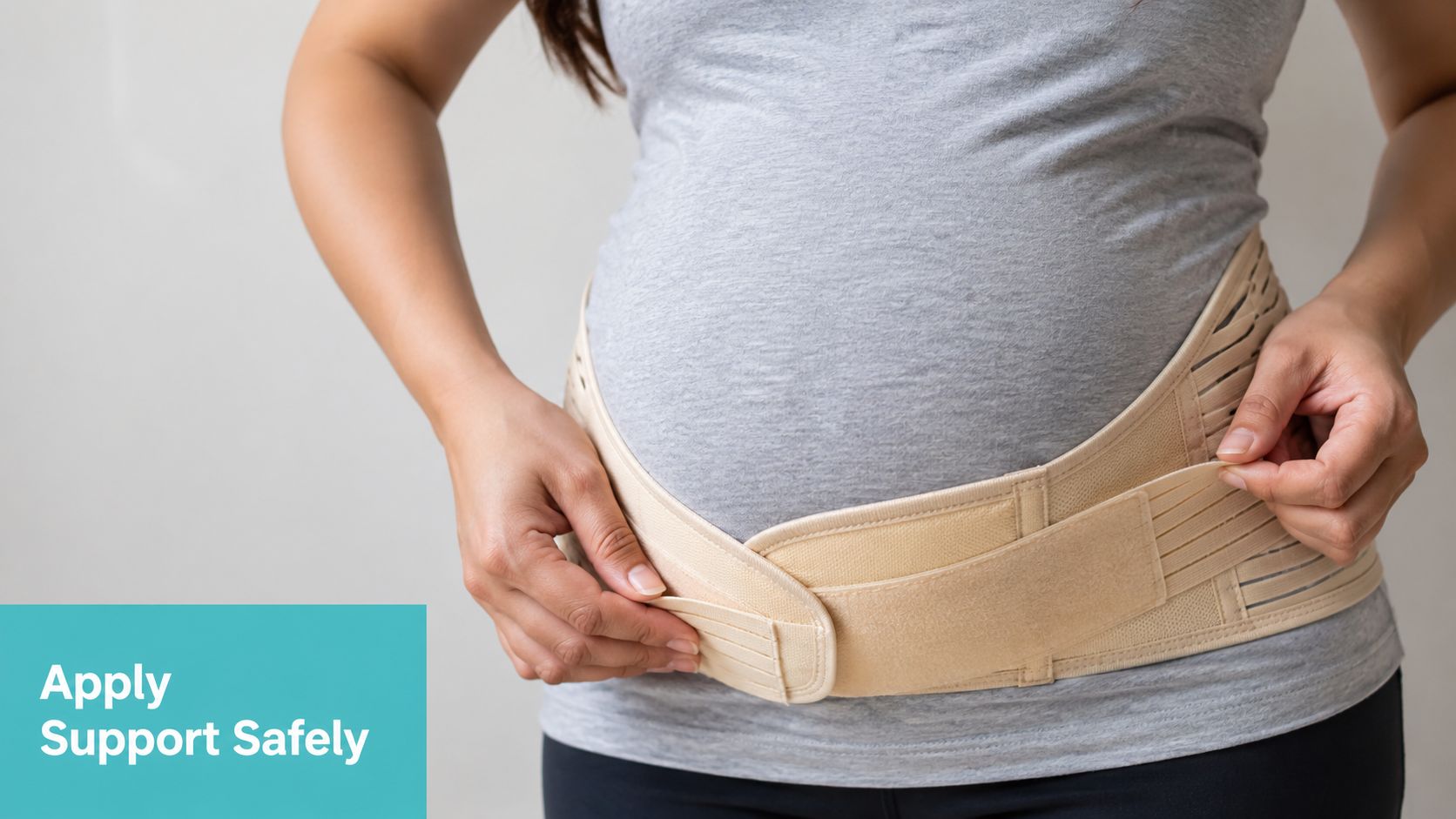
Expert guidance describes belly wrapping as a short-term support strategy. It should give gentle lift, not restrict fetal movement, and it shouldn't be used for prolonged wear while sitting. Proper tension control matters, as explained in this guide to wrapping your bump in late pregnancy.
How a correct fit should feel
Before getting into methods, use these sensory checks:
- You can take a full breath: The wrap shouldn't block rib movement.
- You feel lifted, not squeezed: Support comes from below and around the hips.
- Walking feels easier: It should reduce irritation during movement, not create it.
- Skin feels normal: No burning, numbness, tingling, or rubbing that worsens quickly.
If you put a support on and immediately want to peel it off, trust that response. Good support usually feels relieving within minutes, not like something you need to “get used to.”
Belly band and maternity belt setup
A soft band and a structured belt are applied similarly, although a structured belt usually sits lower and tighter around the pelvis.
- Start standing or slightly reclined.
- Position the support low, across the hips and under the belly.
- Fasten it so the lower part anchors around the pelvis.
- Lift the bump gently with your hands as you secure the front.
- Tighten only until you notice support during standing or walking.
For pelvic girdle pain, the support often works better when it captures the area just under the abdomen and around the pelvic ring, not the narrowest part of the waist.
Ring sling or fabric wrap method
Some women prefer a fabric wrap approach because it feels more adjustable and softer than a manufactured belt.
The general method is to center the fabric over the bump, bring it around the body, gather the fabric before passing it through the rings, then tighten gradually by pulling the tail away from the body to remove slack. Go slowly. Small adjustments work better than one hard pull.
A visual demo can make the fit cues easier to understand:
Simple kinesiology tape approach
A common starting method is a belly sling style setup.
- First strip: Anchor near one side of the lower abdomen and guide the tape under the bump toward the opposite side to create lift.
- Second strip: Mirror that on the other side.
- Optional support strip: Add a lower horizontal strip if you need more cueing across the lower abdomen.
Apply tape to clean, dry skin. Don't stretch it aggressively over the center of the bump. The goal is support and sensory input, not compression.
Best times to use it
Most women do better using support for the parts of the day that provoke symptoms most. That might be a walk, grocery shopping, meal prep, or a workout. If you're mostly sitting, a wrap usually helps less and can become annoying faster.
Critical Do's and Don'ts of Belly Wrapping
The safest mindset is simple. Use support to help you move better, not to force your body through worsening pain. That sounds obvious, but many women keep tightening a belt when what they need is less compression, more rest, or an assessment.
A major gap in most online advice is the lack of clear discussion about safety and contraindications. That matters because wrapping a pregnant belly isn't automatically helpful for everyone. This discussion of safety, contraindications, and red flags raises important concerns including fetal movement restriction, skin irritation, and circulation-related issues, and it emphasizes that benefits are mixed and should be individualized.
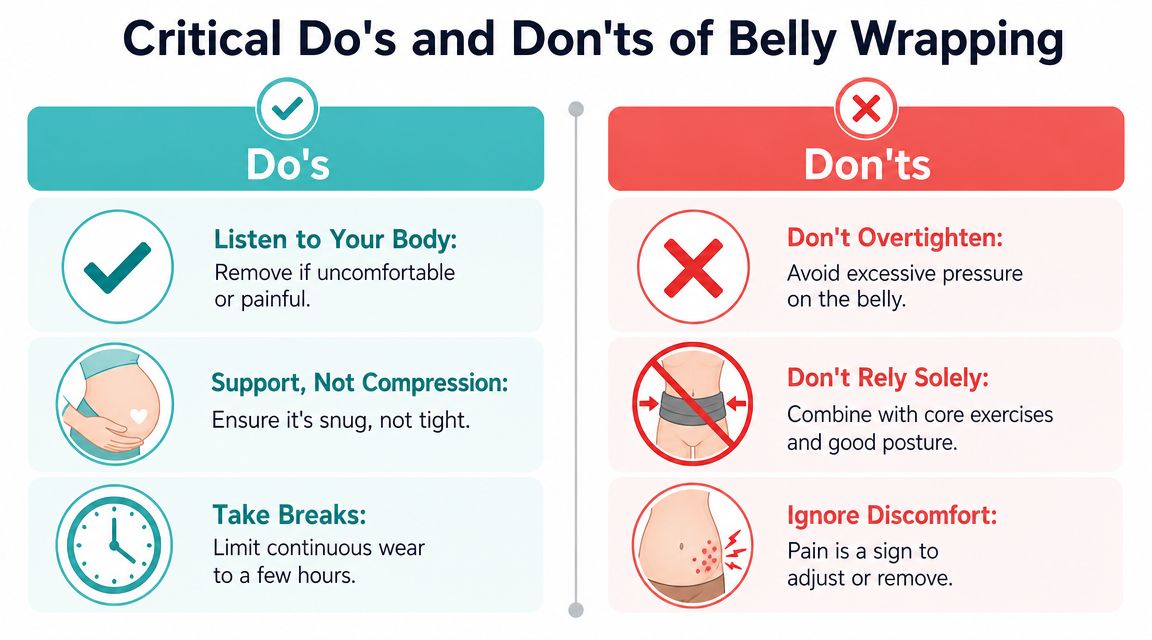
Do these things
- Wear it for activity: Walking, chores, shopping, and exercise are the times support is most likely to earn its keep.
- Keep the tension moderate: Snug is enough. If you have to brace yourself to fasten it, it's too tight.
- Take breaks: Support works best in chunks of time, not as an all-day uniform.
- Check your skin: Remove it if you notice rubbing, itching, or irritation building under the material or tape.
- Notice symptom response: Better movement and less strain are good signs. More pressure, more pain, or more reflux are not.
Don't do these things
- Don't sleep in it: Overnight wear can keep you compressed longer than needed and makes it harder to monitor fit.
- Don't use it as a substitute for rehab: A wrap can help symptoms, but it won't retrain abdominal coordination, hip strength, breathing mechanics, or pelvic floor function.
- Don't overtighten for “extra support”: More pressure doesn't equal more benefit.
- Don't ignore fetal movement concerns: If anything about movement patterns feels different or concerning, remove the wrap and contact your prenatal medical team.
- Don't keep wearing a painful device: Pain from the support itself is a stop sign.
Safety rule: A support garment should make activity feel more manageable. If it creates new symptoms, it's the wrong fit, the wrong method, or the wrong day to use it.
A good self-check before leaving the house
Ask yourself three questions:
- Can I breathe fully?
- Can I sit and stand without pinching or digging?
- Do I feel lighter when I walk?
If the answer to any of those is no, adjust or remove it.
When Wrapping Isn't Enough Signs You Need a PT
A support garment can reduce symptoms. It cannot diagnose why they're happening.
That distinction matters. If a band gives temporary relief but your pain keeps returning, or if you need tighter and tighter support just to get through the day, there's usually more going on than the belly needing a lift. Movement pattern changes, pelvic floor overactivity, hip weakness, abdominal wall strain, scar sensitivity, or joint irritability may all be part of the picture.
Evidence reviews note that support devices may help symptoms, but active core and pelvic floor rehabilitation remains the main evidence-based approach for persistent pain and postpartum recovery. They also don't show strong evidence that wrapping alone prevents diastasis recti or improves labor outcomes, as summarized in this overview of what wrapping can and cannot do.
Signs to escalate care
A pelvic floor or prenatal PT evaluation is a smart next step if you notice any of the following:
- Pain that keeps interrupting daily life: You've tried support, but walking, turning in bed, stairs, or standing are still consistently difficult.
- Urinary leakage or urgency: Support garments don't address the pelvic floor coordination behind these symptoms.
- Pelvic heaviness or bulging: That sensation deserves a more specific assessment.
- Ongoing abdominal wall concerns: A wrap doesn't restore abdominal function by itself.
- You can't tell what helps anymore: Sometimes the most useful thing is having someone sort out whether the issue is back-driven, pelvic-driven, muscular, or pressure-related.
What PT adds that a belt can't
A PT can look at how you breathe, transfer weight, stabilize the pelvis, coordinate the abdominal wall, and manage pressure through the core. That's what turns temporary relief into a plan.
If those symptoms sound familiar, this guide on signs you need pelvic floor therapy can help you decide when support at home isn't enough.
Your Belly Wrapping Questions Answered
When should I start wrapping a pregnant belly
Most maternity support garments are typically started in the second trimester, around the time the growing uterus starts creating more noticeable back and pelvic strain. One consumer-facing medical summary notes they're generally worn for about 2 to 3 hours at a time during activity, as described in this summary on prenatal belly wrapping timing.
Can I wear a belly wrap all day
Usually, no. Support tends to work better as a short-term tool for the parts of the day that aggravate symptoms. If you need constant support just to function, that's a clue to get assessed rather than to increase wear time.
Can I sleep in a belly band or belt
That's generally not a good idea. During sleep, you can't monitor pressure as well, and prolonged compression often becomes more irritating than helpful. Positioning support with pillows is usually the better nighttime strategy.
Will a wrap weaken my core
A wrap used strategically is unlikely to be the main problem. But relying on it for every activity can delay the work your body still needs to do. Support should sit alongside movement, strength, and pressure-management work, not replace them.
How do I clean it
Follow the care instructions for the specific product you bought. Wash it as directed, let it dry fully, and check regularly for stretched-out fabric, curling edges, or adhesive wear that changes the fit.
If wrapping your pregnant belly helps somewhat but you're still dealing with back pain, pelvic pressure, leakage, or a sense that your body just isn't moving well, Lake City Physical Therapy can help you sort out what's driving the problem. Their women's health team provides evidence-based prenatal and pelvic floor physical therapy with practical guidance that goes beyond temporary support, so you can move with more comfort and confidence through pregnancy and recovery.