Frightened About Giving Birth? a Guide to Feeling Confident
Some of the hardest moments in pregnancy happen when the house is quiet. You're trying to sleep, but your mind keeps circling the same questions. How bad will labor hurt? What if I panic? What if something goes wrong? What if my body doesn't do what it's supposed to do?
If you're frightened about giving birth, that fear deserves to be taken seriously. It isn't weakness, and it isn't a sign that you're unprepared for motherhood. It's a real mind-body stress response, and for many women it shows up not only as racing thoughts, but also as jaw tension, breath holding, tight hips, and a pelvic floor that never fully relaxes.
That physical piece holds greater significance than commonly understood. Fear doesn't stay in your head. It shows up in muscle tone, guarding, movement patterns, and the way your nervous system responds to contractions, exams, pushing, and recovery. That's why preparing for birth isn't only about reading a book or hoping to stay calm. It's also about training your body to feel safer, more mobile, and more responsive under stress.
Understanding Why You're Frightened About Giving Birth
A lot of women feel embarrassed to say this out loud. They wanted this pregnancy, they love their baby already, and they still feel dread when they think about labor. That combination is common.
For some, the fear starts after hearing detailed horror stories from relatives or friends. For others, it begins after a difficult gynecologic exam, a prior miscarriage, past trauma, or a strong dislike of feeling trapped or out of control. Some women are most afraid of pain. Others are more afraid of being ignored, rushed into decisions, or feeling like birth will happen to them instead of with them.
Your fear has a name, and that matters
Clinically, severe fear of childbirth is often called tokophobia. It's not rare. An estimated 14% of women worldwide experience significant fear of childbirth, with rates around 10% in developed countries and 25% in developing countries. Some studies have found fear in nearly 46% of pregnant women (reported here and here).
That range tells us something important. Fear around birth is not a strange outlier. It's a recognized maternal health issue.
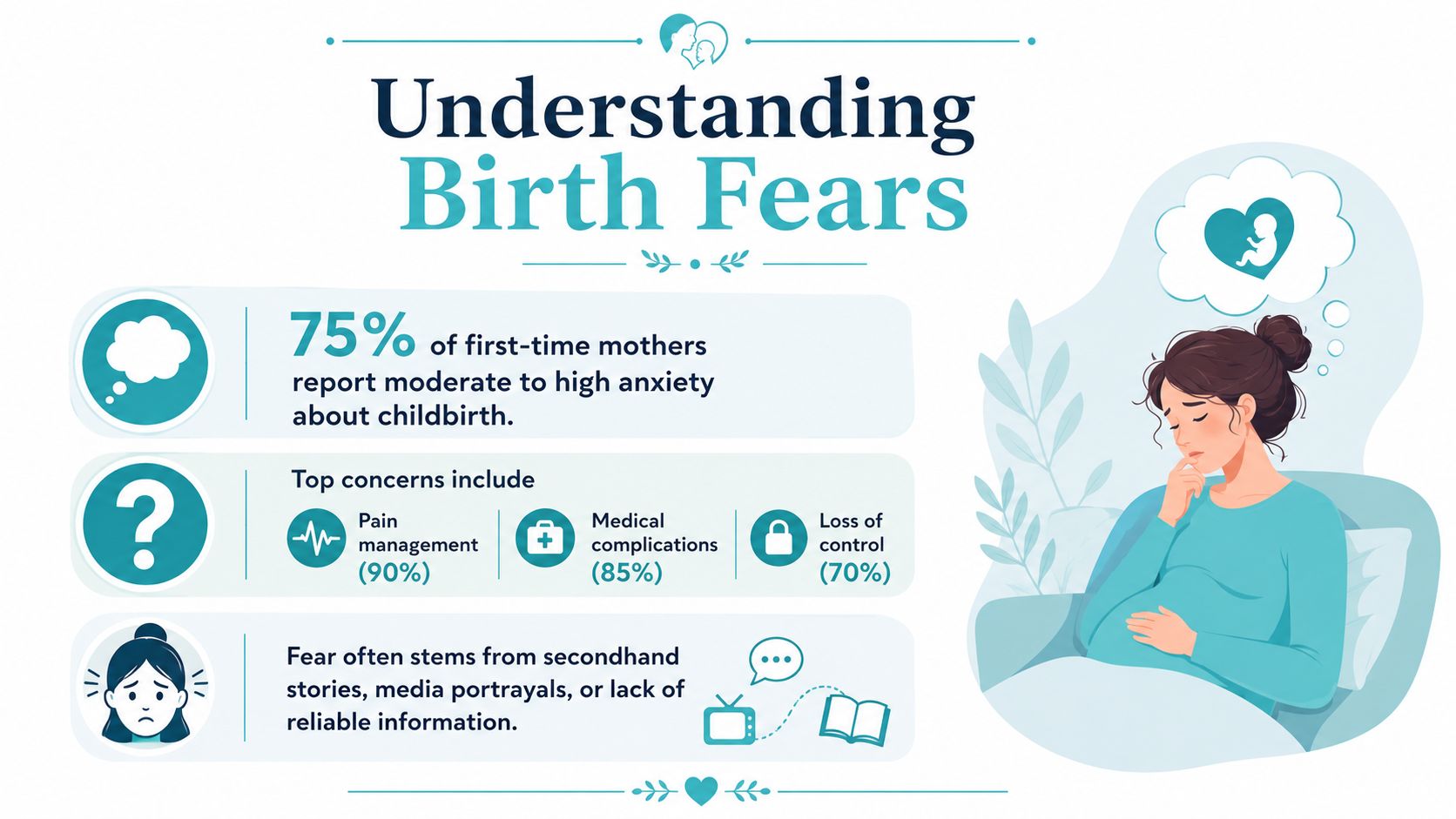
The exact content of that fear varies, but I see the same themes over and over in pelvic health care:
- Pain fear can make your whole body brace before anything has even started.
- Loss of control fear often shows up in women who need clear information and choices.
- Complication fear tends to intensify when someone has had a difficult medical experience before.
- Second-hand fear often grows when the loudest stories are the most dramatic ones.
The quiet anxiety that builds during pregnancy
Fear also grows in the absence of reliable information. If you're trying to sort out what's safe during pregnancy in general, small questions can snowball into bigger anxiety. Sometimes practical resources help calm the nervous system because they replace guessing with facts, like this guide to understanding incense safety in pregnancy.
Being frightened about giving birth doesn't mean you're failing pregnancy. It means your body and mind are asking for more support.
There's another layer to this that often gets missed. If you're already prone to clenching when stressed, your pelvic floor may be responding to birth fear long before labor begins. That doesn't mean anything is doomed. It means your preparation should include your nervous system and your muscles, not just your due date and hospital bag.
Building Confidence Through Childbirth Education
Fear feeds on vagueness. Confidence usually grows when you know what's typical, what's optional, and what questions to ask before you're in the middle of labor.
Women at higher risk for severe childbirth fear include first-time mothers, those with lower education levels, and those who prefer cesarean delivery because of fear (Source 4). That doesn't mean those women will struggle. It means targeted education can help early, before fear hardens into avoidance.
Learn the difference between stories and guidance
A friend's birth story may be honest and meaningful, but it isn't the same thing as childbirth education. One person's emergency induction, long pushing phase, or unplanned cesarean doesn't predict your experience.
Useful education answers questions like these:
| Question | What to look for |
|---|---|
| What happens in early labor | Signs, timing, when to rest, when to call |
| What are common interventions | Why they're offered, benefits, downsides, alternatives |
| What pain relief options exist | Medication and non-medication choices |
| What happens if labor changes course | How decisions are made and who is involved |
A solid childbirth class should explain normal labor physiology, common interventions, pain relief options, partner support, and postpartum recovery. It should make labor feel more understandable, not more frightening.
Use education to make decisions before you're stressed
You don't need to memorize every obstetric possibility. You do need enough clarity that your care team's recommendations won't sound like a foreign language.
Start with a short list of questions for your provider:
- Ask about routine practices like induction timing, mobility in labor, intermittent monitoring, and pushing positions.
- Ask what changes the plan so you understand when an intervention becomes medically reasonable.
- Ask what support is available if anxiety rises during labor.
- Ask how consent is handled in urgent moments.
Practical rule: If a class or resource leaves you more confused than informed, it's not helping your nervous system.
Physical preparation also works better when it's paired with education. If you want guided movement ideas that support labor readiness, these stretches to prepare for labor can help you connect what you're learning to what your body is doing.
What actually helps
The most useful mindset shift is this. Education is not about controlling birth. It's about removing some of the fear of the unknown.
That means learning:
- What contractions are doing so they feel purposeful, not random.
- Why positions matter so movement becomes a tool.
- What a cesarean is for so it doesn't exist in your mind as a vague worst-case scenario.
- How your body responds to stress so you can interrupt tension patterns earlier.
Good education doesn't promise a perfect birth. It gives you context, language, and choices. For many women, that's where confidence starts.
Creating Your Mental and Emotional Support Toolkit
Knowledge helps, but fear of birth isn't always solved by information alone. Some women understand labor very well and still feel panic in their bodies. That's where emotional tools matter.
Clinical management of childbirth fear often includes Cognitive Behavioral Therapy, or CBT, and strong social support. In one benchmark study, the odds of persistent fear decreased by 98.9% for women with high social support compared with women with low support (Source 3).

Change the thought, then change the body
CBT sounds formal, but one of its core skills is simple. Notice the catastrophic thought, then test it.
Examples:
-
Catastrophic thought
“I'm going to lose control and won't cope.”More accurate replacement
“Labor will be intense, but I can prepare support, breath cues, positions, and pain relief options.” -
Catastrophic thought
“If I'm scared now, I won't be able to give birth.”More accurate replacement
“Fear is a response, not a prediction.” -
Catastrophic thought
“If I need help, it means I failed.”More accurate replacement
“Using support is good decision-making.”
Build a toolkit before you need it
An emotional toolkit works best when it's specific. Not “I'll try to relax.” More like this:
- One grounding cue such as feeling both feet on the floor and naming five things you see.
- One breathing pattern you can repeat when your heart rate climbs.
- One support phrase your partner can use, such as “You're safe. Take the exhale first.”
- One reset activity for spiraling evenings, like a walk, shower, or brief guided meditation.
- One outside resource for self-soothing ideas, such as these strategies for managing stress.
A gratitude practice can also steady anxious thinking, especially when it's grounded in reality rather than forced positivity. This article on how acknowledging blessings betters mental health offers a practical way to do that without dismissing what's hard.
Choose support that lowers your guard
Not all support feels supportive. Some people minimize. Some overtalk. Some bring their own fear into the room.
The best support people do a few things well:
- They regulate themselves first so they aren't adding chaos.
- They respect your preferences even when labor doesn't go exactly as planned.
- They use clear, calm language instead of panic or pressure.
- They help you feel less alone during decisions.
“I need you to stay calm, remind me to drop my shoulders, and repeat what the nurse says if I look overwhelmed.”
That kind of request is useful because it's concrete. A good toolkit doesn't depend on willpower. It gives you repeatable ways to come back to safety.
Using a Birth Plan to Reclaim Your Power
A birth plan gets a bad reputation when people treat it like a rigid script. That's not what it should be. A good birth plan is a communication tool.
It helps you think through your preferences while you're calm, then share them clearly with the people caring for you. That process alone often lowers anxiety because it replaces vague fear with informed choice.
A flexible birth plan works better than a perfect one
The strongest birth plans are short, practical, and realistic. Usually one page is enough. They don't demand that labor unfold a certain way. They clarify what matters most to you.
Include preferences such as:
- Environment choices like lower lighting, fewer interruptions when possible, or limiting extra conversation during contractions
- Movement preferences such as walking, changing positions, or using a birth ball if medically appropriate
- Pain management preferences including unmedicated coping tools, nitrous oxide if available, IV medication, epidural, or openness to reassessing later
- Communication needs such as wanting options explained before procedures when time allows
- Support roles so your partner or doula knows when to advocate and when to stay quiet
Why this matters for outcomes
Fear in labor is not only emotional. High levels of fear specifically during delivery are linked to about double the likelihood of adverse birth outcomes, with an adjusted odds ratio of 1.941 (Source 2).
That doesn't mean fear causes every difficult birth. It means fear deserves treatment as a real clinical factor, not a personality issue.
The goal of a birth plan isn't to win against unpredictability. It's to reduce confusion, improve communication, and protect your sense of agency.
Questions to answer while making your plan
Try writing down your responses to these:
| Topic | Ask yourself |
|---|---|
| Pain relief | What do I want to try first, and what would make me change course? |
| Exams and procedures | How do I want consent and explanations handled? |
| Movement | What positions usually help me feel less tense? |
| Support | What does reassurance sound like for me? |
| Changes in plan | What would help me feel informed instead of blindsided? |
One common fear trigger is feeling that decisions won't be respected. Writing a plan and reviewing it with your provider can reduce that fear because everyone starts with the same information. Birth may still ask for flexibility. But flexibility feels very different when you know your voice is part of the room.
How Prenatal Physical Therapy Prepares Your Body and Mind
This is the part many anxious pregnant women haven't been told. Fear changes mechanics.
When your nervous system senses threat, your body often responds with guarding. You hold your breath. Your glutes tighten. Your jaw clenches. Your shoulders rise. Your pelvic floor can also become overactive. Instead of coordinating pressure and release, it stays braced.
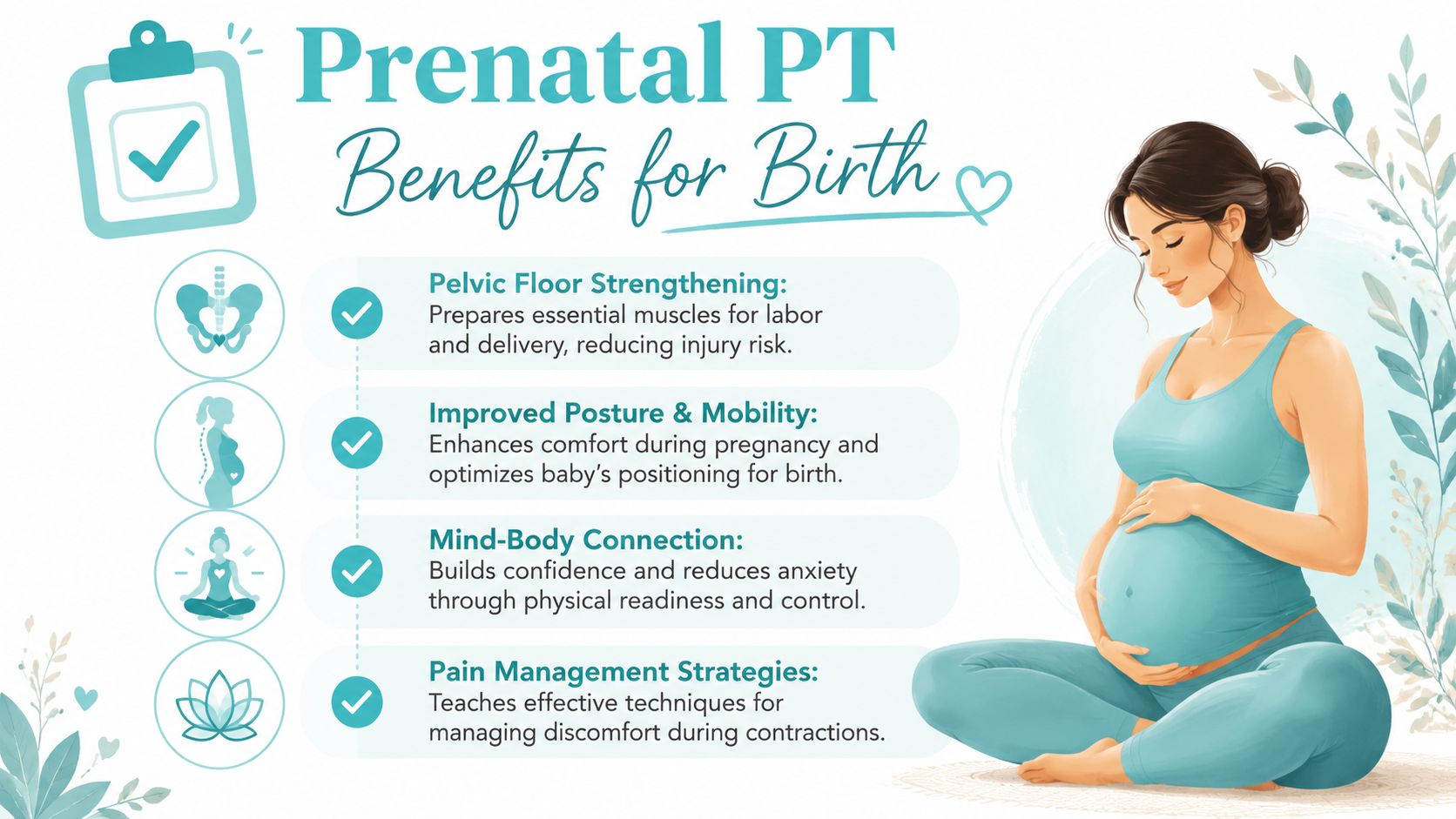
That matters in labor and after birth. Unresolved prenatal anxiety is linked to postpartum pelvic floor dysfunction. High fear can lead to maladaptive guarding, or hyper-tonicity, of the pelvic floor, contributing to dyspareunia and incontinence after birth (Source 5).
Fear and the pelvic floor are connected
A guarded pelvic floor isn't the same as a strong pelvic floor. In fact, women are often told to “do Kegels” without anyone first checking whether their muscles already struggle to let go.
In practice, the common pattern looks like this:
- Stress response rises and the breath becomes shallow
- Abdominal pressure shifts poorly because the diaphragm isn't moving well
- Pelvic floor muscles grip instead of lengthening and responding
- Labor coping gets harder because pain and tension amplify each other
- Recovery may be rougher if that guarding pattern stays in place postpartum
This is one reason some women feel frightened about giving birth even when they've “done all the research.” Their body still feels unsafe.
A detailed look at pelvic floor physical therapy during pregnancy can help you understand how this care fits into prenatal preparation.
What prenatal physical therapy actually does
Prenatal pelvic health PT is not a spa service and not just stretching. It's a clinical approach to improving mobility, coordination, tissue tolerance, pressure management, and nervous system regulation.
A prenatal PT visit may include:
- Breathing assessment to see whether you're stuck in chest breathing, breath holding, or poor pressure control
- Pelvic floor assessment when appropriate, to identify overactivity, weakness, asymmetry, pain, or difficulty relaxing
- Hip, rib cage, and trunk mobility work because restricted movement above and below the pelvis can increase strain
- Practice with labor positions so squatting, side-lying, hands-and-knees, supported sitting, or asymmetrical positions feel familiar instead of awkward
- Perineal preparation including education on perineal massage when appropriate
- Push mechanics coaching so you're not bearing down against a shut pelvic floor
Clinical takeaway: A tense pelvic floor doesn't need more bracing. It usually needs better coordination, better breath, and a nervous system that feels safer.
Here's a practical demonstration many women find helpful before they ever reach labor:
What works better than “just relax”
Telling an anxious pregnant woman to relax rarely works. Giving her a repeatable physical strategy often does.
These are the approaches that tend to help:
-
Down-training the pelvic floor
This means learning how to release, lengthen, and stop unconsciously gripping. Sometimes the skill is not “get stronger.” It's “stop holding all day.” -
Exhale-based pressure management
A full exhale can reduce guarding and help the pelvic floor respond more normally. This is useful during bowel movements, transfers, pushing practice, and contractions. -
Perineal massage and tissue familiarity
For women who fear tearing, guided education around perineal tissue can reduce fear of the unknown. It can also help them stop reflexively clenching. -
Position rehearsal
Trying labor positions in advance matters. A body that has practiced supported squat, side-lying, lunging, and hands-and-knees often feels less threatened by movement during labor. -
Pain neuroscience plus body cues
When women understand that pain, fear, and muscle tension amplify each other, they stop blaming themselves and start using tools sooner.
The long-term reason this matters
A scary birth experience doesn't always end when the baby is born. Some women later deal with leaking, pelvic pain, painful sex, or a sense that their core and pelvis never fully settled again. Fear-driven guarding can be one part of that picture.
Prenatal PT helps before labor by making your body more adaptable. It also helps after labor because you already know the language of breath, pressure, release, and recovery. That continuity is one of the best reasons to treat fear as a physical health issue, not just an emotional one.
Your Next Steps Toward a Confident Birth Experience
If you're frightened about giving birth, start by being honest about it. Fear gets heavier when you hide it.
Then make your support plan concrete:
- Get better information from a quality childbirth class and your medical team.
- Build a mental toolkit with grounding, breathing, and thought-reframing tools.
- Write a flexible birth plan so your preferences are clear before labor begins.
- Prepare your body with pelvic floor and movement work that reduces guarding.
If you want a broader checklist for pregnancy prep, these tips for soon-to-be moms can be a useful complement to the medical and physical strategies discussed here.
You do not need to wait until fear becomes overwhelming. The earlier you address it, the more time your body has to practice a different response.

Confidence before birth doesn't usually arrive as a sudden feeling. It grows from repetition. You learn what helps your nervous system settle. You learn what your pelvic floor is doing. You learn how to ask for care in a way that feels clear and calm. That's how fear starts losing ground.
If you want expert help putting these tools into practice, Lake City Physical Therapy offers one-on-one prenatal physical therapy focused on pelvic health, labor preparation, birth-position training, and postpartum recovery. Their team also provides telehealth options, which can make it easier to get support early if anxiety, pelvic tension, or pain is already affecting your pregnancy.

