8 C-Section Recovery Essentials for a Safer Return
You're home with a newborn, an incision that pulls when you stand, feeding positions that feel awkward, and sleep broken into short stretches. You may be wondering whether you should walk more, rest more, take your medication, or wait until your body feels normal again. After a C-section, recovery is not a race back to routine. It's a coordinated process that protects the incision, controls symptoms, restores pelvic-floor and core function, supports emotional health, and increases activity gradually.
The procedure is major abdominal surgery, so the most useful C-section recovery essentials aren't limited to comfort products. They include clear discharge instructions, practical help, appropriate movement, and follow-up that continues beyond a single postpartum appointment. A supportive pillow setup for C-section healing can make feeding, coughing, and getting comfortable easier, but it works best as part of a wider plan.
Seek medical advice promptly for increasing pain, spreading redness, warmth, swelling, drainage, foul odor, fever, wound separation, heavy bleeding, severe shortness of breath, chest pain, or a painful swollen leg. Your own clinician's instructions take priority, especially if you had complications or another medical condition.
1. Pelvic Floor Physical Therapy
Pregnancy affects the pelvic floor whether or not the birth was vaginal. A C-section also adds abdominal surgery, altered movement patterns, scar sensitivity, and a period of guarded breathing and walking. Pelvic-floor physical therapy connects those pieces instead of treating the incision as an isolated problem.
A pelvic-floor evaluation can assess leaking, pelvic pressure or heaviness, painful intercourse, difficulty coordinating breathing with abdominal effort, and weakness during everyday tasks. It can also examine how the abdominal wall and scar affect movement. Some people need relaxation and coordination more than strengthening, particularly when pain or fear has caused the muscles to remain tense.
What an evaluation can change
A new parent who leaks while coughing may assume the symptom is something to tolerate. A runner may focus on leg strength while overlooking pressure, heaviness, or poor trunk control. A pelvic-floor therapist can identify the movement pattern and build a plan around the person's actual goals, whether that means lifting the baby comfortably, returning to running, or resuming higher-impact sport.
An initial assessment is often considered around 6 to 8 weeks postpartum, once the incision has healed adequately, but the right timing depends on the birth, symptoms, and medical guidance. If symptoms are significant, ask your obstetric clinician whether an earlier referral is appropriate.
For postpartum rehabilitation addressing abdominal-wall recovery, scar mobility, pressure management, and pelvic-floor coordination, see postpartum pelvic-floor physical therapy.
Practical rule: Leaking, heaviness, and pelvic pain are reasons to seek assessment, not reasons to stop talking about your body.
Home exercises only help when they match the problem. Follow the prescribed routine consistently, communicate openly about pain or emotional distress, and choose in-person or telehealth care based on what you can realistically attend.
2. Abdominal Binder or Compression Wrap
An abdominal binder can make early movement feel more controlled. It provides external support around the healing abdominal wall and may reduce the pulling sensation when you stand, cough, walk, or climb stairs. That can be useful during the transition from bed to chair, especially when the incision feels vulnerable.
A hospital-issued wrap may be enough. Commercial options such as Belly Bandit and similar postpartum binders offer adjustable support, but a more expensive garment isn't automatically better. The right wrap should feel supportive rather than restrictive, and it shouldn't cause numbness, increased pain, shortness of breath, skin irritation, or pressure directly over the incision.
Use support without replacing movement
Wear the binder during activities that make you feel less secure, such as short walks or position changes. Remove it for wound care and showering, and follow your clinician's instructions about sleeping in it. If the wrap traps moisture, rubs the incision, or encourages you to ignore pain, it's not serving its purpose.
A binder should support a gradual return to movement, not create the expectation that you can lift, clean, or exercise before your body is ready. The postpartum recovery belt guidance from Lake City Physical Therapy can help you think through fit, timing, and how support may fit alongside rehabilitation.
Compression should be adjusted as swelling changes. As walking and basic core control become easier, reduce reliance on the garment rather than wearing it indefinitely. The longer-term aim is confident movement with your own muscles coordinating the trunk and pelvis.
A simple test is practical: if the binder helps you breathe, walk, and change positions more comfortably, it may be useful. If it makes you feel compressed or encourages overactivity, loosen it or stop and ask your care team for advice.
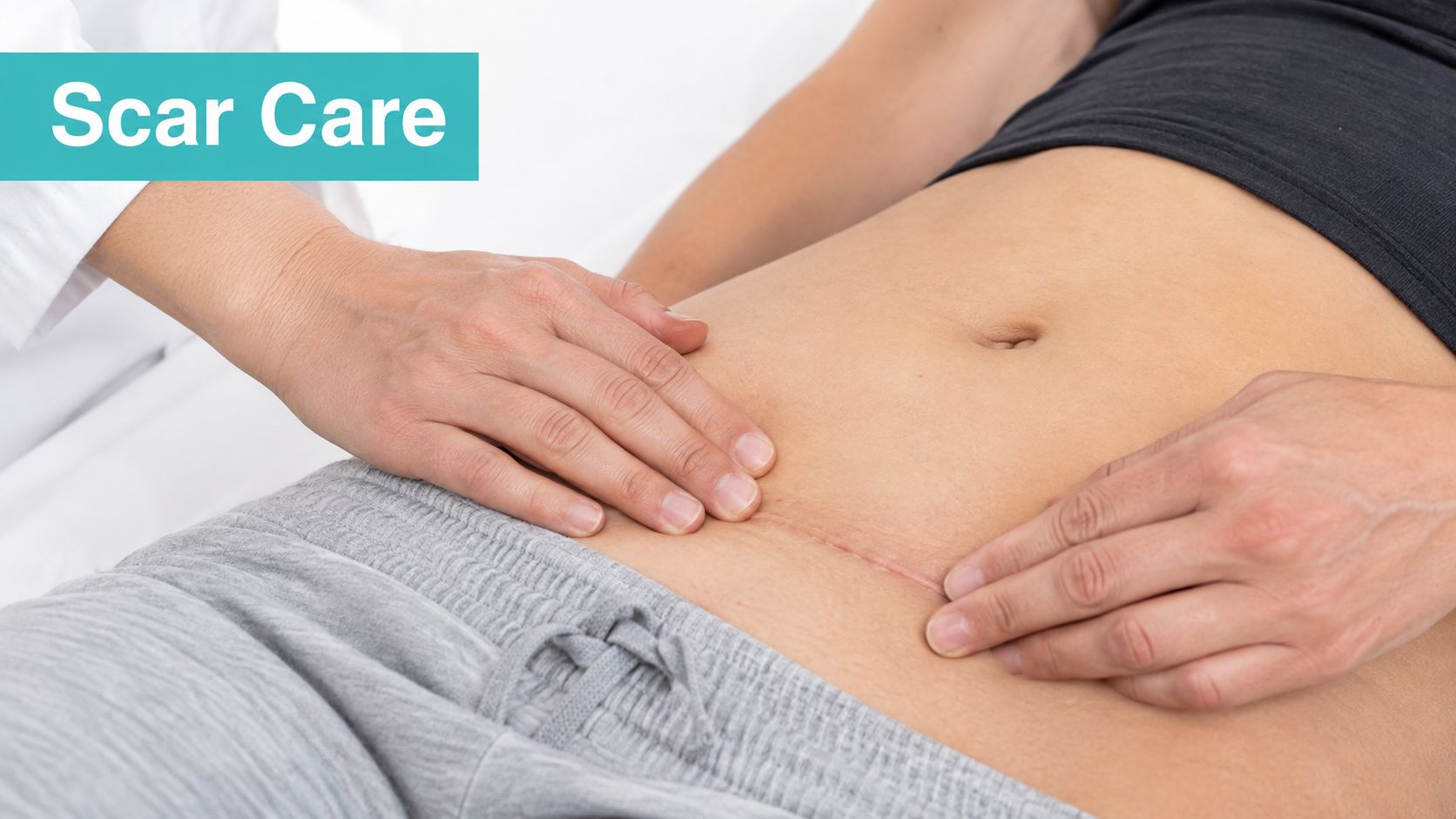
3. Scar Tissue Mobilization and Desensitization
A healed C-section scar can remain numb, itchy, tight, tender, or unusually sensitive. Clothing may feel irritating, and a parent may protect one side of the abdomen while turning in bed or lifting the baby. Those protective habits can affect how the abdominal wall and pelvis coordinate.
Scar work belongs after the incision has fully closed and your clinician has confirmed that the area is ready. Do not massage an open, draining, increasingly red, or infected-looking wound. Early scar care is about gentle contact and restoring tolerance, not forcing tissue to move.
Start with sensation, not pressure
Place a clean hand over the surrounding skin and notice temperature, numbness, tenderness, and areas that feel different. Progress to light skin movement around the scar, then gentle movement across the healed tissue if it feels comfortable. A therapist may use scar mobilization, myofascial techniques, and desensitization, but the intensity should be adapted to the scar and your symptoms.
For a parent whose waistband feels painful, a gradual touch routine may be more appropriate than vigorous massage. For someone who feels tightness when standing tall, scar mobility may be combined with breathing and gentle trunk movement. The response matters more than following a rigid routine.
Read the guidance on C-section scar treatment for a clinically oriented approach to timing and mobility. Use only products recommended by your healthcare professional, and avoid applying oils or creams to an unhealed incision.
Scar care shouldn't hurt sharply. A mild stretching or unfamiliar sensation can occur, but increasing pain, bleeding, drainage, or wound changes require medical review.
Scar mobility is one part of recovery, not a cosmetic obligation. A scar can look different from person to person and still be healthy. The useful goal is comfortable movement, normalizing sensation, and confidence using the abdominal wall again.
4. Pain Management Strategy
Pain control is a mobility tool. When pain is uncontrolled, you may take shallow breaths, avoid walking, tense your shoulders, struggle to feed comfortably, or delay bowel movements. That combination can make ordinary care feel harder than it needs to be.
Use the medication plan provided by your obstetric team. Some patients receive prescription medication and later transition to nonprescription options, while others need a different approach because of allergies, breastfeeding considerations, blood pressure concerns, bleeding risk, or other health conditions. Don't add, combine, or stop medication without checking with a clinician or pharmacist.
Match the tool to the moment
Medication can address the baseline pain. Position changes, a pillow held against the incision during coughing, slow log-rolling to get out of bed, and diaphragmatic breathing can reduce strain during movement. Cold therapy may be useful for early swelling, while warmth may feel better later for muscle tension, but protect numb skin from burns and follow your provider's instructions.
A parent who waits until pain peaks may then avoid walking altogether. Taking approved medication as directed can make it easier to move, drink, eat, and rest. The aim isn't to eliminate every sensation. It's to keep pain controlled enough for safe function.
- During feeding: Use side-lying or a supported position that keeps the baby's weight away from the incision.
- During transfers: Roll to your side, use your arms, and avoid abruptly sitting straight up.
- During walking: Take short, deliberate trips and stop before fatigue changes your posture.
- During coughing: Support the abdomen with a pillow and keep the breath controlled.
Increasing or new pain deserves attention, particularly when it occurs with wound changes, fever, heavy bleeding, leg swelling, chest pain, or shortness of breath.
5. Incision Wound Care and Infection Prevention
Incision care is deliberately simple. Follow the discharge instructions from your hospital or obstetric team, keep the area clean and dry, and inspect it often enough to recognize a change from your normal. Avoid adding antiseptics, creams, oils, or dressings unless your clinician recommends them.
Many patients can shower according to their discharge instructions. Let mild soap and water run over the area rather than scrubbing, then pat the incision dry. Pay attention to skin folds where moisture can collect, and choose loose, breathable clothing that doesn't rub the wound.
Know what requires a call
A healing incision may feel tender, numb, tight, or itchy. It should not be dismissed when symptoms are worsening rather than gradually settling. Contact your care team about increasing redness, warmth, swelling, discharge, foul odor, wound opening, fever, chills, or feeling generally unwell.
The Boston Medical Center aftercare guidance also emphasizes practical early recovery behaviors such as walking as soon as possible, hydration, prescribed pain relief, bowel support, and compression-based clot prevention. Those measures work together. For example, pain control may make walking possible, while walking and hydration can support broader functional recovery.
- Keep the wound dry: Pat carefully after bathing, especially beneath an abdominal fold.
- Avoid soaking: Wait until the incision is closed and your provider has cleared baths or swimming.
- Protect the area: Use clothing and, if recommended, a binder to reduce friction.
- Follow prescriptions: Complete antibiotics exactly as directed if they've been prescribed.
- Avoid straining: Follow lifting and activity restrictions while the tissues heal.
Early movement doesn't mean household labor. A short walk to the bathroom is different from carrying laundry, vacuuming, or lifting a heavy car seat.
6. Pelvic Floor and Core Strengthening Program
Strengthening should follow assessment, healing, and symptom response. The abdominal wall and pelvic floor need coordination, not just force. A person who performs repeated contractions while holding their breath may increase tension without improving functional control.
Begin with the basics your clinician or physical therapist has prescribed. You may work on relaxed breathing, gentle pelvic-floor contraction and release, deep abdominal engagement, posture, and comfortable transitions. The correct exercise depends on whether your main issue is weakness, pain, pressure, poor relaxation, or difficulty coordinating the muscles.
Progress from isolated control to real tasks
A useful program eventually connects the pelvic floor and core to movements you need. That may include rolling, lifting the baby, squatting, carrying, climbing stairs, or returning to sport. Planks, lunges, and running drills shouldn't be introduced because a calendar says you're ready. They should follow a progression that your symptoms tolerate.
A parent who feels fine lying down may notice heaviness while standing or leaking during a brisk walk. That difference is important. Functional testing reveals more than a single set of contractions.
- Breathe continuously: Exhale during effort instead of bracing and holding your breath.
- Release fully: A pelvic floor that never relaxes may contribute to pain and poor coordination.
- Use feedback: Provider guidance or biofeedback can help confirm that the intended muscles are working.
- Track response: Increased pain, pressure, leaking, or bleeding means the program needs review.
- Build gradually: Consistency matters more than chasing exhaustion.
The postpartum pelvic-floor exercise video may provide visual context, but online demonstrations can't replace an individualized examination.
7. Progressive Activity Return Protocol
Rest after surgery is necessary, but bed rest is not the recovery plan for most. The World Health Organization describes C-section use as a major global public-health issue, with rates rising from about 7% in 1990 to 21% by 2021. WHO guidance on rising C-section rates also places the procedure in the context of major abdominal surgery, which explains why mobility, pain control, and function matter alongside the incision.
In the first stage, activity may mean standing, walking to the bathroom, changing position, and taking brief walks at home. Increase one variable at a time. You might walk farther before walking faster, or add a few repetitions of a movement before adding resistance.
Let symptoms guide progression
Mild effort or a stretching sensation may be acceptable, but sharp pain, increasing bleeding, new wound discomfort, pelvic heaviness, urine leakage, or a clear decline later that day means the load was too high. Scale back and contact your provider when symptoms are concerning.
The frequently used 6-week checkpoint is not a universal clearance for lifting, driving, exercise, or full function. A medical review of postpartum guidance describes care as beginning with clinician contact within the first 3 weeks and continuing to a visit by 12 weeks, while strenuous activity is generally discouraged during the first 2 to 3 weeks. Postpartum recovery guidance supports individualized decisions rather than one automatic deadline.
Movement is not a test of toughness. It's a dose that should leave your body able to recover.
A runner, a parent carrying an infant seat, and someone recovering from a complication will need different progressions. High-impact exercise should wait for appropriate pelvic-floor and core assessment, not motivation.

8. Mental Health and Postpartum Recovery Support
Emotional recovery belongs in the same plan as wound care and mobility. A parent may feel grateful, frightened, disappointed, disconnected, overwhelmed, or proud after a C-section. The birth may have been planned, urgent, or traumatic, and physical pain can make ordinary emotional challenges harder to manage.
Some mood changes and adjustment difficulties are common after birth. Persistent sadness, intense anxiety, loss of interest, intrusive thoughts, hopelessness, or difficulty functioning deserve professional attention. Tell your obstetric clinician, primary care provider, or mental-health professional what's happening. Don't wait for symptoms to become unbearable.
Build support into daily care
Ask a partner or family member to take over meals, laundry, driving, or baby care while you attend an appointment. Peer support can reduce isolation, while therapy can help process birth trauma, body-image changes, relationship strain, or fear of movement. CBT for life adjustments may be one option to discuss with a qualified mental-health provider when adapting to major life changes.
Mental health can also affect physical rehabilitation. A parent who feels unsafe touching the scar may need education and gradual desensitization before massage. Someone anxious about movement may benefit from a slower, supervised progression. Tell your physical therapist when fear, low mood, or intrusive thoughts are affecting participation.
- Name the symptom: “I'm anxious every time I stand” gives a clinician more to work with than “I'm not coping.”
- Share the workload: Recovery support should include practical tasks, not only reassurance.
- Protect feeding and sleep opportunities: Ask others to handle nonfeeding duties when possible.
- Seek urgent help: If you might harm yourself or your baby, contact emergency services or an urgent crisis resource immediately.
Your emotional response doesn't determine whether you're a good parent. It tells your care team what support you need.
C-Section Recovery Essentials: 8-Point Comparison
| Intervention | 🔄 Implementation complexity | ⚡ Resource requirements | ⭐ Expected outcomes / 📊 Impact | 💡 Ideal use cases |
|---|---|---|---|---|
| Pelvic Floor Physical Therapy | High, specialized assessment, ongoing sessions | Moderate–High, trained women's health PT, multiple visits, daily home exercises | ⭐⭐⭐⭐, strong evidence for restoring function, reducing incontinence/pain over weeks–months | Post-C-section with weakness, pain, scar restrictions; return-to-sport goals |
| Abdominal Binder or Compression Wrap | Low, simple to apply and remove | Low, OTC purchase, minimal time to use | ⭐⭐, immediate pain/support short-term; limited long-term effect | Immediate postoperative phase (0–6 weeks) to ease mobility and swelling |
| Scar Tissue Mobilization & Desensitization | Moderate, manual skills and graded progression | Moderate, PT guidance plus regular home self-care | ⭐⭐⭐, improves mobility and sensation gradually; variable by individual | Incision closed (≈2–4+ weeks) with scar tightness, sensitivity, or restricted motion |
| Pain Management Strategy (Multimodal) | Moderate, care coordination and individualized plan | Moderate, short-term meds, non‑pharmacologic tools, provider follow-up | ⭐⭐⭐⭐, enables earlier mobility, reduces psychological stress and complications | Immediate postoperative period with significant pain limiting activity |
| Incision Wound Care & Infection Prevention | Low, routine daily care but requires vigilance | Low, basic supplies, education; possible antibiotic therapy if needed | ⭐⭐⭐⭐, prevents infection, permits safe progression to rehab | First days–weeks after surgery to avoid SSI and enable later scar work |
| Pelvic Floor & Core Strengthening Program | High, requires correct activation and progressive loading | Moderate, PT sessions, possible biofeedback, consistent home program (8–12+ wks) | ⭐⭐⭐⭐, prevents incontinence/prolapse and restores function long-term | 6–8+ weeks postpartum for systematic rehabilitation and return to activity |
| Progressive Activity Return Protocol | Moderate, structured timeline with individualized adjustments | Moderate, PT oversight, graded exercise, time over months | ⭐⭐⭐⭐, reduces risk of overload and optimizes safe return to exercise | Active/athletic women planning phased return to running, CrossFit, sports |
| Mental Health & Postpartum Recovery Support | Moderate, screening, therapy coordination, ongoing support | Moderate, mental health providers, peer groups, time and possible cost | ⭐⭐⭐⭐, improves adherence, reduces PPD/anxiety, enhances overall recovery | Any postpartum woman, especially with mood symptoms, trauma, or adjustment difficulty |
Turn the Checklist Into Your Next Safe Step
You don't need to buy every recovery product or solve every symptom today. Start with the step that matches your current situation. If you're still in the hospital or recently home, follow the written discharge instructions, take prescribed medication as directed, keep the incision clean and dry, drink regularly, and take short walks as tolerated. ERAS recommendations for cesarean delivery emphasize standardized written discharge instructions and structured counseling because consistent education is part of safe postoperative care. The ERAS cesarean delivery recommendations30572-1/fulltext) support asking questions before discharge rather than relying on memory during a sleep-deprived week.
If the incision looks different, pain is increasing, or you're worried about fever, discharge, wound separation, heavy bleeding, chest symptoms, or leg swelling, contact your obstetric team. Don't use a binder, scar massage, exercise plan, or online timeline to manage a possible complication. Medical evaluation comes first.
If the wound is healing but you're leaking, experiencing pelvic pressure, avoiding movement, or unsure how to rebuild your core, arrange a pelvic-floor physical therapy evaluation. A clinician can assess abdominal-wall recovery, scar mobility, breathing, pelvic-floor coordination, and the movements that matter in your daily life. That's more useful than choosing exercises based only on a postpartum calendar.
The same principle applies to emotional health. Persistent sadness, anxiety, intrusive thoughts, loss of interest, or difficulty feeling safe with yourself or your baby deserve prompt support. Ask your OB/GYN or primary care provider for a referral, and involve a trusted person who can help you access care.
Recovery research also shows why early milestones shouldn't be confused with complete healing. One contemporary recovery study reported a median recovery time of 2 days, with 96.2% recovering within 4 days under that study's definition of timely recovery. The WHO context for C-section recovery helps frame why those early markers don't mean the abdominal wall, pelvic floor, or emotional recovery is finished. Feeling better quickly is encouraging. It isn't permission to ignore symptoms or rush activity.
Lake City Physical Therapy is one relevant women's-health and postpartum rehabilitation option, with pelvic-floor care, postpartum rehabilitation, in-person clinics, and telehealth availability. It shouldn't replace evaluation by your obstetric or medical team when symptoms are urgent, but it may provide individualized support for rebuilding function after healing has begun.
Lake City Physical Therapy provides women's-health pelvic-floor therapy and postpartum rehabilitation for concerns such as incontinence, pelvic pressure, scar mobility, core coordination, and return to activity. Visit Lake City Physical Therapy to explore in-person and telehealth care and choose a practical next step for your C-section recovery.

