Intercourse Painful After C Section
You expected recovery from abdominal surgery, not burning at the vaginal opening or a deep ache when you try to have sex. Perhaps you had a C-section specifically because you thought it would spare you the kind of pain associated with vaginal birth. If intercourse still hurts, it can be confusing and discouraging, but your experience isn't unusual, and it deserves care rather than dismissal.
Painful intercourse after a C-section can have several overlapping causes. The location, quality, timing, and triggers can offer useful clues, but they can't diagnose the problem on their own. You don't have to push through pain or judge your recovery by a single postpartum milestone. An obstetric clinician or pelvic-health physical therapist can help you understand what may be contributing and what support fits your situation.
Why C-Section Sex Pain Often Goes Unrecognized
Someone may feel ready to try intercourse after a C-section, only to notice stinging as penetration begins, tightening through the pelvis, or a pulling sensation near the lower-abdominal scar. Because there was no vaginal delivery or perineal tear, the pain can seem to come from nowhere. That mismatch between expectation and experience can make it harder to bring up.
The medical term for painful intercourse is dyspareunia. It can occur after cesarean birth, even when there's no vaginal or perineal injury. A systematic review and meta-analysis of 20 studies involving 11,354 women estimated dyspareunia prevalence at 26% after cesarean birth, with a 95% confidence interval of 19%–34% (the review of postpartum dyspareunia after different delivery modes). That estimate doesn't explain an individual's pain, but it makes clear that a C-section doesn't rule it out.
Why the assumption can get in the way
Postpartum information often focuses on vaginal tears or perineal healing, so people who've had a C-section may assume their pain shouldn't be happening. But surgery and childbirth affect more than the visible incision. Healing abdominal tissue, pelvic-floor muscle changes, dryness, fatigue, and emotional stress can all be relevant.
Pain is real, even when its cause isn't obvious from the outside.
Delivery route alone can't identify why intercourse hurts or predict exactly when it will feel comfortable again. Paying attention to your own symptoms is more useful than comparing yourself with someone else or trying to meet a fixed timeline. The clues you notice can help you decide what to discuss with a clinician and whether home adjustments feel appropriate.
Understanding Postpartum Dyspareunia and Recovery
Dyspareunia means pain during or after intercourse. The term describes a symptom, not one specific cause. Superficial pain is felt near the vaginal opening, often as burning or friction when penetration begins. Deep pain is felt farther inside during penetration or movement. Pain in the lower abdomen around a surgical scar is a separate symptom, although abdominal discomfort and intercourse-related pain can overlap.
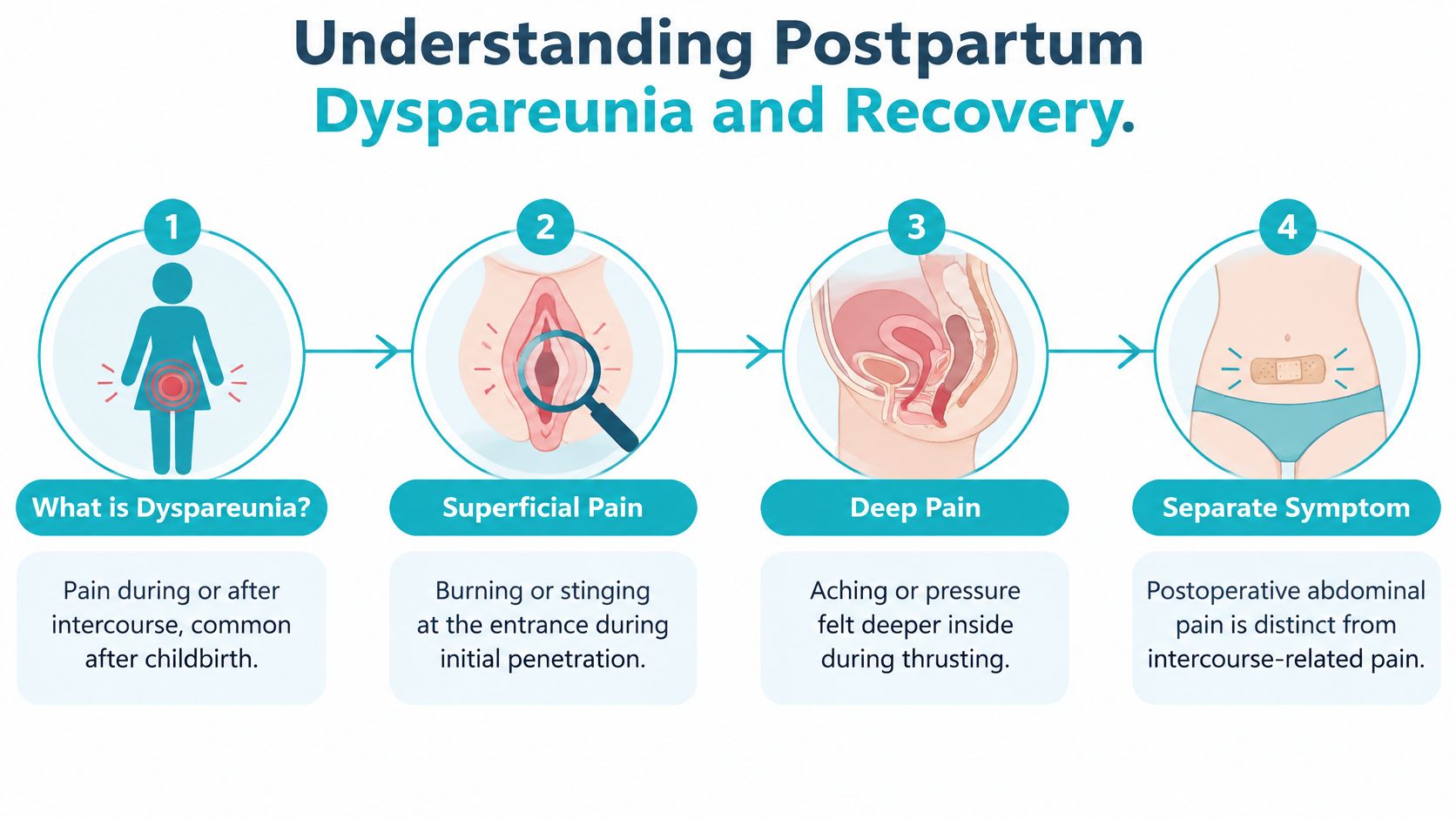
A systematic review summarized by The Lancet reported postpartum dyspareunia prevalence of approximately 43% at 2–6 months and 22% at 6–12 months, with a pooled estimate of about 35% across postpartum periods (the review of postpartum sexual pain00454-0/fulltext)). These estimates describe groups of people, not what any one person will experience. They do show why painful sex shouldn't be treated as proof that something is permanently wrong, or as something that must have resolved by a particular appointment.
A checkup isn't a comfort guarantee
Many people improve over the first months, but symptoms can persist. A routine postpartum visit is a chance to discuss healing and sexual health, not a promise that penetration will feel comfortable by a specific date. If intercourse hurts, it's reasonable to pause and ask for guidance rather than treating the calendar as clearance to endure discomfort.
You may find it helpful to read about what to expect during C-section recovery, while remembering that recovery varies. Persistent, worsening, or severe pain warrants individualized assessment, especially if it keeps interfering with intimacy or daily movement.
Reading the Clues Behind Your Pain
Pain is information, but its location isn't a diagnosis. Describing what it feels like and what brings it on can help a clinician decide which tissues or factors to assess. More than one pattern can be present at the same time.
Notice where and when it happens
- Burning or stinging at the entrance: This may occur as penetration begins and can point toward dryness, friction, or sensitivity near the opening. Notice whether it improves with more time for arousal or changes when you use lubricant.
- A deep ache or pressure: Pain that occurs farther inside during movement may involve pelvic-floor muscles that tighten protectively, or another pelvic concern that needs assessment.
- Pulling near the lower abdomen: A tugging or sharp feeling with certain positions, abdominal stretch, or movement may implicate the scar or nearby tissue.
- Pain with dryness or urinary symptoms: Note whether discomfort comes with a dry sensation, irritation, urgency, or pain when you urinate. Those details can help your clinician decide whether to assess tissue symptoms, the pelvic floor, or other medical causes.
A cohort study of women one year after a first childbirth found dyspareunia rates of approximately 31.3%–41.4% in groups that included cesarean delivery, compared with 62.5% among women who experienced severe obstetric anal sphincter injury (the review discussing birth mode and postpartum sexual pain). These group findings don't determine why you hurt, and they don't mean your pain should be minimized because someone else may have different symptoms.
Make a useful symptom note
Before an appointment, jot down when the pain started, where you feel it, whether it burns, aches, stings, or pulls, and what makes it better or worse. Include whether it happens only with penetration or also with movement, and whether it's changing over time. Mention any associated dryness, bleeding, urinary symptoms, or scar sensitivity. You don't need to arrive with a theory. Clear observations are enough to start the conversation.
How Scar and Pelvic Floor Changes Can Cause Pain
A skin incision can look closed while deeper tissues remain sensitive or restricted. The abdominal wall and its connective tissue help transfer force as you move. If a scar or nearby fascia feels tender or pulls, intercourse positions that stretch the lower abdomen may provoke discomfort, even though penetration isn't occurring through the surgical site.

Think of the body's response as a protective brace. If movement tugs on sensitive tissue, the abdominal muscles or pelvic floor may tighten automatically to guard the area. That response makes sense as protection, but the resulting tension can make penetration more uncomfortable. If an attempt hurts, it's understandable to anticipate pain next time; that expectation may increase tension, reduce arousal, and make friction more noticeable.
A systematic review of chronic post-cesarean surgical-site pain estimated clinically relevant pain at about 15.4% at 3 months and 11.5% at 6 months or later (the review of chronic pain after cesarean surgery). These figures concern surgical-site pain, not a diagnosis for pain during intercourse. They reinforce why a fully closed incision doesn't, by itself, explain every symptom.
Why strengthening isn't always the answer
Pelvic-floor muscles can be overactive, weak, tender, or poorly coordinated. A muscle that already stays tense may need help relaxing and moving comfortably, not repeated strengthening exercises. A pelvic-health physical therapist can assess resting tone, tenderness, coordination, abdominal-wall mobility, scar sensitivity, and relevant movement mechanics instead of focusing on strength alone.
Scar-related restriction is one possible contributor, but it's not the only explanation for pulling or discomfort. Learn more about C-section adhesions and tissue mobility, then discuss your own symptoms with a qualified clinician before trying scar work.
Recognizing Hormonal, Breastfeeding, and Emotional Factors
Sometimes the main clue is a dry, irritated feeling at the vaginal opening. Hormonal changes associated with breastfeeding can reduce estrogen, which may mean less lubrication and less tissue resilience. Breastfeeding isn't the only possible cause of pain, and dryness doesn't prove that hormones are responsible. It's one factor worth mentioning if it fits what you're experiencing.
Pain can also follow a cycle. You anticipate discomfort, feel less relaxed or aroused, and notice less natural lubrication. Increased friction can make penetration hurt, which may leave you more guarded the next time. Fatigue and reduced sexual desire can add to the difficulty of feeling ready.
Real pain can have emotional influences
Fear of pain doesn't mean pain is imagined. The sensation is real, and a previous painful experience can affect how your body responds to another attempt. Emotional safety, communication with a partner, and feeling able to pause matter alongside physical assessment. It's reasonable to want care that takes both seriously.
Earlier clinical literature estimated immediate postpartum dyspareunia across delivery groups at approximately 20%–50%, with symptoms lasting an average of about 4 months (the clinical review of postpartum sexual health). These broad estimates aren't a schedule you need to follow. If emotional strain or low mood is making recovery harder, you can also browse postpartum depression support options as part of finding care that fits your needs.
Comparing Common Pain Patterns and Responses
Use the pattern you notice to shape a conversation, not to diagnose yourself. The same person may have more than one type of discomfort, and a measure that eases friction won't necessarily address deep pain or scar sensitivity.
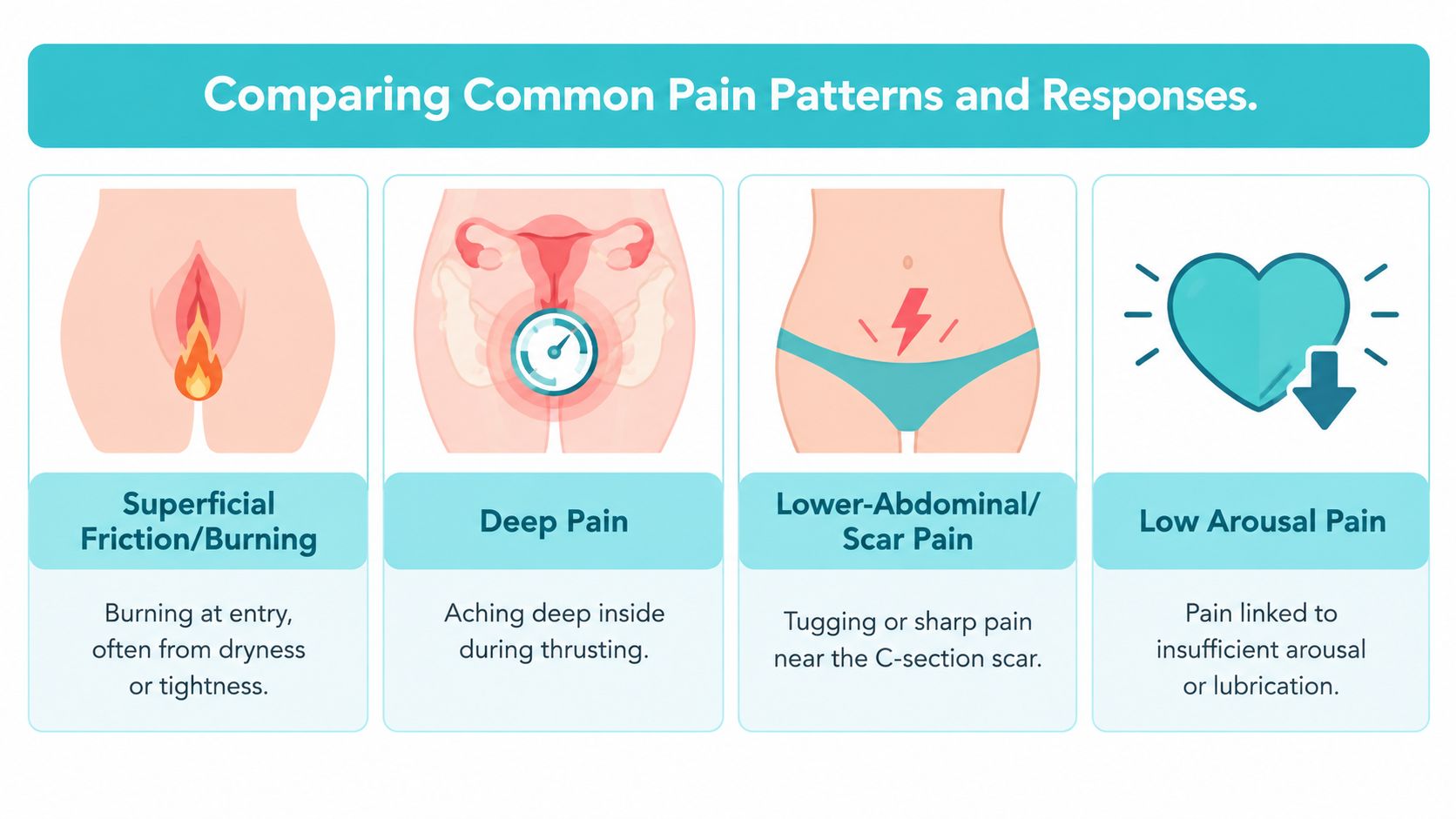
| Pain pattern | Common description | Potential factors to discuss | Conservative response to discuss with a clinician |
|---|---|---|---|
| Superficial friction or burning | Stinging or burning near the entrance, especially as penetration begins | Dryness, friction, or sensitivity | Consider adequate lubricant and pause if discomfort increases |
| Deep pain | Aching or pressure farther inside during movement | Pelvic-floor guarding or other pelvic concerns | Discuss assessment and options that limit depth |
| Lower-abdominal or scar pain | Pulling or discomfort near the incision, sometimes with abdominal stretch | Scar sensitivity, tissue mobility, or abdominal-wall mechanics | Ask whether clinician-led scar mobility work is appropriate after healing and clearance |
| Pain with low arousal or dryness | Penetration feels uncomfortable when you don't feel physically ready | Lubrication, fatigue, or fear of pain | Allow time, communicate, and stop if pain persists |
These are possible discussion points, not universal treatments. If your clinician has cleared sexual activity and your tissues have healed, options may include a position that reduces depth or abdominal strain, diaphragmatic breathing, and gentle pelvic-floor down-training. A qualified clinician can advise whether scar desensitization or mobility work suits your symptoms. Avoid repeated attempts that make pain sharper or leave you feeling more guarded.
What You Can Do at Home Before Retrying
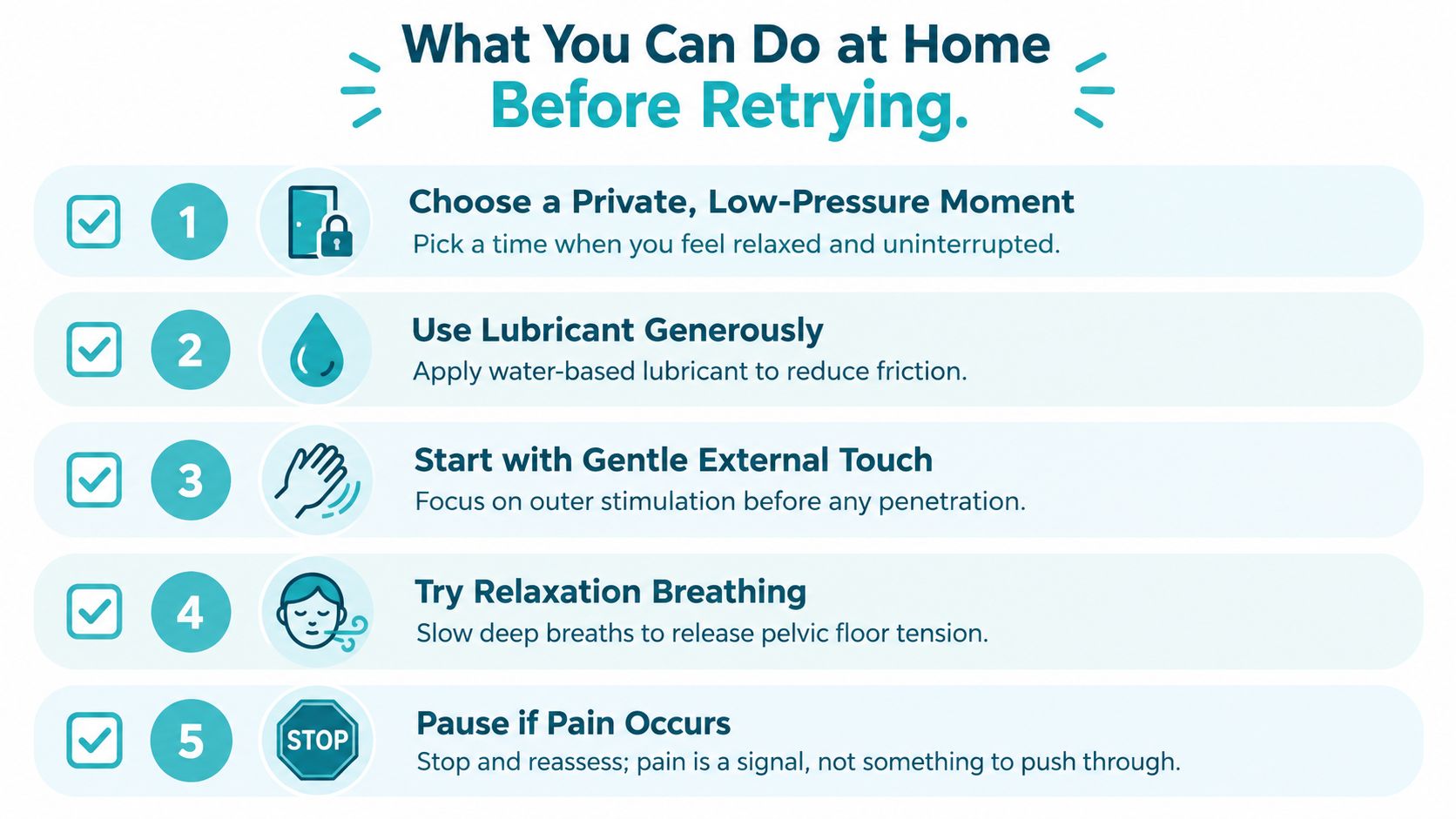
Home adjustments may be reasonable if your obstetric clinician has cleared sexual activity, your tissues are healed, and you feel ready to explore without pressure. There's no requirement to try penetration just because you've reached a particular point in recovery. You and your partner can agree in advance that you can pause or stop at any time.
Keep the first attempt low-pressure
Choose a private moment when you feel unhurried. You might begin with closeness or gentle external touch rather than making penetration the goal. If you choose to try penetration, consider lubricant and a position that gives you more control over depth or reduces pulling on your lower abdomen. Diaphragmatic breathing may help you notice and soften pelvic-floor tension, but it shouldn't be used to force yourself through pain.
Use a simple pause rule: if pain sharpens, stop, change the approach, or end the attempt. Don't keep repeating intercourse while tissue feels irritated in the hope that your body will get used to it. A painful attempt isn't a failure; it's information about what may need to change.
Know where home care ends
Gentle exploration differs from aggressive stretching or scar massage. Don't substitute forceful scar work for individualized screening, particularly if the incision is sensitive or your clinician hasn't assessed it. Home strategies are most useful when they ease discomfort and help you feel more at ease. If they repeatedly increase pain or fear, pause and ask for support rather than trying harder.
When to Seek Pelvic Floor or Medical Care
You don't have to wait until pain is severe to ask for help. Contact an obstetric clinician or another appropriate medical provider if pain repeatedly prevents penetration, persists for several months, worsens, or doesn't change with conservative adjustments. Burning with dryness, focal scar pain, deep pelvic pain, bleeding, or urinary symptoms also give a clinician useful reasons to assess you more specifically.
The American College of Obstetricians and Gynecologists recommends that postpartum care include discussion of sexuality, dyspareunia, resuming intercourse, and cesarean-incision pain (ACOG's guidance on optimizing postpartum care). You can raise the issue at a postpartum appointment or contact your clinician sooner. You don't need to wait for someone to ask the perfect question.
What an assessment can involve
A medical clinician can assess symptoms that may require medical care. A pelvic-health physical therapist can evaluate muscle tone, tenderness, coordination, scar and abdominal-wall mobility, breathing, positioning, and other factors that may affect comfort. Care may include education, gradual progression, relaxation or coordination work, and clinician-guided scar mobility or desensitization when appropriate.
If you're unsure what a visit involves, review what to expect at pelvic-floor therapy. Gentle self-care rituals may also help you create a quieter moment to check in with yourself; these postpartum ritual ideas from SEYANTE offer one place to explore that kind of low-pressure care.
Seek prompt medical assessment for new fever, foul discharge, heavy bleeding, wound changes, or severe pelvic pain. Those symptoms call for medical attention rather than another home trial.
Lake City Physical Therapy provides pelvic-floor physical therapy for painful sex and postpartum recovery, with individualized assessment of pelvic-floor and pelvic-girdle function. If you'd like support interpreting your symptoms and planning next steps, visit Lake City Physical Therapy to explore care options.

